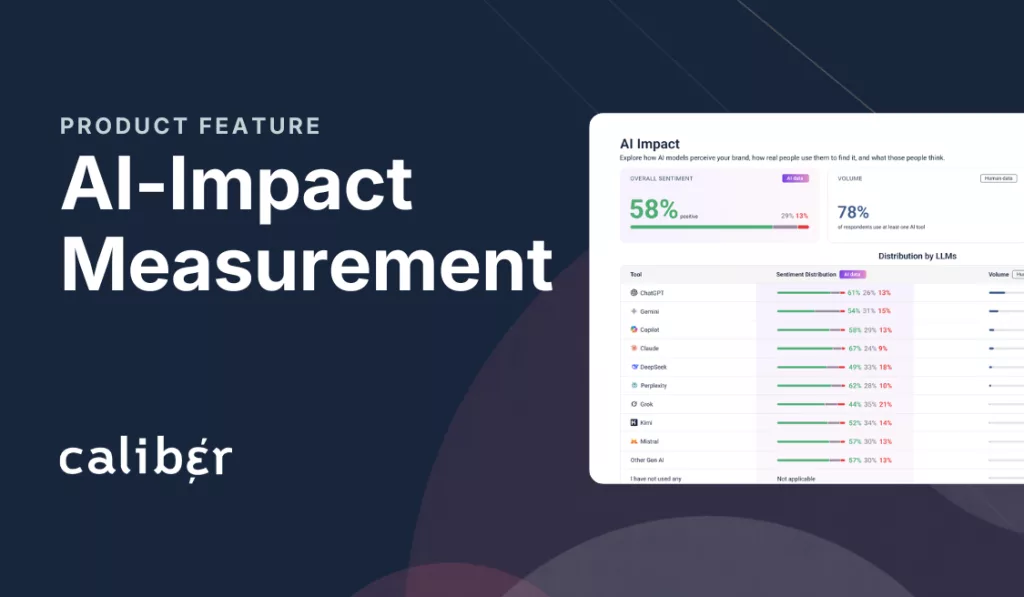
Caliber’s AI Impact feature gives you AI brand monitoring in one view: what nine generative AI tools say about your company, how many stakeholders are actually using AI to research you, and whether those AI users trust you more or less than everyone else.
Every company now has two reputations. One lives in the minds of the customers, employees, and investors who actually deal with you. The other lives inside ChatGPT, Gemini, and half a dozen other chatbots that answer questions about you whether you asked them to or not. AI brand monitoring exists because those two reputations don’t always agree, and until recently, most companies had no way to see the gap.
This article covers what AI brand monitoring means in practice, how Caliber measures it, and what the data actually shows once you separate what AI says from what people think.
Why is AI brand monitoring so hard?
Ai brand monitoring is hard because different AI tools describe the same company in wildly different terms, AI sentiment and human trust often move independently of each other, and most communications teams have no data source that connects the two.
Why do different chatbots tell a different story?
Ask ten people about your company and you’ll get some disagreement. Ask ten AI tools and the spread can be extreme. Caliber’s analysis of Coca-Cola found the company’s AI sentiment score was 13% positive on ChatGPT and 93% positive on Mistral, a gap of 80 percentage points for the same company in the same window of time. If your investors default to one chatbot and your customers default to another, they may effectively be forming opinions about two different companies.
Why doesn’t AI sentiment match stakeholder trust?
The instinct is to assume a low AI sentiment score means stakeholders trust you less. Caliber’s data on Coca-Cola shows that isn’t automatic. Only 40% of LLM responses about Coca-Cola read as positive, with the rest landing as neutral. Its Trust & Like Score (TLS), Caliber’s core measure of what real people think and feel about a company, sits at 71 out of 100.
Three other companies Caliber tracks, an aerospace giant, a pharmaceutical company, and a medical technology leader, scored far higher on AI sentiment (88%, 90%, and 87% positive), yet their TLS scores of 72, 75, and 75 were barely different from Coca-Cola’s.
Part of the explanation is structural: those three companies are B2B, a category that scores higher on trust because its audience is smaller and more specialist. Coca-Cola is about as consumer-facing as a brand gets, and it holds its own on human trust despite a rougher AI narrative.
Why is AI easy to overreact to?
The volume of commentary about AI’s influence on reputation can make it feel like the dominant channel already. Caliber’s stakeholder data says otherwise, at least for now. Across Fortune 30 companies, only 11% of Stakeholder 360 respondents cited Info Search, which includes both traditional search and AI chatbots, as a recent touchpoint. Compare that with Products and Services (33%), Company Websites (25%), and Advertising (25%). Ai brand monitoring matters because AI is growing fast, not because it has already taken over.
What is Caliber’s AI Impact feature for AI brand monitoring?
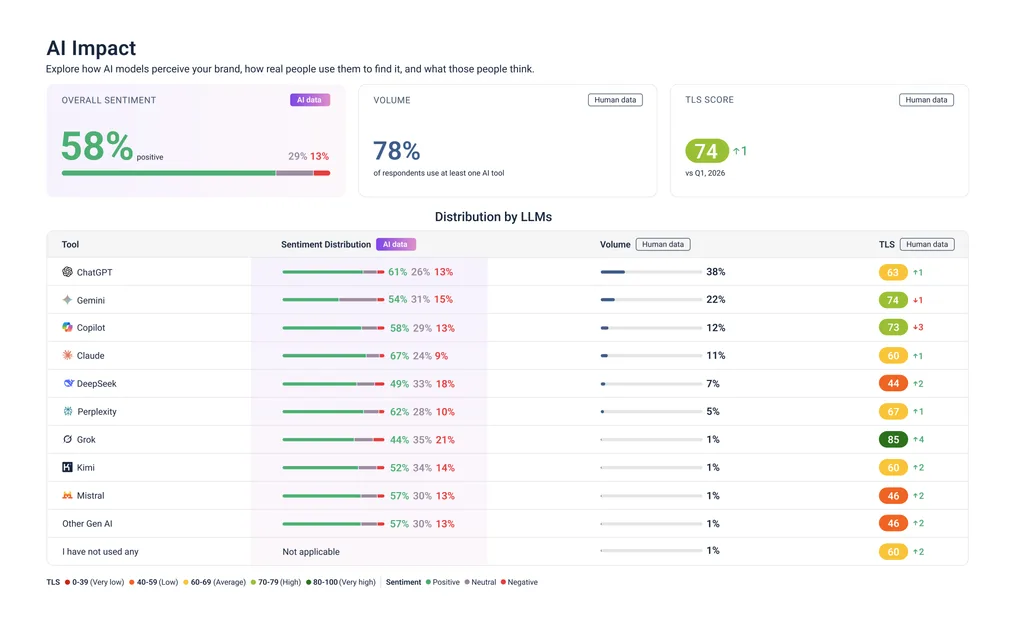
AI Impact is Caliber’s AI brand monitoring feature, launched in August 2026. It shows how generative AI tools shape how people discover and perceive your company, through three data points: AI Sentiment, Search Volume, and Trust & Like Score (TLS) among AI searchers.
What are the three data points behind AI brand monitoring?
AI Sentiment comes directly from the AI models. Search Volume and TLS among AI searchers come from Caliber’s survey respondents, or People data. Keeping the AI-side and people-side data separate is what makes it possible to compare what AI says against what stakeholders actually believe, rather than assuming one predicts the other.
| Data point | What it measures |
|---|---|
| AI Sentiment | Daily prompts sent to nine generative AI tools, classified positive, neutral or negative and reported as a weighted aggregate. Comes from the AI models, not from survey respondents. |
| Search Volume | Share of survey respondents who say they used a generative AI tool in the last few weeks to get information about the company. |
| TLS Among AI Searchers | Trust & Like Score calculated only among respondents who used AI to research the company, so you can see if that group trusts you more or less than everyone else. |
| Breakdown by tool | ChatGPTGeminiCopilotClaudePerplexityMistral |
How is AI brand monitoring broken down by tool?
Every data point can be split by tool: ChatGPT, Gemini, Copilot, Claude, DeepSeek, Perplexity, Grok, Kimi, and Mistral. That breakdown shows whether sentiment differs by platform, and whether your audience is even using the tools you’re checking. As the Coca-Cola example shows, the gap between the best-scoring and worst-scoring tool for the same company can be enormous.
Where does AI Impact sit inside the platform?
AI Impact data is added through Customer Success rather than switched on by default, so clients can add AI sentiment data to their setup when they’re ready for it. Once added, it appears as its own data series in the Development view, and Info Search (including AI) shows up as one of the touchpoints tracked in the Touchpoints view alongside Products/Services, Company Website, and Advertising.
How does AI brand monitoring work in Caliber?
AI brand monitoring works by sending daily prompts to nine generative AI tools and classifying each response as positive, neutral, or negative, then setting that AI-side data next to survey data on how many stakeholders actually use AI to research you and whether those AI users trust you more or less than everyone else.
How is AI Sentiment measured?
Caliber sends daily prompts to the nine tracked AI tools and classifies each response as positive, neutral, or negative. The headline AI Sentiment figure is a weighted aggregate of those responses. This is model output, not respondent opinion, which is exactly why it needs to sit next to human data rather than stand in for it.
How are Search Volume and TLS among AI searchers measured?
Both come from Caliber’s survey respondents. Search Volume is the share of respondents who say they used a generative AI tool in the last few weeks to get information about the company. TLS among AI searchers takes the same Trust & Like Score used across the platform and calculates it only among the people who say they used AI to research the company, so you can see whether that group trusts you more or less than your average stakeholder.
How does correlation, not causation, apply to AI Impact?
The AI Impact series can be overlaid in the Development view alongside events and campaigns from My Activities, media monitoring metrics, and stock market data. That makes it possible to see whether a shift in AI sentiment lines up with a product launch, a news cycle, or a campaign. It shows association, not proof of cause. A spike in negative AI sentiment next to a product recall is a plausible connection worth investigating, not a confirmed one, and Caliber’s Context module helps separate what is happening at your company from what is happening across your whole industry or the wider economy.
What does ai brand monitoring look like in practice?
In practice, AI brand monitoring surfaces gaps that would otherwise stay invisible: a consumer brand holding steady on trust despite a rough AI narrative, B2B companies whose strong AI sentiment barely moves the needle on trust, and a younger audience where AI has already caught up with traditional search.
Coca-Cola: a wide gap between AI sentiment and stakeholder trust
Caliber’s analysis of AI sentiment versus human trust, using Coca-Cola as a case, found only 40% of LLM responses about the company read as positive, with the rest landing as neutral rather than negative. The AI responses leaned on Coca-Cola’s health impact, its water use in some markets, and plastic packaging. Despite that, Coca-Cola’s TLS holds at 71, close to companies with far more positive AI sentiment. Caliber’s read is that decades of brand equity, built on associations with sport, summer, and shared moments, are carrying more weight with stakeholders than the AI narrative is chipping away.
There’s a further twist. Among people who say they’ve used AI to research Coca-Cola specifically, TLS climbs to 79, eight points above the overall score. That’s not the direction you’d expect if AI sentiment were dragging trust down. It suggests the people using AI to look up Coca-Cola are either already positive toward the brand and unmoved by the AI take, or are only now encountering the more critical narrative, in which case that 79 figure is one to keep watching over time.
When AI sentiment and trust move together, and when they don’t
The same Caliber analysis compared Coca-Cola against three other companies it tracks: an aerospace giant, a pharmaceutical company, and a medical technology leader. All three scored far higher on AI sentiment than Coca-Cola, yet their TLS scores were within a few points of Coca-Cola’s.
| Company | AI Sentiment (positive) | Trust & Like Score |
|---|---|---|
| Coca-Cola | 40% | 71 |
| Aerospace giant | 88% | 72 |
| Pharmaceutical company | 90% | 75 |
| Medical technology leader | 87% | 75 |
Part of that gap is structural. B2B companies typically score higher on trust because their audience is smaller and made up of people with a direct professional reason to know the company well: buyers, partners, employees. Consumer brands like Coca-Cola don’t get that advantage, which makes its performance against AI headwinds more notable, not less.
Talent 360: AI Chat catching up with search among jobseekers
The picture changes for younger audiences. On Talent 360, which focuses on 18 to 45 year olds who are in education, employed, or between jobs, Info Search and AI Chat are tracked separately. Across three consecutive two-month periods, Info Search moved 15% to 21% to 17%, while AI Chat moved 13% to 20% to 18%, slightly overtaking traditional search in the most recent period. For this audience, ai brand monitoring isn’t a future concern. AI Chat is already a corporate and employer discovery channel in its own right, which matters directly for how companies present themselves to potential candidates.
How do teams benefit from AI brand monitoring?
Ai brand monitoring benefits corporate communications, brand and marketing, HR, and investor relations teams by giving each of them a shared, evidence-based view of how AI is representing the company, rather than isolated impressions from separate teams checking separate chatbots.
How do corporate communications teams use AI brand monitoring?
Communications teams use AI brand monitoring to know whether AI-generated narratives need a response, and which one. Seeing that AI sentiment is low but human trust hasn’t moved, as with Coca-Cola, is a very different situation from seeing both decline together. The first calls for patience and monitoring; the second calls for action. Overlaying AI Impact against My Activities events and campaigns lets teams check whether a specific announcement shifted the AI narrative.
How do brand and marketing teams use AI brand monitoring?
Brand teams use AI brand monitoring to see whether the associations AI tools attach to the company match the ones the brand is actively building. Caliber’s Coca-Cola analysis found ESG-related scores pulling down the AI narrative while brand-related scores stayed strong, a split that’s only visible once AI sentiment is broken into its component parts rather than read as a single number.
How do HR and employer brand teams use AI brand monitoring?
For HR and employer brand teams, AI brand monitoring is increasingly about candidates, not just customers. Talent 360 data shows AI Chat has already caught up with traditional search among 18 to 45 year olds researching employers. Teams thinking about careers sites, employer branding, and search visibility need to extend that thinking to how AI platforms describe the company as an employer. Caliber’s employer brand tracking connects that picture to the rest of the employer perception data.
How do investor relations and risk teams use ai brand monitoring?
Investor relations and risk teams use ai brand monitoring as an early-warning layer. A sudden shift in AI sentiment, especially one that diverges sharply between tools, is worth checking against media coverage and stakeholder trust before it reaches a wider audience. That’s the same crisis-ready logic behind Caliber’s crisis communications use case, applied to a newer touchpoint.
How can Caliber support your AI brand monitoring?
AI brand monitoring only works if it sits next to the rest of your stakeholder data, not off in its own dashboard. Caliber’s Stakeholder 360 platform brings AI Sentiment, Search Volume, and TLS among AI searchers into the same Development view as your other touchpoints, your My Activities events, and your Context module data, so you can see how AI fits into the bigger picture rather than in isolation.
From there, you can:
- See how your company’s AI Sentiment compares against Search Volume and TLS among AI searchers, broken down by tool
- Track AI Impact over time in the Development view, alongside campaigns, media coverage, and market data
- Compare what AI says about you against how you benchmark against competitors on the metrics that matter to stakeholders
- Bring AI data together with survey, media, and market signals through Caliber’s multi-source data integration
If you want to see what AI is currently saying about your company, and how that compares to what your stakeholders actually think, book a demo with Caliber.