Listen to the episode on your favorite podcast platform:
A LinkedIn profile and a Wi-Fi connection are all it takes to be visible today. But visibility isn’t the same as being believed.
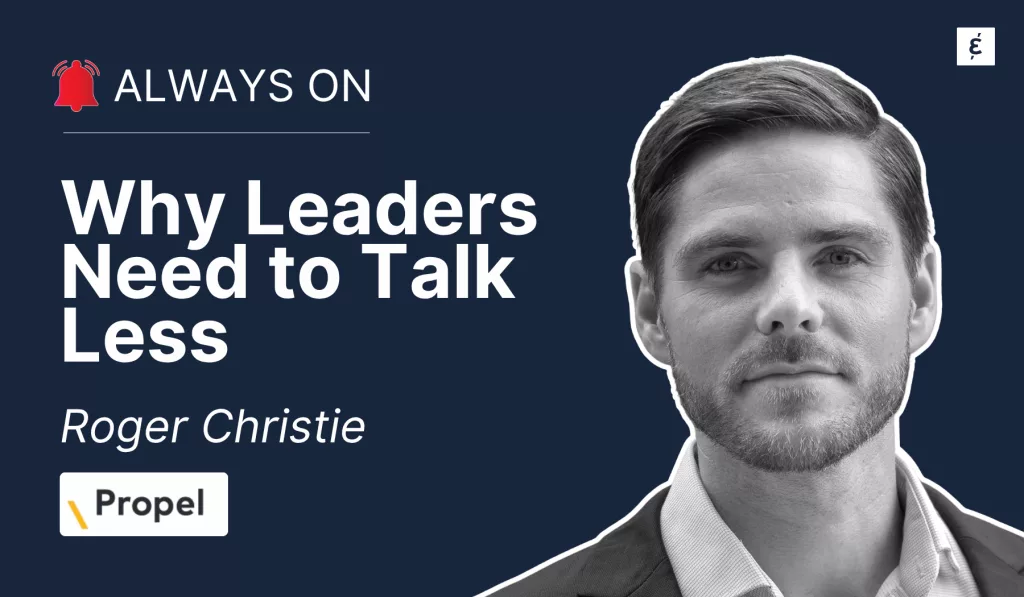
In this episode, Shahar sits down with Roger Christie, founder and managing director of Propel, to unpack why the rise in executive visibility hasn’t translated into more trust — and in many cases has done the opposite.
Roger shares data from Propel’s own trust diagnostic, including one telling stat: leaders analyzed generated over 1,000 inbound comments across six months, and replied to zero of them. He argues that belief isn’t built through broadcasting, but through the same things that build trust offline: listening, curiosity, and showing up consistently when it’s tested — what he calls the “pressure moment.”
Watch the video episode
Read the full transcript
Shahar Silbershatz: Welcome to Always On, the podcast about brand, reputation and stakeholder intelligence. I’m Shahar Silbershatz in Copenhagen, and our guest today is Roger Christie, founder and managing director of Propel, a Sydney-based strategic reputation consultancy. Welcome to Always On, Roger.
Roger Christie: Thanks so much for having me, Shahar. It’s nice to chat again.
Shahar: So Roger, great to have you with us. Tell us a little bit about your company, Propel.
Roger: Yeah. So I founded Propel, just over 13 years ago actually, and essentially what we do is we help make leadership trust visible and measurable, which is something that I know we both have a very mutual interest in. And so what’s interesting about that is that we help leaders and their advisors, you know, surface risk, diagnose where the problem might be coming from, and help them ensure that they’re building trust with stakeholders, particularly when they’re not in the room.
Shahar: Definitely close to what we’re doing and a very interesting angle on that, and we also know that you host a podcast, so tell us a little bit about that.
Roger: Yes. Your Digital Reputation is the name of the podcast, and we’re up to season seven. So the podcast is, and I think particularly this season, is focused on this idea of, you know, the risk of visibility versus believability or belief. And so what we’ve been trying to explore with people, and I’m sure we’re going to touch on this through our conversation, this misnomer about the idea of, being visible is all you need today to have and earn and retain and leverage trust. What we found through our data, and what I’ve found through the podcast conversations we’ve had, is that visibility can actually lead to far more risk than reward. And it’s really belief that you want with stakeholders at the end of the day, and that doesn’t simply come from turning up and talking louder or talking more. It comes from listening and building, you know, valued relationships with people.
Shahar: And this topic that you mentioned, believability or belief, walk us through the argument of how believability is now more important than visibility. I think that’s how you put it before.
Roger: So I suppose the way I look at it, Shahar, is that visibility is essentially accessible to anyone today. So even if we go back as far as the dawn of social media, everyone had the opportunity, everyone had the right, essentially, to go and set up their own profiles and communicate, and with that, they had the ability to be seen. Obviously the rules, if you will, the guardrails around that from the major platforms and how they control things have changed in that time.
But visibility is something that has been easy to achieve for some time. What’s happened in the past couple of years, and I think has really put some rocket fuel on that fire, is the, introduction of generative AI. And so previously, I think the only thing that held people back from talking all the time online – everyone had a platform or a profile – what held them back was the words and the ability to find either the time or the courage to say things and share those things online. Well, you know, you introduce ChatGPT, Gemini, Copilot, any of those tools, and all of a sudden, there’s no barrier to entry. So visibility is table stakes today. Yes, you may not be seen by everyone, it’s not a free-for-all in that sense, but the ability to be seen is free for everyone.
And so if anyone can be seen, and if anyone can produce content, and if anyone with any amount of frequency can get out there today, well, what value is that? And so suddenly what we’re seeing is a shift in not just the algorithms and how they respond to this deluge of content, but also from users themselves, from audiences. And maybe as a byproduct of what’s been happening with brand communications and marketing over many years, or maybe it’s just, you know, the maturity of audiences, what we’re seeing is a move away from seeing a message and accepting that at surface value.
What people are doing is they’re looking deeper, they’re scratching deeper. And even with the use of AI for synthesis purposes, they’re able to absorb huge amounts of information far more quickly than they could before. And in that sense, they’re able to stress-test comments or posts and information that leaders might be sharing. They’re able to stress test those and hold up a digital mirror and say to people, “Well, hang on a minute. You don’t stand for that,” or, “Hang on a minute. I’ve heard you say this before,” whatever it might be.
And so if you lean towards visibility, if you lean towards being overexposed and to oversharing or overproducing information, there’s no guarantee of belief from your stakeholders, and in fact, it can go the other way, as they’re increasingly skeptical of those sorts of pre-prepared or generic messages. Instead, what we’re seeing with belief, it’s not built in words, it’s built in behaviors, and that’s the advice that we give our clients is: “How are you showing up? How is that reinforced by credible third parties? And then therefore, how is that bleeding out, if you will, in a positive way into search and AI, so that the message that other people are hearing, far beyond the conversation you might be having with someone one-to-one is the same that they would have and they would experience in person with you?”
Shahar: I find this really fascinating. I mean, you’re talking about how the evolution of technology, in a sense, had an impact on visibility or at least the ease with which people can become visible, especially business leaders. And I fully agree with that. But at the same time, there’s also another evolution, another development that’s been happening over the last few years, which is more around geopolitics and expectations of business leaders to be vocal about things.
And we’re finding actually in the last maybe two, three years, that there’s been a reverse shift where a lot of leaders are actually afraid to be visible because they don’t want to be vocal. How do you reconcile these two trends? You know, the easier kind of the increasingly easier way to be visible, but the more and more demanding and scrutinizing environment that makes leaders not wanna be vocal. I mean, how do you see the two coexisting or interacting?
Roger: Yeah, you’re hitting on such an important tension, and the way that I look at it is, and maybe it’s unfortunate and maybe this is a little bit glass half-empty, but I get the sense from talking to people in workshops or when talking with clients that feel like they’re hearing more from the people they don’t want to hear from. And I would argue that the opposite is also true, that we’re not hearing enough from the people that we actually would really value hearing from, and those leaders who might have really strong, positive values and want to have a positive impact on the world. And unfortunately, certainly from my experience, it’s those leaders who have a real genuine social conscience and humility who are the first to turn away from using these platforms.
Whether you’re saying, or as you’re saying, whether that’s because of the fear of saying the wrong thing and the complex geopolitical environment, or whether it’s simply because they’re tired of the noise, and they’re tired of hearing and seeing so many people that they don’t want to see. So, within that environment, I suppose the way that I reconcile it is, we’re not trying to be visible to everyone, and we’re not trying to even be believed by everyone, Shahar. That’s not the goal here. It’s about being very clear on who your audiences are, what their needs and expectations are of you, and therefore what role you can play in their lives.
So, it almost, counter to the very much the kind of, “I can be anywhere at any time,” mentality of digital, this is actually about being visible to a select group of people on issues that are relevant between the two of you. So the way that I look at that is you shouldn’t be looking at this as a popularity contest. You should be looking at this as what are the critical issues that our stakeholders expect us to have a view on, and then are we harnessing all channels, all domains that are at our disposal to make sure that we’re building, maintaining, strong positive perceptions, being seen as a regular participant in dialogue around those issues, in channels that scale, in channels that are asynchronous, in channels that people can access anywhere at any time, as opposed to just sharing those insights, behind closed doors, one-to-one, in rooms that won’t scale and where the benefits won’t scale.
So it is a balance, it’s a mix, but as I say, it’s about being very particular and specific and strategic about the audiences you’re most keen to build relationships with.
Shahar: So in a sense, you’re not making the assumption that visibility is a good thing, now we need to build credibility on top of that. Visibility in itself needs to be relevant visibility and appropriate visibility, and then you need to build believability. And talk to me a bit more about this believability aspect. So how do you build credibility? I mean, you mentioned a few things about, you know, behaving in the same way as what you’re talking, so basically doing what you preach and doing what you say, but also being, I guess, visible in a more authentic way. But talk to me a bit more about how do you build that? What does it consist of, this credibility that you’re talking about?
Roger: So the way that I like to talk through it with clients and people I’m chatting with, executives, about this sort of stuff is to really bring it back to basic first principles. So if you think about the way that you would interact with someone offline, you have a natural rapport, you have a natural demeanor, you have a natural way that you might ask questions, be curious. There’s a two-way dialogue, there’s a two-way engagement as opposed to a one-way broadcast. You know, the firehose-style analogy of just ramming messages down people’s throats. So if we think about those offline interactions, the way that we build our best relationships is through mutual respect and by showing care and curiosity and adding value in people’s lives. There’s no way that we’re going to build valuable offline relationships if we’re always just talking about ourselves, if we’re always just talking about what’s happening in our organization, if we never bother to listen to responses or stick around to answer any questions that might come. There’s just no way that happens offline. So the idea of belief and credibility, it’s the same offline as it is online.
But I think where people have got maybe misguided or maybe they’ve been distracted is the lure of this, you know, seemingly unlimited boundary where we can reach literally every single person who’s got a smartphone around the planet and a Wi-Fi connection even, so we can reach all those people, and that appeal, that lure is too great. And so we’ve over-indexed on sharing messages out to those people and trying to reach as many people as possible, whereas to your point earlier about the geopolitical environment, we don’t need to be present with all people and across all issues. We just need to make sure that we’re believed and credible to those people who matter most to us. And so in the same way that you would build an offline relationship in a two-way manner, you would build an online relationship in that way.
So maybe if it’s helpful to break that down into some, you know, practical behaviors online, what does that look like? We did a bit of research recently. We were looking at several executives, across one sector, so there are four executives across six months, and what we found by analyzing their efforts online was they generated more than 1,000 inbound comments on the content that they were producing and putting out there, via their LinkedIn profiles in this case. So what’s interesting about that, this is topics that the CEOs themselves have decided are important to them and their organization, and you would assume therefore their stakeholders, and they’re putting that out online over the course of six months and generating 1,000 inbound responses.
Now, of those 1,000 inbound responses, they replied to zero. And so what that tells me is that there’s a system, there’s a structural issue here, and that probably stems from education or literacy, but there’s a systemic issue here whereby people believe the best way to use these platforms and the best way to build trust via these platforms is to talk at people. And if I take that same thinking and then apply it offline, you shake your head and you go, “There’s no way you’re going to build trust by talking at people.” You’re going to build trust by listening and being curious and caring and showing an interest in others. And so what that means is, hopefully in the future when we look at this, and certainly the advice we give our clients, you don’t see 1,000 inbound comments and zero replies, but you see leaders starting to engage in an open and, you know, genuine, authentic, we used that word before, way on the issues that do and should matter to them with the people that do and should matter to them, and that two-way dialogue is where you’re going to build belief by turning up when others want you to turn up, not when it suits you.
Shahar: I imagine it’s a pretty hard case to argue. I mean, when you have clients and audiences that you talk to and try to explain the importance of that different way of communicating, I mean, are there any data points that you use to convince people that, this is proven to be more effective?
Roger: Yeah, it’s an interesting one, isn’t it? Because it’s almost like it’s the known and unspoken thing. So if you look at the amount of resources that are put into producing content, I would argue it’s probably eighty-five, ninety percent of the amount of time, effort, and energy and money that organizations would put into what they might term as a executive communication program. So if a lot of that investment is going to what goes out, we then need to look at what comes back in. And so what we’re looking at in terms of those data points, we’re seeing an increasing decline in the amount of responses that come back to leaders as they fail to respond to that initial interest from people. We’re seeing no follow-up conversation, no genuine dialogue, with these leaders. It’s more token. So what you’re seeing is the token reaction. You’re seeing a response, an increasing response, from both staff, and that’s not necessarily a bad thing. But if your remit is to reach outside your organization, and that’s why we’re using these channels, then that’s certainly a narrow audience.
But the other thing is the rise in bots and, you know, fake content and fake profiles responding to these leaders as well. All these things are going up, while really the interest that you want from those audiences you’re trying to reach and those audiences who will help grow and reinforce your business, they’re just not there. And so our data is saying that as the volume increases and as the reciprocal relationship fails to exist, the reciprocal conversations fail to exist, we’re seeing that the effort that is going into the content going out is not generating the response that people want in return.
Now, on the flip side, Shahar, and what’s interesting, you talk about data points, we’re not saying that this needs to be done one hundred percent of inbound responses needs one hundred percent of a response from the leaders. I appreciate that people don’t have time for that. Of course they don’t. But what we’re seeing, if we look at some of the best examples that we’ve looked at through our trust diagnostic, the exemplars that we would consider in industry, the number seems to be around about fifteen percent response rate. Now, what these leaders are doing incredibly well is they’re being very selective about the people, i.e., their credibility, their profile, their influence, and the issues that they engage on. They’ve got to be relevant. They’ve got to be connected to that leader in their remit. And when they do that, they get a very effective outcome because they’ve got credible conduits spreading messages on the issues that matter to them as a leader to new networks.
So there’s logic in it, there’s data in it, and certainly what we’re seeing from the reverse of this, if we just take a broadcast approach, what we’re seeing is that it’s just not building the trust and connection and affinity with audiences that leaders are craving today, and frankly, I’m assuming why these systems would have been built in the first place. So it’s worth people looking at their own performance and saying, “Where is our interest coming from today? If we are the ones pushing all this content out, where is our response coming from? Is it the right audiences, and is it leading to tangible outcomes in terms of those commercial benefits that we’re looking for?”
Shahar: There’s another thing that you talk about that I found interesting. I heard you talk about how a lot of leaders today, again, with the easy use of, of generative AI, they produce this polished content, so something that’s kind of very performative and you say it creates this illusion of success, which is dangerous. Can you talk a bit, can you put a few more words on that?
Roger: So we’ve talked about behaviors already. We touched on that and the value of behaviors in building belief. Words have visibility, behaviors build belief, and I think that’s the key point here, Shahar. So when we talk about performative content or when we talk about polished content, there’s a couple of things at play here. One is the more polished something looks, the more it looks like it’s been manufactured, the more it looks like it’s been manipulated, the more it looks like it’s been contrived, and that’s simply a byproduct of savvy audiences and a marketing engine which has been, you know, priming them over many years to go, “Well, hang on a minute. This looks like an ad and smells like an ad, so it probably is one.”
So when we see that sort of content, we disengage, and you’ll know this even if you just thumb through your feed today. The content that looks overly polished, it’s, you know, the drone shot or the distance shot or the brochure-style shot. When you see those things, they don’t generate the lean-in engagement and response that you want from audiences that show they’re connected to issues. That’s the polish that actually, while it gives people comfort and confidence to know that it’s a quality product, it actually creates a distance between you and your target audiences.
And if you want a simple reference point, a comparison point for that, while I’m not saying that everyone needs to go out there and share selfies all the time, if you look at photos that people take that aren’t necessarily polished, that are more genuine, more authentic, people close up to the camera, it may be even at the wrong angle with terrible lighting, Shahar, the point is that you can recognize that person’s face and you know it’s them and you know it’s genuine. We all know this inherently. As human beings, we trust those people who are authentic. We don’t trust those people who feel like they’re veiled or guarded. There’s just something about that, and so when we see those same attributes in content, we become skeptical, and that’s what I think people need to be very careful about.
So again, polish as opposed to behaviors, it’s easy to create and it’s easy to have, you know, arms and legs and resources from a communications muscle point of view who can make things look great. That whole system breaks down the first time a question is asked and that leader is nowhere to be seen, and that’s where the behaviors then follow through and they reinforce, “Yes, this was a message that I shared, and yes, this is a topic that I care about because I’m here and I’m listening to your answers and I want to share my perspective and I want to hear your perspective.” It reinforces that idea of polish and veneer and performative content when I’m nowhere to be seen, and I don’t think people realize the risk that’s being created through that performative content when people just set an expectation they don’t follow through on.
Shahar: Yeah, and is that what you describe as the “pressure moment” where stakeholders suddenly kind of step back and start seeing, okay, there’s actually a pattern here, and they stop believing you and in a sense, you lose their trust? Is that what you refer to as a pressure moment?
Roger: So I had this example the other day. I was having a conversation with someone about recruitment, talent attraction and retention. And this is an isolated example, but I’m sure it is more commonplace. today are looking not just at what an organization says on its website. They’re far more savvy than that. They’re looking at a range of different sources. They’re looking at leadership teams, and they’re looking at what comes out. They’re not just looking at that. They’re looking in the comments. That’s where reality happens, in the comments, not in the performative stuff that, as you say, is very easy to produce and manufacture behind the scenes with whatever resources you want. People are looking in the comments, and people are interested in knowing what does this organization actually stand for.
So the example, if I’m a young… Say I’m a young female graduate, and I’m looking for an organization that has, you know, values that’s going to empower me and going to support me in my next role. If I’m looking at, a CEO, whatever gender they might be, but let’s just say that they’re male. If I’m looking at a male CEO who might talk about, you know, come March next year, they might talk about International Women’s Day once a year. Well, that candidate can very easily see if you’ve mentioned anything about your female colleagues and staff and equity in the workplace and those sorts of things outside that one-week window every single year.
It’s very easy for them to do that. So when you talk about those pressure moments, people are able to stress-test that. They’re able to analyze and synthesize waves of information far more quickly than they could before, and they’re holding up these examples and saying to leaders, “I don’t believe it.” And so if they don’t believe it, guess what they’re not doing? They’re not applying.
And so this is the invisible impact that organizations aren’t seeing today. They’re seeing the vanity metrics. They’re seeing the stuff that makes the performative content look good, but what they’re not seeing is the candidates who are turning around at their front door and walking somewhere else. What they’re not seeing is the investor who looks at what they’ve said and gone, “Hmm, that smacks as a little bit too woke for me or a little bit too performative. That’s not quite right,” and again, are turning around and investing elsewhere. So I think this hidden impact, as well as what we can see through things like our trust diagnostic, and I’m sure you see through your stakeholder intelligence, we can see these patterns emerging. And all it says is, “Be careful.”
Shahar: I imagine also that the issue there, you’re not just losing the stakeholder at that moment, you might be losing that stakeholder for life, because as we know, gaining trust is a lot harder than losing trust. So once you lose it, it’s so much harder to regain it in the future. This is an area that I’m also kinda curious to dive into now with you because we, obviously, focus more on the corporate side and corporate trust, corporate reputation. And I’m very curious about where does the leader reputation meet the corporate reputation? I mean, what is the impact of one on the other? In your case, what would be the impact of the online presence of a leader on the reputation of the company?
I mean, there’s a lot of data points on that. On our side, we actually found that most people don’t really connect leaders and companies. Most leaders don’t have a high enough public profile to be connected to the companies that they run. So quite often, what they do does not affect their company’s reputation. But of course, I have a list of data points that claim the opposite, from Weber Shandwick and Brunswick and FTI Consulting, about how much leader’s behavior affects the way people see and think about a company. From your perspective, what is the connection between the two?
Roger: I think there’s two things that I’d say about this, and one is about the way that leaders are being used, and I do use that term intentionally, being used today. And the first one there around how they’re being used, I think that initially, leaders have basically been treated as organizations. They are being treated as another corporate channel. And so when we talk about the value of any leader and the connection and trust and the kind of positive halo effect that has in terms of corporate reputation, most consumers or most stakeholders on the outside are looking at that and saying, “This is just another corporate channel.” And so when we use the channel that way, it’s very hard to measure with any degree of certainty that that channel is being used the right way, and so therefore can be measured in a valuable, credible way.
What I will say, on the other hand, is that the role of corporate reputation is different to the role of leader reputation. And so what I’ve seen recently, and you know, where I am in Australia, we’ve had a couple of very high-profile instances with some professional services firms here over the past couple of years, and what I found fascinating is despite these brands, and despite, you know, major commercial impacts, financial risk, reputational risk that’s happened as a result of some poor decisions and poor governance, while these brands have been dragged through the mud, what’s been really interesting to hear is how some clients and some, you know, fee-paying clients to these firms have stayed with their partner, have stayed with the individual within that firm, frankly, because they don’t see the connection between the corporate, the organization, and the individual.
They trust the person, even if the brand has been dragged through the mud. And so again, I’m fascinated to, not turn the question around, Shahar, but to hear your perspective on it because what I’m seeing is, one, organizations are using, they’re stripping away, frankly, the personal, the human benefits of the CEO, of the leader, and treating them as a corporate channel, which therefore, you know, belies the use of that person and the involvement of that person. It’s almost like they’re renting their profile.
And number two, if it’s, you know, if we’re seeing that people are willing to stay with the individual, and their relationship and trust is with the individual, not the firm, then the risk for the firms is that they don’t treat people well enough, and they go somewhere else and take their clients with them.
Shahar: That’s a good point, and I think the answer really is, from our perspective, from our perspective the answer is it depends on the stakeholder because there’s a lot of different stakeholders, and some of them are more reliant on the CEO and the CEO’s profile than others. You know, of course, investors and B2B customers and partners and so on, certainly employees, they all consider the CEO important. They all look up to the CEO and want to hear from the CEO, and the respective leaders of the company, right?
When it comes to consumers, when it comes to retail investors, when it comes to, you know, other audiences, especially for B2C companies, ir’a maybe less important. I would also say that today, the tenure, the average tenure of a CEO is much shorter than it was twenty years ago. So, in some cases, you have got to have a bond and belief in the company that goes way beyond the CEO because the CEO might be replaced tomorrow. and that creates a very different dynamic today.
So, you know, it’s very difficult to… this is also, I imagine, the risk from our perspective of creating too strong of a link between the CEO and the company because if the CEO is gone tomorrow, then you may need to rebuild the company’s reputation from scratch. And of course, if the CEO suddenly decides to become politically involved, and certainly there are some cases today in the US, you’re taking a big risk. If the company’s reputation is very much depending on the CEO as a person, as a public profile, then you run a huge risk if that public profile becomes entangled in different negative, you know, coverage or certain controversial issues. So in a sense, it’s a double-edged sword, right?
Roger: It’s such an interesting point because I think you’re touching on something that a lot of people don’t think too carefully about, which is, and again, it depends on our mindset coming into how, what role our executives play. Who’s advising or who’s managing, who’s guiding their efforts on the channel? Because if we expect these leaders to be the source of everything, and what I mean by that is, if we expect them to be the brand ambassadors, the communicators, the thought leaders, the salespeople, the talent attractors, if we expect them to be all these things, absolutely that’s not sustainable, and absolutely that creates significant risk.
You talked about key person risk, and if they leave the organization and take all that goodwill with them, absolutely. Let alone the bottleneck risk. There’s no possible way that a leader can appeal to all different audiences, at all different times. They simply don’t have the capacity, let alone the authenticity, to be able to do that. So I think the answer there is a structural one, though. If there’s an organization that’s investing too much in their leader or expecting too much of their leader in this environment, they’re setting themselves up for failure. Instead, you need to build bench strength and build redundancy into that system by ensuring that you have more than one figure, and that each of these figures plays a complementary, not a cannibalizing role, but a complementary role, supporting them. Based on what?Based on their key audiences.
So who are the people that they need to know, that they need to reach, that they need to build strong relationships and trust with. For what purpose? Whether that’s sales, whether that’s talent, whether that’s partnerships, whatever reason that might be, we need to engage more than just one central figure.
So yes, the CEO might be the lead voice or the lead authority on certain issues for the organization, but they’re not the lead salesperson, and that’s where we need other people to come in and, you know, work in coordination with those leaders. And this is the challenge to organizations. If you’re a communicator, then you’re responsible for your CEO’s reputation and their presence online, which is an important role to play. There’s no way that you’re also responsible for, you know, activating a sales force behind that person. That’s not your role and responsibility. So how do you do that? You need to create a system that makes this governable, that makes capability shared and spread across different people, but makes it governable, measurable, and, you know, improved over time, so that you’re generating performance and results not on one person, but on a collective, a coalition of people working towards the same goal but playing different roles.
Shahar: This is great because it leads me straight into the next question, which is thinking about our audience, and our audience is typically CCOs. what is some of the advice that you give them? So you’re talking about you have to have a system, you have to think about a host, a roster of speakers that you’re building within the company or people who are, in a sense, spokespeople for the company. What other questions should you ask yourself as a CCO? What are the things that you need to look at? What are the tips that you would give CCOs in this regard?
Roger: Yeah, well, I think a great question to start with is: looking at your program, your strategy today, and saying, “What is its primary purpose?” And if the primary purpose of what we’re doing, and therefore where our resources are focused and what we’re measuring, is based on communication, and what I mean by that is communication in terms of content and output, and making sure that messages, however carefully prepared and articulated, so they can be brilliant messages, but if that’s where our primary focus is, it follows that we’re going to skew our resources there, and we’re going to measure that as well, and that’s what’s going to keep us accountable.
I would argue that what social media have done, and what this whole executive presence, space has done, is it’s challenged that structure. It’s no longer easy, or it’s no longer possible even, for CCOs to look at this from a brand lens and say, “Well, what is the brand’s job and who is the brand communicating to, and how do we track that in the way that we may have traditionally, if it’s through media or if it’s through our owned channels?” It’s not the same when it comes to executives, CEOs, or executive teams, because it’s much more about relationships. Trust isn’t about communications as a core discipline. It’s much more about the relationships and the stakeholder-engagement side of things.
So the question I’d be asking is, what are we focused on today, and how are we measuring that? And by doing that and looking at your measurement and looking at your core programs, it’s very, you know, quickly and easily identified whether we’re skewing our efforts towards what we say or whether we’re skewing our efforts towards what we do. And I would argue, and my advice or counsel to anyone in that communications lead role, is to look at this as a wonderful opportunity. If you haven’t already or your organization hasn’t looked at this already, this is an amazing opportunity for communicators to get much more closely aligned to business outcomes. Use these channels as a way not just to communicate, but as a way to build deep commercial relationships with key stakeholders.
And, as you were saying earlier, you’ve now got the data to show where you’re having an impact. It’s not about impressions, it’s not about eyeballs, it’s not about those sorts of metrics. It’s about building relationships that create genuine commercial output, or building relationships that attract talent that you otherwise couldn’t have accessed before, or partners that you otherwise or investment that you couldn’t have otherwise accessed before.
So I think it’s this huge opportunity, but it all starts by looking at where is our program focused today and what are we measuring. And when we know that, you can then start to course correct and ensure that you’re engaging the right stakeholders across the organization from a governance perspective, from a system perspective, as you were saying, not from a comms or words-only perspective. And that, then certainly from the clients that I’ve worked with, where they get the best bang for their buck. That’s where they get the best return, because suddenly they’re seen as a valuable conduit, or a valuable domain owner, to advise people across a whole range of, business units within an organization, not just on the words, but on how we manage strong relationships with stakeholders to generate commercial output.
Shahar: Sounds to me like you’re making a really crucial point here. You’re basically saying the online channels are not there to amplify your brand, they’re there to build relationships.
Roger: If they were there to amplify the brand, people would be lapping up our messages every single day. And so what we see is the reverse of that. We’re seeing people turn away. We’ve reached peak content some time ago, and generative AI has not helped that process. It is harder to get heard on the message. So what do you need to do instead? You need to be famous to a small group of people, those stakeholders who matter most to you, those stakeholders who are going to buy from you, who are going to invest in you, who are going to advocate for you, refer you, those allies as well. Being famous to a very small group of people, what we call with our clients the VIPs, those who matter most to you in this world in achieving your goals.
So if you look at it that way, I mean, communications in a way has become… I see it as a huge opportunity, but it has become a lot more complicated because we’re having to manage these much more niche stakeholder groups. A leader to a small audience is very different to a brand to a larger customer base. They’re very different things. But as I said, I think it’s a huge opportunity for communications practitioners to show the organization the data that means something and show the organization that if we, you know, tweak this dial a little bit, we’re going to see very different commercial outcomes, and hopefully that’s exciting.
Shahar: Yeah, and of course, this is the holy grail for all communicators, right? To actually connect to the business outcomes rather than just measure the brand itself. So I think this is a great point to end with, and to wrap it up, I wanted to ask you something we tend to ask all of our guests here, is whether there is any conventional wisdom in the field that you think is wrong, in any part of your field? Something that you tend to hear a lot and you think, “Nah, this I don’t agree with that.”
Roger: I think we’ve touched on it, and I’m probably beating people over the head with it if I say it again, Shahar, but I will because it is so important. And when you say that conventional wisdom, talk less. And I do genuinely mean that. If you think of how you’ve built your best relationships in any walk of life, talk less. And that doesn’t mean don’t talk. That absolutely doesn’t mean don’t talk. It means talk less. It means listen first. It means ask good questions, be curious, care. Show that you’re interested in your stakeholders. And, again, think about your very best relationships in all domains. The best relationships that you have offline are those relationships where people take the time to listen to you and add value to you, and that would be my encouragement. Talk less and add more value by listening and participating in others’ areas of interest.
Shahar: I couldn’t agree more. it’s been great to have you here. Thanks so much for joining us.
Roger: It’s been a pleasure, Shahar. Thank you.
Shahar: Many thanks for listening to this episode of Always On. If you haven’t done so already, check out some of the other episodes. They’re packed with unique insights from seasoned experts at leading companies. Oh, and if you have any comments or questions about anything you’ve heard on the pod, we’d love to hear from you. Just drop us a line at [email protected]. Thanks again for listening. Till next time, take care.