Generative AI tools — ChatGPT, Gemini, Claude, Copilot, and a growing list of others — have quietly become one of the first places people go to learn about a company. Before someone signs a contract, applies for a job, or writes a review, there’s a decent chance they’ve already asked an AI chatbot what it knows.
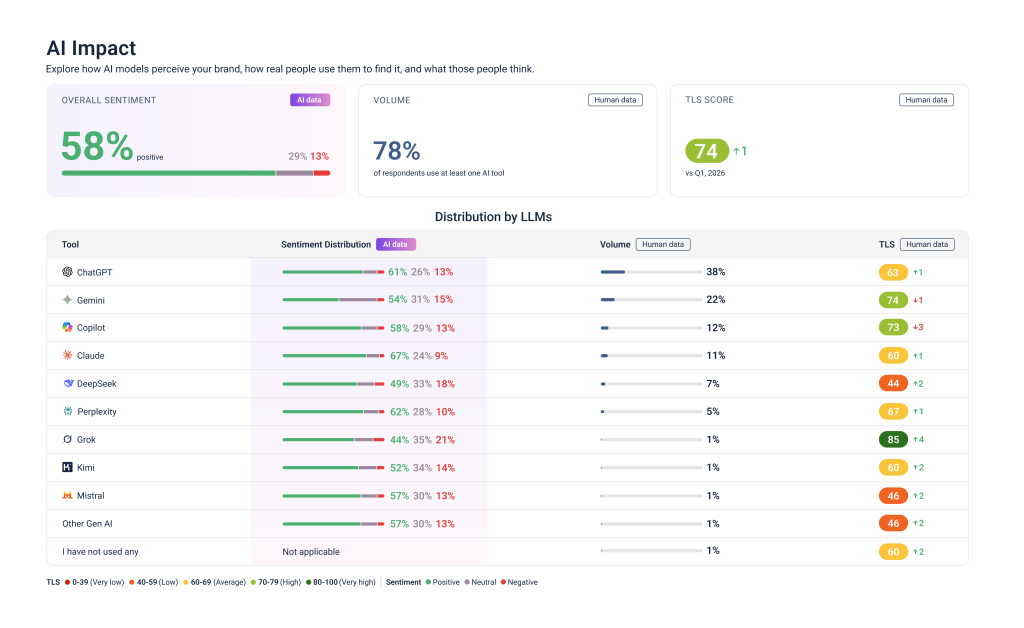
That shift creates an obvious question for anyone responsible for brand or reputation: how do you actually measure this? Caliber’s answer is AI Impact, a new analytics view that shows how generative AI tools are shaping the way people discover and perceive your brand, and how the humans on the other end of those conversations respond.
Before getting into how it works, it’s worth being precise about what it is — and isn’t — measuring.
AI is a channel, not a stakeholder
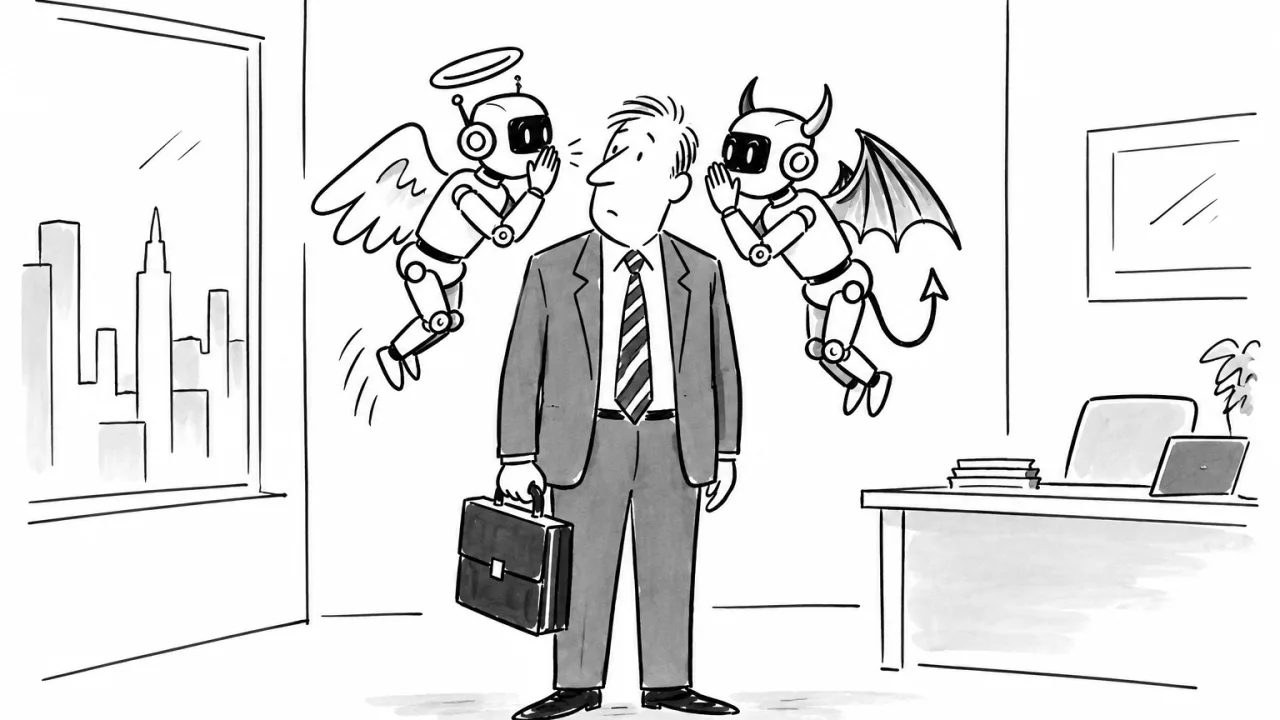
It’s tempting to talk about AI the way you’d talk about a stakeholder: something whose “views” of your company need to be tracked, managed, and improved. Resist that temptation. It’s the wrong model, for a few reasons.
An LLM doesn’t hold a stable opinion of your company between conversations. Ask it about your governance and you’ll get a governance-shaped answer; ask about product quality and the picture shifts entirely; push back on either and it will often simply agree with you.
There’s no consistent attitude sitting underneath those answers, which means there’s no “relationship” to manage in the way there is with a customer, employee, regulator, or journalist. And unlike a real stakeholder, an AI model won’t act on a bad impression of you — it won’t quietly go elsewhere, warn a colleague, or raise something at a shareholder meeting off its own back. It only responds when someone asks.
What an LLM does when queried about your company is much closer to what a search engine or media outlet does: it synthesises what’s already out there and reflects it back through the lens of the question asked. That makes sentiment and volume — not attitude or trust in the human sense — the right things to measure. It’s the same logic you’d apply to media coverage: how does it skew, and how much of it is there?
That distinction isn’t just philosophical. It’s the design principle behind AI Impact. The tool doesn’t claim to tell you what Claude or ChatGPT “thinks” of you, because that framing doesn’t hold up. Instead, it measures two related but separate things: what AI models actually output when asked about your brand, and how the real people who’ve used AI to research you subsequently feel. One is a media signal. The other is genuine stakeholder sentiment, filtered through a new touchpoint. AI Impact keeps them separate rather than conflating them into a single, misleading “AI sentiment” score.
Read more: Stop Managing AI Like a Stakeholder
How Caliber measures AI Impact
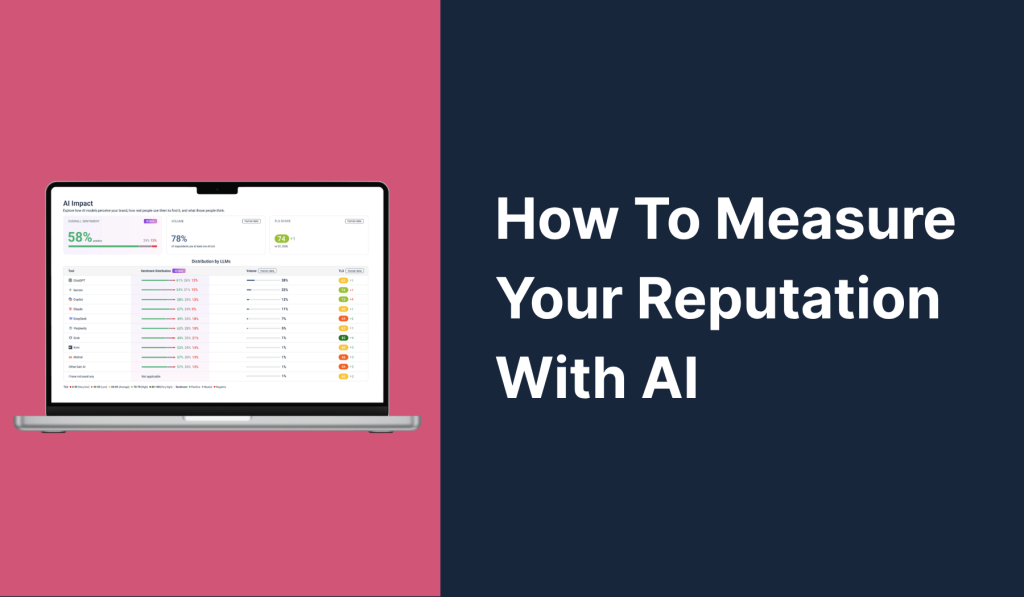
AI Impact is built around three core metrics, each pulling from a different source.
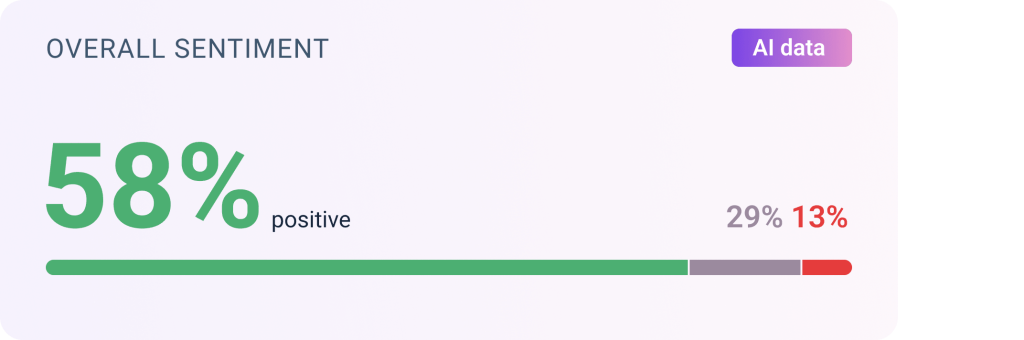
AI Sentiment
AI Sentiment captures how your brand comes across when AI models are directly asked about it. Caliber sends daily prompts to nine different generative AI tools and classifies the sentiment of each response as positive, neutral, or negative. The headline percentage is a weighted aggregate across all nine. Critically, this figure comes straight from the AI models themselves, not from survey respondents — it’s the media-coverage side of the picture.
AI Search Volume
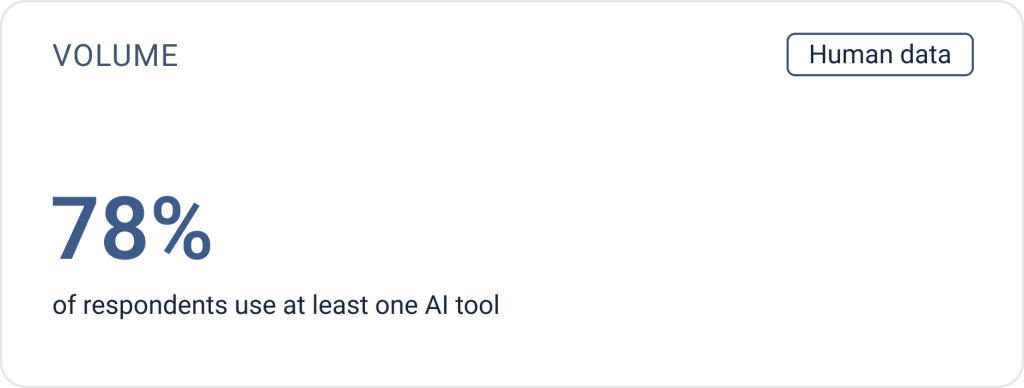
AI Search Volume shifts to the human side. It measures the proportion of survey respondents who say they’ve actively used a generative AI tool to look up information about your company. Respondents are asked, in effect, whether they’ve used any of a list of AI tools or chatbots — via a website or app — specifically to find out more about your organisation in the recent past.
The percentage reported reflects how many said yes to at least one tool. This is the figure that tells you how much of your audience is actually treating AI as a research channel for you, as opposed to a channel that theoretically exists.
Trust & Like Score (TLS)
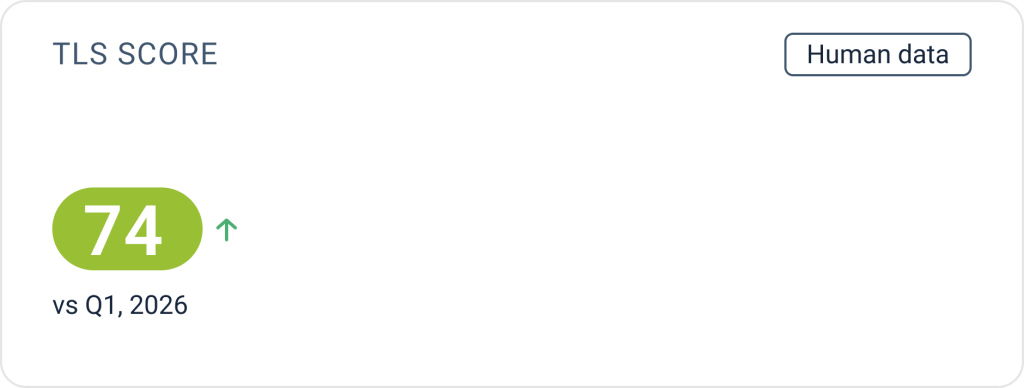
Trust & Like Score narrows in further still. It’s calculated only from the subset of respondents who said they have used AI to research your company, and it captures how that AI-influenced group feels about your brand as a result. This is the metric that most directly answers the “so what” question: not what AI said, and not how many people looked, but what actually happened to trust once they did.
Put together, the three data points separate cleanly into “what AI outputs” (AI Sentiment) and “what happened to real stakeholders as a result” (Search Volume and TLS) — which is precisely the separation the channel argument requires.
Breakdown by AI tool
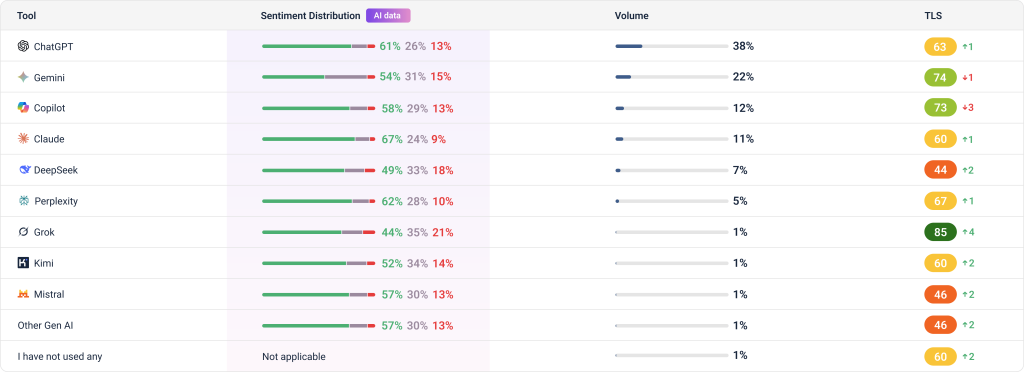
Because not all AI tools are created equal — some models lean more critical, some are used far more than others — AI Impact breaks all three metrics down by individual tool: ChatGPT, Gemini, Copilot, Claude, DeepSeek, Perplexity, Grok, Kimi, Mistral, and more. This lets you see, for instance, whether your brand comes across noticeably differently in Claude versus ChatGPT, or whether the tool your audience actually uses to find you is one you hadn’t been paying much attention to.
Tracking changes over time
All three metrics are also available in the Development chart view, plotted along a time axis. That makes it possible to spot trends — an improving or worsening AI Sentiment score, or growing Search Volume as more of your audience turns to AI tools to research you — rather than relying on a single snapshot.
A note on data sources
Because AI Sentiment comes from a different source than Search Volume and TLS, the interface labels them accordingly: AI data versus People. Both live in the same view deliberately, so you can hold the two halves of the picture together — what AI models are actually saying about your brand, and how that plays out in the trust of the people who go looking.
The bottom line
AI hasn’t become a stakeholder. It’s become a channel — arguably the fastest-growing one companies now have to reckon with. AI Impact is built to measure it as exactly that: sentiment and volume on the AI side, real human trust on the stakeholder side, and no pretence that the model in between has feelings about you one way or the other.
Curious how your brand shows up across AI tools? Get in touch to see AI Impact in action.