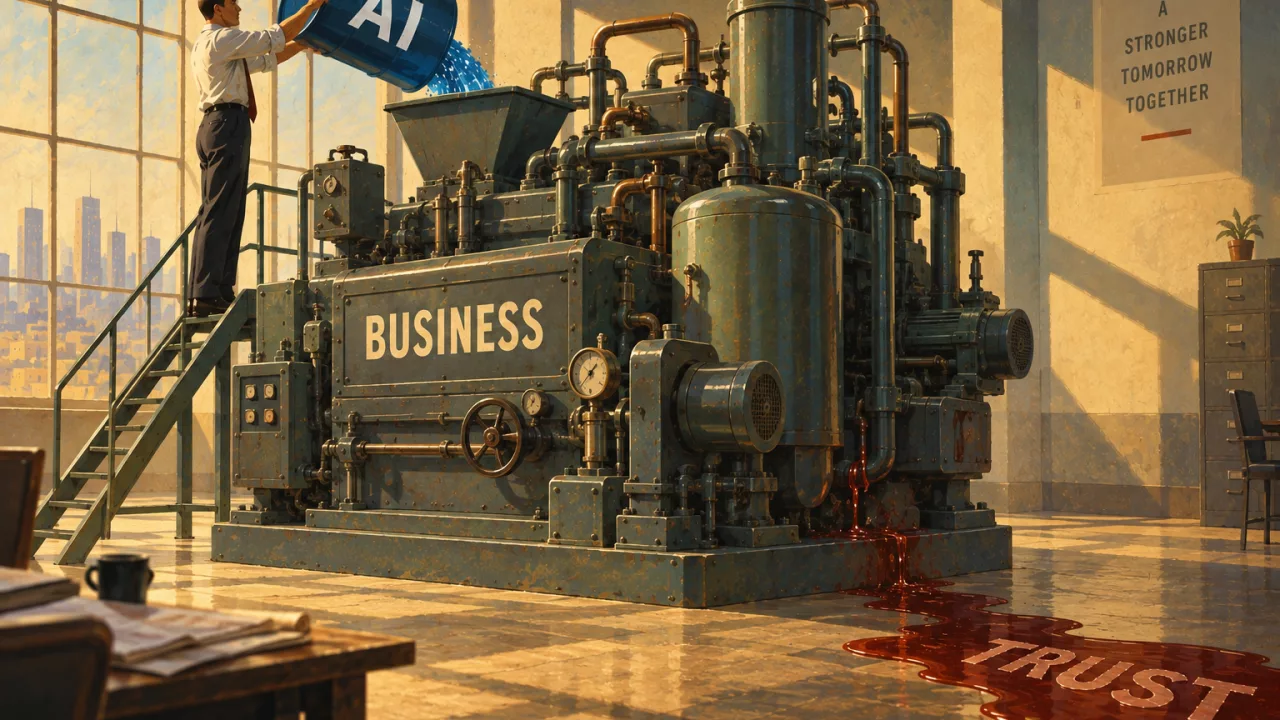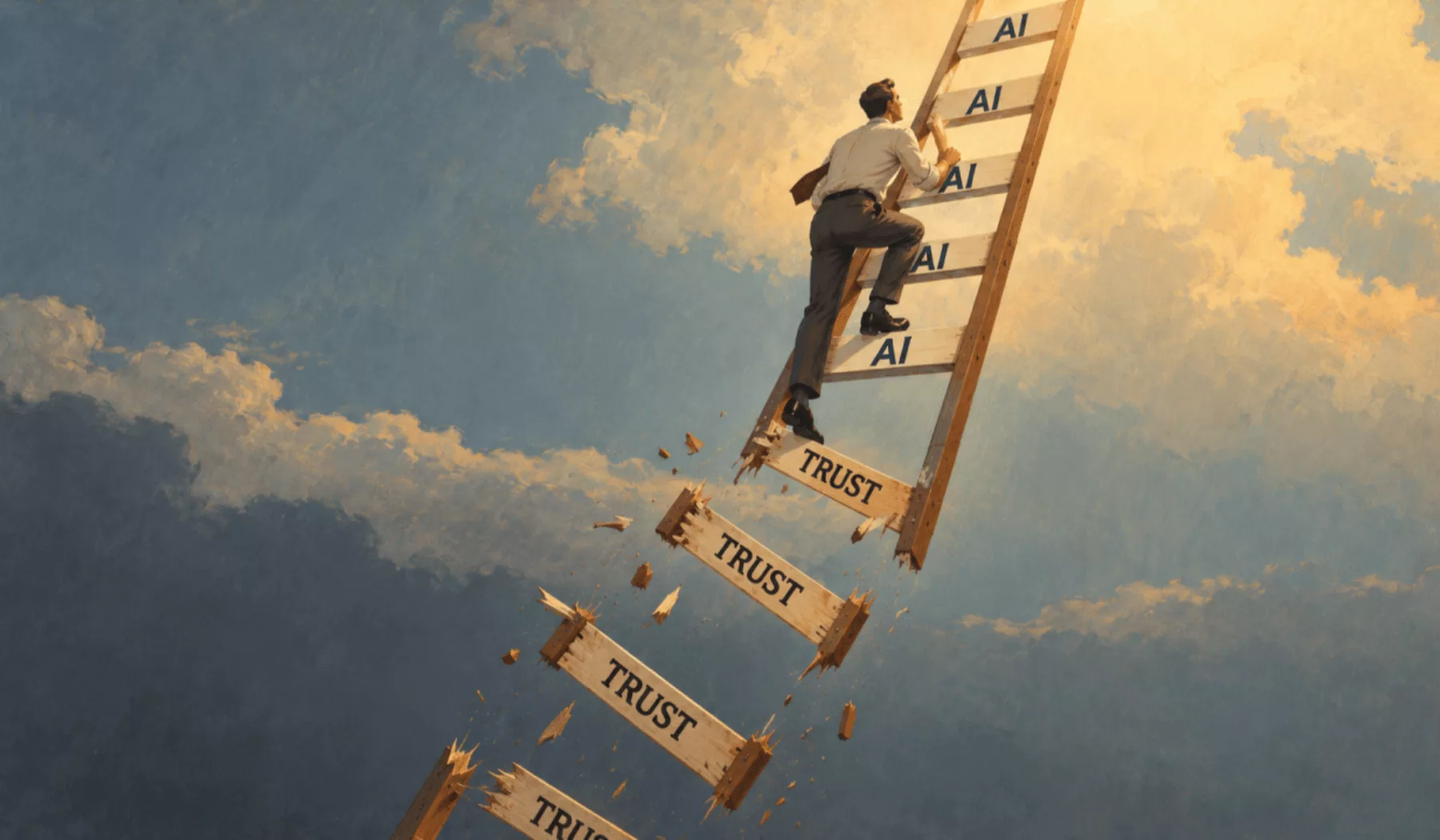
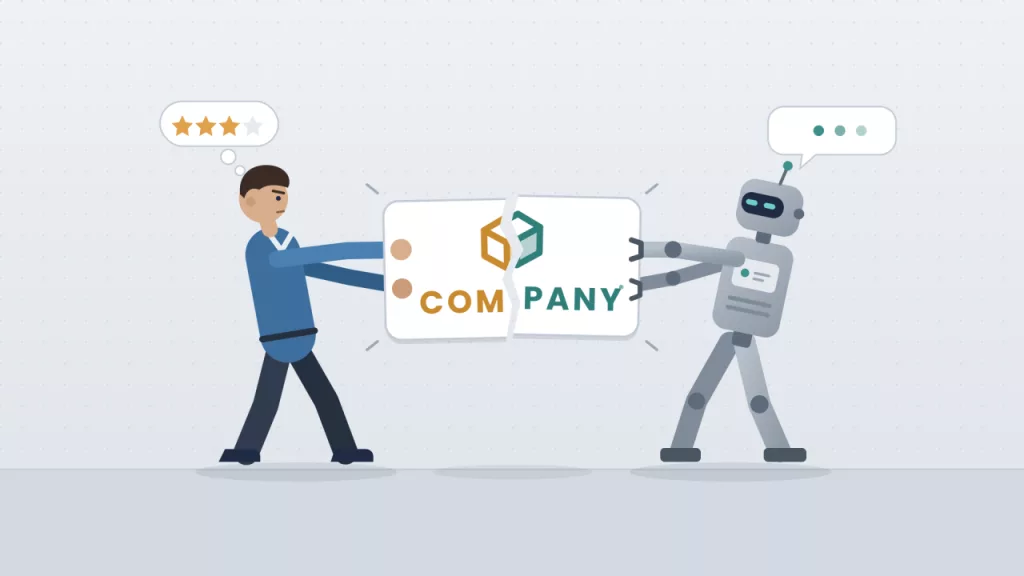
Never mind there being two sides to every story: thanks to AI, there are now at least two stories to every company.
I wouldn’t wear Coca-Cola socks myself, but I wasn’t surprised when a colleague of mine shared a candid pic he’d taken of a young man sporting a pair (with sandals, natch).
Coca-Cola is one of the world’s most recognisable brands, and makes one of the most popular products ever, a soft drink that’s long been associated with happiness and shared moments. Coke has, in other words, built up decades of brand equity and loyalty.
Hence the snazzy socks. I mean, dedicated employees aside, it’s hard to imagine anyone willingly wearing items of clothing festooned with the name and logo of, say, Anthropic, Eli Lilly, or Shell.
Regular readers may be feeling a touch of déjà vu.
Coca-Cola was the subject of the first issue of this newsletter, when I looked at how its reputation among stakeholders compared with the picture painted by AI chatbots.
Back then, though, Coke was a sample of one. We’ve since gathered the same kind of data on 29 other global companies, which means we can finally ask whether Coke’s story is the exception or the rule.
The data concerned two similar but different types of stakeholder intelligence.
First, our standard analysis of stakeholder perceptions, quantified as a Trust & Like Score (our chief metric of corporate reputation, a score out of 100, with the average being between 60 and 70) for each company, alongside scores for a dozen-odd brand and reputation attributes — Innovation, Leadership, Integrity, and so on.
Second, our analysis of what nine leading LLMs say about each company (given as a percentage of “positive” responses).
Comparing the two, we can see for the first time where stakeholder perceptions and AI descriptions align and where they diverge.
We do so by analysing each LLM’s responses to a simple daily prompt — “tell me about [company X]” — and classifying whether the answer skews positive, negative, or neutral.
We also score the same response against the attributes we tracked, so we can determine what an LLM says about, say, how innovative or ethical a company is and set that alongside how actual stakeholders rate the same company on the same attribute.
In the coming weeks, I’ll be sharing some of our findings — including what that attribute-level comparison throws up — beginning with a fresh look at our finding about Coca-Cola.
A tale of two reputations
You see, when we looked at Coke’s data, we found that while only 46% of AI responses about the company read as positive, its Trust & Like Score was 70.
We read that gap as evidence of a company coasting on decades of so-called brand equity, and that LLMs were more likely than actual stakeholders to be factoring negative issues such as Coca-Cola’s health or environmental impact into its responses.
Our next question was whether that reputational gap was unique to Coke or not.
It isn’t, and the gap isn’t even that wide.
Compared to the other 29 companies in our study, Coca-Cola sits close to the middle. Seventeen companies have a bigger gap between how AI describes them and how people perceive them.
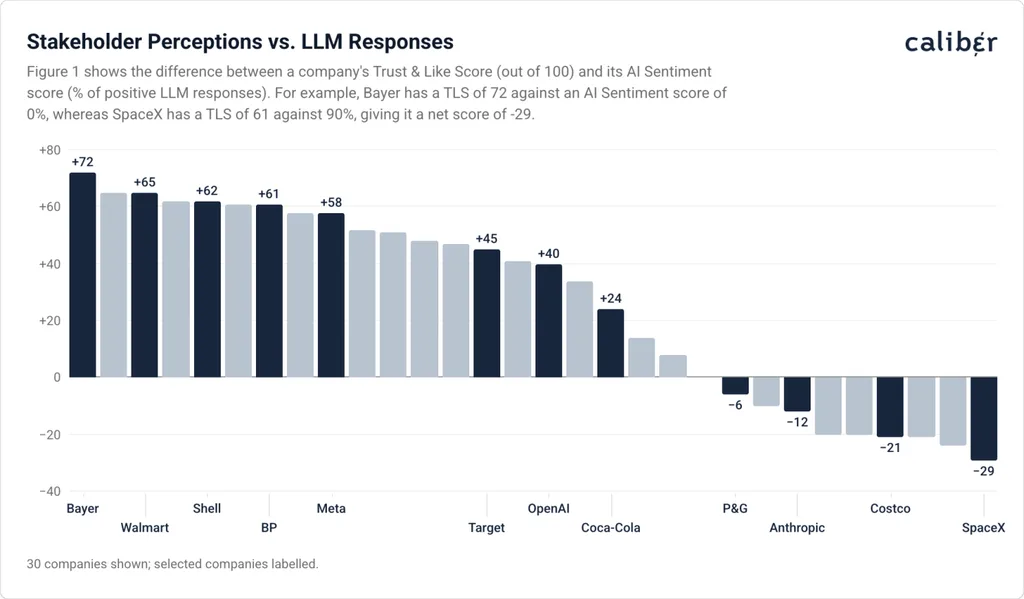
I’d assumed Coke would be an outlier, but it’s actually fairly ordinary.
At one extreme is the pharmaceutical giant Bayer, which has a Trust & Like Score of 72 (in the 90-day period up to 22 September) but an AI Impact score of 0, meaning 0% of LLM responses about it in this same period were positive (48% were negative, the rest neutral). For comparison’s sake, the average Trust & Like Score for the 30 companies was 68, and their average AI Impact score is 41%.
Boeing and Walmart aren’t far behind, both having a 65-point gap between their two scores. (For example, Walmart has a Trust & Like Score of 76, yet just 11% of LLM responses are positive.) Similarly, Chevron and Shell have a 62-point gap.
What connects many of the companies at this end of the scale is a well-documented history of controversy — such as litigation, safety issues, product recalls, or labor disputes — which AI seems to weigh more heavily than stakeholders (whose trust either rebounded or never moved in the first place). In short: AI has a longer memory than we humans do.
The mirror image
At the opposite end, the pattern flips on its head. The standout company is SpaceX, whose AI score is 29 points higher than its Trust & Like Score. In other words, LLMs are measurably fonder of Elon Musk’s rocket-ship venture than stakeholders are. Who knows, perhaps humans perceive things about other people that bots don’t (or can’t).
NVIDIA, Eli Lilly and Costco all show something similar in their scores, albeit to a lesser degree, with AI perceiving them more warmly than stakeholders do.
Put Bayer and SpaceX side by side, then, and you get about as clean a contrast as this data offers: one company where AI seemingly can’t find anything positive to say, despite an informed general public that largely trusts and likes it, another where AI is enthusiastic about it, yet the public is lukewarm.
Another issue we spotted concerns the impact on people’s expected behaviour. Simply put, across the 30 companies, the ones with a higher AI score tend to also have a higher Employment score (meaning a greater percentage of survey respondents say they would be “highly likely” to consider the company if they were looking for a job). This tendency isn’t there in our measurement of whether people would consider, recommend or support a given company. In other words, trust built through years of buying Coca-Cola, say, isn’t undone by one LLM’s answer, whereas a jobseeker with less experience of a company, or simply considering it as a potential employer, might weigh the LLM’s answer more heavily.
Mind the gap
The major lesson I take from all this is that some — perhaps most — companies have a different story being told about them by AI and by their actual stakeholders, and that gap typifies the challenge facing anyone tasked with building trust, protecting brands, and spotting reputational risks in the age of AI. It also behooves every company to understand what its own reputational gap looks like.
And there’s one more wrinkle. The response you get from LLMs really depends on which one you’re asking. Just as not all people should be treated alike (which is why our platform allows clients to segment stakeholders according to profession, background, behavioral characteristics, and a host of demographic factors), so too do we advise clients not to read too much into a monolithic AI Impact score. You might get “positive” responses from ChatGPT or Copilot, but if all your key stakeholders (engineers, say, or scientists) are using Mistral or DeepSeek, that’s pertinent information, and particularly relevant to your AEO/GEO efforts.
And, as I’ve written already, not as many people are finding out about you via AI as you might think.
Much more about all this soon, including a deeper dive into our data. For now, I’m off to buy new socks.
Roll up, roll up
Next week, I’m hosting a webinar about corporate reputation in the age of AI, alongside former LinkedIn CCO Greg Snapper. It’s free to join and we’d love to see you there.
Reserve your spot for the October live conversation here.
(This article was originally published by Caliber CEO Shahar Silbershatz in his LinkedIn newsletter, What People Think.)