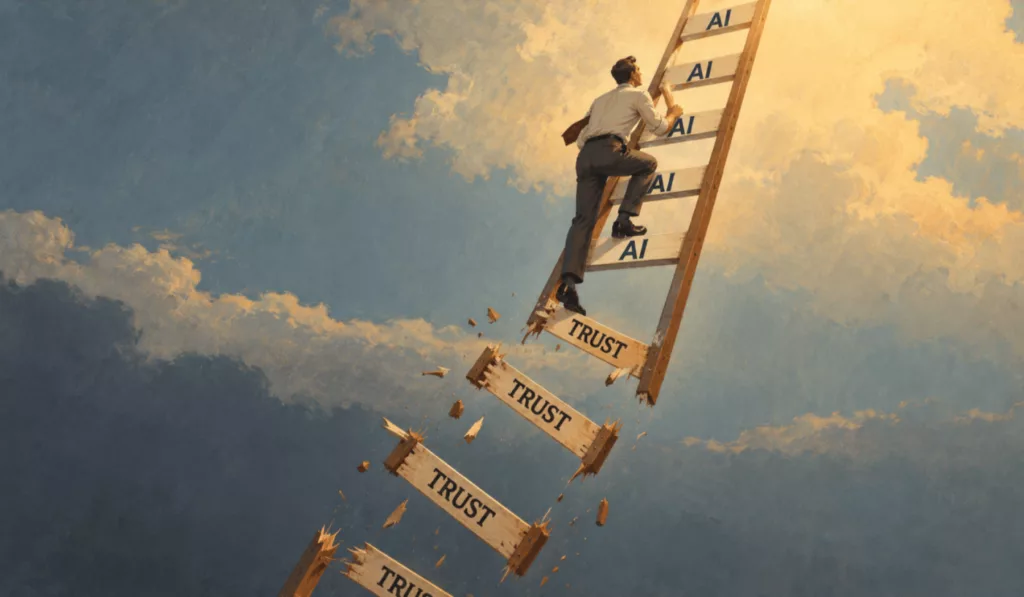
This week’s newsletter maps out how AI-generated content can ruin a company’s reputation, from slop to hallucinated research to a decline nobody notices until it’s too late.
The tell wasn’t the flawlessly anodyne prose, the breezy tone of voice, or even the fact that nobody at the outlet had heard of the sender before her pitch landed. It was the photo. When a journalist at Futurism opened the headshot attached to an email from a publicist calling herself June Barton, supposedly of a firm called VectorGuideHQ, pitching coverage for a wellness startup called RiseGuide, the image still carried a visible watermark: this-person-does-not-exist.com, a website that generates AI faces for free.
June Barton doesn’t exist. Neither, as it turned out, does VectorGuideHQ; the domain simply redirected back to a UK PR agency called Movchan, which appeared to be running more than a dozen invented “publicists”, replete with fabricated names, biographies and faces, pitching journalists on behalf of real clients. Those clients, asked about it afterward, said they had no idea any of this was happening in their name.
That story did the rounds in PR and marketing circles last month, and it’s worth dwelling on, because it isn’t really about one agency’s questionable shortcut. It’s the tip of a much bigger iceberg: the myriad ways that AI, and how companies use it, can quickly and quietly wreck the trust they spent years building.
At Caliber, we track which issues keep people up at night, week over week, across markets. AI just became a bigger worry for Americans than the Trump presidency, and globally it’s second only to the rising cost of living. Little wonder, when Anthropic’s own Alignment Science Lead is on record this week saying he believes there’s a greater than 10% chance AI wipes out humanity within a decade (what odds on Trump doing so, I wonder).
In other words, for all its promised upside, AI remains a live source of anxiety for a lot of people, which is exactly why the reputational riskiness of it, in all its forms, needs to be properly understood, not waved away. Which why this week, and next, I’m setting out my taxonomy of it.
Slop, and the Great Flattening
Let’s start with slop: AI-generated content so hollow and homogeneous it strips out anything that makes your brand sound interesting and original. There’s even a name for this now. The Great Flattening, a study on creative convergence, argues that every brand using generative AI is being mathematically pulled toward the same statistical centre of gravity. The reductio ad absurdum of every company leaning on ChatGPT and Claude to refresh its brand voice, marketing material or landing page is that they all end up sounding alike.
Or as one wag recently put it on LinkedIn: “Bud, everyone’s using the same three tools and you’re just copying what your competitors are doing, thereby blending in when you need to stand out. You’re creating the marketing equivalent of H&M denim. It won’t last two washes.”
I run a stakeholder intelligence company, not a taste consultancy, so I’m not here to judge anyone’s tone of voice or aesthetic choices. What I will say is that from a reputational standpoint, your reliance on AI-generated communications matters for a simple reason. Give people any cause to doubt a human being was actually behind a message, and they’ll doubt the truthfulness of what’s inside it, too. A crisis statement or a redundancy announcement needs to sound like someone felt something when they wrote it (ideally empathy, sadness, or compassion). If it sounds even remotely “sloppy”, people will read carelessness, if not callousness.
That erosion of trust is already measurable within organizations. A recent report on AI “workslop” found that 55 per cent of employees have received low-quality AI-generated work from a manager, and 85 per cent said that experience lowered their trust in leadership overall. QED.
When misinformation gets loose
For professional services firms — organizations whose stock in trade is knowledge and expertise — the greater danger is posed by AI slop’s evil twin, misinformation: content that isn’t simply sloppy, but inaccurate or misleading. Think: deepfaked images, dodgy data, false facts, hallucinations, and bias.
Last month, City AM reported that researchers at GPTZero, an AI detection firm, had combed through four of the consulting giant PwC’s thought-leadership reports and turned up “hallucinated citations and fabricated claims”. Among them was a supposedly real PwC product called Citizen Pulse, said to already be in use by four governments. It doesn’t exist.
PwC now rounds out an unfortunate set, the fourth of the Big Four caught out this way inside a year: EY had already pulled a loyalty-rewards study due to AI errors, KPMG withdrew a report on AI usage due to, yes, apparent hallucinations, and Deloitte handed back part of a $290,000 fee to the Australian government after fabricated case law surfaced in its work, along with a quote invented for a judge who never said it.
For some companies, especially those in professional services, this kind of mistake could be reputational curtains, or at the very least a stain that’s impossible to remove, because it speaks not just to their competency but to their values. The Wall Street law firm Sullivan & Cromwell apologised to a federal judge after AI-generated hallucinations and fabricated citations turned up in one of its filings. Search the firm’s name today, and the story is one of the first to come up.
Anyone can do anyone’s job, badly
A related risk here is that because AI makes it trivially easy to do almost anything, notwithstanding the blandness and fabrication problems above, it increasingly means anyone can do anyone else’s job (or believe they can). The sales team can knock out marketing copy in an afternoon, HR can start its own newsletter, and the CEO can vibe-code a new website. It might look fine on the surface, but look closely and the the logo turns out to be misshapen, the person in the hero image has six fingers, and the HR newsletter cites a non-existent Gallup poll. Off-brand content erodes trust just as fast as outright errors do.
Even with guardrails
OK, you may be thinking, what if we have a foolproof process for using AI in our company, like trained experts aware of the pitfalls, doing their own thinking, producing original first drafts, editing ruthlessly, and fact-checking everything? Well, even with guardrails in place, the reputational risk doesn’t fully disappear. Because using AI isn’t just about protocol. It’s also about stakeholder perceptions. And here’s the thing about generative AI. Yes, it makes people more productive, but one side effect of that is it can also make them look complacent, if not lazy. The report that used to take months, done in a day, loses some of its perceived value. The consultancy that turns out a dozen such reports before lunch comes across as less credible, not more. Get the cadence wrong and people could stop trusting anything with your name on it, while clients start wondering why exactly they’re paying the same fees.
There’s an even slower, more insidious version of this risk, one that doesn’t announce itself with a viral screenshot or a tribunal ruling, but I’ll pick that up next time, along with what happens when agents go rogue, and the bigger societal reckoning sitting underneath it all.
In the meantime, I’d love to hear from you on this topic, so drop me a line and let me know what you think are the biggest reputational riks posed by AI. And if you’d like to continue the conversation, I’m hosting a webinar with former LinkedIn CCO Greg Snapper next month.
We’d love to see you there → Reserve your spot for the October live conversation
(This article was originally published by Caliber CEO Shahar Silbershatz in his LinkedIn newsletter, What People Think.)