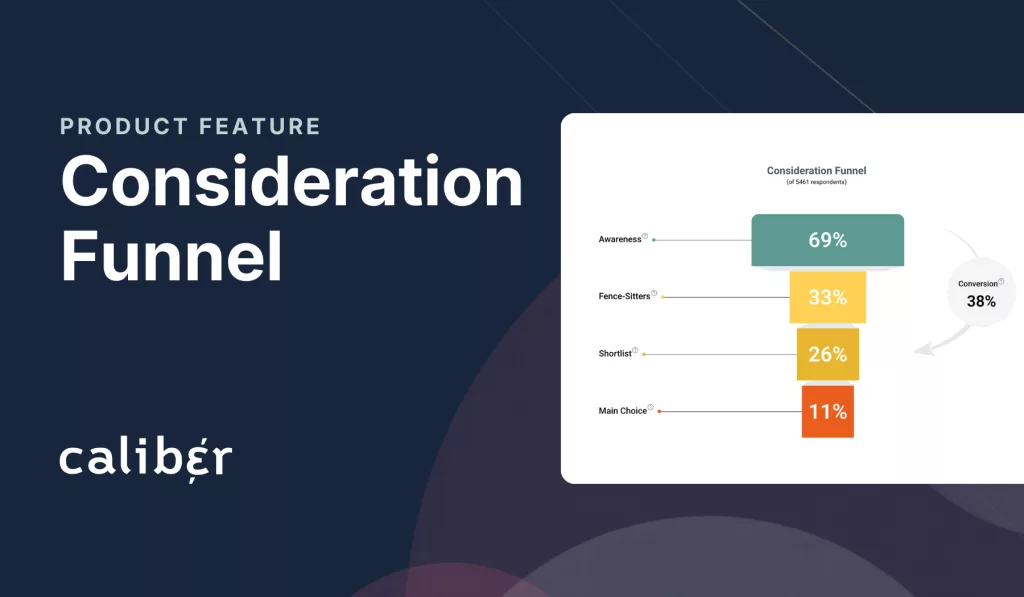
Caliber’s Consideration Funnel shows the part of the recruitment funnel your applicant tracking system can’t see: how many people in your target talent pool know you, would consider you, have you on their shortlist, and would choose you first, long before anyone clicks apply.
Every recruitment funnel has a blind spot at the top. Hiring teams can count applications, interviews, offers, and hires to the decimal point. What they rarely know is how many qualified people looked at the company, thought about it, and quietly moved on.
That silent drop-off is where most of the talent is lost. According to Caliber’s How to Win the War for Talent report (2026), around nine in 10 STEM professionals in Germany, Italy, and the US know the leading employers in their market, yet fewer than one in five name one of them as their main choice. This article explains why the top of the recruitment funnel is so hard to measure, how the Consideration Funnel in Talent 360 measures it, and what the data shows once you can see it.
What is a recruitment funnel, and why is the top so hard to measure?
A recruitment funnel is the path a person takes from first hearing about an employer to accepting a job there. The top is hard to measure because it happens in people’s heads, on channels you don’t own, among people who never enter your hiring system.
Where does the recruitment funnel usually start?
Most models of the recruitment funnel start with awareness and end with a hire. AIHR’s guide to the recruitment funnel, for example, runs through seven stages: awareness, attraction, interest, applying, evaluating, interviewing, and hiring.
The measurement tells a different story. Nearly every metric HR teams track, from source of hire to cost per hire, starts at the application. Awareness, attraction, and interest appear on the diagram, but the data behind them is thin or missing. In Symphony Talent’s 2026 Talent Acquisition Outlook, 89% of respondents reported average or below-average visibility across the talent funnel.
Why do most candidates drop out before they apply?
Most candidates drop out before they apply because knowing a company and wanting to work there are two different things. Caliber’s data shows that the gap between those two points is where the recruitment funnel loses most of its volume.
According to Caliber’s How to Win the War for Talent report (2026), aided awareness of the leading companies among STEM professionals averages around 90% across Germany, Italy, and the US. Roughly half are open to working at one of those companies. By the time you reach people who would make one of them their main choice, the figure is below 20%. None of these people show up in an applicant tracking system, because most of them never apply.
Why doesn’t awareness predict who applies?
Awareness doesn’t predict who applies because name recognition says nothing about whether talent understands what you stand for. Caliber’s report introduces the Awareness-Familiarity Gap, the ratio between how many people have heard of a company as an employer and how many feel they know it.
Companies with a small gap, where most people who know the name also feel they know the company, tend to score higher on Employer Trust & Like Score among potential talent. Companies with broad awareness and shallow familiarity score lower. For the recruitment funnel, that means a big awareness number can hide a weak pipeline.
Why is the talent market making this harder?
The talent market is making this harder because more people are looking, and they’re looking in more places. According to Caliber’s How to Win the War for Talent report (2026), 32% of 18 to 45 year olds across the three markets are likely to look for a new job in the next 12 months, rising to 42% in the US.
Where they look matters as much. Social media and networking (31%), online job portals (30%), and search engines (29%) lead as sources of job information. Company websites come fifth, at 22%. By the time a candidate reaches your careers page, they’ve usually formed an opinion somewhere else, and an increasing share of them formed it by asking an AI chatbot.
What is Caliber’s Consideration Funnel?
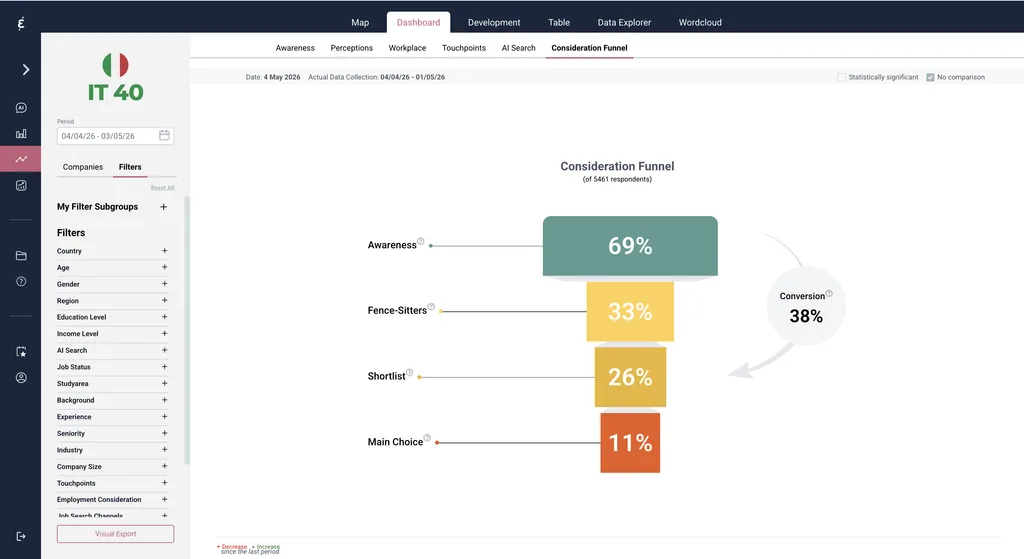
Caliber’s Consideration Funnel is a Talent 360 dashboard that measures the pre-application stages of the recruitment funnel among your target talent segments. It tracks four stages, Awareness, Fence-Sitters, Shortlist, and Main Choice, plus a conversion rate that shows how well awareness turns into serious consideration.
What are the four stages of the consideration funnel?
Each stage is built from survey answers given by people in the talent pool, not by applicants. Respondents who know a company are asked how they’d feel about continuing their career there, on a scale from 1 to 7. Their answers place them in nested stages of the consideration funnel.
| Stage | What it measures |
|---|---|
| Awareness | Share of respondents who recognize the company by name when shown it (aided awareness) |
| Fence-Sitters | Share open to working at the company, scoring 2 to 7 on the 1 to 7 scale |
| Shortlist | Share who would seriously consider the company, scoring 4 to 7 |
| Main Choice | Share for whom the company is a first-choice employer, scoring 6 to 7 |
| Conversion | How much of your awareness turns into a place on the shortlist |
Because each stage sits inside the one above it, the drop between stages shows exactly where the recruitment funnel leaks. A company with high awareness and a low shortlist has a perception problem. A company with a healthy shortlist and a thin main choice has a differentiation problem.
How is funnel conversion calculated?
Funnel conversion compares the Shortlist figure with the Awareness figure. In Caliber’s STEM data for Germany, for example, 90% awareness and a 39% shortlist give a conversion rate of 43%.
Conversion is the single number most worth watching over time. Awareness can rise with a big campaign while conversion falls, which means you’ve reached more people without giving them a reason to consider you. A rising conversion rate means your employer brand is doing its job with the audience it already reaches.
Where does the Consideration Funnel sit in Talent 360?
The Consideration Funnel sits on the Dashboard in Talent 360, next to the Awareness, Perceptions, Workplace, Touchpoints, and AI Search views. Every view uses the same filters, so you can read the funnel for the exact talent segment you’re hiring for.
Those filters cover job status (students, professionals, and job seekers), field of study, background, experience, seniority, industry, company size, touchpoints, job search channels, and AI search use, alongside country, age, gender, region, education, and income. The funnel sits alongside the Employer Trust & Like Score, which asks how much talent trusts and likes the company as an employer.
How does the Consideration Funnel work in Caliber?
The Consideration Funnel works by tracking your company and your competitors continuously among the talent segments you choose. You read where each stage drops, compare it with your competitors, find the perceptions driving the drop, and follow the result over time.
What are the steps?
- Define your talent segments. Choose the profiles you’re hiring for, such as STEM professionals, final-year students, or experienced finance talent, using job status, field of study, seniority, and the other Talent 360 filters.
- Choose your competitors. Track the companies your target talent weighs you against. That includes scale-ups and start-ups as well as your usual peers, since half of all talent in Caliber’s report prefers something other than a mature, established employer.
- Read the funnel. Look at where the biggest drop sits: awareness to fence-sitter, fence-sitter to shortlist, or shortlist to main choice. Each points to a different fix.
- Find the drivers. Use the Perceptions and Workplace views to see which brand, reputation, ESG, and workplace attributes separate you from competitors, and the Touchpoints and AI Search views to see where talent meets you. The logic mirrors benchmarking against competitors in Stakeholder 360.
- Track the funnel over time. Follow each stage by week, month, quarter, or year in the Development view, and log recruitment campaigns, careers events, and news to see what lines up with changes.
- Check significance, then ask Sherlock. Tick “Statistically significant” to confirm a change is real for your sample size, then ask Sherlock, Caliber’s AI assistant, to summarize what moved and why.
What does it look like at a glance?
Here’s everything that goes into reading the recruitment funnel in Talent 360.
| Feature | How it works |
|---|---|
| Funnel stages | Awareness, Fence-Sitters, Shortlist, Main Choice |
| Conversion | Shortlist as a share of Awareness |
| Core metric | Employer Trust & Like Score: how much talent trusts and likes you as an employer |
| Talent segments | Job status, field of study, background, experience, seniority, industry, company size, plus demographics |
| Related views | Awareness, Perceptions, Workplace, Touchpoints, AI Search |
| Attributes | 24 brand, reputation, ESG, and workplace attributes |
| Development over time | Funnel stages tracked by week, month, quarter, or year |
| Significance | Under 100 responses: directional only. For shares, 100 to 199: 6+ points, 200 to 299: 5+ points, 300 to 699: 4+ points |
| Sherlock | Summarizes what changed and helps explain why |
| Coverage | 6,000+ companies tracked in 40+ countries |
What does the recruitment funnel look like in practice?
In practice, the recruitment funnel narrows sharply between awareness and main choice in every market Caliber measures. Brand-level perceptions do more to move talent through it than pay and perks, and the channels that reach talent aren’t always the ones HR teams invest in most.
STEM professionals in Germany, Italy, and the US
According to Caliber’s How to Win the War for Talent report (2026), the shape of the consideration funnel for STEM professionals is remarkably consistent across three different markets.
| Stage | Germany | Italy | United States |
|---|---|---|---|
| Awareness | 90% | 86% | 97% |
| Fence-Sitters | 49% | 46% | 50% |
| Shortlist | 39% | 38% | 40% |
| Main Choice | 16% | 15% | 19% |
| Conversion | 43% | 44% | 41% |
The US has the highest awareness and the highest main choice, but also the lowest conversion. That fits the wider US picture in the report: a more fluid job market, where 42% are likely to look for a new job, and a talent pool that knows nearly every big name without committing to one.
What moves a fence-sitter onto the shortlist?
Brand perceptions move a fence-sitter onto the shortlist far more than compensation does. Caliber’s driver analysis measured the impact of 24 attributes on Employer Trust & Like Score among STEM talent at each stage of the funnel.
Inspiration, Relevance, and Differentiation were the top three drivers at every stage. Among STEM fence-sitters, sustainable work culture ranked 16th, health and family benefits 18th, career development 19th, compensation 20th, and on-site benefits 23rd out of 24. Those factors are the entry fee. They’re rarely what gets a company shortlisted.
The drivers shift as talent moves down the funnel. A company’s products and services rank 4th among all STEM talent, but fall to 17th among main choice candidates. By that point, candidates have already decided the business is relevant. Leadership rises to 4th and Integrity to 5th, so the final step is about trust and values.
Which touchpoints move talent down the funnel?
Every touchpoint helps, and being absent hurts most of all. Caliber’s report measured how much each channel adds to or takes away from Employer Trust & Like Score among the talent who encountered a company through it.
| Touchpoint | Impact on Employer TLS (global) |
|---|---|
| Corporate Owned | +7 |
| HR Owned | +6 |
| Corporate Direct | +5 |
| HR Direct | +5 |
| HR Earned | +5 |
| HR Paid | +4 |
| Corporate Earned | +3 |
| None of the above | -9 |
Reach tells the other half of the story. Half of respondents (52%) encountered companies through corporate earned media, such as news and editorial coverage, compared with 26% through HR paid content. The Employer TLS each produced was almost identical, 74 and 75. Corporate owned content had the strongest effect on high-intent talent, adding 12 points among job seekers and eight among STEM professionals.
The penalty for no touchpoint at all reached -12 among STEM professionals, the highest of any segment. AI chatbots now sit in the same equation. The report found that candidates who researched a company with any generative AI tool rated it more favorably than the full sample, while those who didn’t use one gave a score four to five points lower. Our guide to AI brand monitoring covers how to track what those tools say.
How sector funnels differ between STEM talent and everyone else
The same company can sit in different places depending on which talent segment you look at. STEM sample sizes in the report’s sector spotlights are small, so these figures are directional, but the patterns are clear enough to act on.
In Germany’s auto sector, BMW leads among both the general talent pool (71) and STEM professionals (74). Mercedes-Benz Group ties for first in the general pool at 71 but drops to 64 among STEM professionals. In Italian banking, Banca Mediolanum ranks fifth in the general pool (69) and first among STEM professionals (75). In US tech, Amazon tops both rankings, rising from 80 to 86 among STEM professionals.
For the recruitment funnel, the lesson is simple. A funnel read across your whole talent pool can look healthy while the segment you most need to hire is going elsewhere.
How a global healthcare company replaced periodic employer surveys
A global healthcare company needed to know how aware its target talent pools were of the company and how much they wanted to work there, across several international markets. It also needed frequent reporting on shifts in job search behavior and talent motivations.
Caliber tracked talent pool awareness and employer appeal continuously, alongside how industry events and market shifts affected employer perceptions. The result was a move away from periodic employer brand surveys to always-on tracking, so the team could respond to shifts in talent perception as they happened.
How do HR and talent teams benefit from the Consideration Funnel?
HR and talent teams benefit from the Consideration Funnel because it gives every function the same view of the recruitment funnel before the application. CHROs use it to decide where to compete, talent acquisition teams to fix conversion, and employer brand and communications teams to shape the story talent hears.
How do CHROs and HR leaders use it?
CHROs use the Consideration Funnel to answer the strategic questions: whether the company is competitive as an employer, in which markets, and for which profiles. The funnel gives external validation of the employer value proposition, measured among the people you want to hire rather than the people who already work for you.
It also connects employer brand to business outcomes. Caliber’s report recommends consideration funnel conversion rates, Employer Trust & Like Score, and the Awareness-Familiarity Gap as more useful indicators of employer brand health than application volumes or cost per hire alone.
How do talent acquisition and recruitment teams use it?
Talent acquisition teams use the Consideration Funnel to understand why they aren’t getting enough of the right candidates. If awareness is strong but the shortlist is thin, the problem is upstream of recruitment, and more job ads won’t solve it.
Touchpoint data shows which channels are working for each segment. Students rely on university career services (18%) and podcasts and video (17%), professionals on referrals (19%) and colleagues (15%), and job seekers on recruiters and headhunters (10%). A single channel plan can’t serve all three.
How do employer brand teams use it?
Employer brand teams use the Consideration Funnel to decide what to say. The driver data points to Inspiration, Relevance, and Differentiation as the attributes that move talent, which makes purpose and a distinctive story more valuable than another list of benefits.
Segment differences sharpen the message further. Among STEM students and humanities students, Environment ranks as the top driver of employer attractiveness. For graduate hiring, a weak sustainability story can cost candidates before they ever reach the funnel.
How do corporate communications teams use it?
Communications teams use the Consideration Funnel to see how much of the recruitment funnel they already influence. Corporate earned media reaches twice as many potential employees as HR paid content, with almost the same effect on Employer Trust & Like Score.
It also shows where employer reputation and corporate reputation split. Caliber’s data shows Meta’s reputation is poor while its employer brand isn’t: a TLS of 53 among the informed general public, and an Employer TLS of 72 among 18 to 45 year olds. Managing both with one strategy misses that gap.
How can Caliber support your recruitment funnel?
Caliber supports your recruitment funnel with Talent 360, which tracks the stages before the application continuously, for your company and your competitors, among the talent segments you need. It shows where talent drops out, why, and whether your changes are working.
Your applicant tracking system shows what happens after someone applies. The bigger decisions happen earlier: whether talent has heard of you, whether they understand you, and whether you make their shortlist. Measuring that part of the recruitment funnel takes always-on data from the talent pool itself, not from your applicants.
Talent 360 is built for this work. It provides:
- The Consideration Funnel, from Awareness to Fence-Sitters, Shortlist, and Main Choice, with a conversion rate
- Continuous tracking of your company and the competitors you choose, on the same questions and methodology
- Talent segments by job status, field of study, seniority, experience, industry, and more
- Driver data on 24 brand, reputation, ESG, and workplace attributes
- Touchpoint and AI Search views that show where talent meets you
- Sherlock, Caliber’s AI assistant, to summarize what changed and why
For the full dataset behind this article, download How to Win the War for Talent, or see how companies compare in Caliber’s Employer Attractiveness Rankings.
Book a demo to see where your recruitment funnel loses talent before they apply.