The scandal has dented how people see NVIDIA’s character, for now. The bigger risk to its reputation may be what happens without him.
How much damage can a CEO do to the reputation of the company they run? It’s a question we’ve pondered for years at Caliber, and Jensen Huang has just given us the clearest test yet.
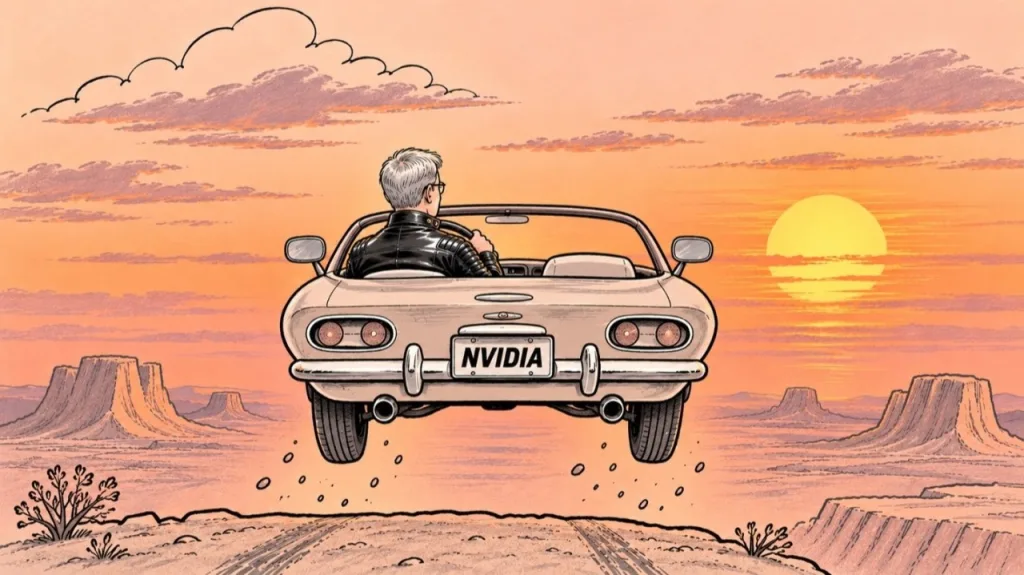
Inside the tech world, Jensen Huang was a star, his black leather jacket as iconic as anything NVIDIA produces. Outside it, until a few weeks ago, most people would have struggled to name him. Then, on 29 October, The New York Times reported that US intelligence agencies had concluded Alice Huang, a tech executive close to him, was passing information to Beijing. Within a fortnight, NVIDIA had opened an investigation, Huang had admitted an affair, shareholders had sued, the Times had reported a second relationship, with an NVIDIA employee president who reported to him, and Huang had resigned, 33 years after co-founding the company.
Our data shows the scandal has dented how Americans see NVIDIA’s character. Yet I suspect the bigger risk to its reputation isn’t what Huang did, but what NVIDIA becomes without him.
Character, not competence
We’ve long suspected that founders can drag down their companies’ reputations. Tesla’s Trust & Like Score fell from 67 in 2022 to 48 in early 2025 as Elon Musk’s politics took centre stage, and Meta’s reputational slide has often been put down to Mark Zuckerberg’s persona. But with recalls, crashes and union battles at Tesla, and Cambridge Analytica, whistleblowers and lawsuits at Meta, we could never say how much their low scores were down to the founder. It walked like a duck and quacked like a duck, but we couldn’t honestly call it a duck.
NVIDIA is different. In the past fortnight, there’s been nothing else about the company in the headlines, so when NVIDIA’s scores move, it’s hard to point the finger at anything but Huang.
Just last month, Forbes named NVIDIA America’s most trusted company for the second year running. Our data shows how quickly that can change.
NVIDIA’s Trust & Like Score, our chief measure of a company’s reputation, has fallen from 74 in October to 69 among the 225 US stakeholders we surveyed in the first half of November. Every October answer came before the Times report; every November answer came after it. That’s the lowest we have ever recorded for NVIDIA in the US, and its biggest monthly fall since we began tracking it continuously in October 2025.
Underneath, three measures of character fell sharply:
- Whether NVIDIA does business ethically: down 6 points, from 71 to 65.
- Whether it behaves responsibly: down 6 points, from 72 to 66.
- Whether it has a positive impact on people and society: down 6 points, from 75 to 69.
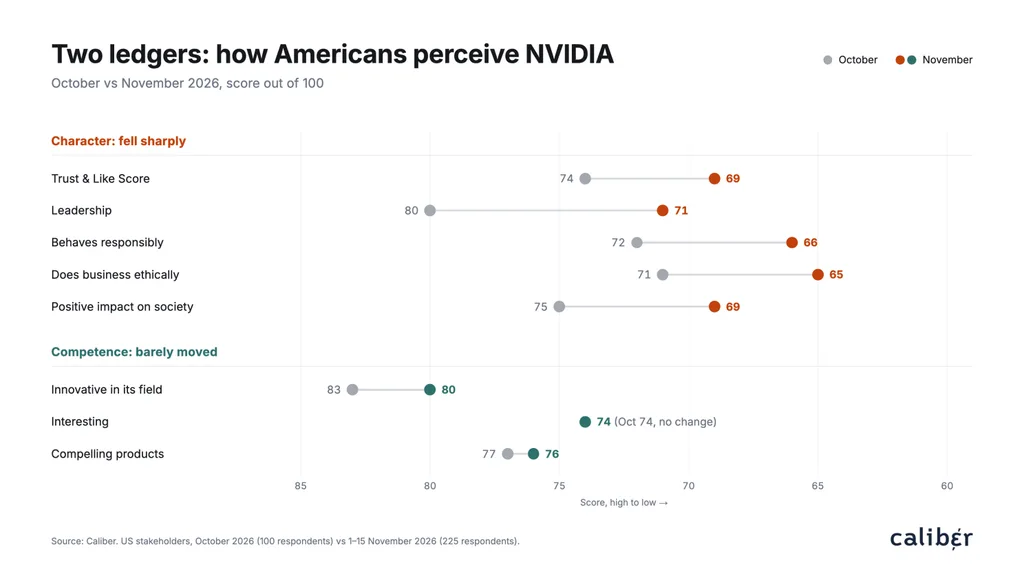
All three falls are statistically significant, and the first two take those scores to their lowest in our series. Through the summer and into October, all three were stable. The view of NVIDIA’s leadership fell further still, from 80 to 71, which is hardly surprising when the leader is the story.
People are also less keen to be associated with the company. The share of US stakeholders who would consider working at NVIDIA has fallen from 52% to 41%, the lowest we’ve recorded.
Here’s the part I find most telling. Ask the same people whether NVIDIA is innovative in its field, and the score is 80, down three points from October, within the margin of error. Ask whether they find NVIDIA interesting, and it’s 74, exactly as before. And their view of its products has slipped by just a single point, from 77 to 76.
Nobody, in other words, has decided NVIDIA makes worse AI chips. What people have revised is their view of its character. They’re keeping two ledgers, and only one of them has taken the hit.
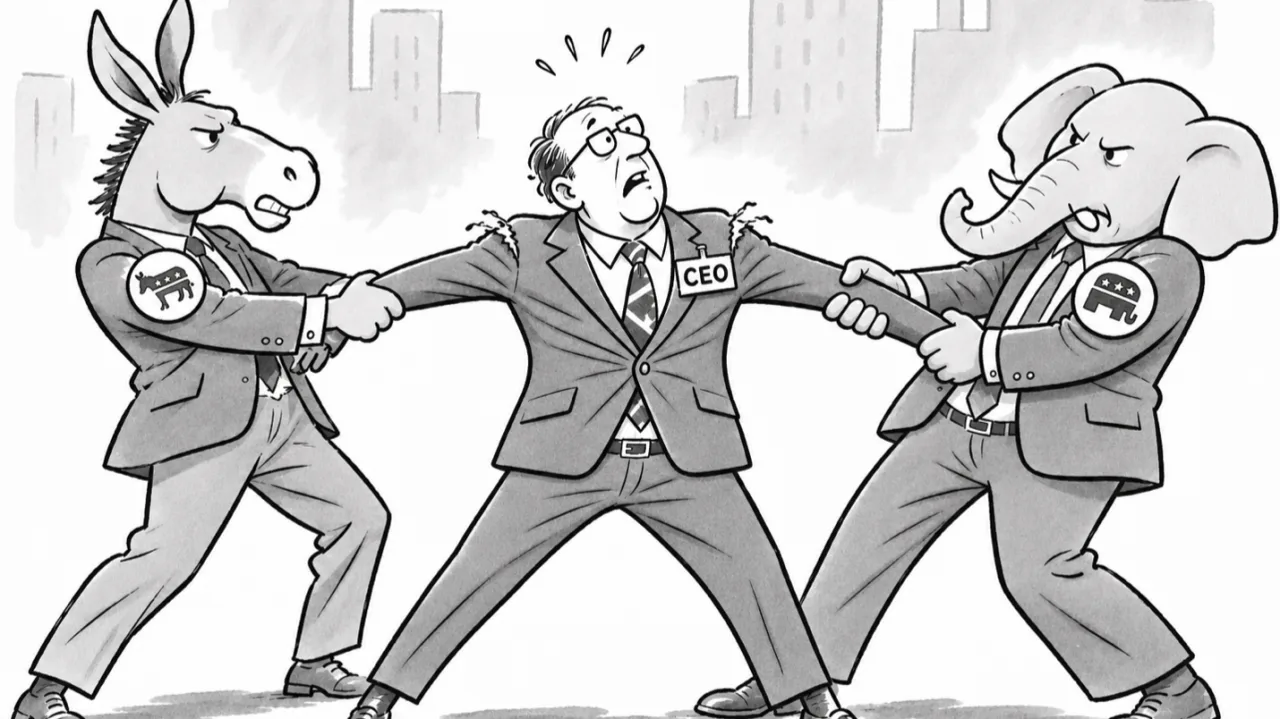
The CEO is where those ledgers meet. When people know little about a company beyond what it makes, the CEO’s conduct becomes the company’s conduct by default. That would explain why the leadership score fell alongside the character scores, while innovation barely moved.
With Tesla, we never quite called it a duck. This time, at least in the short term, it’s hard to call it anything else.
The ultimate key man
Huang co-founded NVIDIA in 1993 and ran it for 33 years. He is the ultimate key man: with around 60 people reporting directly to him, he sat at the centre of how NVIDIA works in a way no one else does. That raises a bigger question than the scandal itself. Could his departure do more damage to NVIDIA’s reputation, indirectly, than the stories of the past few weeks have done directly?
Within the industry, Huang has long been a brand in his own right, arguably a bigger one than NVIDIA: the founder who turned a graphics-chip maker into the engine of the AI boom. For investors, customers and engineers, Huang and NVIDIA have been almost interchangeable. That’s the paradox of this story. To the wider public, he was a stranger until a few weeks ago. To the people who matter most to NVIDIA’s business, he was the company.
It could now go either way. Once the dust settles and a degree of stability returns under the interim CEO, Colette Kress, NVIDIA’s scores may bounce back. Or it may simply not feel like the same company any more, and suffer a slow-burn decline instead.
Then again, a company built largely around one man carries its own risk. Before the announcement, analyst Dan Ives valued NVIDIA at $300 a share with Huang and $225 without him: a Jensen premium. But perhaps there’s been a Jensen discount all along, and a more conventional NVIDIA, with less riding on one person, will do even better.
And there’s always the Apple parallel. Steve Jobs was forced out of the company he co-founded in 1985, and came back in 1997 to save it. Huang’s comeback could come a lot sooner. As I write, the Financial Times is reporting that he has discussed a return with confidants, as allies lobby the board to reinstate him. “Everyone that matters in tech outside the frontier labs loves Jensen,” one told the FT. Major shareholders, Elon Musk and some NVIDIA employees have all backed his return, though Washington is pushing the other way.
It’s a fluid situation, to say the least. But at least some of the people who matter most to NVIDIA clearly believe it can’t be NVIDIA without him. If he doesn’t return, NVIDIA’s Trust & Like Score will tell us, in the weeks and months ahead, whether its wider stakeholders agree. And if he does, it will tell us whether they’re ready to forgive him.
Communicating in a polarized America
In the wake of the midterms, the question I keep hearing from communications leaders is simple: how do you keep the trust of people who want opposite things from you?
Employees expect one thing, customers another, policymakers and investors have their own criteria, and AI chatbots now describe your company to all of them, in words you didn’t choose.
Tomorrow, 17 November, we’re bringing a small group of communications, corporate affairs and brand leaders together in Washington, DC, to talk it through, under the Chatham House Rule.
I’ll moderate the conversation, joined by Perry Yeatman and Greg Snapper, and we’ll bring Caliber data on how Americans across the political spectrum see the country’s largest companies.
If this is up your street and you’re in DC, request a seat here.
(This article was originally published by Caliber CEO Shahar Silbershatz in his LinkedIn newsletter, What People Think.)