Employer reputation and corporate reputation aren’t the same thing. Many companies are still managing them as if they were — and paying for it in ways they can’t yet see. This edition explains the gap, shows you what drives it, and asks whether you know which side of it you’re on.
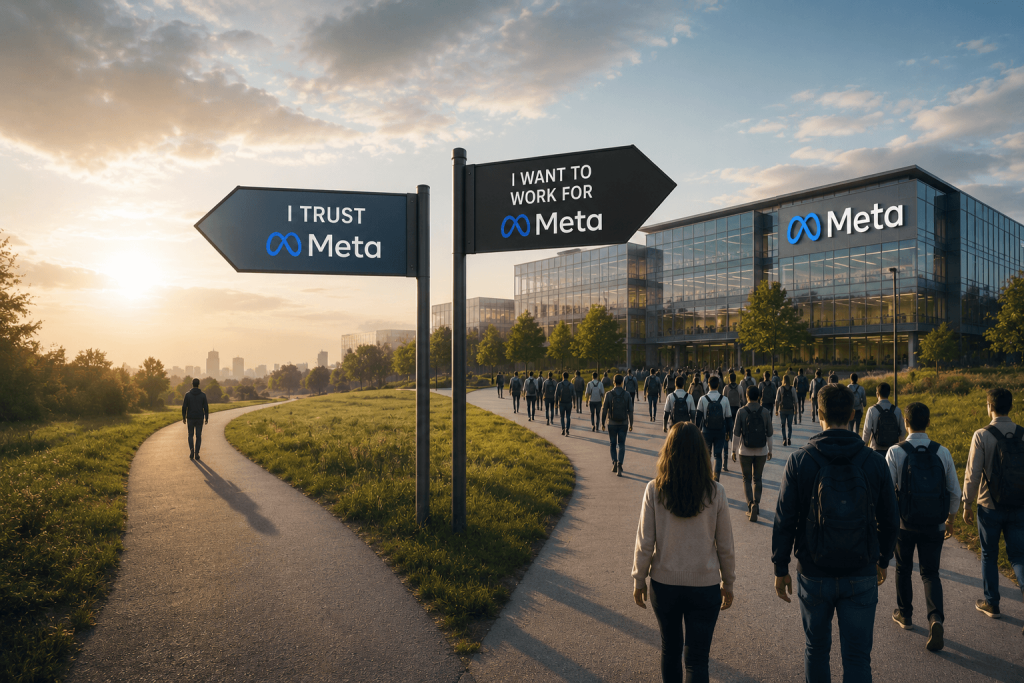
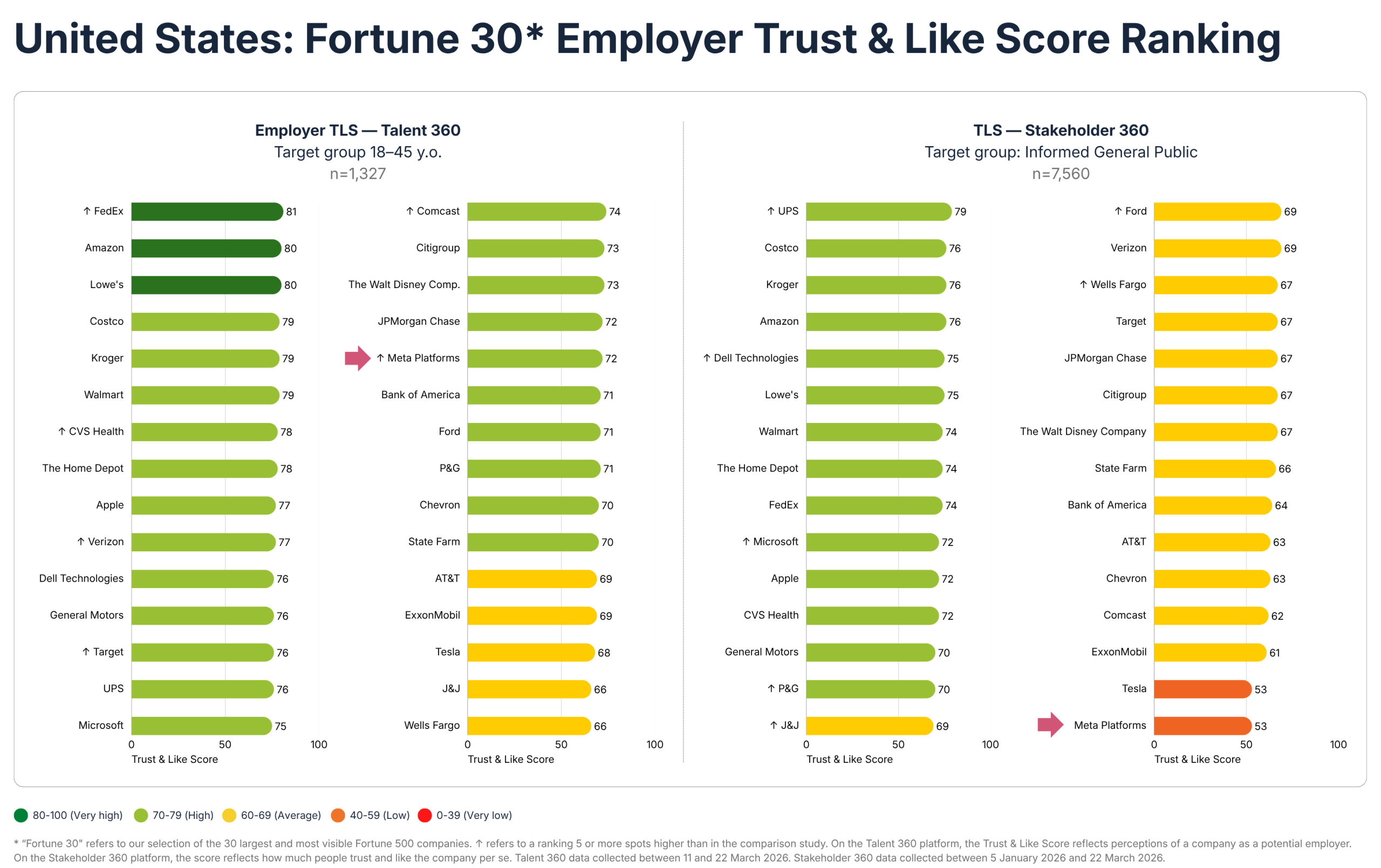
Talk about interesting Meta data. The company behind Facebook, WhatsApp, and Instagram has the lowest Trust & Like Score of the leading US companies whose reputation we track — scoring 53 out of 100 among the public. But among 18–45-year-olds, a proxy for potential employees and the talent that matters most to its future, that score rises to 72.
That’s a 19-point gap, and Meta isn’t an outlier but a warning.
The gap is everywhere — and it runs in both directions
This spring, we surveyed nearly 5,000 people aged 18–45 in Germany, Italy, and the United States — students, professionals, and active job seekers — and asked them how much they trusted and liked the leading companies in their market specifically as potential employers. We then compared those scores to how the same companies are perceived by the broader public.
Download the “How to Win the War for Talent” Report
In the US, Target is rated 9 points higher as a potential employer, despite months of controversy over its DEI policy reversals. FedEx tops the US employer ranking — despite arch-rival UPS having a stronger overall stakeholder reputation.
The pattern repeats in Europe. In Italy, Italgas scores 73 among the public. Among those evaluating it as a potential employer, that score falls to 63. Prysmian drops from 6th in the general ranking to 16th among talent. Strong companies, but invisible to the people they most need to hire.
In Germany, Adidas ranks 14 places higher as an employer than as a company overall. Deutsche Telekom climbs 17 places. These variations reflect genuinely different perceptions, operating on genuinely different logic.
Why employer reputation and corporate reputation diverge
There are three good reasons why companies like Meta have 19-point gaps between their Trust & Like Scores among talent and the broader public.
1. What drives those scores differs by audience — and by segment
We measured the relative impact of 24 brand, reputation, ESG, and workplace attributes on employer attractiveness across every talent segment. The ones that most powerfully move the needle are almost entirely brand-level — how interesting, distinctive, and relatable a company feels.
The same attributes — Inspiration, Relevance, Differentiation — most drive Trust & Like Scores among the broader public.
But the picture shifts meaningfully when you look at specific talent segments.
For STEM professionals, Governance ranks first — how ethically a company conducts itself matters more than anything else. For STEM students, Environment comes first, above Inspiration, above everything. Companies perceived as lagging on sustainability aren’t just risking their broader reputation, but forfeiting their position in the competition for the technical talent they most need, before the application process has even begun.
Across every segment, Compensation sits at or near the bottom of attributes driving employer attractiveness. Among STEM professionals it ranks 24th out of 24. Compensation and career prospects obviously matter, but they’re the floor, not the ceiling. Every serious employer offers some version of a competitive package. The companies winning the talent war are differentiating on who they are, not what they pay.
The implication is clear. A single employer brand message can’t serve all these talent segments equally. What works for STEM students in Germany isn’t what works for business graduates in the US.
2. Positive perceptions must be earned separately, through the right channels
A corporate communications strategy that builds Inspiration among investors and customers doesn’t automatically or necessarily build it among 28-year-old STEM graduates deciding where to take their career. The message must be calibrated, the channels correct. And, crucially, the starting point has to be what that specific audience actually thinks of you today, not what your broader reputation would suggest they should think.
Even the right message delivered through the wrong channel won’t close the gap. According to our study, half of all respondents interact with companies via earned media — editorial coverage, news, third-party commentary — compared to just 26% via paid HR content. The Employer Trust & Like Scores generated by each are virtually identical. Earned media reaches twice as many people at the same reputational impact.
Your careers page isn’t where most people first encounter you. By the time a potential candidate finds it, they’ve already formed an opinion — probably based on what they found elsewhere. For younger talent segments, that increasingly means an AI chatbot.
The most consistent finding across every market and every segment is the reputational penalty for having no touchpoint at all. Being unknown to a STEM candidate is not a neutral position. It is an actively negative one.
That’s where many companies have a gap. They assume a strong corporate reputation is doing the employer branding work for them. The data says it isn’t.
3. Familiarity is a reputational moat
Our data consistently shows that the smaller the gap between Awareness (name recognition) and Familiarity (qualified knowledge), the more stable a company’s trust score tends to be. Companies that are widely recognized but poorly understood are the most vulnerable: their scores are more volatile, because candidates fill the knowledge gap with assumptions that reality can quickly contradict. And companies with higher Familiarity rates typically have stronger reputations.
Meta’s awareness among 18–45-year-olds is 93%, which is unsurprising for one of the world’s most visible brands. What’s surprising is that 77% feel they’re somewhat or very familiar with the company. Among the broader public, over the same period, that figure is 56%. The 21-point difference between how well the public and potential employees feel they know Meta explains, more than anything else, the 19-point gap in their respective Trust & Like Scores.
The depth of understanding that familiarity represents is what converts awareness into employer consideration, and it holds largely independent of whether candidates approve of Meta’s corporate record.
Hidden Talents
The best things we read this month on employer branding, HR, and talent intelligence — curated for the people trying to win it.
The Moral Premium: What Meta’s Layoffs Reveal About the Collapse of Purpose-Driven Employer Branding — When Meta notified 8,000 employees via automated email, it exposed the gap between mission-language employer branding and what the employment contract actually delivers. Read alongside our own driver data, and the picture is more nuanced than the headline suggests.
AI Is Changing Who Gets Hired in America’s Economy — Skilled trades are in genuine shortage while white-collar graduate unemployment climbs above the US national average for the first time in recent memory — the clearest account yet of why a broad hiring strategy is no longer sufficient
HR Monitor 2026: A Turning Point for the People Function — McKinsey’s annual benchmark across Europe, the US, and China finds that only 11% of organizations take a long-term strategic approach to workforce planning — and most hiring processes remain built around administrative efficiency rather than capability prediction.
Is DEI Dead? Not According to New Catalyst Data on Workplace Inclusion — New research pushes back against the narrative that inclusion is in retreat, with implications for any talent leader navigating board pressure to scale back DEI commitments.
AI Is Splitting the Job Market in Two — and Human Skills Are Becoming the Real Advantage — PwC’s 2026 AI Jobs Barometer, drawn from over a billion job ads, finds professionalised roles growing twice as fast as democratised ones — and in the US, AI-exposed junior roles are now seven times more likely to require senior-level skills.