
Why do emotional halos matter? And how should you measure AI’s impact on your reputation?
Our intelligence on SpaceX reveals an odd anomaly. Ask people what they think of the company’s innovation, its leadership in the field, or simply how interesting it is, and the numbers are impressive.
But ask whether they trust and like it, and a different picture emerges.
SpaceX’s Trust & Like Score — Caliber’s chief measure of corporate reputation — is just 60 out of 100: 18 points below its score for Innovation, 13 below Inspiration, 10 below Leadership.
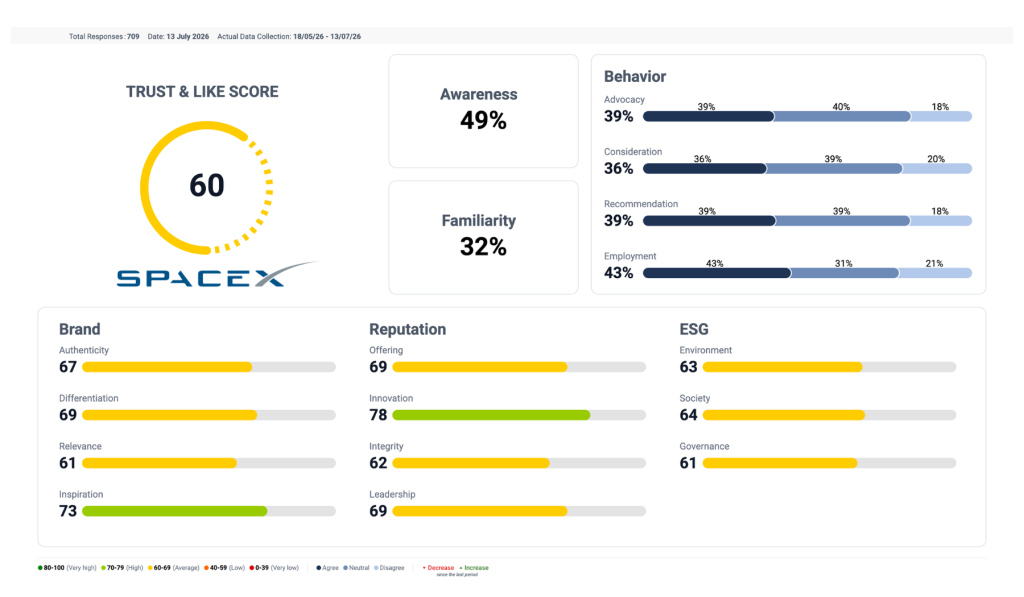
Rationally, people admire what SpaceX is doing. They just don’t care as much for the company behind it.
That gap matters. For many companies Caliber tracks, a strong Trust & Like Score acts as an emotional insurance policy. Even when the rational case wobbles — a rocket launch fails, a regulator intervenes — emotional attachment holds steady and cushions the blow.
SpaceX has no such halo, yet. Instead it has a reputation based more on rational admiration than emotional connection, with reservations likely deriving from Musk’s polarizing politics and his newfound trillionaire status.
The company is itself deeply polarizing as a result:
| Segment | Trust & Like Score |
|---|---|
| Republicans | 76 |
| Democrats | 46 |
| Men | 67 |
| Women | 52 |
Our data reveals a further twist. Media and social media, the channels that do the most to shape SpaceX’s Trust & Like Score, are actively hurting it. People who encounter the company through news or social feeds rate it lower than the company’s overall average; its website and customer service score higher. The story SpaceX tells about itself and the one told about it are pulling apart.
What moves SpaceX’s Trust & Like Score more than Innovation?
As ever with stakeholder intelligence, the data also reveals a fix. Three attributes move SpaceX’s Trust & Like Score more than Innovation does:
- Relevance — how relatable SpaceX is perceived to be
- Governance — how ethically it’s perceived to do business
- Integrity — how responsibly it’s perceived to behave
Innovation is assumed of SpaceX now. The money spent reinforcing it would be better redirected to proving the company is relatable, responsible, and well-governed.
The lesson for others is this, then: building something people respect or admire doesn’t always translate into a robust reputation, and only the latter holds you up if a crisis breaks. Knowing exactly where your company sits, and which levers to pull, is what stakeholder intelligence is for, of course.
Talk to us about how stakeholder intelligence can help protect your reputation
How Should You Measure AI’s Impact on Your Reputation?
Generative AI tools — ChatGPT, Gemini, Claude, Copilot, and a growing list of others — have quietly become one of the first places people go to learn about a company. Before someone signs a contract, applies for a job, or issues an RFP, there’s a decent chance they’ve already asked an AI chatbot what it knows.
That shift creates an obvious question for anyone responsible for brand or reputation: how do you measure this? Group Caliber’s answer is AI Impact, a new analytical tool that shows how generative AI is shaping the way people discover and perceive your brand, and how the humans on the other end of those conversations respond.
AI Impact is Caliber’s tool for measuring how generative AI shapes brand discovery and perception, tracked across three metrics: AI Sentiment, Search Volume, and Trust & Like Score.
Before getting into how it works, it’s worth being precise about what it is, and isn’t, measuring.
Is AI a stakeholder or a channel?
It’s tempting to talk about AI the way you’d talk about a stakeholder: something whose “views” of your company need to be tracked, managed, and improved. Resist that temptation. It’s the wrong model, for a few reasons.
An LLM doesn’t hold a stable opinion of your company between conversations. Ask it about your governance and you’ll get a governance-shaped answer; ask about product quality and the picture shifts entirely; push back on either and it will often simply agree with you. There’s no consistent attitude sitting underneath those answers, which means there’s no relationship to manage in the way there is with a customer, employee, regulator, or journalist.
And unlike a real stakeholder, an AI model won’t act on a bad impression of you. That is, it won’t quietly go elsewhere, warn a colleague, or raise something at a shareholder meeting off its own back. It only responds when someone asks.
What an LLM does when queried about your company is much closer to what a search engine or media outlet does: it synthesizes what’s already out there and reflects it back through the lens of the question asked. That makes sentiment and volume, not attitude or trust in the human sense, the right things to measure. It’s the same logic you’d apply to media coverage: how does it skew, and how much of it is there.
What are the three metrics that make up AI Impact?
That distinction isn’t just philosophical. It’s the design principle behind AI Impact, which measures three things instead of collapsing everything into one score:
| Metric | What it measures |
|---|---|
| AI Sentiment | What AI models actually say when asked about your brand |
| Search Volume | How many real people have actually gone looking |
| Trust & Like Score | How those people feel once they have |
The first is a media signal. The other two reflect genuine stakeholder sentiment, filtered through a new touchpoint. Caliber tracks all three tool by tool — ChatGPT, Gemini, Copilot, Claude, DeepSeek, Perplexity, Grok, Kimi, Mistral, and more — and over time, so you can see not just what’s being said about you, but what it’s doing to your Trust & Like Score.