Every company will face a crisis. The variable is not whether, but when, what kind, and how prepared you are when it hits. A product recall, a data breach, an executive scandal, a viral social media incident, a regulatory investigation. The specifics differ. The pattern is the same: something unexpected threatens your reputation, and the quality of your communication in the hours and days that follow determines how much damage sticks.
Most crisis communication advice focuses on tactics: appoint a spokesperson, prepare holding statements, monitor social media. Those are table stakes. What separates companies that navigate crises well from those that don’t is the quality of intelligence they have going in, the discipline of their response, and their ability to measure whether their communication is actually working.
This article covers the full crisis communication lifecycle: what to do before a crisis (preparation), during a crisis (response), and after a crisis (recovery). Each phase is informed by a principle that most companies miss: crisis communication is more effective when it’s guided by real-time stakeholder perception data, not by guesswork or media coverage alone.
Key Takeaways
- The most important crisis communication work happens before the crisis. Companies with a clear plan, a trained team, and a baseline understanding of how stakeholders perceive them respond faster, make better decisions, and recover more completely.
- During a crisis, speed and honesty are more important than perfection. Stakeholders forgive honest companies that respond quickly. They don’t forgive companies that deflect, delay, or disappear. The first 24 hours set the tone for everything that follows.
- Recovery is not the absence of media coverage. A crisis is resolved when stakeholder trust has genuinely been rebuilt, not when the story drops out of the news cycle. Continuous measurement is the only way to know whether recovery is real or superficial.
What Makes Crisis Communication Different from Regular Communications
Crisis communication operates under conditions that regular corporate communications does not face: compressed timelines, high emotional intensity, incomplete information, intense public scrutiny, and rapidly shifting stakeholder expectations. A message that works in normal conditions can backfire in a crisis if the tone, timing, or channel is wrong.
Three characteristics distinguish effective crisis communication from everyday corporate messaging.
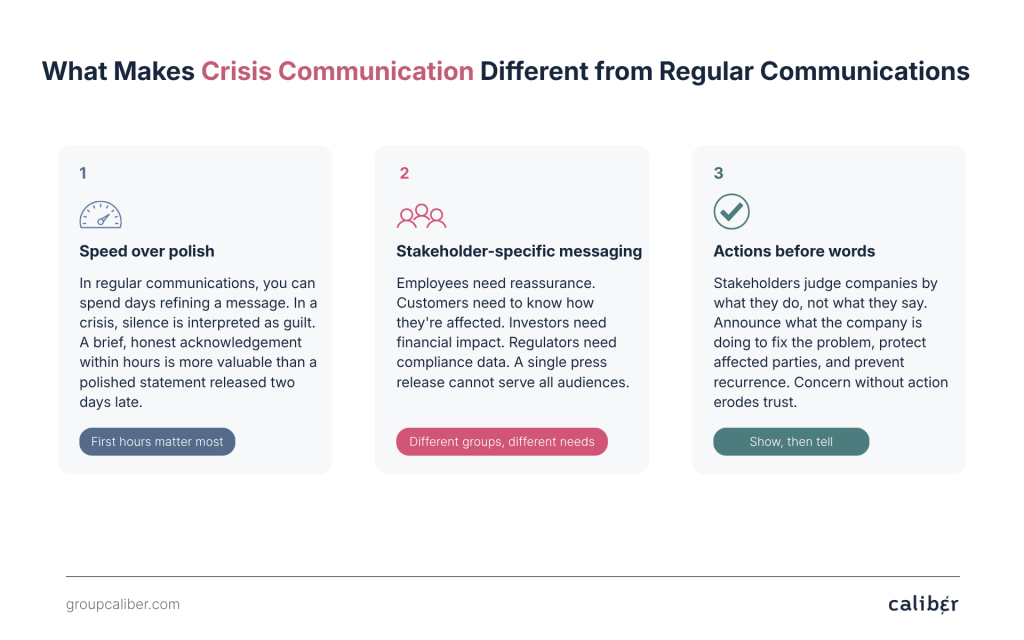
Speed over polish. In regular communications, you can spend days refining a message. In a crisis, silence is interpreted as guilt or incompetence. The first public response should come within hours, even if the full picture is still emerging. A brief, honest acknowledgment that the company is aware of the situation and is taking action is more valuable than a polished statement released two days late.
Stakeholder-specific messaging. Different stakeholder groups need different messages delivered through different channels. Employees need reassurance and clear instructions. Customers need to know how they’re affected and what to do. Investors need to understand the financial implications and the response plan. Regulators need compliance information. A single press release cannot serve all of these audiences.
Actions before words. Stakeholders judge companies by what they do, not what they say. The most effective crisis communication announces actions: what the company is doing to fix the problem, protect affected parties, and prevent recurrence. Statements that express concern without announcing action erode trust rather than building it.
Phase 1: Before the Crisis – Preparation
The quality of your crisis response depends almost entirely on the quality of your preparation. Companies that invest in crisis readiness before anything goes wrong consistently outperform those that improvise under pressure.
Build a crisis communication team
Designate a cross-functional crisis team before you need one. This typically includes the CCO or head of communications (who leads the response), the CEO (who decides on major actions and serves as the senior spokesperson when needed), legal counsel (who manages regulatory and liability considerations), HR leadership (who handles internal communications and employee support), and operational leads from the most likely affected functions.
Assign clear roles. One spokesperson should be the primary public voice. Internal and external communications should be coordinated but differentiated. Decision-making authority should be pre-defined so the team can act quickly when time is compressed.
Develop scenario-specific response plans
Generic crisis plans are better than nothing, but scenario-specific plans are far more useful. Identify the three to five crisis types most likely to affect your company based on your industry, geography, and risk profile. For each scenario, prepare holding statements, stakeholder-specific messaging templates, channel plans, and escalation protocols.
A pharmaceutical company faces different crisis scenarios than a technology company or a financial services firm. Your plans should reflect your specific vulnerabilities, not generic crisis management theory.
Know your reputation baseline
This is the preparation step most companies skip, and it’s the one that matters most for crisis recovery. If you don’t know your Trust & Like Score, your Integrity perception, and how different stakeholder groups view you before a crisis, you have no reference point for measuring damage or tracking recovery.
Caliber’s continuous measurement provides this baseline automatically. Clients go into a crisis knowing their TLS across all stakeholder groups, which perception attributes are strongest and most vulnerable, and how they compare to competitors and sector norms. This intelligence shapes every decision during the response: which groups need the most reassurance, which perception dimensions are most at risk, and what recovery looks like in quantitative terms.
Train and drill regularly
Crisis plans that sit in a binder are worse than useless. They create a false sense of security. Run tabletop exercises at least twice a year, simulating your most likely crisis scenarios. Test whether the team can assemble quickly, whether decision-making protocols work under pressure, whether messaging templates hold up when tested against realistic media questions, and whether internal and external communications stay aligned.
Phase 2: During the Crisis – Response
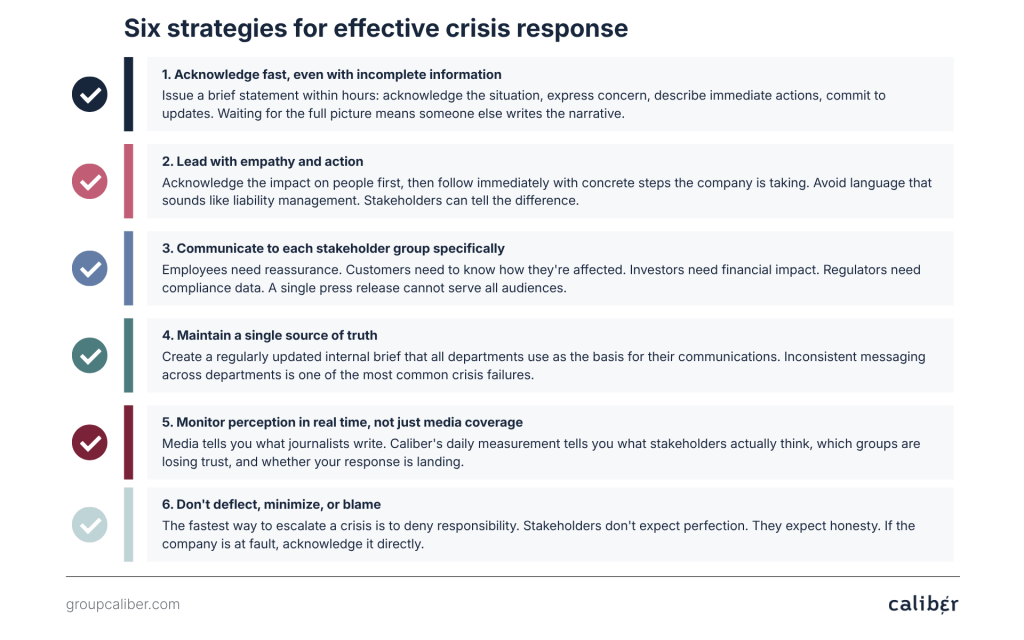
When a crisis hits, the preparation phase either pays off or its absence becomes painfully obvious. Six strategies define an effective crisis response.
1. Acknowledge fast, even with incomplete information
The first hours of a crisis set the narrative. If you don’t fill the information vacuum, someone else will. Issue a brief initial statement within the first few hours: acknowledge the situation, express concern for affected parties, describe the immediate actions being taken, and commit to providing updates as more information becomes available.
This statement does not need to have all the answers. It needs to demonstrate that the company is aware, engaged, and acting. A common mistake is waiting until you have the full picture before saying anything. By the time you do, the narrative has already been written without you.
2. Lead with empathy and action
Every crisis affects people. Whether it’s customers whose data was compromised, employees who feel uncertain about their jobs, or communities affected by an environmental incident, stakeholders want to know two things: does the company care, and what is it doing about it?
Lead with empathy: acknowledge the impact on people. Follow immediately with action: what concrete steps the company is taking. Avoid corporate language that sounds like it was written by a legal department. Stakeholders can tell the difference between genuine concern and liability management.
3. Communicate to each stakeholder group specifically
A single press release is not a crisis communication strategy. Different stakeholder groups have different information needs, different levels of concern, and different expectations for how they should hear from you.
Employees should hear from leadership directly, ideally before the news goes public. Customers need clear information about how they’re affected and what they should do. Investors need an assessment of financial impact and the response plan. Media needs factual information and access to a spokesperson. Regulators need compliance-specific communication through appropriate channels.
Caliber’s stakeholder segmentation data is particularly valuable here. If you know, from pre-crisis measurement, that your Integrity perception is weakest among opinion leaders or that your TLS is lowest among talent segments, you can prioritize communications to the groups where trust is most fragile.
4. Maintain a single source of truth
Inconsistent messaging across departments is one of the most common crisis communication failures. When the CEO says one thing, the PR team says another, and customer service representatives say something different, stakeholders lose confidence in all of them.
Establish a single source of truth: a regularly updated internal brief that all departments use as the basis for their communications. Update it as the situation evolves. Make sure every customer-facing employee has access to the current version.
5. Monitor perception in real time, not just media coverage
Most companies monitor media coverage during a crisis. That’s necessary but insufficient. Media coverage tells you what journalists are writing. It doesn’t tell you what stakeholders actually think or how their perceptions are changing.
Caliber’s daily measurement continues during a crisis, providing real-time visibility into how each stakeholder group is responding to both the crisis and your communications. You can see which groups are losing trust, which perception attributes are taking the most damage, and whether your response is stabilizing perceptions or failing to land. This is intelligence that media monitoring alone cannot provide.
6. Don’t deflect, minimize, or blame
The fastest way to turn a manageable crisis into a catastrophic one is to deflect responsibility, minimize the impact, or blame others. United Airlines’ initial response to the 2017 passenger removal incident, in which the CEO characterized the passenger as “belligerent,” turned a PR problem into a global boycott campaign. The company’s eventual course correction, taking full responsibility and announcing policy changes, was effective but came at a much higher cost than an immediate honest response would have.
If the company is at fault, acknowledge it directly. If the facts are still emerging, say so honestly. Stakeholders don’t expect perfection. They expect honesty.
Phase 3: After the Crisis – Recovery
A crisis is not over when the media moves on. It’s over when stakeholder trust has been genuinely rebuilt. That distinction is the difference between companies that recover fully and companies that carry permanent reputational damage.
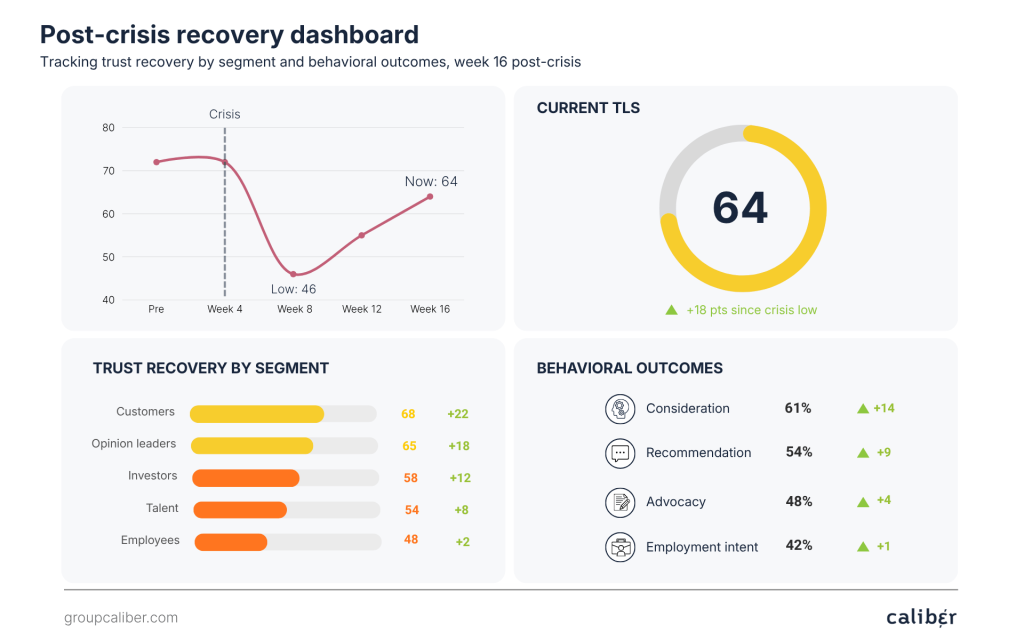
Measure recovery, don’t assume it
The most common recovery mistake is assuming that silence equals resolution. When media coverage fades and social media volume returns to normal, companies often conclude the crisis is over. But media attention and stakeholder trust are different things. A story can drop out of the news cycle while investors remain cautious, employees remain disengaged, and opinion leaders remain skeptical.
Caliber’s continuous measurement provides the recovery tracking that gut instinct cannot. You can monitor TLS recovery by stakeholder group, see which segments are returning to pre-crisis levels and which are lagging, and track whether specific perception attributes (particularly Integrity) are rebuilding or stuck. This evidence-based recovery assessment replaces the dangerous assumption that no news is good news.
Communicate what you’ve changed
Stakeholders who gave you the benefit of the doubt during the crisis expect to see what you’ve learned and what you’ve changed as a result. Publish the findings of your internal investigation (to the extent appropriate). Announce specific policy, process, or structural changes. Demonstrate through actions, not just words, that the company has taken the issue seriously.
This follow-through communication is often more important for long-term reputation recovery than the initial crisis response. It’s the proof that the company’s promises during the crisis were genuine.
Conduct a thorough post-crisis review
Within 30 days of the crisis resolution, conduct a structured review with the crisis team. What worked well in the response? What failed? Where were the information gaps? Which stakeholder communications landed and which didn’t? Where were the delays, and what caused them?
Use Caliber’s data to ground this review in evidence. Compare pre-crisis, mid-crisis, and post-crisis TLS across all stakeholder groups. Identify which perception attributes took the most damage and which have recovered. This data turns a subjective debrief into an objective assessment that informs future crisis preparedness.
Rebuild, don’t just repair
The strongest post-crisis recoveries don’t just return to the previous baseline. They use the crisis as a catalyst for genuine improvement. Johnson & Johnson’s response to the 1982 Tylenol poisoning, which included a nationwide recall and the introduction of tamper-proof packaging, became the gold standard for crisis management precisely because the company emerged with stronger safety practices and higher consumer trust than it had before the crisis.
This requires honest self-assessment. What systemic issues contributed to the crisis? What needs to change in the organization’s culture, processes, or governance to prevent recurrence? The answers to these questions should inform the company’s post-crisis communications strategy and its longer-term reputation management program.
The Role of Stakeholder Intelligence in Crisis Communication
Most crisis communication frameworks treat stakeholder perception as something you respond to anecdotally: monitoring social media, reading press coverage, listening to what customers tell call center agents. These inputs are useful but incomplete. They capture the loudest voices, not the representative picture.
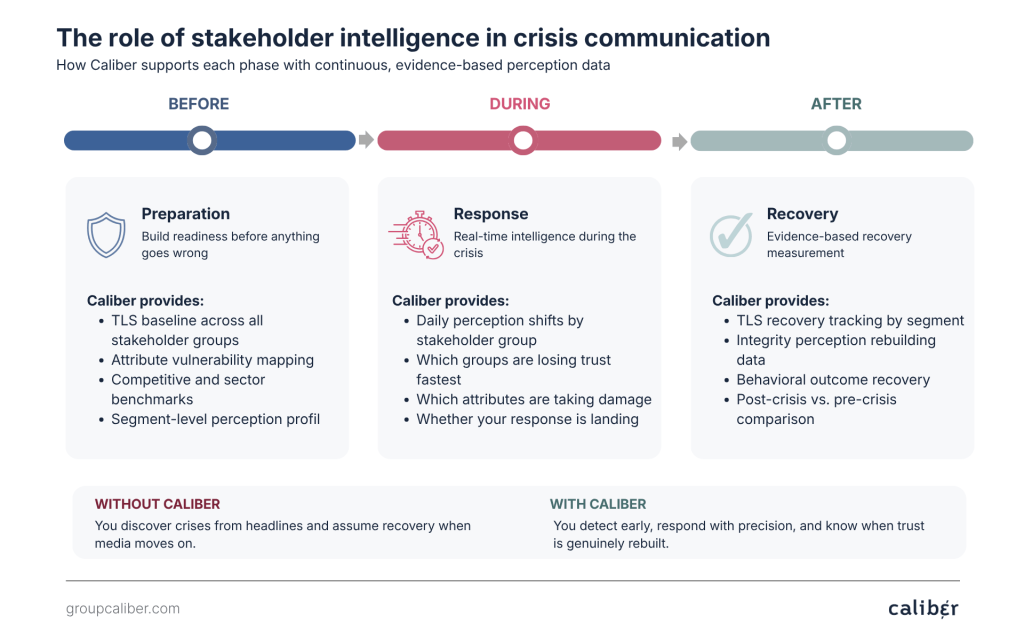
Caliber adds a structured intelligence layer to crisis communication. Before the crisis, it provides the reputation baseline that frames the response strategy. During the crisis, it provides daily stakeholder perception data that shows whether your response is working, which groups are losing trust, and which perception dimensions are taking the most damage. After the crisis, it provides evidence-based recovery tracking that distinguishes between genuine trust rebuilding and superficial media silence.
This intelligence doesn’t replace crisis communication expertise. It informs it. The CCO and the crisis team still make the strategic decisions. Caliber provides the real-time evidence that makes those decisions more precise, more targeted, and more measurable.
Go Into Your Next Crisis with Intelligence, Not Assumptions
Companies that know their reputation baseline, that can track perception shifts in real time during a crisis, and that can measure recovery by stakeholder group don’t just respond better. They recover faster and more completely.
If you want to see how Caliber’s continuous stakeholder intelligence supports crisis preparedness, response, and recovery, book a demo and see where your reputation stands today.