Companies spend more on employer branding than ever. LinkedIn content, EVP campaigns, careers page redesigns, employer awards, campus events. The investment is real. The measurement usually isn’t.
Most employer branding programs can tell you how many impressions their LinkedIn posts got, or how many applications a job posting received. What they can’t tell you is whether target talent segments actually perceive the company differently as a result. Did awareness go up among software engineers in the Nordics? Did familiarity increase among mid-career finance professionals in the US? Would more people consider working for you today than they would six months ago?
These are the questions that employer branding metrics should answer. This article covers which metrics matter, how they fit together, and how to measure them in a way that connects employer brand investment to tangible outcomes.
Key Takeaways
- Most employer branding programs measure outputs, not outcomes. Impressions, applications, and career site visits tell you what happened at the surface. They don’t tell you whether your employer brand is actually changing how target talent perceives you.
- The metrics that matter are perception metrics. Awareness, familiarity, and employment consideration among defined talent segments are the leading indicators that predict whether your employer brand is working.
- Caliber’s Talent 360 measures external employer brand perception continuously, by profession, seniority, and market. It tracks the metrics that sit upstream of every recruitment outcome.
Why Most Employer Branding Metrics Miss the Point
Employer branding sits at the intersection of HR, marketing, and communications. Each function brings its own measurement habits, and most of them are designed for a different purpose.
Marketing teams measure campaign performance: impressions, reach, engagement, click-through rates. These are useful for evaluating channel efficiency, but they measure content distribution, not perception change. A LinkedIn post that reaches 50,000 people and generates 300 likes has not necessarily changed how any of those people perceive your company as an employer.
HR teams measure recruitment outcomes: applications per role, time-to-hire, cost-per-hire, offer acceptance rates. These are lagging indicators. They tell you what happened after the talent pipeline was already formed. They can’t explain why some roles attract strong candidates organically while others require expensive agency support.
What’s missing is the perception layer that sits between employer brand activity and recruitment outcomes. How do the people you want to hire actually perceive your company as a place to work? That’s what employer branding metrics should measure.
The Employer Branding Metrics That Matter
Effective employer brand measurement tracks perception among external talent segments, not internal employee satisfaction. The distinction is important: internal engagement surveys (pulse tools, eNPS, satisfaction scores) measure how current employees feel about working at your company. Employer brand metrics measure how people who don’t work for you perceive you as an employer. Both matter, but they answer different questions with different tools.
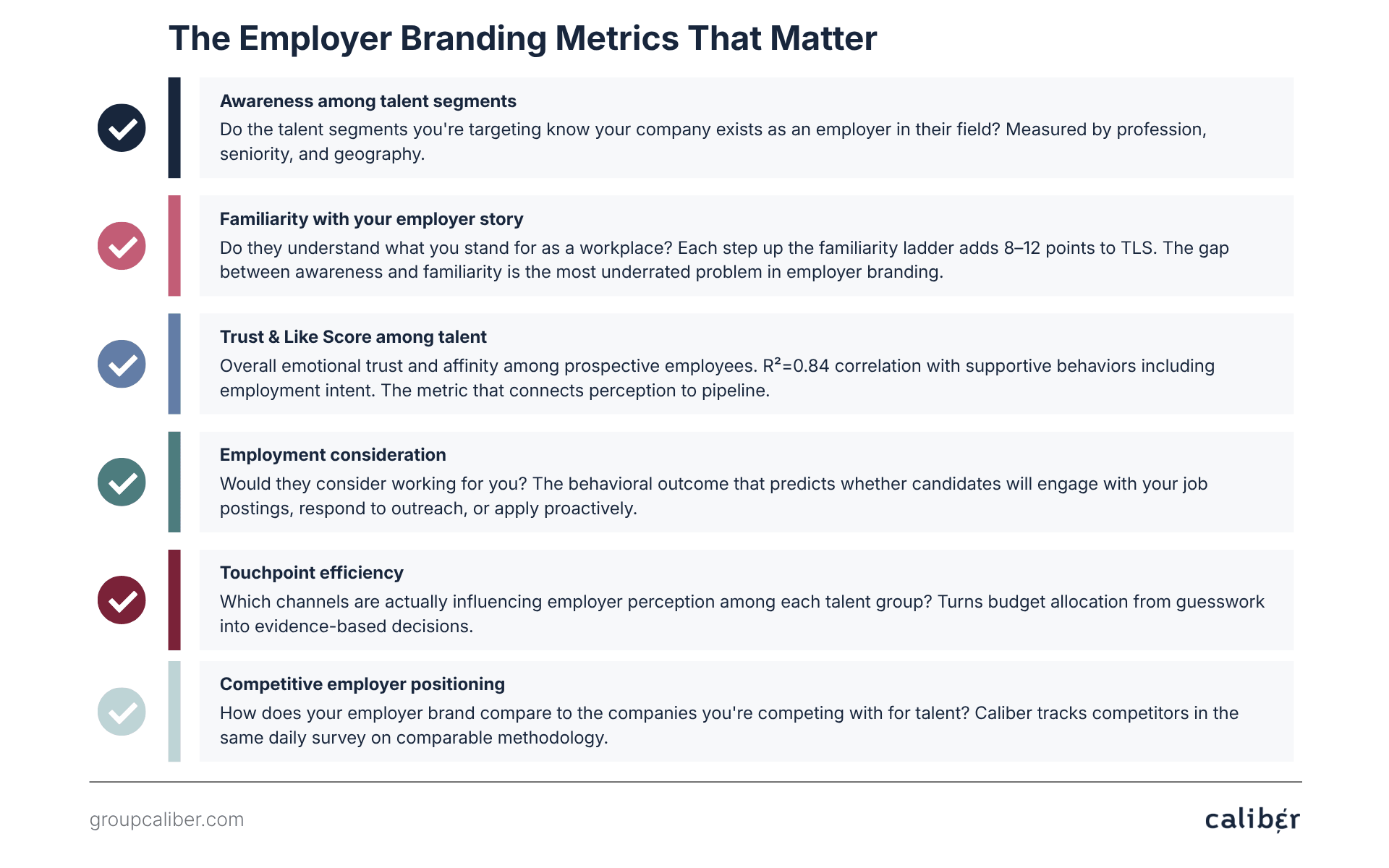
Six metrics form the core of a credible employer brand measurement framework.
1. Awareness among talent segments
Do the talent segments you’re targeting know your company exists as an employer in their field? Many companies have strong consumer brand recognition but near-zero awareness among the talent pools they need. A B2B industrial company might be well-known among procurement professionals but invisible to the software engineers it’s trying to hire.
Awareness should be measured by segment: by profession, by seniority level, by geography. An overall awareness number hides the gaps that matter. Caliber’s Talent 360 tracks awareness among defined talent segments continuously, so you can see whether your employer brand campaigns are reaching the right audiences.
2. Familiarity with your employer story
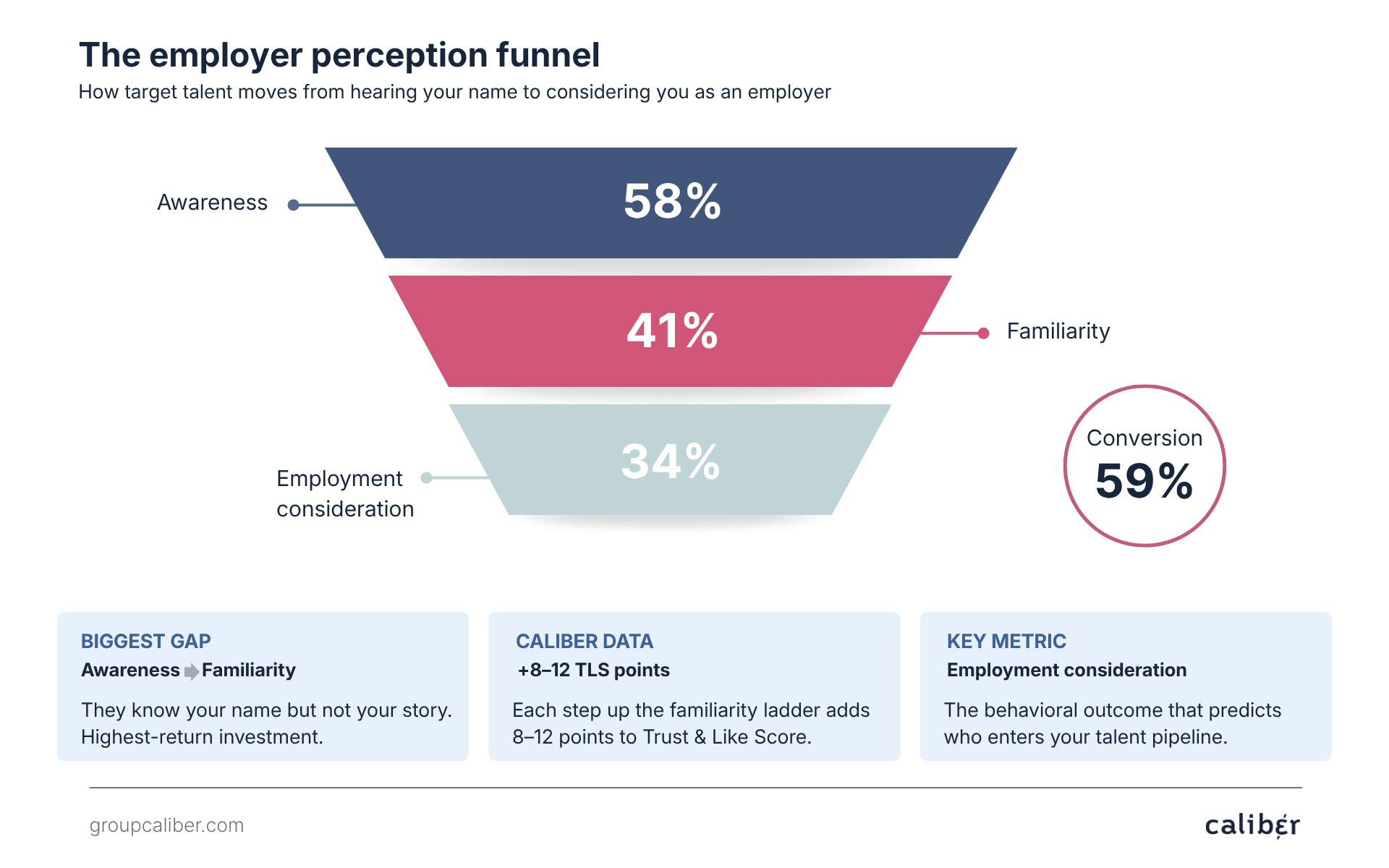
Awareness alone is not enough. Familiarity measures whether talent segments understand what your company does, what it stands for as a workplace, and what it offers as an employer. The gap between awareness and familiarity is one of the most common and most underrated problems in employer branding.
Caliber’s research shows that each step up the familiarity ladder adds roughly 8–12 points to the Trust & Like Score. A candidate who has heard of your company but doesn’t know what it’s like to work there will default to assumptions. When those assumptions are wrong or incomplete, no amount of recruitment marketing will close the gap efficiently.
3. Trust & Like Score among talent
The Trust & Like Score (TLS) captures overall emotional trust and affinity among a representative sample of stakeholders. When measured specifically among talent segments, it tells you whether prospective employees trust and like your company as an employer.
TLS is the metric that connects perception to behavior. Caliber’s global data shows an R²=0.84 correlation between TLS and supportive stakeholder behaviors, including employment intent. A high TLS among your target talent segments means they’re more likely to consider, apply for, and accept roles at your company. A low TLS means you’re spending more to attract less.
4. Employment consideration
This is the behavioral outcome metric that matters most for employer branding: would this person consider working for your company? Employment consideration is the bridge between perception and pipeline. It predicts whether a candidate will engage with your job postings, respond to recruiter outreach, or apply proactively.
Employment consideration should be tracked by segment. A company might have strong consideration among early-career candidates but low consideration among experienced professionals, or high consideration in its home market but near-zero in an expansion geography. These differences determine where employer brand investment should be concentrated.
5. Touchpoint efficiency
Which channels and activities are most effective at shaping employer perception among each talent segment? LinkedIn might be highly effective for reaching mid-career professionals but irrelevant for technical talent who spend their time on GitHub and Stack Overflow. Campus programs might drive awareness among graduates but do nothing for experienced hires.
Caliber’s Talent 360 measures touchpoint efficiency by showing which channels are actually influencing employer perception among each talent group. This turns employer brand budget allocation from guesswork into evidence-based decisions.
6. Competitive employer positioning
How does your employer brand compare to the companies you’re competing with for talent? In many sectors, the competition for employer reputation is fiercer than the competition for customers. Caliber tracks employer perception across competitors in the same daily survey, so all data is collected on comparable methodology. This shows where you have an employer brand advantage and where competitors are perceived more favorably.
Metrics That Don’t Measure Employer Brand Perception
Several commonly cited employer branding metrics are useful for other purposes but do not measure employer brand perception. Knowing what to exclude is as important as knowing what to track.
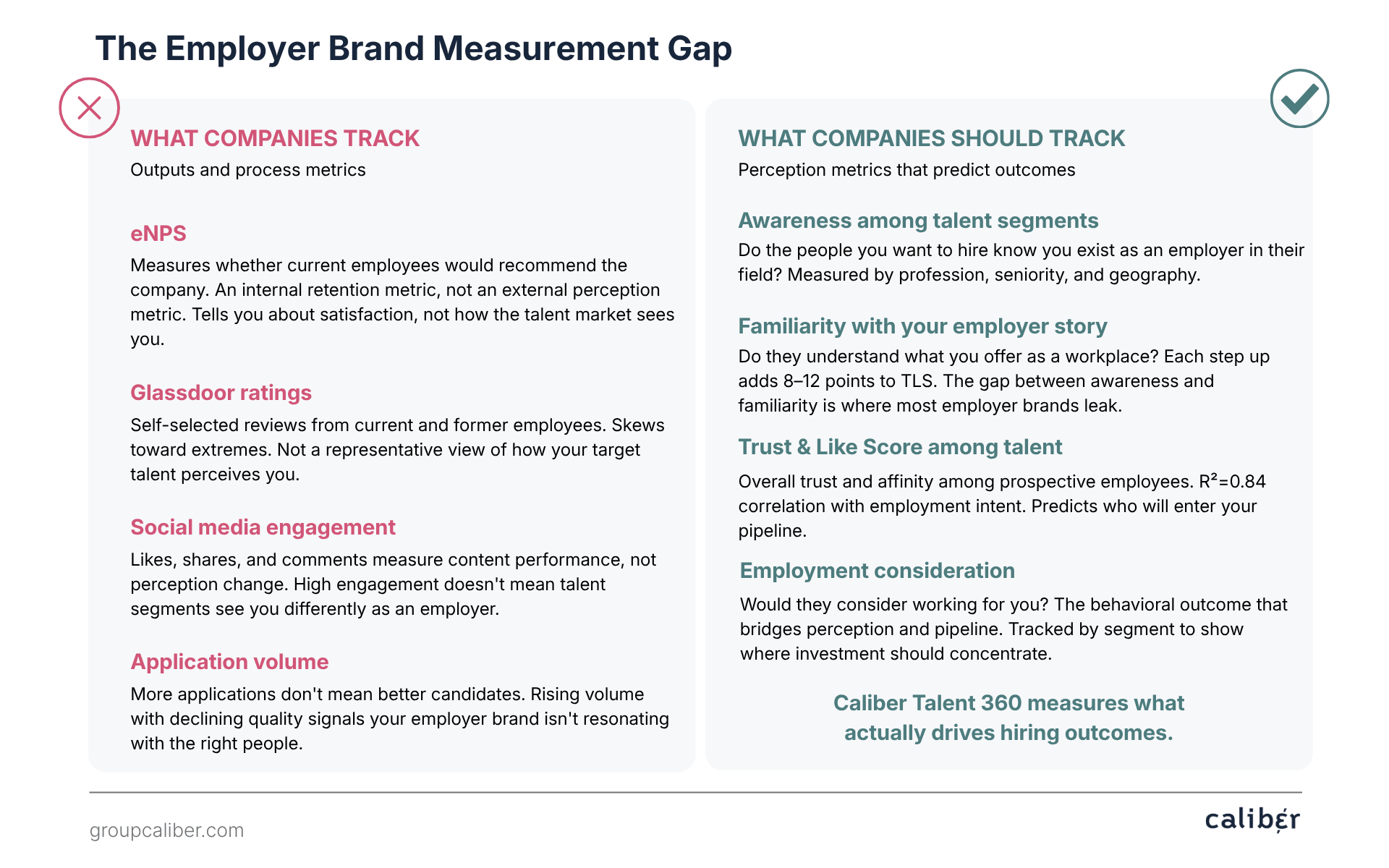
eNPS (Employee Net Promoter Score). Measures whether current employees would recommend the company as a place to work. This is an internal retention metric, not an external perception metric. It tells you about employee satisfaction, not how the talent market perceives you.
Glassdoor ratings. Useful as a reference point, but Glassdoor reviews represent a self-selected sample of current and former employees, not a representative view of how your target talent perceives you. Ratings skew toward extremes: people leave reviews when they’re very happy or very unhappy.
Social media engagement. Likes, shares, and comments on employer brand content measure content performance, not perception change. High engagement on a LinkedIn post about company culture doesn’t mean your target talent segments perceive you differently as an employer.
Application volume. More applications don’t mean better candidates. Rising application volume with declining quality signals that your employer brand isn’t resonating with the right people. It’s a recruitment process metric, not an employer brand metric.
How to Build an Employer Brand Measurement Program
Define your target talent segments
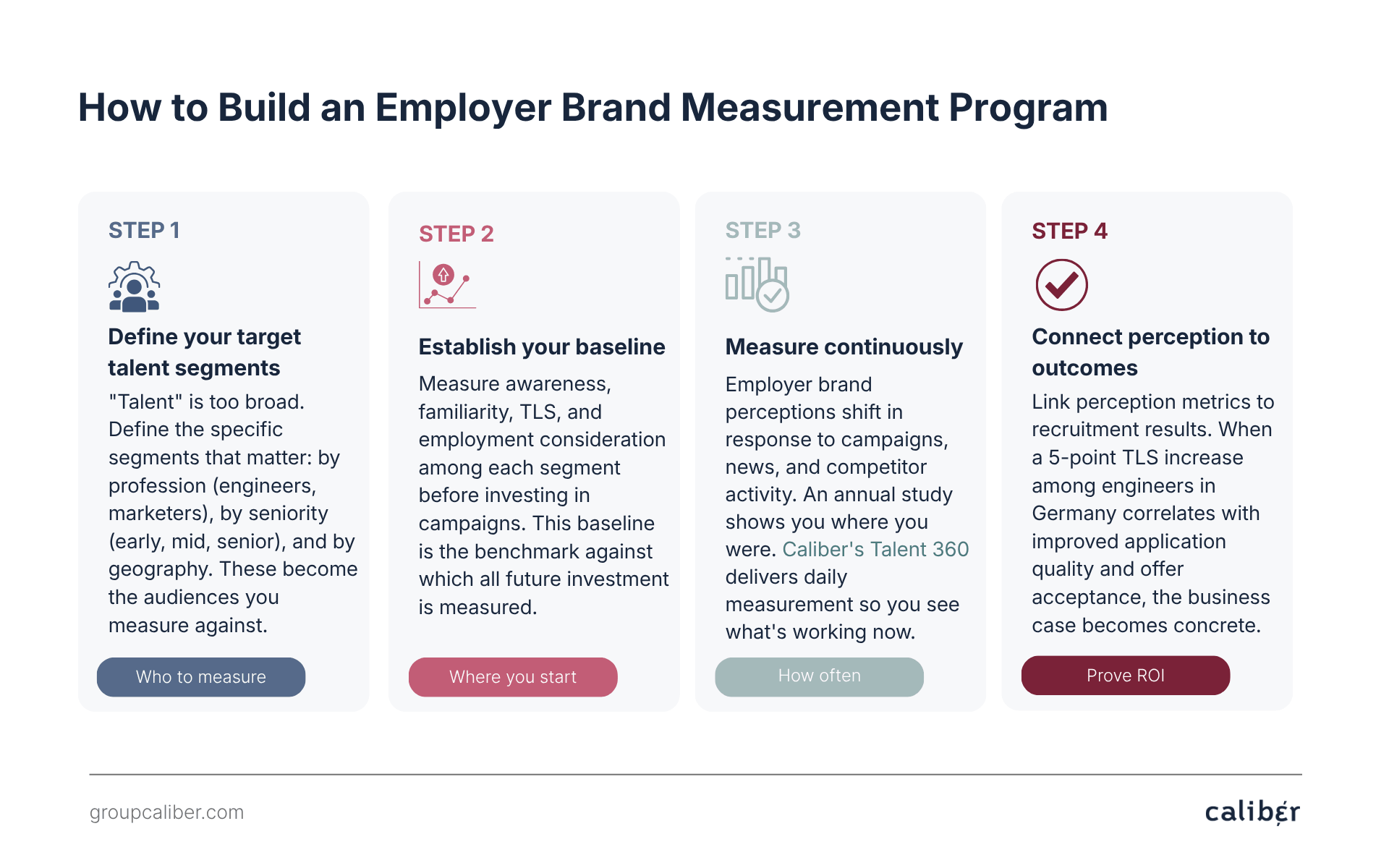
“Talent” is too broad. Your employer brand doesn’t need to resonate with everyone. Define the specific talent segments that matter most to your business: by profession (engineers, marketers, finance professionals), by seniority (early-career, mid-career, senior leadership), and by geography (home market, expansion markets, specific countries). These become the audiences you measure against.
Establish your baseline
Before you invest in employer brand campaigns, measure where you stand. What’s your awareness among each target segment? How familiar are they with your employer story? Would they consider working for you? How do you compare to the companies you’re competing with for talent? This baseline becomes the benchmark against which all future investment is measured.
Measure continuously, not annually
Employer brand perceptions shift in response to campaigns, news, leadership changes, and competitor activity. An annual employer brand study shows you where you were twelve months ago. Continuous measurement shows you where you are right now. Caliber’s Talent 360 delivers daily measurement of employer perception among defined talent segments, giving CHROs and employer brand managers a real-time view of what’s working and what isn’t.
Connect perception to recruitment outcomes
The most valuable employer brand measurement programs connect perception metrics (awareness, familiarity, TLS, employment consideration) to recruitment outcomes (quality of hire, time-to-fill, cost-per-hire, offer acceptance rates). When you can show that a 5-point TLS increase among software engineers in Germany correlates with a measurable improvement in application quality and offer acceptance, the business case for employer brand investment becomes concrete.
Know How Your Target Talent Perceives You
Most companies invest in employer branding without measuring whether it’s working. Caliber’s Talent 360 shows you how prospective employees and target talent segments perceive your company as an employer, by profession, by market, updated daily.
If you’re ready to make employer brand decisions based on data instead of assumptions, book a demo and see where your employer reputation stands right now.