A brand reputation crisis can escalate within hours. One social media post, one critical news article, one leaked internal memo, and the narrative shifts faster than most companies can respond. By the time communications teams are briefed and holding statements are drafted, the story has already been framed by someone else.
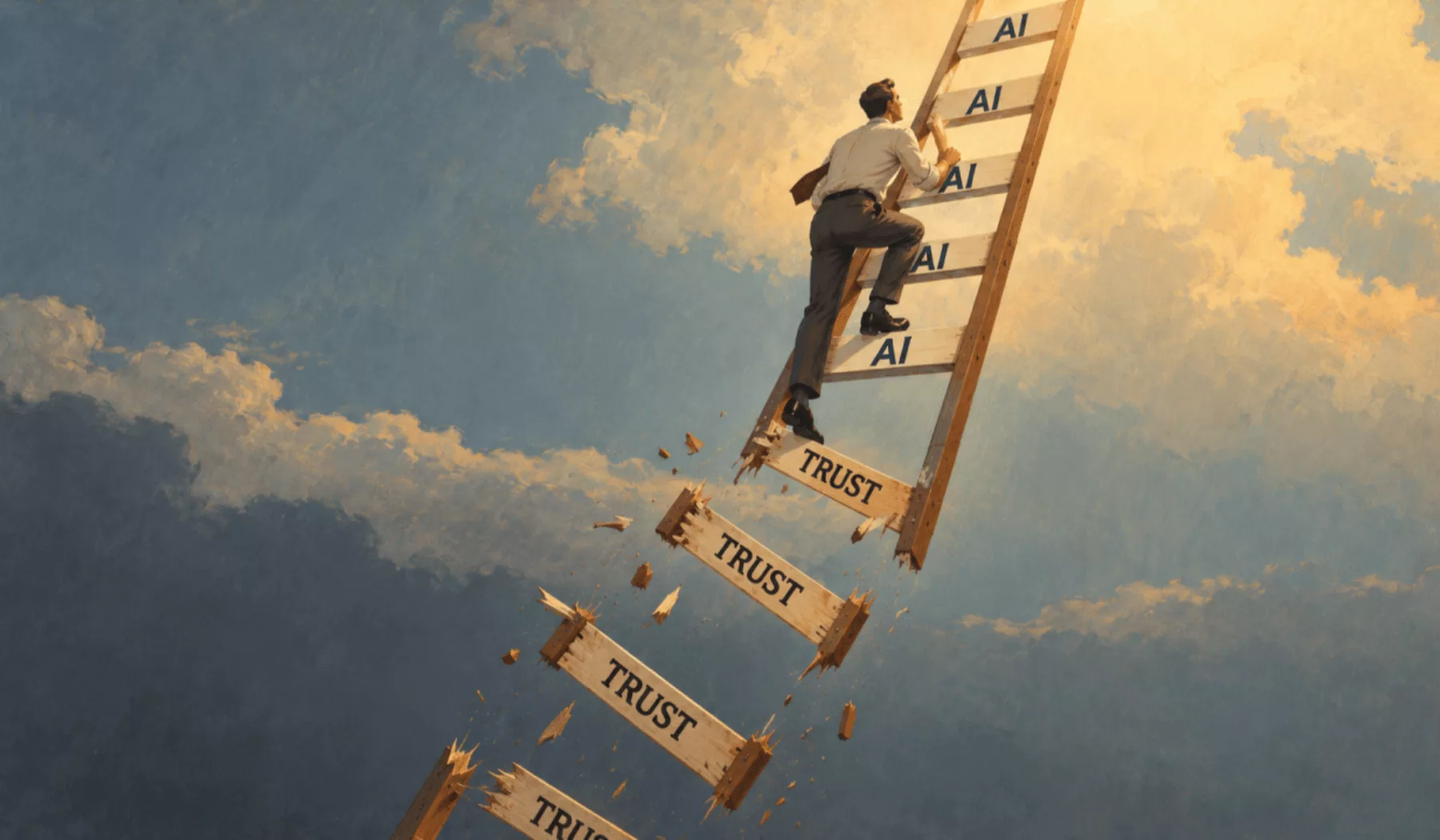
But here’s what most companies miss: a reputation crisis rarely starts with the headline. It starts with perception shifts that build over days or weeks, in specific stakeholder groups, often invisible to the tools companies rely on. Media monitoring catches the moment the story breaks. It doesn’t catch the weeks of eroding trust that preceded it.
The Reuters Institute Digital News Report 2025 highlights how audiences have fragmented across social media, video platforms, and niche publications, making it harder than ever for communications teams to track every potential risk. Information overload, media fragmentation, and resource pressure create blind spots. Those blind spots are where reputation crises begin.
This article covers five early warning signs that a brand reputation crisis may be forming, and how to build the detection systems that surface them before they escalate. Each sign follows a simple structure: what the signal is, why it matters, and how to spot it.
Key Takeaways
- A reputation crisis doesn’t start with headlines. It starts with perception shifts in specific stakeholder groups, often weeks before the issue becomes public. The warning signs are there. Most companies don’t have the measurement systems to see them.
- Warning signs only help if you detect them continuously. A company measuring reputation quarterly will always be looking backward. Companies with daily measurement see the slope starting to turn, not the cliff they’ve already fallen off.
- Three-quarters of organizations report that their most serious disruption had a medium-to-high operational impact (BCI Horizon Scan Report). Preventing a reputation crisis before it develops is far more cost-effective than managing the fallout. Early detection buys the time to brief leadership, coordinate messaging, and activate a crisis communication plan.
Why Companies Miss the Early Signs of a Reputation Crisis
Most companies discover a brand reputation crisis the same way the public does: through a news headline, a viral social post, or a sudden drop in commercial metrics. By that point, the damage has been building in stakeholder perceptions for days, weeks, or sometimes months.
The gap between when reputational damage begins and when it becomes visible is the most expensive blind spot in corporate communications. Three factors make early detection difficult.
Quarterly measurement leaves blind spots. Periodic brand studies produce reliable data at a specific point in time, but a perception shift that begins in October won’t show up until the January wave runs. By then, the issue has had months to compound.
Media monitoring captures coverage, not perception. Social listening and media monitoring track what people post and what journalists write. They measure published content, not what stakeholders genuinely believe. A company can have positive media coverage and declining trust among investors.
Fragmentation creates noise. Audiences are spread across traditional media, social platforms, video channels, and niche communities. No single monitoring tool captures the full picture, and the signal-to-noise ratio makes it easy to miss the early indicators that matter.
The 5 Early Warning Signs
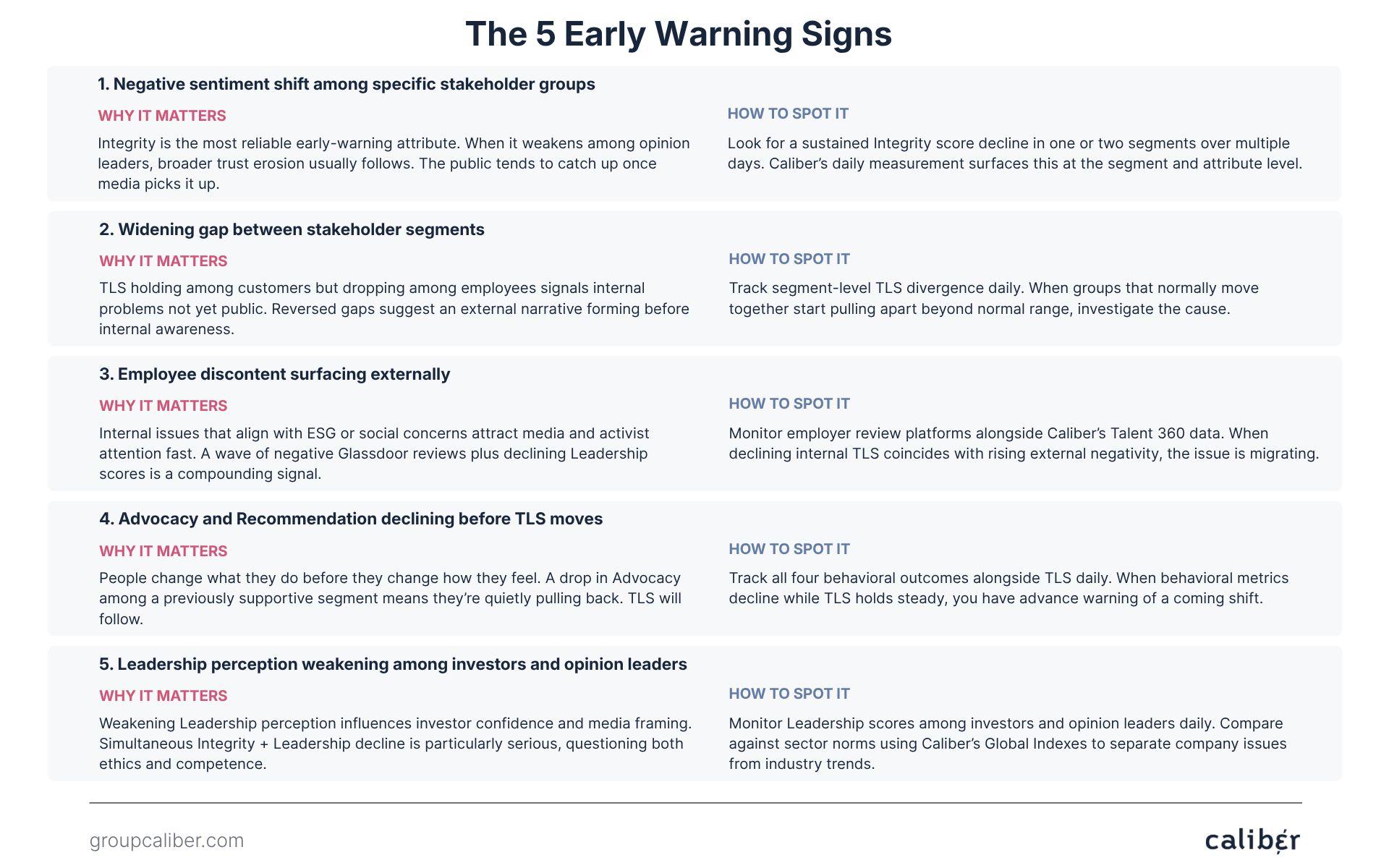
1. A negative shift in sentiment among specific stakeholder groups
An increase in brand mentions isn’t necessarily alarming. It becomes a concern when the tone turns increasingly negative, and the shift is concentrated in a specific group rather than spread evenly. A small but sustained dip in sentiment among opinion leaders, investors, or employees can foreshadow broader backlash.
Why it matters. Of all the reputation attributes Caliber measures, Integrity is the most reliable early-warning signal. When Integrity perceptions weaken among opinion leaders, journalists, analysts, and industry experts, it often precedes broader trust erosion. These groups are more attuned to governance issues, regulatory risks, and ethical questions. The general public tends to follow once the issue gains media traction.
How to spot it. Look for a statistically significant decline in Integrity scores, concentrated in one or two stakeholder segments, sustained over more than a few days. Caliber’s daily measurement makes this pattern visible in near real-time, segmented by group, market, and attribute. Media monitoring alone cannot provide this level of granularity because it measures what’s published, not what stakeholders believe.
2. A widening gap between stakeholder segments
Healthy reputations tend to be relatively consistent across stakeholder groups. Customers, employees, investors, and opinion leaders may rate a company differently, but the gaps are stable and predictable. When those gaps start widening unexpectedly, it signals that something is affecting specific groups differently.
Why it matters. A company might see its Trust & Like Score hold steady among customers while dropping sharply among employees. That pattern could signal internal problems, a restructuring, a leadership change, a policy controversy, that haven’t yet reached external stakeholders. Or the gap might work in reverse: opinion leaders losing confidence while employees remain supportive, suggesting an external narrative is forming that hasn’t reached the internal audience.
How to spot it. Track segment-level TLS divergence over time. Caliber measures TLS by stakeholder group daily, so you can spot when segments that normally move together start pulling apart. A divergence that exceeds your company’s normal range, sustained over multiple days, warrants investigation.
3. Employee discontent surfacing externally
Internal dissatisfaction that starts leaking into public channels, through Glassdoor reviews, social media posts from current or former employees, or anonymous tip-offs to journalists, is one of the clearest precursors to a full brand reputation crisis. Employee activism has become a growing reputational risk, particularly when internal concerns align with broader ESG or social issues that attract media attention.
Why it matters. Issues raised internally can turn into external reputational damage quickly, especially if they connect to topics that journalists and activists are already covering. A wave of negative Glassdoor reviews about management culture, combined with a declining Leadership attribute score among employees, is a compounding signal that demands attention.
How to spot it. Monitor sentiment on employer review platforms alongside Caliber’s stakeholder perception data. When declining TLS among employees coincides with rising negative reviews externally, the issue is migrating from internal frustration to public narrative. Caliber’s Talent 360 tracks how both prospective and current talent perceive the company, providing the early signal that internal culture issues are affecting external employer reputation.
4. Advocacy and Recommendation declining before TLS moves
Behavioral outcome metrics often shift before the overall perception score does. People change what they’re willing to do (recommend, advocate, purchase) before they change how they feel overall. A stakeholder might still say they trust a company but quietly stop recommending it. That behavioral withdrawal is an early signal that the underlying perception is softening.
Why it matters. A drop in Advocacy or Recommendation, particularly among a segment that was previously highly supportive, is worth investigating even if TLS hasn’t moved. It means stakeholders are pulling back from active support. If left unaddressed, TLS will follow. The absence of expected positive coverage or engagement can be just as telling as the presence of negative coverage.
How to spot it. Track behavioral outcomes (Advocacy, Consideration, Recommendation, Employment intent) alongside TLS daily. When behavioral metrics decline among previously strong segments while TLS remains stable, you have early warning of a perception shift that hasn’t yet reached the headline number. Caliber tracks all four behavioral outcomes in the same continuous model.
5. Leadership perception weakening among investors and opinion leaders
The Leadership attribute captures whether stakeholders see a company as well-managed and strategically sound. When Leadership perceptions weaken, it often reflects emerging doubts about the company’s direction, competence, or governance, sometimes triggered by executive behavior, strategic missteps, or organizational instability.
Why it matters. Leadership perception influences investor confidence and media framing. Investors who perceive weakening leadership are more likely to reduce positions. Journalists who detect a leadership narrative gap are more likely to frame other company news through a lens of management problems. Both dynamics can accelerate a reputation crisis that might otherwise have remained contained. A simultaneous weakening of both Integrity and Leadership is a particularly serious signal.
How to spot it. Monitor the Leadership attribute specifically among investors and opinion leaders. Caliber’s daily data shows when Leadership scores start declining in these groups. Compare against your sector norms using Caliber’s Global Sector and Country Indexes to distinguish between a company-specific problem and a broader industry trend.
How to Build an Early Detection System
Warning signs are only useful if you have a system that detects them continuously. Five elements define a credible early detection capability for brand reputation crisis prevention.
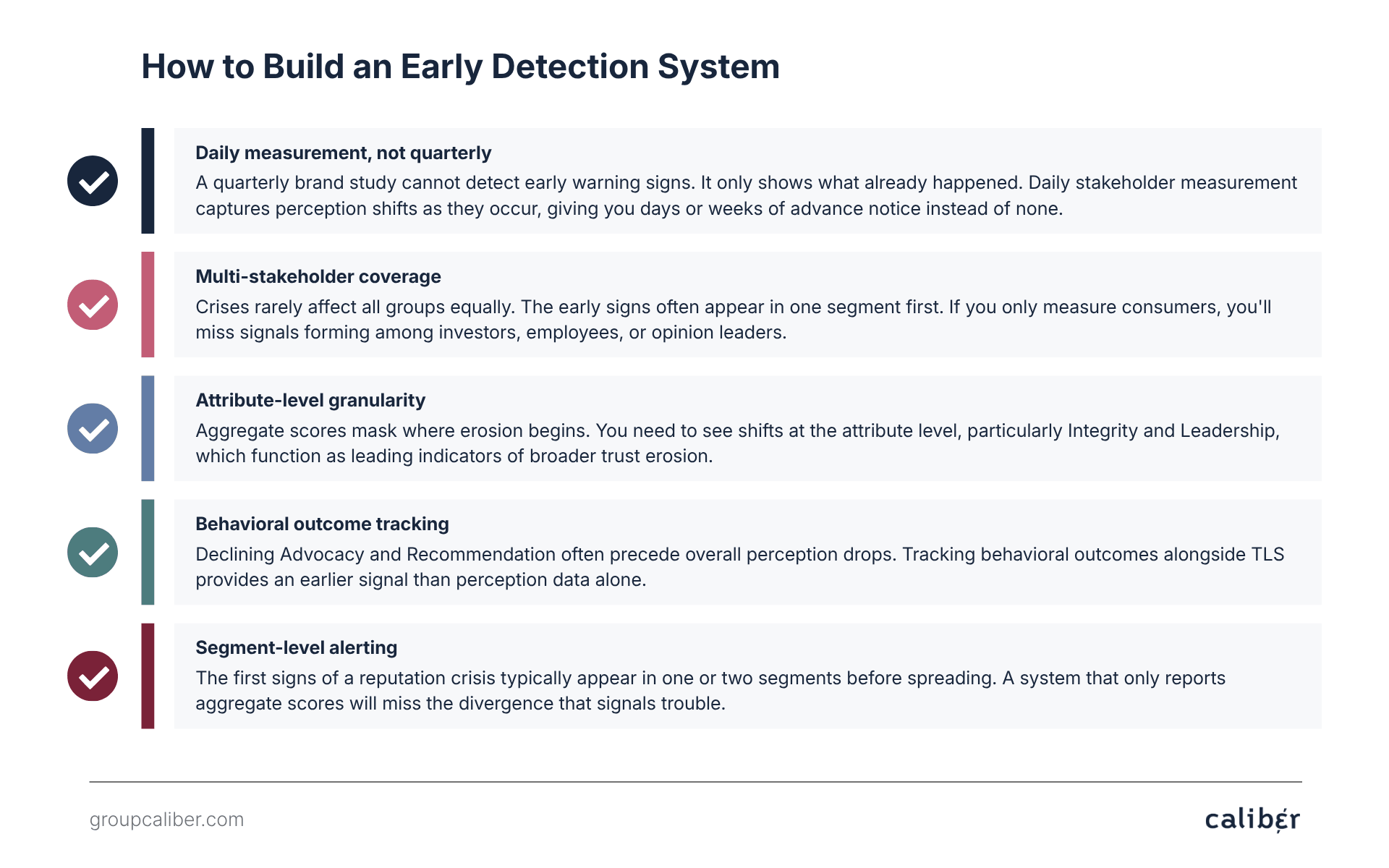
Daily measurement, not quarterly. A quarterly brand study cannot detect early warning signs. By definition, it only shows you what already happened. Daily stakeholder measurement captures perception shifts as they occur, giving you days or weeks of advance notice instead of none.
Multi-stakeholder coverage. Reputation crises rarely affect all stakeholder groups equally. The early signs often appear in one segment first. If you only measure consumers, you’ll miss signals forming among investors, employees, or opinion leaders. Caliber’s multi-stakeholder model covers all relevant groups in a single continuous platform.
Attribute-level granularity. Aggregate scores mask the specific dimensions where erosion begins. You need to see shifts at the attribute level, particularly Integrity and Leadership, which function as leading indicators of broader trust erosion.
Behavioral outcome tracking. Declining Advocacy and Recommendation often precede overall perception drops. Tracking behavioral outcomes alongside TLS provides an earlier signal than perception data alone.
Segment-level alerting. The first signs of a reputation crisis typically appear in one or two stakeholder segments before spreading. A system that only reports aggregate scores will miss the segment-level divergence that signals trouble. Caliber’s stakeholder segmentation makes these differences visible daily.
What to Do When You Spot a Warning Sign
Detecting a warning sign is not the same as declaring a crisis. Most perception shifts have explanations that are more mundane than catastrophic. The value of early detection is that it gives you time to investigate and prepare rather than react and scramble.
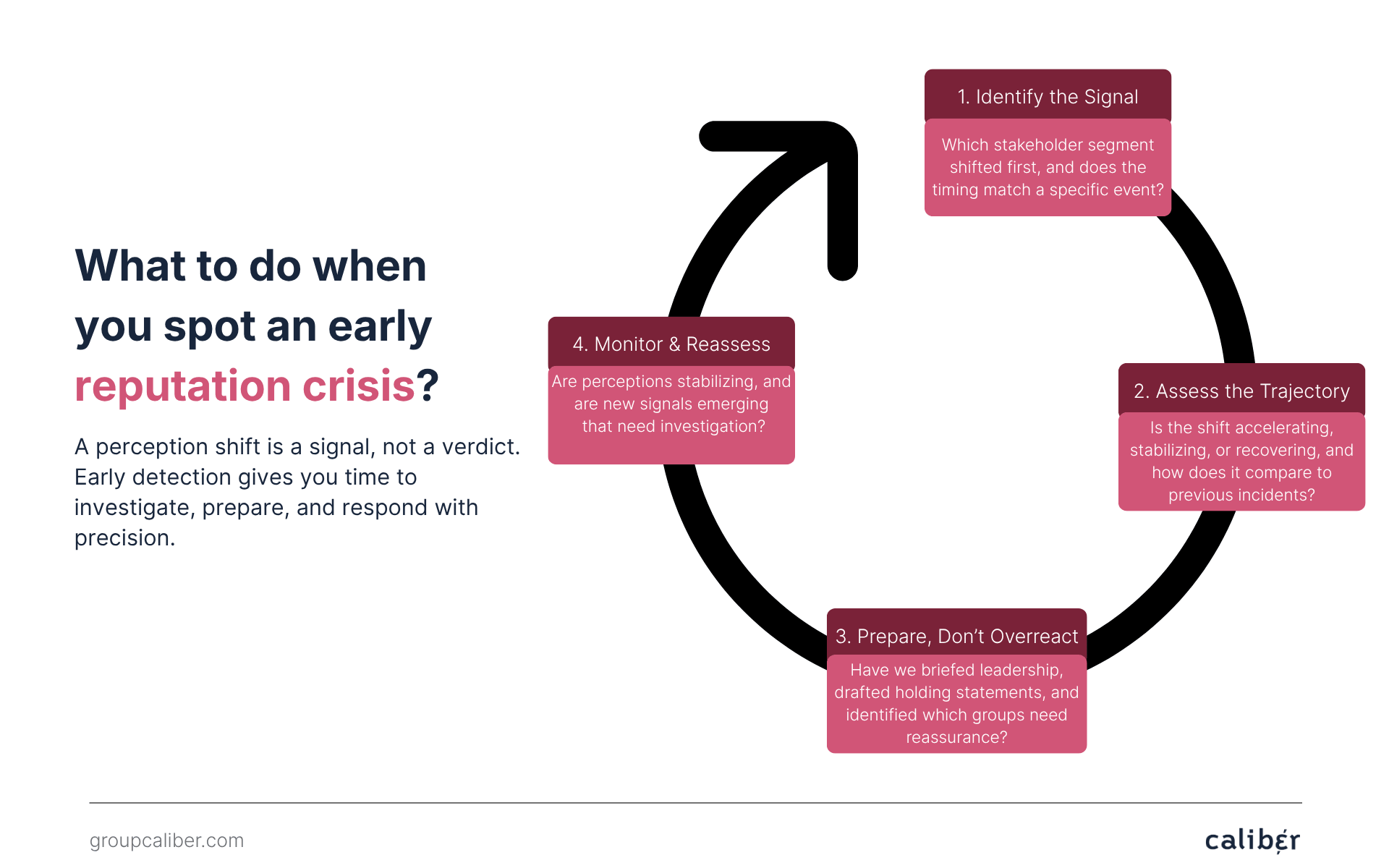
Investigate the cause. A dip in Integrity among opinion leaders could reflect a media report, a competitor campaign, a regulatory filing, or an internal event that has started to leak. Understanding the cause determines the appropriate response.
Assess the trajectory. Is the shift accelerating, stabilizing, or recovering? A one-day dip that bounces back the next week is different from a steady three-week decline. Caliber’s daily data provides the trend visibility to distinguish between noise and signal.
Prepare, don’t overreact. Early detection enables proactive preparation: briefing leadership, preparing holding statements, identifying which stakeholder groups may need reassurance. It does not mean launching a full crisis response to every perception fluctuation. In a 24/7 media cycle, that lead time can mean the difference between a contained risk and a full-scale brand reputation crisis.
Monitor the response. If you do take action, Caliber’s continuous measurement shows you whether it’s working. You can track whether the perception shift is stabilizing, which segments are responding to your communications, and which are not.
See the Slope Before You See the Cliff
Most companies discover a brand reputation crisis from the news. Caliber gives you continuous, multi-stakeholder perception data that surfaces warning signs before they reach the headline stage, measured daily across every group that shapes your success.
If you’d rather see the slope turning than the cliff you’ve already fallen off, book a demo and see what your stakeholders think right now.