Corporate reputation is one of the most valuable assets a company has, and one of the least understood. It drives purchasing decisions, talent attraction, investor confidence, and regulatory goodwill. Yet most organizations measure it with less rigor than they apply to financial performance, operational efficiency, or marketing ROI.
This reputation guide covers the complete picture: what corporate reputation is, why it matters at the C-suite level, how to measure it with the right metrics and methodology, how to build a corporate reputation strategy that connects measurement to action, and how to avoid the mistakes that leave most companies managing perception reactively instead of proactively.
Whether you’re building a reputation measurement program from scratch or looking to upgrade from periodic surveys to continuous stakeholder intelligence, this guide provides the framework, the metrics, and the practical guidance to do it well.
Key Takeaways
- Reputation is a perception construct that predicts behavior. Caliber’s global data shows a strong correlation between Trust & Like Score and supportive stakeholder behaviors. How people feel about your company predicts what they’ll do.
- The best measurement frameworks are hierarchical, not flat. A primary KPI (TLS) sits at the top, supported by attribute-level scores that explain what drives it, connected to behavioral outcomes that tie perception to business results.
- Measurement without strategy is a reporting exercise. The value of corporate reputation measurement comes from using it to inform decisions: which stakeholders to prioritize, which perceptions to address, how to allocate resources, and how to prove ROI.
Part 1: What Corporate Reputation Is and Why It Matters
What is corporate reputation?
Corporate reputation is the aggregate perception that stakeholders, customers, employees, investors, and more, hold about a company over time. For the full breakdown of what corporate reputation management involves and how it differs from PR, crisis communications, and ORM, see our guide to what corporate reputation management is.
Why corporate reputation matters at the C-suite level
Three areas make reputation a C-suite concern.
Revenue and commercial outcomes. Stakeholders who trust and like a company are more likely to buy, recommend, and advocate. Caliber’s global data shows an R²=0.84 correlation between its Trust & Like Score (TLS) and supportive stakeholder behaviors, including purchase consideration, recommendation, and advocacy. Companies with strong reputations convert attention into action more efficiently.
Talent attraction and retention. A LinkedIn survey found that 86% of workers would not apply for, or continue to work for, a company with a bad reputation. Employer reputation directly affects who enters your talent pipeline and how much you spend to attract them. Caliber’s Talent 360 measures how prospective talent perceives your company as an employer, giving CHROs the intelligence to target employer brand investment effectively.
Resilience and crisis recovery. Companies with strong pre-crisis reputations recover faster. Stakeholder goodwill acts as a buffer: when people already trust you, they’re more likely to give you the benefit of the doubt. Companies without that trust have no margin for error. Caliber’s continuous measurement allows companies to track the recovery curve at the segment level, providing evidence-based clarity on whether a crisis is resolved or simply out of the news cycle.
The business case in numbers
A 2007 Harvard Business Review article by Robert Eccles and colleagues estimated that 70–80% of market value comes from intangible assets like brand equity, intellectual capital, and goodwill. That proportion has only grown. Volkswagen paid over $30 billion in fines and settlements following its emissions scandal, illustrating the financial scale of reputational damage. And Gartner reports that 75% of organizations now struggle to fill full-time roles, making employer reputation a direct input to talent acquisition costs.
Part 2: The Complete Measurement Framework
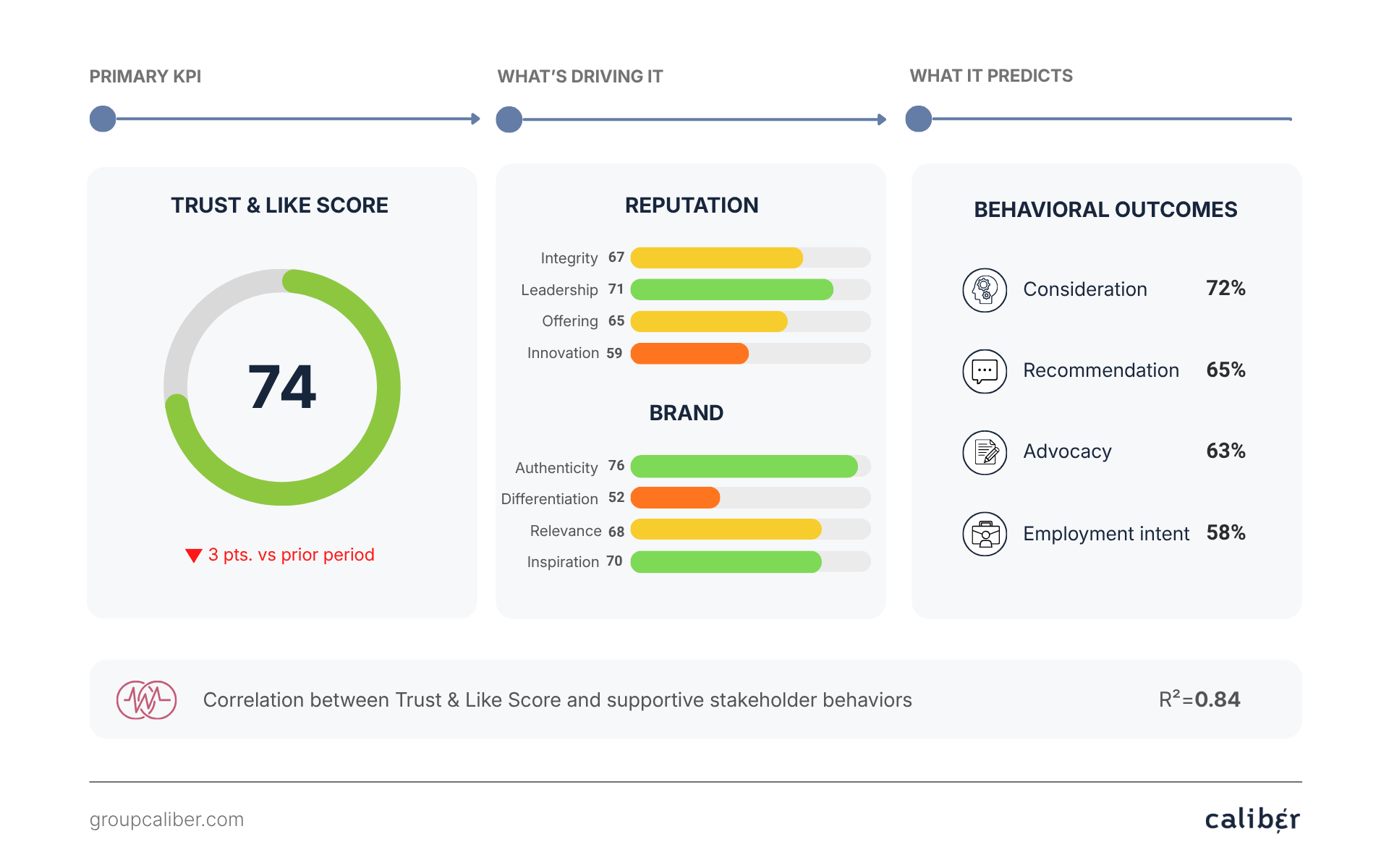
Corporate reputation measurement requires a framework that is hierarchical (organized from a top-level KPI down to specific drivers), multi-stakeholder (covering all groups that matter), continuous (updated daily, not quarterly), and connected to behavior (linking perception to the actions that affect your business).
Caliber’s measurement model was built specifically around these principles. Here is how the full framework works, layer by layer.
Trust & Like Score: the primary KPI
The Trust & Like Score (TLS) is the top-level metric in Caliber’s model. It captures overall emotional trust and affinity toward a company among a representative sample of stakeholders, measured daily through structured surveys across 60+ countries.
TLS serves as the single number that tells you whether your reputation is strengthening, stable, or eroding. Its strategic value comes from its validated connection to behavior: the R²=0.84 correlation means TLS predicts, with high accuracy, whether stakeholders will buy from you, recommend you, advocate for you, or consider working for you.
TLS is not the same as Reputation Score. TLS is the primary KPI that predicts behavior. Reputation Score breaks down the rational drivers underneath it. Understanding this distinction is essential for using the data correctly.
Reputation Score: the rational evaluation
The Reputation Score captures how stakeholders assess a company’s performance across four attributes.
Offering. Does the company provide compelling products and services?
Innovation. Is it seen as forward-thinking and adaptive?
Integrity. Does it operate ethically and transparently?
Leadership. Is it well-managed and strategically sound?
These attributes explain the “why” behind the TLS number. When TLS drops, the Reputation Score attributes tell you which dimension is driving the decline. A company with weakening Integrity scores needs a different response than one with declining Innovation perceptions. This specificity is what makes the data actionable.
Brand Score: the emotional connection
Caliber’s Brand Score captures the emotional and identity-level perceptions that shape how stakeholders feel about a company, measured across four dimensions.
Authenticity. Is the company genuine and true to its values?
Differentiation. Does it stand apart from competitors?
Relevance. Does it matter to the stakeholder’s life or work?
Inspiration. Does it inspire confidence or aspiration?
Brand and reputation are complementary. Reputation attributes capture rational assessment of how the company performs. Brand attributes capture emotional association with who it is. Companies need both to understand perception fully. Caliber measures them in an integrated model, so leadership teams can see how rational and emotional perceptions interact and which dimensions have the greatest influence on overall trust.
ESG Score: the responsibility dimension
Caliber’s ESG Score tracks stakeholder perceptions across three dimensions: Environment (environmental responsibility and sustainability practices), Society (impact on people and communities), and Governance (ethical conduct and accountability). ESG perceptions increasingly influence investment decisions, purchasing behavior, talent attraction, and regulatory relationships. Measuring what stakeholders believe about your ESG practices, which may differ significantly from your actual ESG performance data, is a distinct and necessary intelligence input.
Awareness and Familiarity: the qualifiers
Before stakeholders can trust or like your company, they need to know it exists and understand what it does.
Awareness measures whether stakeholders have heard of your company. High awareness is necessary but not sufficient.
Familiarity goes deeper: do they understand what the company does, what it stands for, and what it’s like to engage with? Caliber’s research shows that each step up the familiarity ladder adds roughly 8–12 points to TLS. The gap between awareness and familiarity is one of the most underrated sources of reputational risk.
Behavioral Outcomes: the business connection
The final layer in Caliber’s model tracks what stakeholders intend to do as a result of their perceptions.
Advocacy. Would they speak positively about the company?
Consideration. Would they consider buying from it?
Recommendation. Would they recommend it to others?
Employment intent. Would they consider working there?
This perception-to-behavior chain is what makes reputation measurement strategically relevant. It’s the difference between knowing your score and understanding what it means for your business. A drop in Advocacy among a key customer segment, even when overall TLS is stable, signals a behavioral shift that precedes commercial impact.
Part 3: Building a Corporate Reputation Strategy
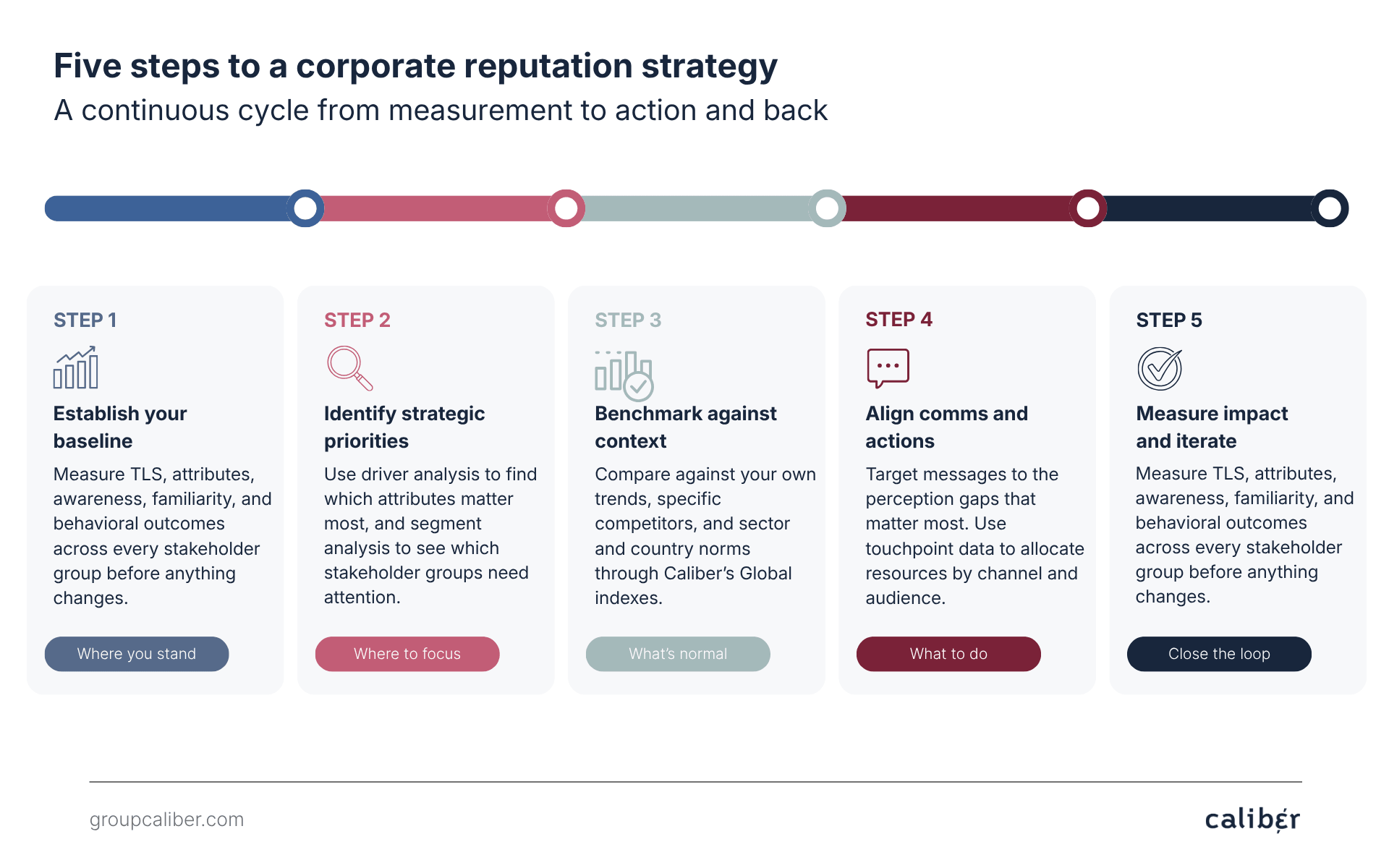
Measurement is the foundation. Strategy is what turns it into business value. A corporate reputation strategy is the deliberate, ongoing effort to understand where your reputation stands, identify where it needs to change, and take targeted action to close the gaps.
Step 1: Establish your baseline across all stakeholders
Before you can manage reputation, you need to know where it stands. That means measuring TLS, reputation and brand attributes, awareness and familiarity, and behavioral outcomes across every stakeholder group that matters to your business. Caliber’s Stakeholder 360 product provides this cross-stakeholder baseline in a single, continuous platform.
The baseline answers three questions: How are we perceived overall? Which perception dimensions are strong, and which are vulnerable? Where do significant gaps exist between stakeholder groups?
Step 2: Identify your strategic priorities
Not every perception gap is equally important. Driver analysis ranks reputation and brand attributes by their influence on TLS for your specific company and sector. If Authenticity is the strongest driver of TLS in your industry but your score is below sector average, that’s a high-priority gap. If Innovation is a weak driver in your sector, a low Innovation score may be less urgent.
Segment analysis adds another layer: which stakeholder groups need the most attention? A company with strong customer perception but weak employer reputation among talent has a specific strategic challenge that requires different resources and messaging than one with uniformly moderate scores across all groups.
Step 3: Benchmark against competitors and norms
A score without context is a number without meaning. Caliber provides three layers of benchmarking context.
Trend data. How are your scores changing over time? Is the trajectory positive, stable, or declining?
Competitive benchmarking. How do you compare to specific competitors, measured on the same methodology, at the same time?
Normative benchmarks. How do you perform relative to industry and geographic norms through Caliber’s Global Sector and Country Indexes?
This context separates real risk signals from normal fluctuation. A two-point TLS dip might be within normal range for your sector. A two-point dip concentrated in one stakeholder group over three consecutive weeks is something different entirely.
Step 4: Align communications and actions
Once you know where the gaps are, reputation strategy becomes communications strategy. Which messages address the perception dimensions that matter most? Which channels reach the stakeholder groups that need attention? Which proof points close the gap between what you say and what stakeholders experience?
Caliber’s touchpoint efficiency data shows which channels are most effective at influencing perceptions in each stakeholder group. This allows communications teams to allocate resources based on evidence rather than assumption.
Step 5: Measure impact and iterate
Corporate reputation strategy is not a one-time plan. It’s a continuous cycle of measurement, action, and reassessment. Campaigns, executive communications, product launches, and crisis responses all leave marks on stakeholder perception. Caliber’s continuous data lets you see how specific activities shift perception in near real-time, connecting communications investment to measurable outcomes.
This closes the ROI loop. When you can show that a campaign increased Authenticity scores among opinion leaders by 4 points, or that a leadership visibility program raised TLS among investors by 6 points, the business case for reputation investment becomes concrete.
Part 4: Seven Common Mistakes in Corporate Reputation Measurement
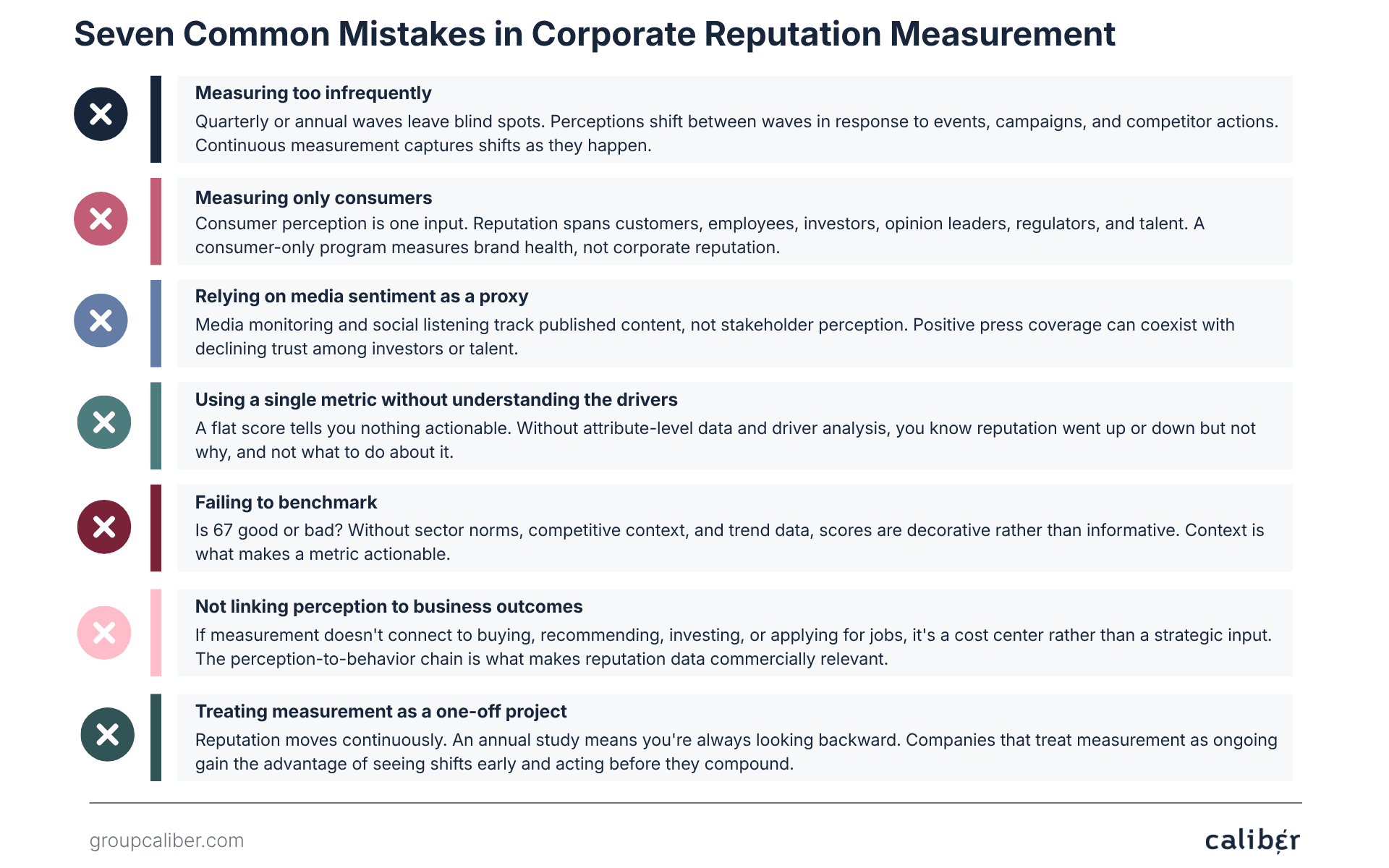
- Measuring too infrequently. Quarterly or annual measurement leaves blind spots between waves. Perceptions shift in response to events, campaigns, and competitor actions. By the time the next wave runs, you’ve missed weeks or months of signal. Continuous measurement captures shifts as they happen.
- Measuring only consumers. Consumer perception is one input. Reputation spans customers, employees, investors, opinion leaders, regulators, and talent. A program that only tracks consumers is measuring brand health, not corporate reputation.
- Relying on media sentiment as a proxy. Media monitoring and social listening track published content, not stakeholder perception. A company can have positive press coverage and declining trust among investors. Social listening captures what a vocal online minority posts, not what a representative cross-section of stakeholders believes.
- Using a single metric without understanding what drives it. A flat score tells you nothing actionable. Without attribute-level data and driver analysis, you know your reputation went up or down but not why, and not what to do about it.
- Failing to benchmark. Is 67 good or bad? That depends on your sector, your geography, and your competitors. Without normative and competitive context, scores are decorative rather than informative.
- Not linking perception to business outcomes. If measurement doesn’t connect to the behaviors that affect your business (buying, recommending, investing, applying for jobs), it’s a cost center rather than a strategic input. The perception-to-behavior chain is what makes reputation data commercially relevant.
- Treating measurement as a one-off project. Reputation is not a static asset. It moves continuously in response to what you do, what competitors do, and what happens in the world. Treating measurement as an annual exercise means you’re always looking backward.
Part 5: Who Owns Corporate Reputation?
Corporate reputation doesn’t belong to one function. It spans the organization, and effective management requires cross-functional coordination around shared intelligence.
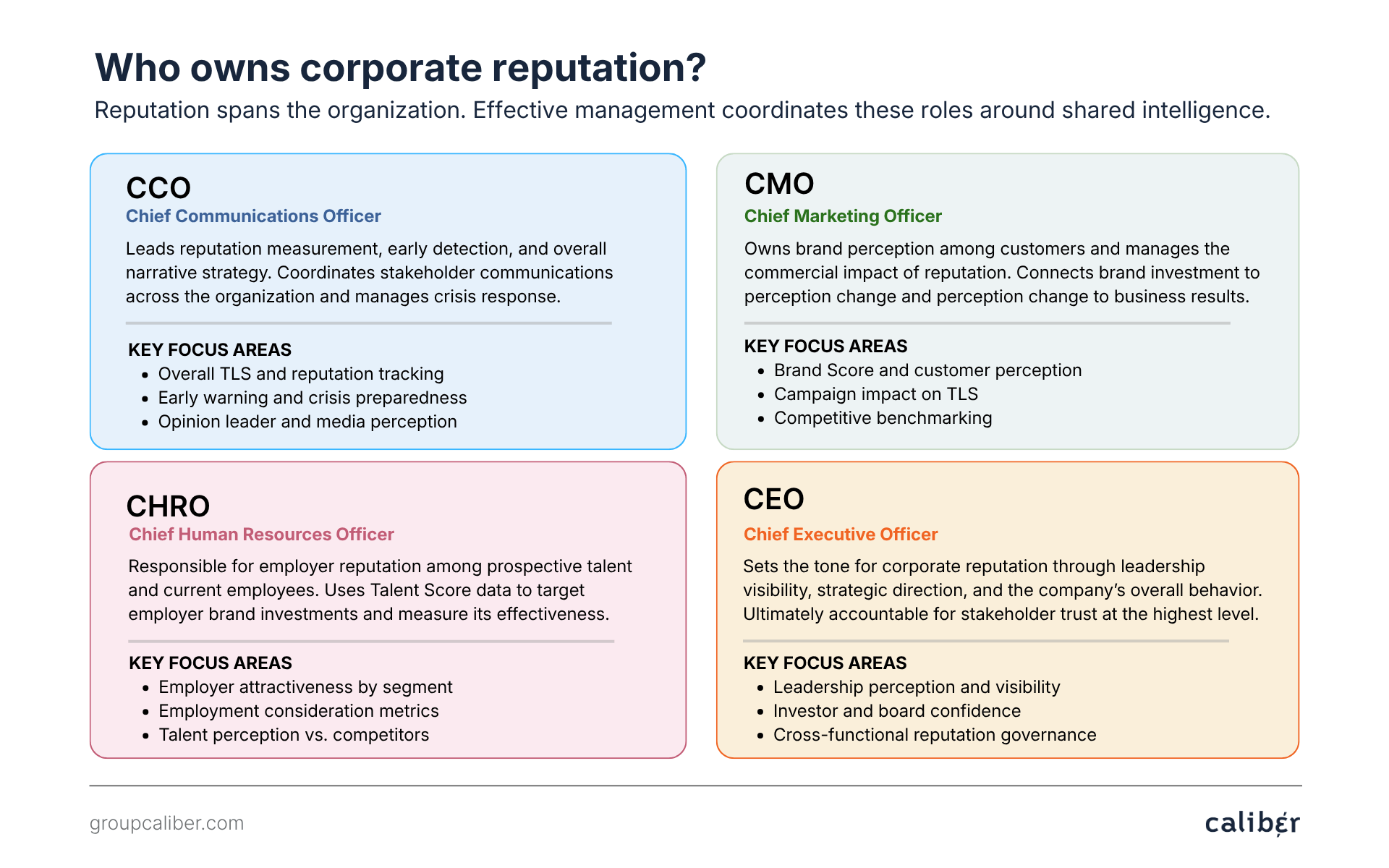
The CCO typically leads measurement, early detection, and reputation strategy. They coordinate the overall narrative and manage stakeholder communications.
The CMO owns brand perception among customers and manages the commercial impact of reputation through campaign effectiveness and brand tracking.
The CHRO is responsible for employer reputation among prospective talent and current employees. Caliber’s Talent 360 provides the external perception data that informs employer brand strategy.
The CEO sets the tone for corporate reputation through leadership visibility, strategic direction, and the company’s overall behavior in the market.
Investor relations manages perception among the investment community, where trust and governance perceptions directly affect valuation and cost of capital.
Caliber’s platform is built for this cross-functional model: a shared dashboard where each function accesses the stakeholder data relevant to their remit while seeing how their piece connects to the company’s overall reputation. This shared intelligence is what separates reputation management from siloed tracking running in parallel without connection.
Part 6: How Caliber Fits Into This Framework
Caliber is a stakeholder intelligence platform that provides the measurement and intelligence infrastructure described throughout this guide. It was founded in 2016 by former Reputation Institute directors who recognized the limitations of periodic, single-stakeholder research and built a platform for continuous, multi-stakeholder intelligence from day one.
Caliber has conducted more than 4 million stakeholder interviews and tracked over 6,000 companies in 40+ countries. Its clients include Airbus, ASML, AstraZeneca, BASF, Boehringer Ingelheim, Henkel, and Novo Nordisk.
The platform integrates surveys with media monitoring, share price data, market signals, and web analytics, using AI to connect diverse data sources into a unified intelligence ecosystem. An AI assistant provides conversational access to perception data, answering questions and surfacing patterns directly within the platform.
Caliber does not do reputation management. It provides the intelligence layer that enables it. The strategy, the communications, and the actions remain with the CCO, CMO, CHRO, CEO, and their teams. Caliber provides the continuous, stakeholder-level data that makes those decisions informed, timely, and evidence-based.
Start Measuring What Matters
Corporate reputation is too important to manage on assumptions. Caliber gives you the continuous, multi-stakeholder intelligence to understand how you’re perceived, why it’s changing, and what to do about it.
If you’re ready to build a reputation measurement and strategy program backed by data, book a demo and see where your reputation stands today.