Financial anxiety persists, trust has plateaued, and product quality alone won’t set you apart. Our inaugural Stakeholder Intelligence Report surfaces six findings that should reshape how companies communicate with US audiences in 2026.
1. Financial sentiment is gloomy but unchanged
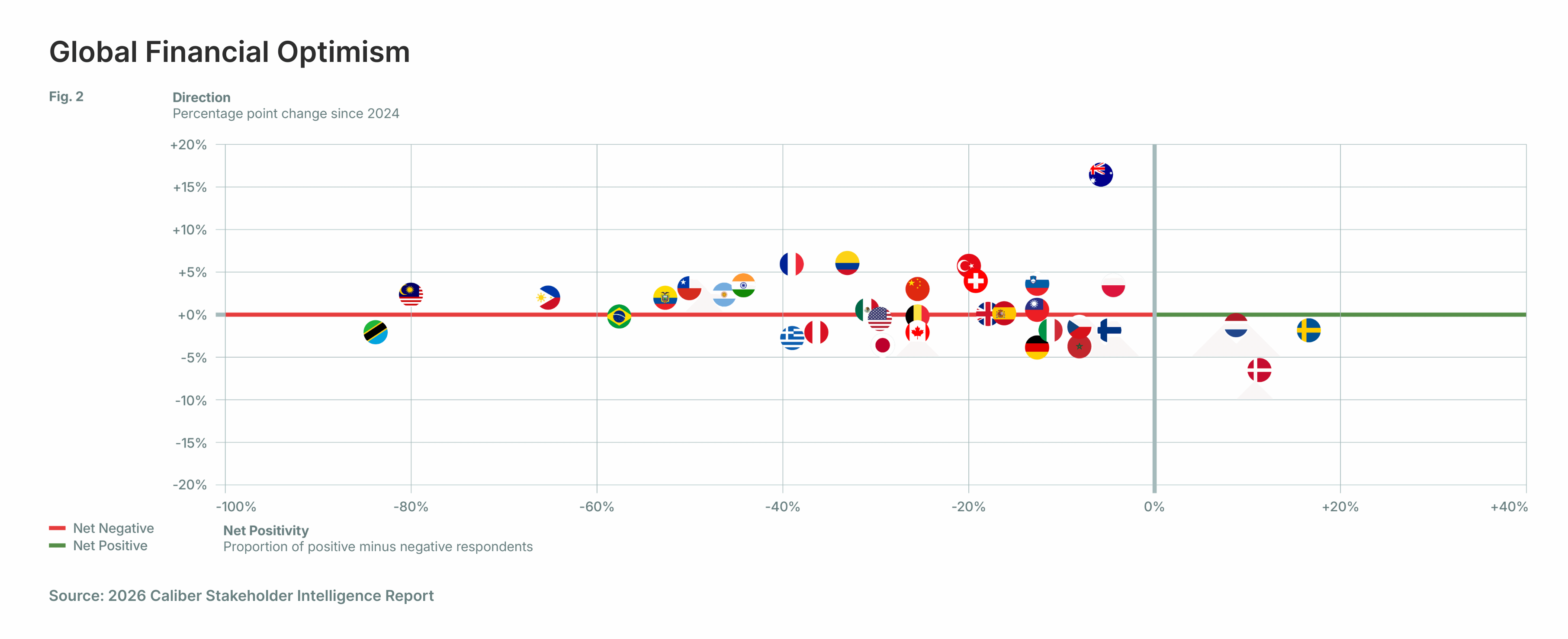
US stakeholders’ financial optimism level stands at −30 pp (share of optimists minus share of pessimists), unchanged from 2024, meaning pessimism has stabilized rather than deepened, but has found no floor for recovery either.
In a global context, the US is more pessimistic than Germany (−12 pp) and Canada and China (both −25), but more optimistic than France (−39) and India (−44). The outliers to watch remain the Netherlands, Denmark, and Sweden — the only three markets in the study that were net positive last year.
This ambient economic anxiety is relevant context for communications strategy. Audiences who feel financially insecure are more likely to scrutinize corporate behavior, less forgiving of perceived overreach or tone-deafness, and more responsive to brands that demonstrate genuine relevance to their lives.
2. Overall trust in business is stable
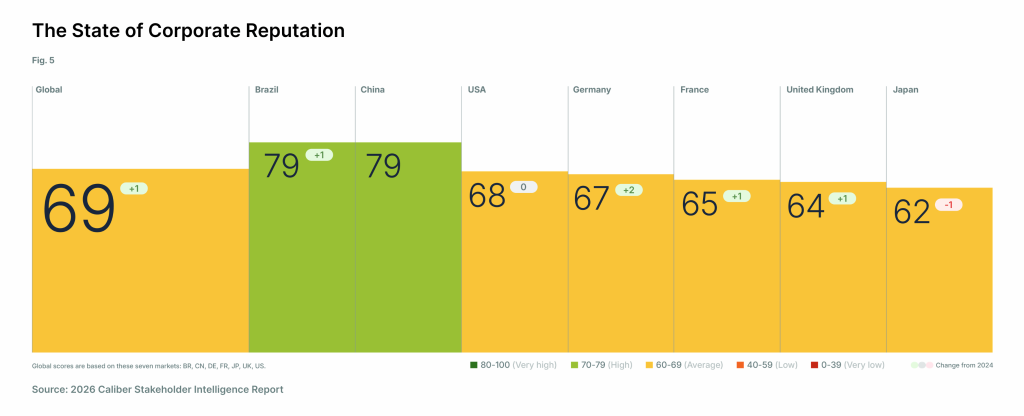
The average Trust & Like Score in the US is 68, flat versus 2024 and broadly in line with the global average of 69. It outperforms France, Germany, the UK, and Japan, but the absence of upward movement is notable in a market where companies have invested heavily in purpose and reputation initiatives.
3. "Offering" drives trust, with brand attributes close behind
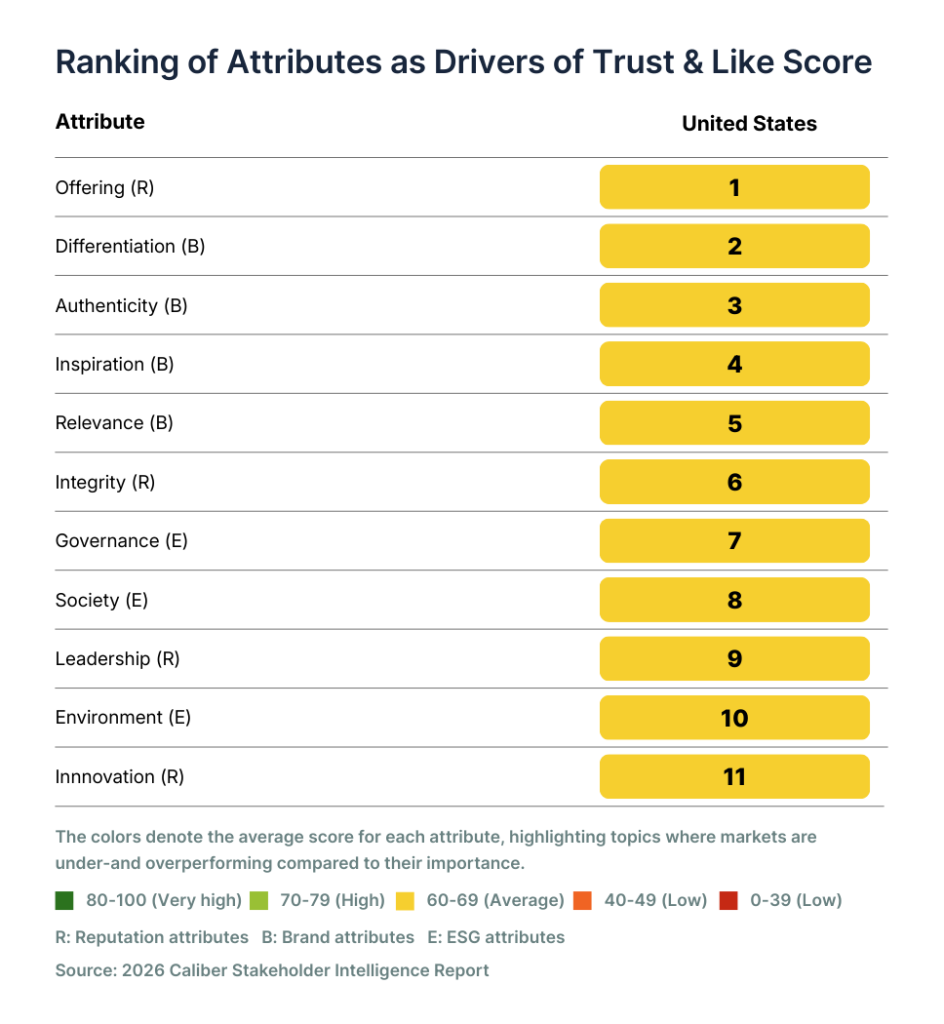
Analysis of 11 brand and reputation attributes reveals which ones deliver the most return on investment in brand, communications, marketing, and HR. The US finding is distinctive: “Offering compelling products and services” is the strongest driver of Trust & Like Scores, a more product-rational result than many other markets.
But Offering alone is not enough. Ranking 2nd through 5th are brand attributes, specifically: Differentiation, Authenticity, Inspiration, and Relevance. The pattern is consistent with what we see globally: once a company clears the credibility bar set by its products and services, the attributes that create genuine competitive distance are attitudinal.
Attributes like Innovation and Leadership function as table stakes: they establish credibility and provide a license to operate, but they do not differentiate. Brand attributes are where stakeholders develop a real desire to engage. Companies that put authentic human stories, clear values, and relatable voices at the heart of their communications build trust and loyalty that a competitor’s feature list cannot replicate.
For heavily regulated sectors in particular, technical competence is assumed. The real opportunity lies in who you are, not just what you do.
4. Governance matters to US job seekers
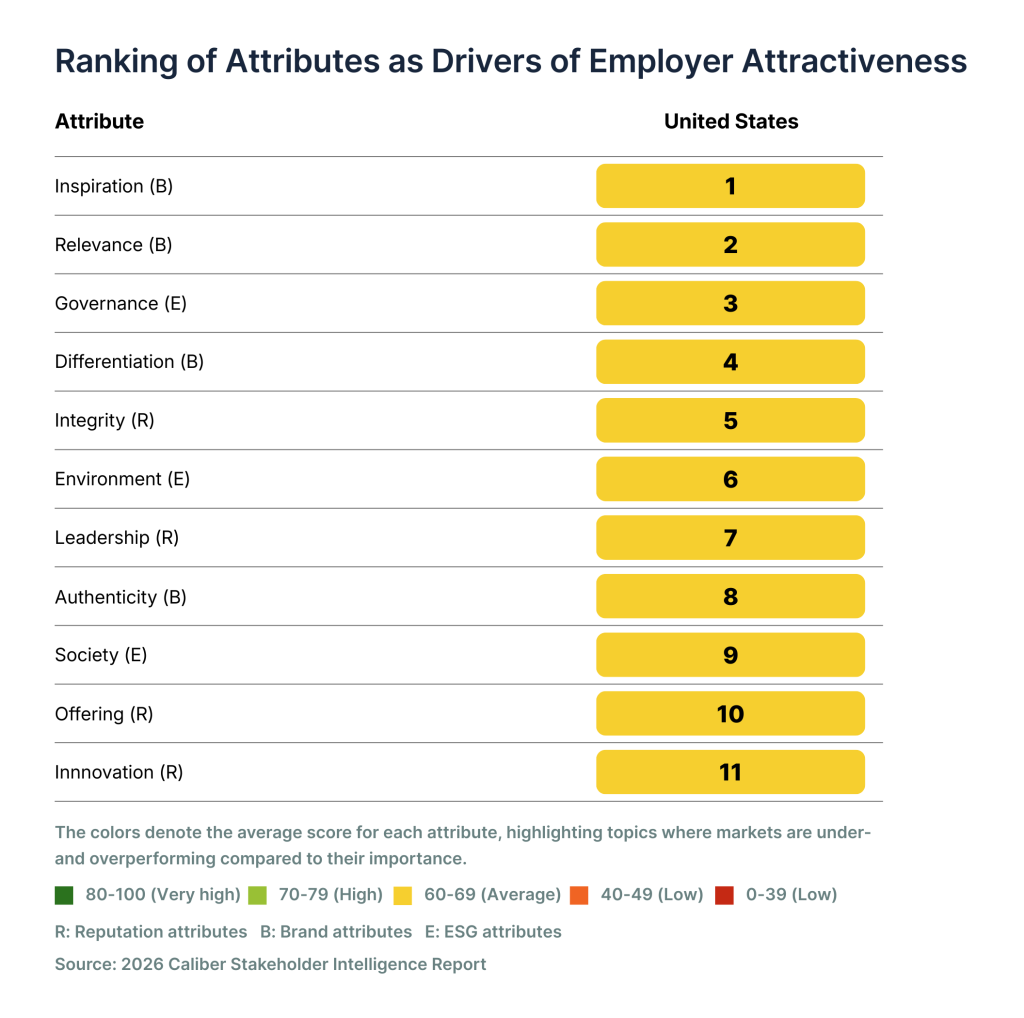
A parallel driver analysis — this time focused on employer attractiveness rather than overall trust — surfaces a distinctly American finding.
While Inspiration and Relevance take the top two spots, Governance ranks third: job seekers in the US weigh ethical conduct more heavily than differentiation, authenticity, innovation, or a company’s impact on people and planet.
In a market shaped by high-profile corporate controversies and growing employee activism, this is both a risk signal and an opportunity. Companies with genuinely strong governance records have a concrete employer branding asset, one that goes beyond culture messaging and speaks directly to what US talent is evaluating when choosing where to work.
5. The Familiarity Effect: familiarity breeds contentment
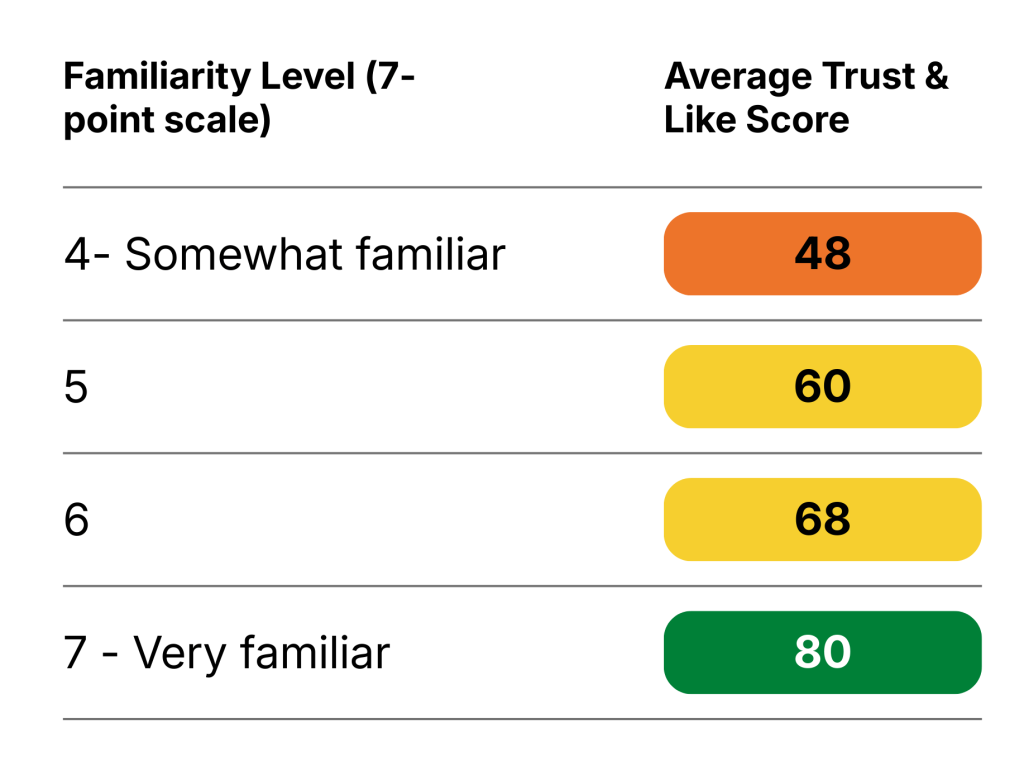
One of the most actionable findings in the data is the relationship between familiarity and trust. The hypothesis is intuitive — the more familiar a stakeholder is with a company, the higher their Trust & Like Score — and the data confirms it clearly. The more compelling implication is what happens when companies actively move stakeholders up through familiarity levels.
For Fortune 30 companies, the average Trust & Like Score rises as follows:
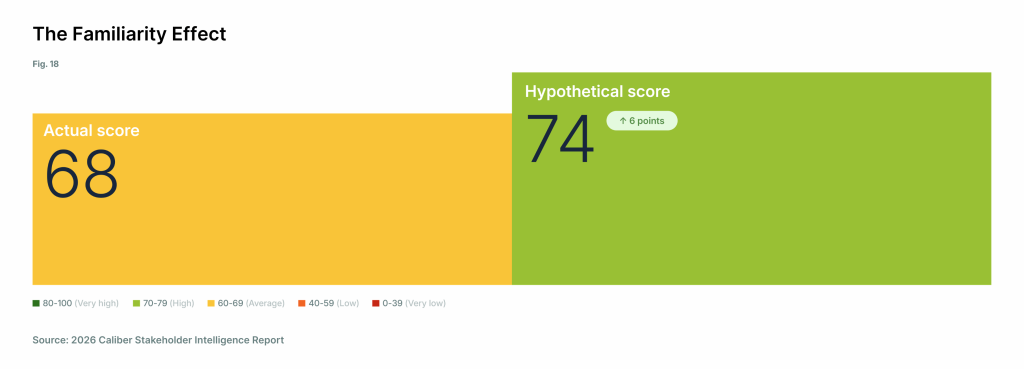
Each step up the familiarity ladder adds roughly 8–12 points to the Trust & Like Score. Moving a stakeholder from tier 4 to tier 7 represents a 32-point lift in trust. More practically: if a Fortune 30 company were to move each tier of its stakeholders up just one familiarity level, it would see an estimated 6-point rise in its overall Trust & Like Score — from 68 to 74.
This is not a marginal effect. Increasing the visibility and depth of engagement with key stakeholder groups is not a soft communications objective, but a direct driver of the scores that matter.
Companies that invest in sustained, meaningful contact with their audiences — rather than episodic campaign bursts — can build a compounding trust advantage that lower-familiarity peers cannot easily close.
6. Stakeholder trust varies meaningfully by audience
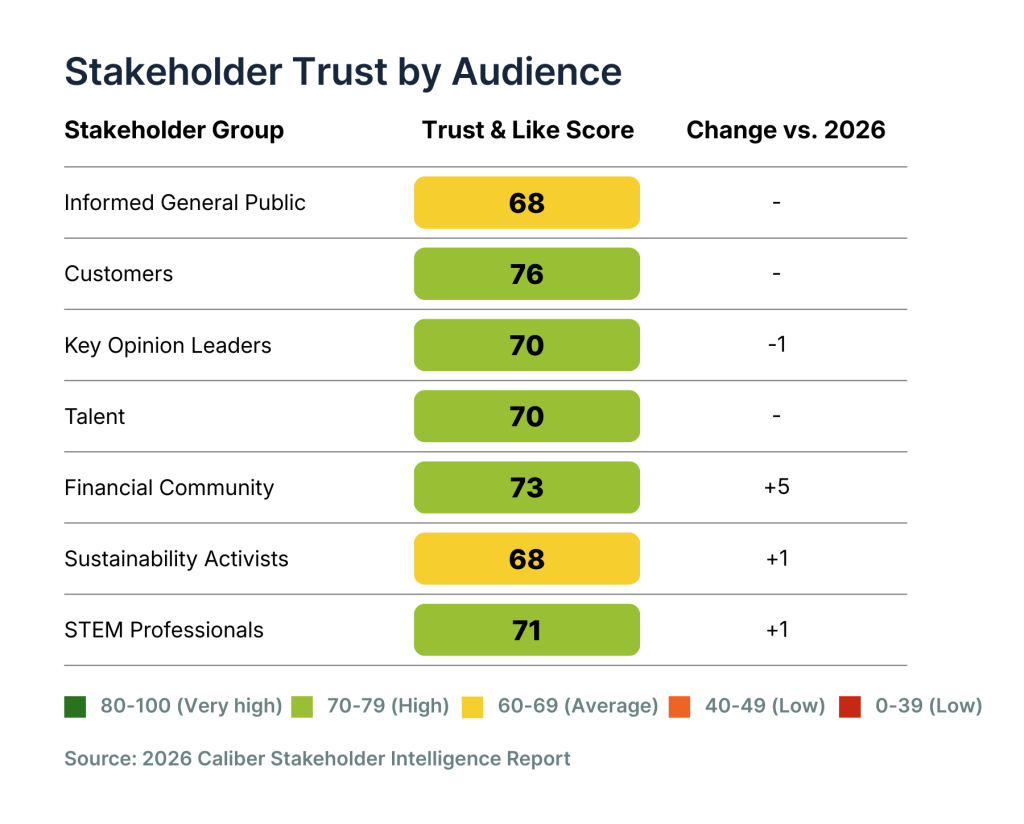
The US shows a substantial spread across stakeholder groups: an 8-point gap between the most and least positive audiences, which is wider than many comparable markets and signals that different stakeholder segments are having meaningfully different experiences of companies operating here.
The standout mover is the Financial Community (+5), suggesting that IR- and analyst-oriented communications are gaining meaningful traction. KOLs are the only group to have declined (−1), a modest but worth-watching signal for media and influencer strategy.
Taken together, these six findings point to a single strategic imperative: sustained, substantive engagement beats episodic visibility every time.
In a market where pessimism is entrenched, trust scores are flat, and different stakeholder groups are pulling in different directions, the companies that will gain ground are those that treat communications as a long-term compounding investment — not a campaign — going deeper with their key audiences to build the familiarity, authenticity, and governance credibility that no product launch or purpose statement can shortcut.