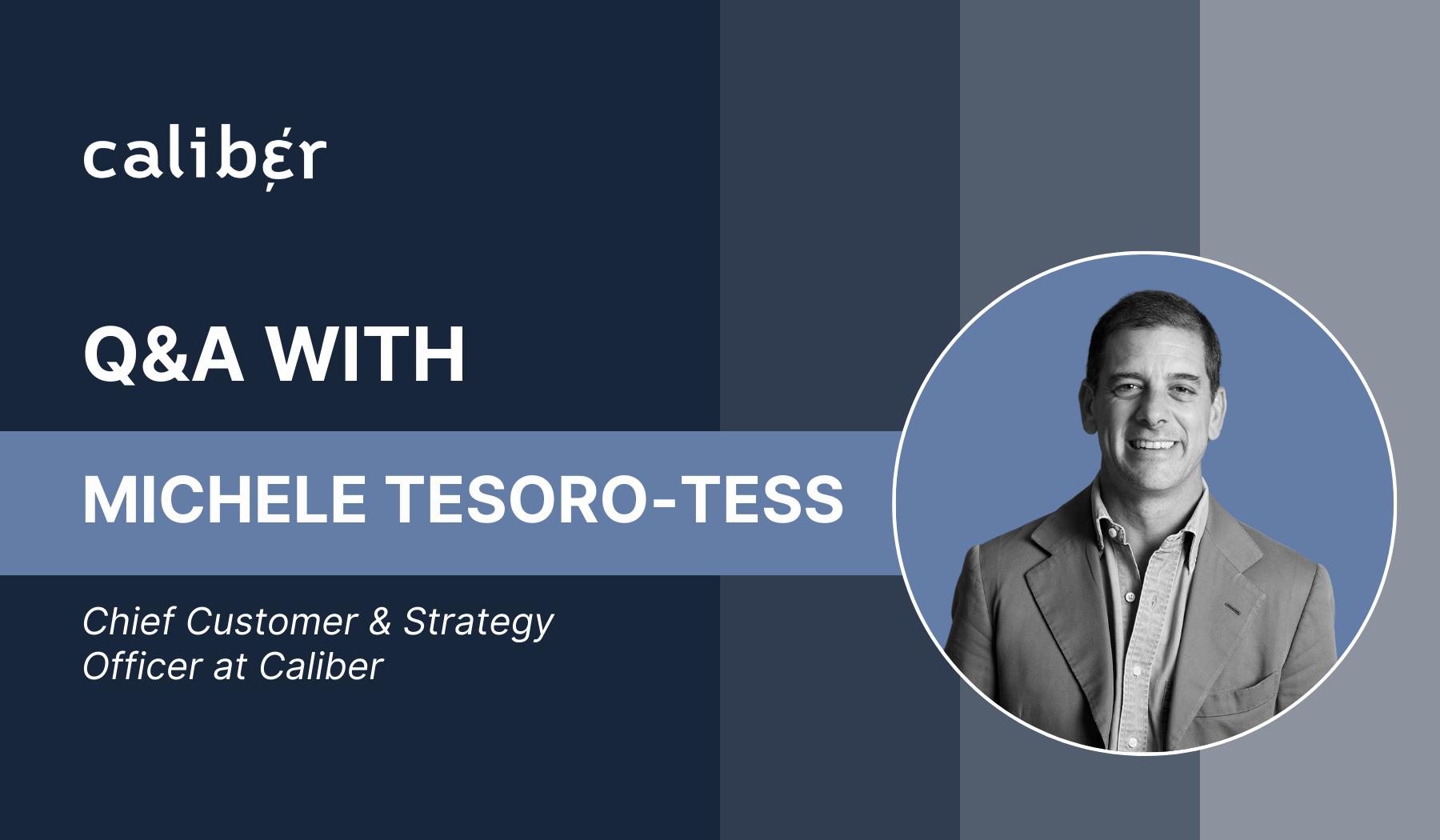
An interview with Michele Tesoro-Tess, Caliber’s Chief Customer & Strategy Officer, on his career path, the data-driven epiphany he had in California, and why real-time stakeholder intelligence is a strategic asset that the C-suite can’t afford to ignore.
I began my career as a consultant in communications, HR, change management, and stakeholder relations. But the inflection point came when I was doing my master’s in Strategic Communications Management at the University of Lugano back in 2009.
The master’s program included a summer at UCLA’s Anderson School of Management in Los Angeles. There, someone from a major communications consultancy presented this huge dashboard combining media metrics, stakeholder metrics, and reputation metrics — all integrated to help manage an entire stakeholder universe.
Seeing those metrics tied together in a way that could inform real strategy was a revelation for me. I thought, This is the future. It was the first time I saw how data and intelligence could transform the way businesses manage intangible assets like culture, communications, and stakeholder relationships.
That moment set me on an entirely new career path focused on connecting data and intelligence with stakeholder management.
Exactly. And it came from frustration. For the first ten years of my career, every presentation I made to CEOs, CCOs, or CHROs was based on opinion.
They would ask, “Why should we do this and not that?” “Well, because I feel it’s what needs to be done.” When I saw that data, I realized opinions could be set aside.
It’s not about opinions — it’s about what data says. We can move away from an opinion-based conversation and rely on data that informs decisions and builds intelligence as an asset to stand behind.
It’s evolved tremendously over the last fifteen years, and I see that evolution in distinct phases.
When I started, it was all about reputation research. Companies commissioned big studies, often static, often done once a year. Then came reputation management — the realization that the value isn’t just in having the data but in applying it to decision-making.
After that, companies began demanding more proactive reputation management. They wanted to understand trends, not snapshots. They couldn’t wait months between data waves because their reality was changing too quickly.
That shift was happening already, but COVID amplified it dramatically. Remote work reshaped the HR function. Gen Z’s expectations were completely different from earlier generations. So the area of reputation management expanded from the CCO to the CHRO, whose questions were: “How do we source talent now? What are the expectations of these people?”
At the same time, marketing began focusing more on values and purpose, not just consumer-focused conversations, while geopolitical tensions rose, AI emerged as a disruptive force, and economic instability became the norm. These overlapping crises — what some call the polycrisis — forced companies to see reputation not as a communications issue but as something deeply relevant to every part of the C-suite.
That’s how the concept of stakeholder intelligence emerged: a need to understand in real time how different audiences, with different levels of influence and different priorities, were reacting to events happening inside and outside the company. It’s a huge shift from where we were.
Absolutely. Early in my career, companies were doing one or two data waves a year. Eventually, companies wanted quarterly waves, then monthly. Monthly data felt revolutionary because we started to see trends. But when COVID hit, even monthly wasn’t enough. There was simply too much time between data collection and insights. We had clients going through crises asking for biweekly or even more frequent data.
But even that was limited. I kept thinking about situations like Dieselgate. Back then, I did a deep analysis to see if the scandal impacted Volkswagen’s financial performance. We discovered something interesting: sales didn’t decline because Volkswagen dropped prices and consumers responded to the price signal more than the scandal.
But profitability did correlate strongly with reputation decline. The challenge was that the monthly data made it hard to see the timing with real precision. That’s when we started thinking seriously about real-time data — not because it sounded nice but because strategically it was essential.
And now we can do that. We have clients tracked weekly, and for some metrics, essentially in real time. For example, in Italy recently, there was a huge discussion around a commercial bank acquiring one of the country’s most prestigious investment banks. Because we track both banks weekly, we saw awareness levels jump to nearly 90 percent, which is astronomical in the banking sector.
Seeing this was only possible because we had real-time data. Then, in the week of 15 September, the Trust & Like Scores of both banks combined reached 89, which is completely out of range.
The ability to have real-time data changes completely the paradigm for CCOs and boards because it allows them to have a crisis-ready tool and to be able to respond on a daily basis — to make decisions whether to respond or to stay silent.
Yes. One client I’ve worked with for many years integrates Trust & Like Scores with share price, media coverage, media sentiment, and key articles. After one earnings announcement, media volumes skyrocketed and sentiment dropped because the coverage was negative. The CFO asked the CCO whether they should respond to the flood of negative articles. But by examining all the data together, we saw that the share price remained stable and the Trust & Like Score was completely flat.
It was a perfect example where media noise did not translate into reputational impact. That combination allowed us to look at the CCO and say, “Based on the facts, just stay silent. It’s all noise. You don’t have to worry about it because your intangible asset, your value, is not being touched at all. Your reputation is resilient.”
That’s the power of integration. It’s not that the media never affects reputation; it absolutely does. It’s that the effect varies enormously depending on the company, sector, and moment. Only integrated intelligence reveals the truth.
Every strategic decision touches multiple audiences, but historically, tracking multiple stakeholder groups was incredibly expensive. Each one required a separate sample, a separate panel, a separate cost line. If you wanted to track seven or eight different stakeholder groups, you were quickly talking about a million-dollar program per year.
The unique capability that Caliber has is that we’re able to derive all stakeholder audiences from the same general public dataset. This allows us to be very competitive in the marketplace because we can offer multistakeholder across endless audiences at a very cost-competitive offering.
It’s a disruptive game-changer for CCOs because now they can actually have a multi-stakeholder intelligence overview on a tech platform at a very competitive price.
Yes, it’s about proving the relevance of the intangible side of the business, which implies correlating different metrics. You have to take the dependent metric, like our Trust & Like Score, and correlate it with a business metric to understand whether it has an impact on the business.
I first worked on this seriously in 2016 when I correlated reputation metrics with ARPU (average revenue per user) and churn for a telecom/media company. The correlations were strong, but the data was only monthly.
If we only look at perception metrics in isolation, we’re just saying perception is either growing or decreasing, which is important. But proving that there is a business impact changes the game completely because you can sit at the table with a CFO and the CEO and have a conversation, not just a communications conversation.
Today, we can correlate the Trust & Like Score with share price movements, ESG ratings, social media data — any metrics a company wants. That’s where we’re going to make our mark in the future— the combination of different data sources.
Integrating data sources is the secret sauce. If you look at ten separate datasets individually, it’s paralysis by analysis. But when you combine them and run advanced analytics to determine what leads, what lags, and what correlates with what, the complexity drops dramatically.
And AI is accelerating that process — not replacing human interpretation, but highlighting patterns that used to be buried. We’re still far from perfect causal models, but we’re moving towards it.
I like to use the newborn analogy: first you crawl, then you walk, then you run. Companies that try to “run” immediately — integrating everything at once — usually struggle. The data overwhelms them, and internally, it can damage credibility.
The right approach is to start with the most business-critical audiences — the ones tied to your strategy — then connect media and perception data.
Every CEO reads the media every morning. But very few know whether published opinion actually influences public opinion. The alignment or misalignment between the two is incredibly powerful to see. And then you bring your C-suite peers on the journey, showing how the data links to the strategic objectives already agreed upon.
We’ve found a very cost-competitive way of doing it that removes the barriers to entry and allows people to experiment with the options.
We have a lot of options, including flexibility around sample size. We allow companies to decide whether or not to customize the platform, and the degrees of customization are endless. We allow people to integrate different data sets through APIs, and the amount is up to the client to decide.
We allow clients to have an overview of the geopolitical and macroeconomic environment through our global context and financial indicators. And we provide the option of 20-plus stakeholder audiences or just the general public. We’ve got tons of flexibility, which allows C-levels to play with the options at a very hospitable price.
Mindset. Many CCOs are used to operating in a world of narrative and opinion. Real-time data introduces transparency they’re not always comfortable with.
Some worry that exposing real-time metrics to their CEO could backfire. But the world is moving in that direction regardless. The more we educate the market and demonstrate clear business value, the faster the mindset shifts.

James is a communications strategist and senior content lead at Caliber, where he writes about corporate reputation, stakeholder intelligence, and brand trust. He draws on more than a decade of experience helping organizations turn data into stories that build credibility and connection.
You may also be interested in
Follow Caliber
Get the results of our latest research directly in your inbox!