
The EU’s Omnibus Directive, in force since March 18, 2026, cut the number of companies required to report under the CSRD and reduced mandatory disclosure datapoints by roughly 61%. For many companies, the compliance bar just got lower. The stakeholder bar did not move at all.
An ESG strategy is how a company manages its environmental, social, and governance priorities in a structured, measurable way: which issues it prioritizes, how it integrates them into real business decisions, and how it reports on progress. Improving your ESG ratings starts here, with a deliberate strategy, not a stack of disclosures assembled to meet a filing deadline.
This guide covers why ESG strategy still matters even where regulation has eased, what today’s ESG expectations mean for how you build one, and the practical steps that improve ESG ratings over time.
Key Takeaways
- Lighter regulation does not mean lower stakes. The EU’s Omnibus Directive narrowed CSRD scope to companies with more than 1,000 employees and over €450 million in turnover, but investors, employees, and customers are not lowering their own expectations to match.
- ESG ratings are still tied to the cost of capital. According to MSCI’s 2024 study of ESG ratings and financing costs, the lowest-rated companies in its sample financed themselves at an average of 7.9%, compared to 6.8% for the highest-rated group.
- Caliber helps companies confirm whether an ESG strategy is actually landing with stakeholders, once it has been built, by tracking real-time reputation data alongside the strategy itself.
Why ESG Strategy Is Central to Corporate Performance in 2026
ESG has moved from a marginal consideration to a core indicator of business performance in a remarkably short window. According to Ocean Tomo’s 2025 Intangible Asset Market Value study, released in February 2026, intangible assets, including reputation, brand, and intellectual property, now make up approximately 92% of S&P 500 market capitalization, up from just 17% in 1975.
When nearly all of a company’s value sits in things that cannot be measured on a balance sheet, how stakeholders perceive a company’s ESG conduct becomes a direct driver of enterprise value, not a side concern for the communications team.
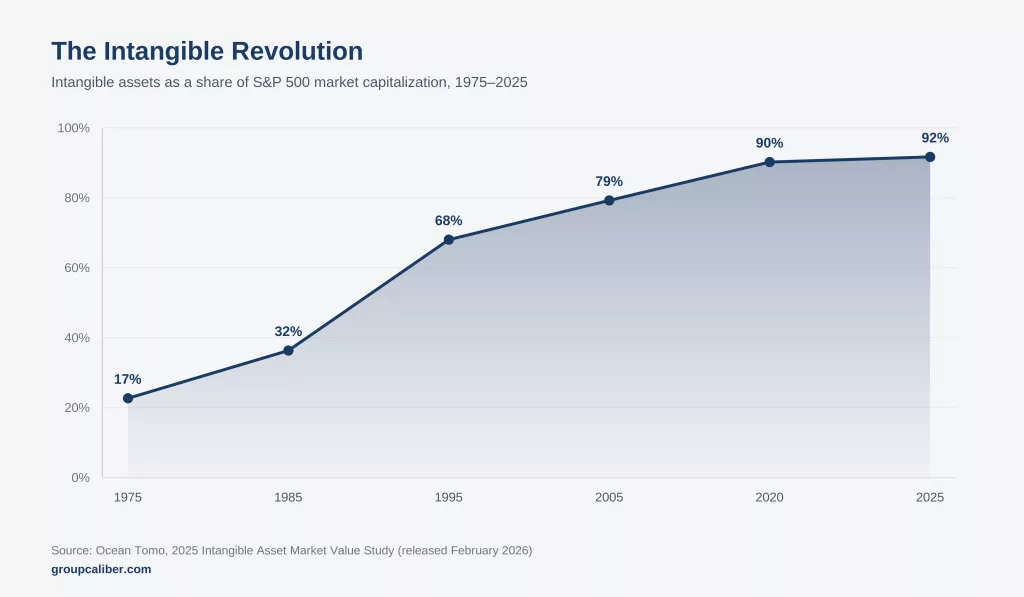
Ocean Tomo's 2025 Intangible Asset Market Value Study (released Feb 2026): 92% of S&P 500 market cap, up from 17% in 1975.As one industry leader put it:
“Companies that have not taken ESG strategy seriously face a risk in terms of branding, investor preference, and their ability to transform at a time when business models need to be sustainable. Doing business as usual is no longer a valid option.”
Niko Avonas, President of CSE
Investor pressure reinforces the same point. Institutional investors increasingly build ESG criteria into how they evaluate and select companies, and governments in several markets now factor sustainability performance into market access decisions. That pressure has not eased just because reporting requirements in the EU have.
As Caliber’s CEO and co-founder puts it:
“In our work with multinational companies around the world, we have seen ESG becoming the key reputational battleground to secure customer loyalty, talent attraction, and advocacy from opinion leaders. Those who do it well, and do it differently, win.”
Shahar Silbershatz, CEO & Co-founder of Caliber
What Today’s ESG Expectations Mean for Your ESG Strategy
Three shifts define what companies need to account for when building an ESG strategy today.
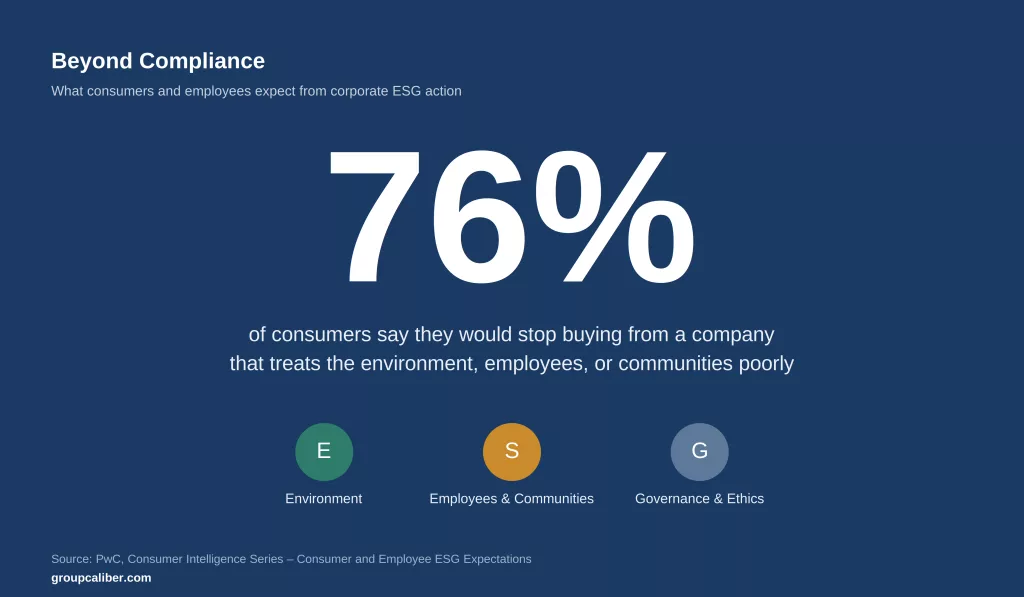
The public expects responsible behavior, not just disclosure.It is no longer a nice-to-have for companies to behave ethically, sustainably, and responsibly. It is a baseline expectation among consumers and employees alike. Tracking ESG performance against this expectation lets a company identify problem areas, benchmark its progress, and communicate that progress transparently, rather than assuming disclosure alone satisfies the expectation.
Strong ESG performance still shows up in the numbers. MSCI’s 2024 study of ESG ratings and cost of capital found that companies in the top ESG-rating quintile financed themselves at an average rate of 6.8%, compared to 7.9% for the bottom quintile, over a study period running from August 2015 through May 2024. A well-executed ESG strategy is not just a reputational hedge. It shows up directly in financing costs.
Perception shapes both brand and investor confidence. Companies seen as strong ESG performers are also perceived as better at anticipating future risk, thinking long-term, and creating durable value. That perception depends on ESG initiatives genuinely aligning with a company’s stated purpose and public image, not just existing as a separate reporting exercise. Strengthening this alignment supports stronger stakeholder relationships, better access to capital, and more durable trust over time.
Why ESG Strategy Still Matters, Even as EU Regulation Eases
For the past two years, EU sustainability regulation has moved in one direction: less. The Omnibus Directive, finalized in February 2026 and in force since March 18, narrowed CSRD and CSDDD scope substantially and simplified the European Sustainability Reporting Standards. Fewer companies are required to report, and those that still do report on fewer datapoints.
None of that changes what investors, employees, and customers expect. It changes what regulators require.
The EU’s Omnibus Directive Changed the Compliance Bar for ESG Reporting, Not the Stakeholder Bar
Companies that scale back their ESG strategy because mandatory reporting requirements eased are solving the wrong problem. Regulatory reporting is a floor, not a strategy. Investors still weigh ESG factors in capital decisions, employees still factor governance and workplace ethics into where they choose to work, and customers still make purchase decisions partly on perceived corporate conduct. A lighter compliance requirement does not reduce any of that.
ESG Ratings Still Correlate With a Lower Cost of Capital
The financial case for a strong ESG strategy remains measurable even as reporting mandates shrink. Investor demand has not disappeared either: the US SIF Trends Report for 2025/2026 puts $6.6 trillion in U.S. assets under management explicitly marketed as ESG or sustainability-focused, out of $61.7 trillion in total US assets under management, with 69% of that total held under some form of stewardship policy. Companies that treat ESG strategy as a compliance exercise rather than a genuine business priority are leaving a measurable cost-of-capital advantage, and a large pool of interested capital, on the table.
How to Build an ESG Strategy That Improves Your ESG Ratings
A strong ESG strategy follows a consistent structure, regardless of company size or sector. The steps below build on each other, starting with organizational buy-in and ending with a communication and reporting approach that reinforces the work.
1. Get Executive Buy-In for Your ESG Strategy
An ESG strategy needs resourcing and cross-functional cooperation to work. Before building anything else, confirm that leadership is willing to commit budget and time across finance, operations, HR, and communications. Depending on company size, age, and culture, this step alone can take longer than any other, and it can be complex and costly to get right.
2. Run a Materiality Assessment to Set Your ESG Ratings Priorities
A materiality assessment identifies which ESG issues matter most to your business and to your stakeholders, weighted by two factors: the issue’s potential effect on company performance and reputation, and its importance to stakeholders and society.
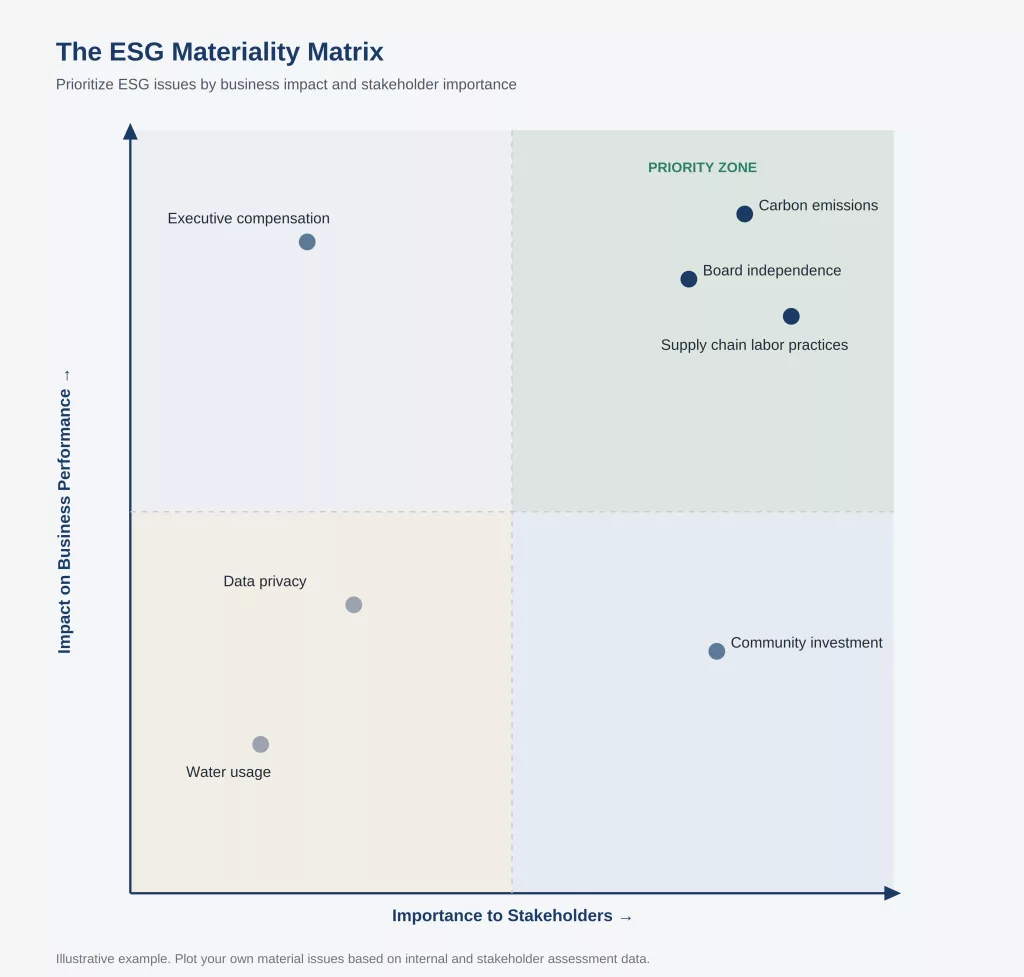
Caliber’s ESG Perception Rankings offer a useful benchmark for seeing how peer companies score on these same materiality-driven issues.
This assessment becomes the foundation for every resourcing decision that follows, and it helps justify investment in initiatives that might otherwise get deprioritized for lack of immediate, visible payoff.
3. Integrate ESG Into Core Business Strategy
ESG considerations that live in a separate report, disconnected from actual business decisions, rarely improve a rating in a meaningful way. Rating agencies and investors look for evidence that ESG priorities shape real decisions: capital allocation, supplier selection, product design. Companies that treat ESG as integral to strategy, rather than as a parallel reporting exercise, build more credibility with the agencies and investors evaluating them.
Turn Your ESG Strategy Into Measurable ESG Ratings Gains
Building the strategy is only half the work. The other half is turning it into a defined action plan, a communication approach, and a reporting framework that together move the rating.
4. Build a Measurable ESG Action Plan to Improve Ratings Over Time
Turn prioritized issues into specific initiatives with clear ownership, defined success metrics, and realistic timelines. Resist the urge to launch too many initiatives at once. A smaller number of well-executed, well-measured initiatives builds more internal confidence, and more credible external evidence, than a long list of underfunded commitments. Engaging employees and stakeholders early, starting with initiatives that show quick wins, builds the internal momentum needed for the harder, longer-term work.
5. Build a Communication Strategy That Reinforces Your ESG Ratings
Consistent communication reinforces transparency and strengthens confidence in a company’s ESG progress and sustainability initiatives. It lets stakeholders understand an organization’s priorities and track its progress over time, and it gives leadership an early signal of gaps before they escalate.
Transparent ESG communication supports a company across several fronts at once:
- Reputation: demonstrates accountability, ethical behavior, and genuine commitment to corporate responsibility.
- Differentiation: helps a company stand out among peers competing for the same sustainability-minded customers, employees, and investors.
- Integrity: signals a willingness to be evaluated on ESG progress and to act in stakeholders’ interests.
- Consideration: appeals to investors weighing long-term value alongside measurable ESG progress.
Alignment between internal practice and external communication matters as much as the communication itself. Companies that publicly share commitments that do not match internal reality tend to face sharper reputational consequences than companies that simply communicate less. Familiarity, not just intention, is what shapes stakeholder perception in the end: a company can be genuinely committed to ESG progress and still see a weak result if stakeholders never become aware of the work. Sharing concrete progress on issues like pay equity, diversity, and inclusion helps build that familiarity through legitimate, specific evidence rather than general claims.
6. Report Against a Recognized ESG Framework
Choose a reporting framework that fits your business and your investor base.
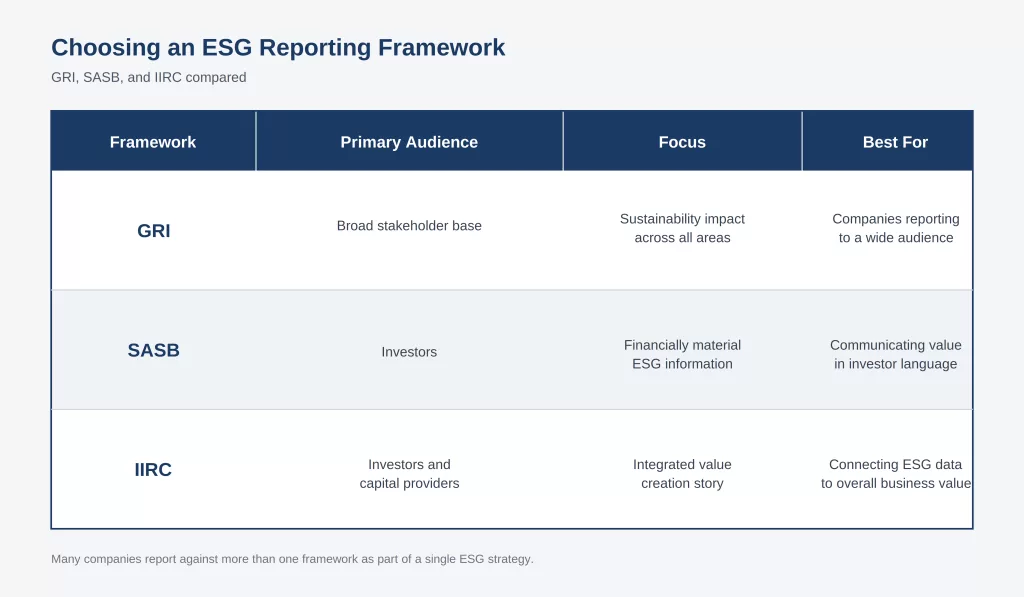
The Global Reporting Initiative (GRI) is the most widely used sustainability reporting standard globally, aimed at a broad range of stakeholders. The Sustainability Accounting Standards Board (SASB) framework is built specifically to communicate financially material ESG information in language investors use, and it is often paired with GRI. The IIRC’s integrated reporting approach connects ESG data directly to overall business value creation, which suits companies that want to tell that story explicitly to investors.
Companies in the EU should also track the post-Omnibus European Sustainability Reporting Standards (ESRS) directly, since scope and datapoint requirements changed substantially in 2026 and will likely continue to evolve as the Commission finalizes revised standards later this year.
ESG Strategy and ESG Reputation: Related, But Not the Same
An ESG strategy is only as strong as stakeholders’ belief in it. A strategy defines what a company does and how it reports on it: materiality, action plans, and disclosure frameworks. ESG reputation reflects something separate: whether stakeholders are aware of that work and believe it reflects genuine commitment. A company can execute a strong ESG strategy on paper and still face a reputation gap if stakeholders do not know about, or trust, its efforts.
For a closer look at that distinction and how it’s measured directly from stakeholders, see our guide to what ESG reputation actually measures.
Case in Point: How a Global Building Materials Company Strengthened Its ESG Strategy
A global building materials company, operating in more than 120 countries and known for sustainable insulation solutions, needed a consolidated view of stakeholder sentiment to support its ESG and commercial strategy across markets. Fragmented, market-by-market data made it difficult for leadership to connect sustainability communication with broader business performance.
By tracking stakeholder sentiment continuously and bringing it into an integrated data view, the company’s team gained a single, holistic picture connecting reputation and commercial performance, rather than siloed regional reporting. That consolidated view gave leadership better alignment on where the ESG strategy was resonating and where it needed reinforcement.
The Bottom Line on ESG Strategy in 2026
Regulatory requirements around ESG reporting are getting lighter in the EU, but the business case for a genuine ESG strategy has not weakened. Ratings still correlate with the cost of capital, investors still allocate trillions toward ESG-labeled assets, and stakeholders still form judgments about corporate conduct independent of what any single regulation requires.
Once your ESG strategy is in place, the next question is whether it’s actually working with the people who matter most to your business. Caliber’s ESG Perception Tracker measures that directly, continuously, and segmented by stakeholder group, so you can see whether your strategy is closing the gap between what you do and what stakeholders believe.