Stakeholder intelligence is about finding the gaps between what you think and what the people who shape your success think. Here’s a potentially big one.
I’ve spent the past six weeks in the US, and a question many people ask me is “What exactly is stakeholder intelligence?” My short answer: it’s knowing what the people who buy from you, work for you, want to work for you, regulate you, invest in you, or report on you think. Then knowing why and what to do about it.
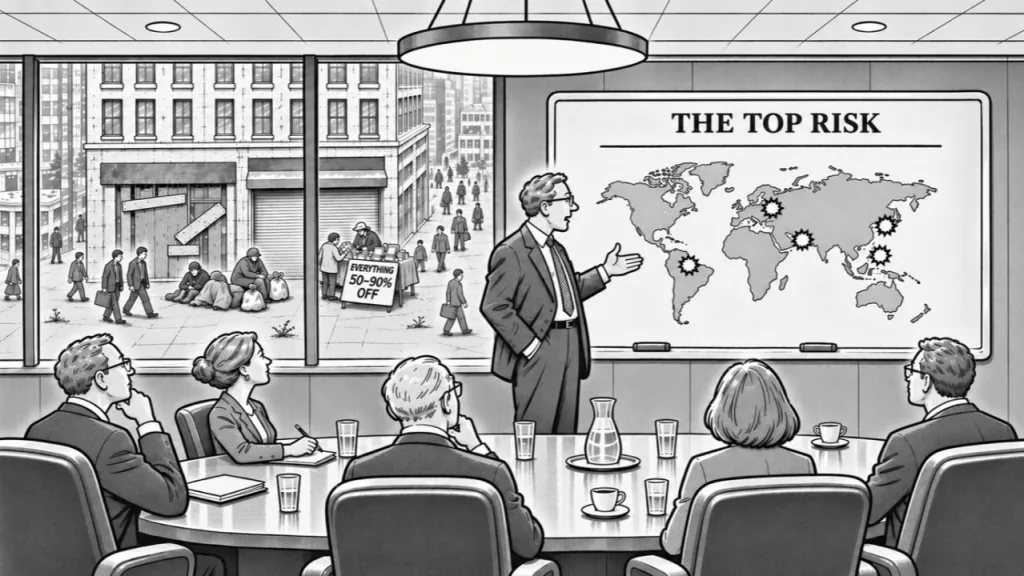
That’s why a recent PRovoke Media survey of communications leaders caught my eye. In it, 91 percent of senior in-house communications leaders identified geopolitical instability as one of their organisation’s greatest reputational challenges, followed by misinformation at 66 percent, with economic uncertainty and regulatory scrutiny each cited by 57%.
PRovoke’s survey tells us what in-house comms leaders think. Caliber’s continuous, real-time data tells us what their stakeholders think. And I’m afraid there’s a gap.
We track which issues keep people up at night, week over week, across markets, and cut the data by stakeholder segment and demographics. In the first week after the US midterms, war and geopolitics didn’t appear in the top ten concerns for Democrats, Republicans or Independents, and misinformation reached only 13–16%. The two surveys ask different questions, one about threats to companies and the other about issues facing society. But the gap matters, because leaders are bracing for the risks they discuss with each other while their stakeholders are living with the cost of living.
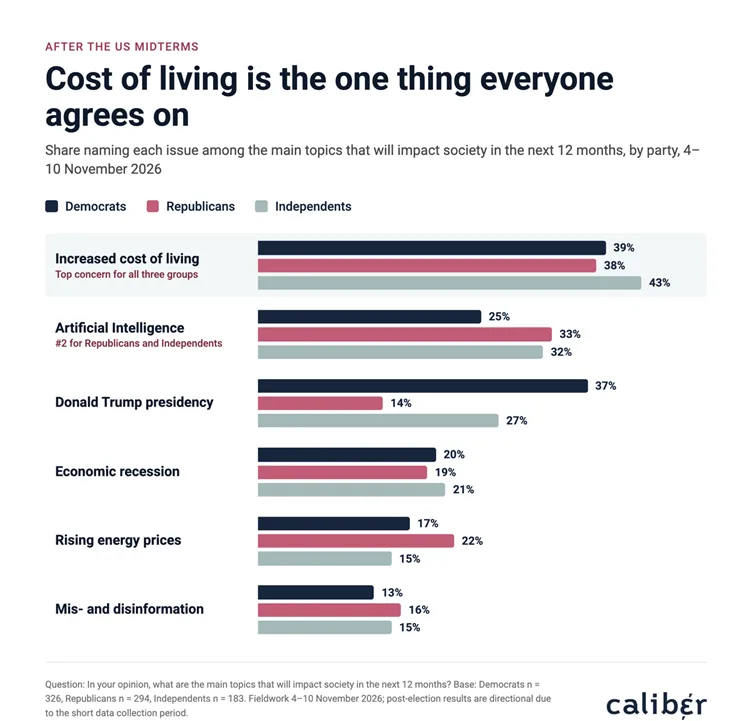
Increased cost of living is the unifier. Post-midterms, Democrats (39%), Republicans (38%) and Independents (43%) all name it as the issue most likely to affect society in the next 12 months. For Democrats, it has edged past the Trump presidency. If you need common ground with stakeholders who agree on little else, this is it.
AI still ranks surprisingly high. It’s the second-biggest concern for Republicans (33%) and Independents (32%), ahead of recession and energy prices, and third for Democrats (25%). Unlike the cost of living, AI is an issue companies shape directly, through how they use it and what they say about it.
Financial pessimism dropped post-midterms. Independents moved the most, from net optimism of −26 in October to −16, and are now the least pessimistic group. Republicans improved 5 points to −20, while Democrats barely moved, remaining the most financially pessimistic group. Optimists are still scarce: only 15–17% in each group feel positive about their finances.
So the point bears repeating. What senior comms leaders see as their biggest reputational risk sits at odds with what most Americans think will shape society over the next 12 months. Both can be true, of course, since the forces that move society aren’t always the ones that threaten a company’s reputation. Still, the gap here is wide enough, with armed conflict missing from Americans’ top ten concerns, that it makes me wonder whether comms leaders are living in a different reality.
It reminds me of political debates, in the US and elsewhere, where politicians argue about one set of issues while voters worry about another. More than 30 years ago, the Democratic strategist James Carville summed up where Bill Clinton could hurt the incumbent, George H.W. Bush, in four words: “It’s the economy, stupid.” Might the same lesson apply here?
In case you missed it: the Global Communications Intelligence Pulse 2026
Earlier this month we published our survey of 259 communication leaders across 47 countries with the Global Alliance for Public Relations and Communication Management. Their message was clear: reputation matters to everyone, but few teams have the tools, budget or buy-in to act on it. Read the full findings → https://lnkd.in/eqPPhXV8