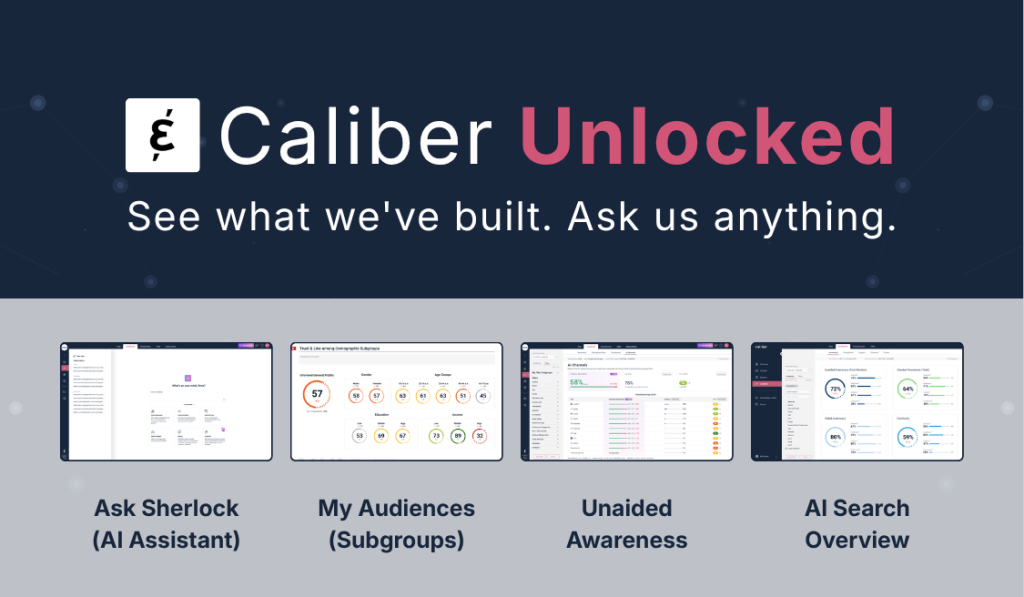
On June 18, 2026, Caliber held the first edition of Caliber Unlocked — a new quarterly webinar series giving clients, prospects, and the broader communications community a direct look at what’s being built on the platform.
This article covers everything announced in the session: four new capabilities that expand what AI reputation management looks like in practice — from how brands measure awareness, to how AI models portray them, to how teams extract insight from complex stakeholder ecosystems.
If you weren’t in the room, here’s what you need to know.
Quick Takeaways
- Unaided brand awareness is now a core platform metric. Caliber started collecting unaided awareness data in March 2026, meaning clients will see trend lines from day one when the feature rolls out this summer.
- Ask Sherlock, Caliber’s proprietary AI assistant, goes live within weeks. Unlike general-purpose AI tools, it’s trained on Caliber data and connected to external sources including media monitoring, stock data, and the open web — so it answers questions about your specific brand, not brands in general.
- LLM brand sentiment is a new reputation frontier, and Caliber is building measurement for it. AI Impact tracks both how often stakeholders use AI tools to search for your brand and what those tools actually say about you — combining real human behavior with AI-generated perception data.
What Is Caliber Unlocked — and Why It Matters for AI Reputation Management
Why Caliber launched a quarterly product showcase
Caliber Unlocked exists because the pace of product development has accelerated faster than traditional release notes or account manager updates can communicate.
The platform now spans three solutions — Stakeholder 360, Caliber Focus, and Talent 360 — and each is evolving along three strategic pillars: AI integration, multi-source data, and platform usability. A quarterly webinar creates a moment where clients and the wider market can see exactly where that investment is going.
What the inaugural session covered
The first session covered four features across the platform, each addressing a different dimension of how organizations understand and manage their reputation in an AI-shaped world. Those four are: unaided brand awareness, Ask Sherlock (Caliber’s AI assistant), AI Impact (LLM brand sentiment and volume tracking), and custom audiences. Each is covered in detail below.
Unaided Brand Awareness: The AI Reputation Management Metric You’ve Been Missing
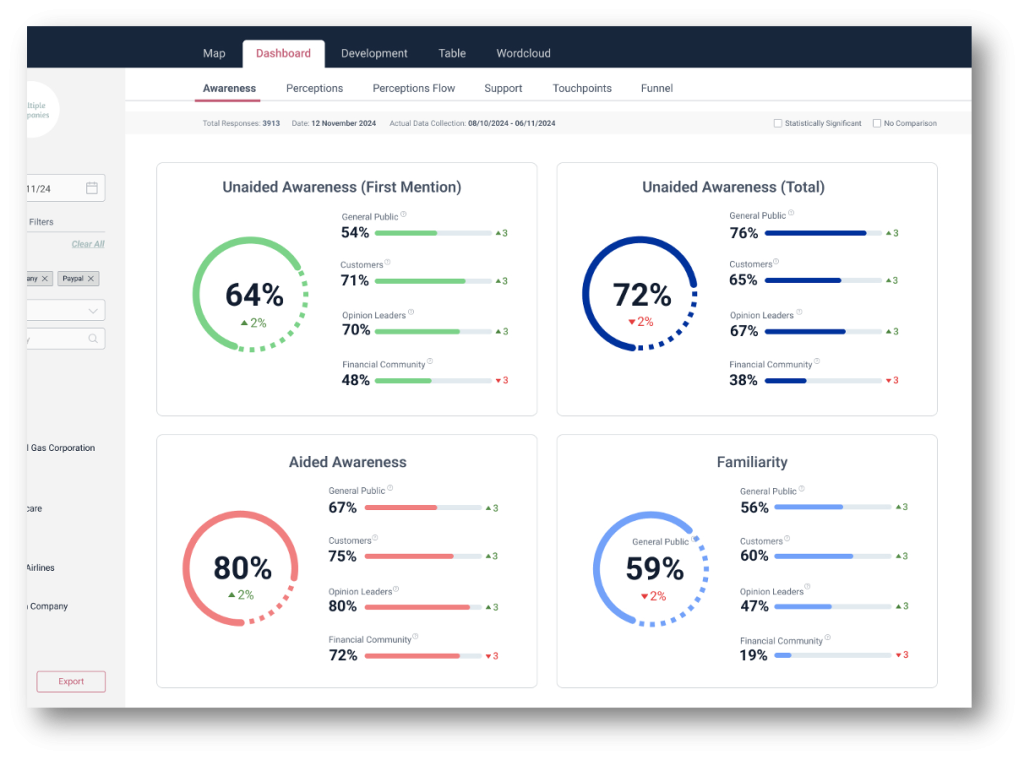
What’s the difference between aided and unaided awareness?
Aided awareness asks respondents whether they recognize a brand when shown its name. It’s useful, but it’s a low bar — recognition is easier than recall. Unaided awareness asks something harder: when you think of a specific industry or category, which brands come to mind without prompting?
That distinction carries real weight. According to Forrester research, over 90% of B2B buyers have a shortlist of preferred vendors before they ever engage with sales — and brand recall drives who makes that list. If your brand doesn’t surface unprompted when a buyer starts thinking about solutions, aided awareness scores won’t tell you that. Unaided awareness will.
LinkedIn’s 2025 B2B Marketing Benchmark found that 42% of senior B2B marketers rank increasing brand awareness and reputation among decision-makers as their single most important goal. The metric they’re chasing — whether they know it or not — is unaided recall. It’s the signal that tells you whether your brand occupies real mental real estate in the minds of your stakeholders, or whether you’re simply recognizable when someone puts your logo in front of them.
How Caliber now measures unaided awareness across stakeholder groups
Caliber’s unaided awareness feature introduces two distinct measures. The first is first mention — whether your brand is the very first name that comes to mind within a specific industry when respondents are asked unprompted. The second is total unaided mentions — the broader share of respondents who name your brand at all, without being shown it.
Both metrics are broken down by stakeholder group: general public, customers, opinion leaders, financial community, and any other audience segments configured for a given client. Caliber started collecting this data in March 2026, meaning clients won’t start from zero when the feature launches. Trend lines will be available from day one.
Why this matters for campaign evaluation and competitive benchmarking
Unaided awareness is particularly valuable in three scenarios.
First, campaign evaluation: if a communications push or brand campaign ran, did it actually move recall — or just recognition?
Second, crisis response: after a reputational event, is your brand being thought of differently, or just recognized reluctantly?
Third, competitive benchmarking: why familiarity is the most underrated metric in reputation management becomes concrete when you can see your unaided share versus peers in the same industry.
For B2B companies in particular, where industry-specific recall matters more than general consumer recognition, this metric gives communications and marketing teams a direct line of sight into whether their brand is earning real mindshare — not just logo recognition.
Ask Sherlock: AI-Powered Reputation Management Inside Your Platform
What does Ask Sherlock do, and how is it different from other AI tools?
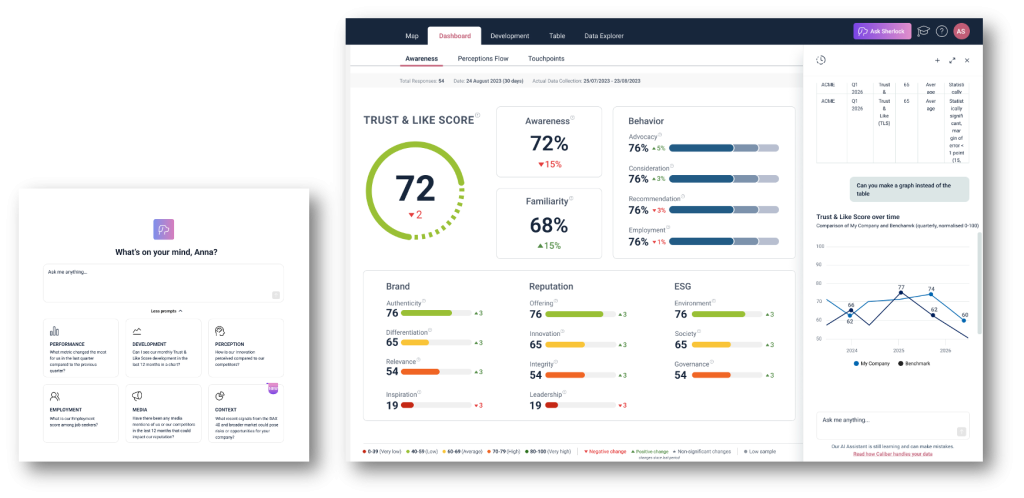
Ask Sherlock is Caliber’s proprietary AI assistant, and the key word is proprietary. General-purpose AI tools like ChatGPT or Claude are trained on broad public data. They can answer general questions about brand reputation, but they have no access to your specific tracking data, your stakeholder scores, your media integrations, or your historical trend lines.
Ask Sherlock does.
It’s trained on Caliber data and connected to every source integrated into a client’s platform — including the context module (macroeconomic and industry index data), media monitoring integrations, stock data, uploaded reports and activity files, and 80 to 100 trusted news and industry publication sources tracked by default. When you ask it a question, it draws from all of that. You can learn more about how it works on the Caliber AI Assistant page.
Which data sources does it draw from?
By default, the assistant pulls from Caliber’s proprietary perception data, the platform’s context module, and a curated set of trusted open-web sources. Clients can also request additional websites to be added to the tracked set, which then inform Sherlock’s responses to questions about the open web.
Beyond that, Sherlock connects to any source integrated into a client’s Caliber account. If a client has connected a media monitoring provider — the demo used Caliber’s Polecat integration as an example — Sherlock can pull from that data alongside proprietary scores, combining sources in a single analysis. If a client has uploaded their own reports or activity logs, those become part of the intelligence layer too.
One data privacy point addressed during the Q&A: all client data is fully siloed. Sherlock uses your data to answer your questions, but it doesn’t train on that data in ways that would surface it in another client’s account.
How does it help teams move from data to decisions faster?
The demo showed Ask Sherlock answering increasingly complex questions in sequence: which countries had the lowest reputation scores this year, what drivers were behind those scores, how those scores compared to the country index, and then — with a single follow-up prompt — layering in media monitoring data to see whether media volume correlated with the score trend.
What would take a skilled analyst several hours of cross-referencing dashboards and exports takes Ask Sherlock seconds. That’s the practical value: not replacing analytical thinking, but removing the friction between a question and an answer. Teams can ask in natural language, adjust the output format (table, line chart, filtered date range), and export the results — all without leaving the platform.
AI Impact: How LLMs Shape Brand Reputation — and How to Track It
Why LLM brand sentiment is the next frontier in reputation management
Ten years ago, AI reputation management meant managing how search engines indexed your brand. Five years ago, it expanded to include social listening and media monitoring. Today, a growing share of how stakeholders form opinions about companies runs through AI chatbots — and most organizations have no visibility into what those chatbots are saying about them.
Large language models like ChatGPT, Claude, Gemini, and Perplexity have become trusted advisors for millions of users making purchasing decisions. When an AI model describes your brand negatively to a user, that interaction doesn’t appear in any social listening dashboard. The sentiment simply exists, replicated across countless conversations, shaping perceptions in ways you can’t see unless you’re actively tracking it.
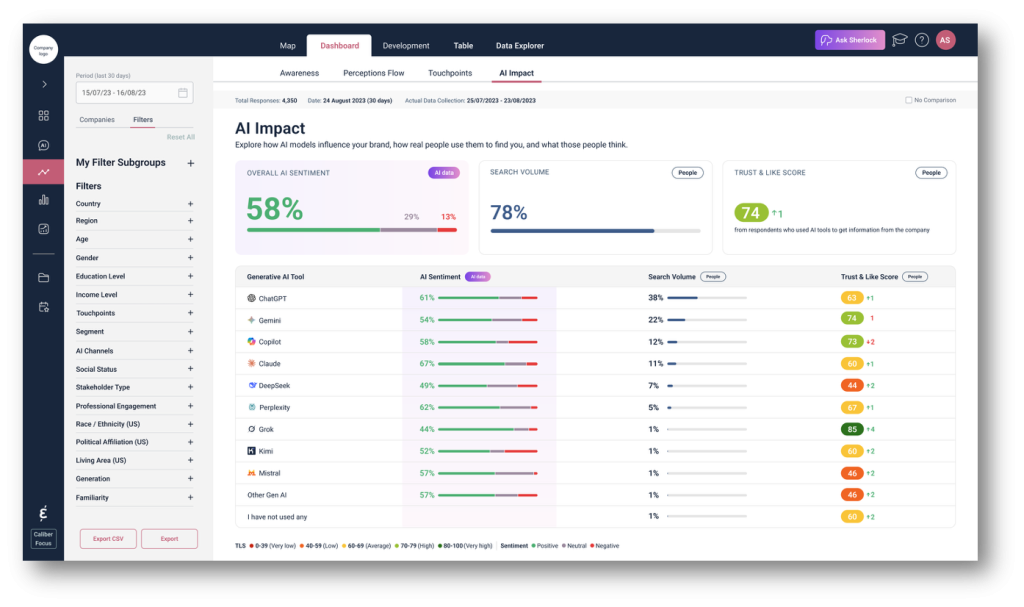
This is why Caliber built AI Impact. The framing from the session is important: Caliber doesn’t treat AI as a stakeholder. It treats AI the same way it treats media — as an influence channel that shapes what real stakeholders think. The question AI Impact answers is: what is that channel saying about you, and how many of your stakeholders are actually using it?
How Caliber measures AI impact — real people plus real sentiment
AI Impact combines two data sources. The first is survey-based: Caliber asks real respondents which AI tools they use to search for information about a brand, giving a volume figure — the share of stakeholders actively using LLMs as a discovery or research channel for your category. This grounds the measurement in actual human behavior, not just AI output.
The second is proprietary prompt-based sentiment analysis. Caliber’s team has developed a structured methodology for querying major LLMs about a brand and scoring the sentiment of the responses. During the session, Orel Gilad described this as the “secret sauce” — the specific prompt engineering is not published, but it’s designed to produce high-quality, consistent sentiment readings rather than random outputs. The result is a sentiment score that reflects how AI models portray your brand, tracked over time and comparable against your own reputation scores.
The combination matters. A brand with high AI search volume and negative LLM sentiment faces a very different challenge than one with low volume and positive sentiment. And both look different against a Trust & Like Score (TLS) — Caliber’s core metric measuring stakeholder trust and affinity on a scale of 0 to 100.
What communications and reputation teams should do with this data
The practical application is straightforward. If your LLM sentiment is negative and your TLS is high, you have a gap to close — AI is telling a different story than your stakeholders’ direct experience. If your AI search volume is low, communications energy may be better spent on channels where stakeholders are actually forming opinions. And if sentiment is shifting, you now have a signal that can inform crisis response before a media story picks it up.
Tracking LLM brand sentiment requires configuring systems to automatically flag significant changes in how AI models discuss your brand — a sudden shift from positive to neutral deserves investigation, and new negative sentiment appearing across multiple models may indicate a PR issue or damaging content that needs addressing. AI Impact builds exactly that infrastructure into the Caliber platform, so teams don’t have to build it themselves.
Custom Audiences: Smarter AI Reputation Management Starts With the Right Segments
What are custom audiences in the Caliber platform?
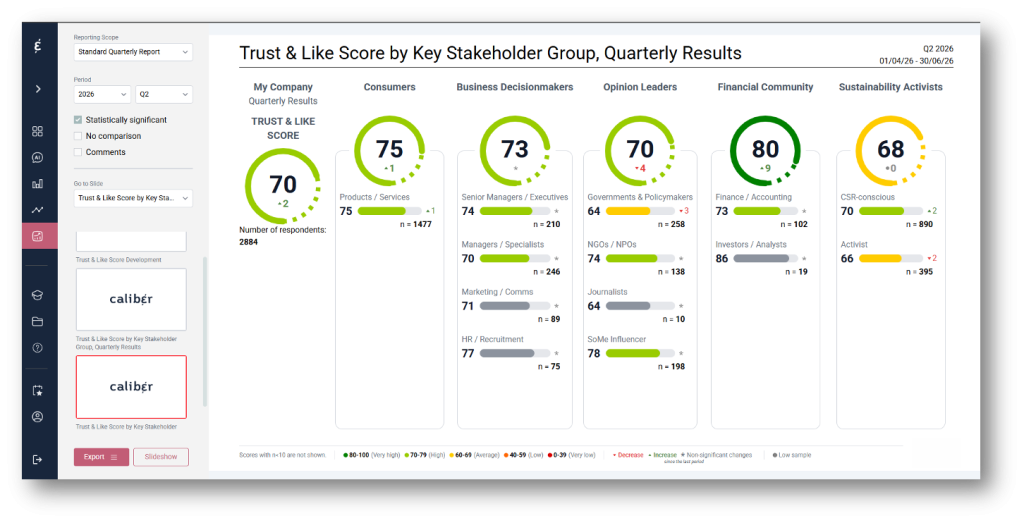
Custom audiences — previously called subgroups or filter subgroups — allow clients to define and name specific stakeholder segments that matter to their business, then track all platform metrics against those segments in a consistent, reusable way. A global energy company might define audiences like “opinion leaders in Germany,” “financial community in the US,” and “customers in emerging markets.” A healthcare company might segment by talent pool, existing employees, and institutional investors.
The feature itself isn’t entirely new — audience filtering has existed in the platform — but what Caliber Unlocked showcased was a significantly simplified and more powerful version. Complex filter combinations that previously required manual configuration on every query are now saved as named audiences, usable across every section of the platform. The goal, as Michele Tesoro-Tess put it during the session, is to shift from a platform people look at to a tool people use.
How custom audiences connect to Ask Sherlock and proactive alerts
Two integrations make custom audiences considerably more powerful than standalone segmentation. First, they’re referenceable inside Ask Sherlock. Once an audience is defined and named, you can prompt Sherlock directly: “What do my opinion leaders think about our innovation scores in Sweden?” The assistant knows which segment you mean and pulls the relevant data. No manual filter setup required per query.
Second, custom audiences will power proactive alerts. If a KPI you track for a specific audience moves beyond a defined threshold — a trust score dip among financial community respondents, for example, or a drop in employer appeal among a target talent pool — you’ll receive an email alert. The platform surfaces the signal before you have to go looking for it.
A global financial services company using Caliber moved from broad brand tracking to granular audience segmentation across B2B and B2C groups, enabling targeted communication strategies for each distinct stakeholder group — a use case that custom audiences are now designed to support more efficiently for all clients.
What this means for complex multi-stakeholder ecosystems
For organizations managing reputation across multiple markets, stakeholder types, and communication objectives, the practical impact is significant. The Caliber Stakeholder Intelligence Report 2026, which draws on nearly one million responses from more than 360,000 individuals across 37 countries, makes clear that different stakeholder groups respond to very different signals. Employees, investors, customers, and opinion leaders don’t move together. Custom audiences make it possible to track those groups separately, consistently, and without analyst overhead — and to get notified when any of them shifts.
How to see these features in action
The best way to understand what these features look like for your specific brand, your stakeholders, and your markets is to see them with your own data. If you’re already a Caliber client, your account team can walk you through what’s now available in your platform. If you’re not yet a client and want to see what Stakeholder Intelligence means in practice, book a demo and we’ll show you.