Listen to the episode on your favorite podcast platform:
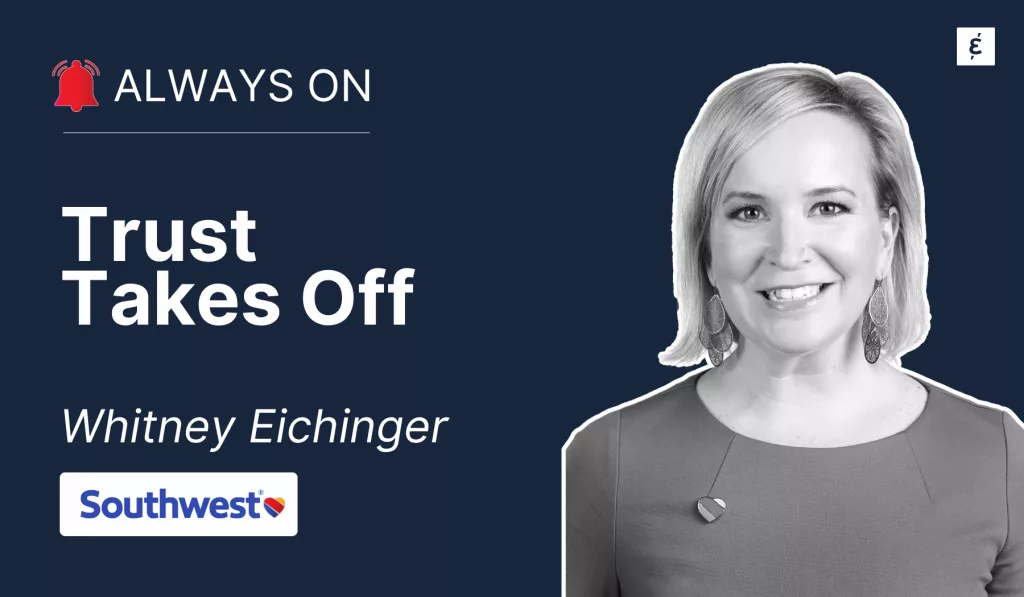
Fasten your seatbelt and prepare for takeoff, as we take to the skies with Whitney Eichinger, SVP and Chief Communications Officer at Southwest Airlines.
Whitney joins Always On to unpack what it actually looks like to run comms for a 100-million-passenger-a-year airline — from planning winter operations in the middle of a Dallas heatwave, to managing the message when a competitor’s engine issue puts the whole industry under the microscope.
She talks candidly about how Southwest uses data to guide decisions (not make them), why she’s skeptical of how the industry talks about AI, and why the strongest crisis response comes down to one thing: a consistent drumbeat of trust, built long before the crisis ever hits.
Watch the video episode
Read the full transcript
Shahar Silbershatz: Welcome to Always On, the podcast about brand, reputation and stakeholder intelligence. I’m Shahar Silbershatz in Copenhagen, and our guest today is Whitney Eichinger, Senior Vice President and Chief Communications Officer at Southwest Airlines. Great to have you here, Whit.
Whitney Eichinger: Oh, thanks for having me, Shahar. It’s an honor.
Shahar: So probably all of our listeners know pretty well Southwest Airlines, but why don’t you give us your elevator pitch on the company?
Whitney: Well, largest domestic carrier here in the United States. We just celebrated fifty-five years. So Southwest is known obviously for our personality, our great customer service, our people who love to have fun, great fares, and basically service to any destination that you need to go to when you are operating here out of the US.
I think it’s been known as a brand that has a super-strong corporate culture. Yes, we exist to fly people from A to B, but we connect them to what matters most in their life, and I think that’s the joy along the journey is where Southwest really shows up.
Shahar: I should probably just say “happy birthday” first.
Whitney: I know, June, we turned 55 in June. I know, I’m always like, “still looking so cute”. So yeah, just celebrated our 55th anniversary.
Shahar: In terms of your actual job, so the job of a chief communications officer is very varied, and it changes by the day, but what’s really interesting for people to hear is some examples of, you know, what does a typical day look like. So talk to us about yesterday. What were you up to? What did your day consist of?
Whitney: That’s the best part about these types of roles. When you’re in communications, every day is different, but that is almost your normal. So you never can guess what will come your way. There’s always something going on in the operation. And when you think about, either from coast to coast, you know, we carry more than 100 million customers every year, so there’s always something going on out in the industry, but we’ve got a tremendous amount of issues facing us. We just had a great second-quarter earnings call a couple of weeks ago. So we’re looking at, how do we make sure the performance of what we had before carries on in our third quarter. But what we really are looking at is August is trending towards the end of summer for us, and if you can imagine it, we’re already thinking about, how do we make sure that we staff up for the holidays and that we’re ready? We’re always working a few months in advance. So even though it’s August and it’s more than 100 degrees here in Dallas, one of the things we did yesterday was get our employees ready for winter operations, so we would internally call that “winter ops”. We also are doing some new internal decorating here with our history, so we have opened up some more of our walls to be able to tell the story of our company history, and so we just unveiled that last week, so everyone’s just walking up and down the halls reading, learning, looking, and it’s a great way to tell our story.
Shahar: Are there things that you find yourself spending a lot more time on than you had expected before you started this job?
Whitney: What you have to balance is, you of course are spending a lot of time on company strategy. You are spending a lot of time on looking ahead. I think there’s a lot in communications that’s also looking at the now, and so you have to make sure that you’re balancing the ability to look ahead and plan for the future, talking about winter operations, while you’re dealing with whatever the issue of the day is for the team.
So it could be thunderstorms, it could be hurricane, it could be fires in Spokane. It could be a number of different things that are impacting either the customers that are getting to your aircraft or employees who are having to work in those situations, and so you just make sure that you’re ready for both.
Since it’s midyear, we spend a lot of year planning for what goals we want to meet for the rest of the year, what are we looking for out about three to five years, and how are we making sure that, on the communications side, we’re doing the most to shape our external perception but also bring our employees along, to make sure that they are also supportive and understanding of all the changes, adaptations, new things that are coming our way.
Shahar: I can imagine this balance between … that’s the always on part, isn’t it? The balance between what’s happening right now, which might not be expected and changes all the time, with the planning for down the line, which is one of the, I think, hardest balancing acts that a CCO has to do compared to others who usually either focus on now or focus on the future. You have to focus on both, right?
Whitney: Yeah, you have to do both, especially in our industry. I would just say a lot of things, you know, airlines are in the news every day. There’s always something affecting airlines. It’s a very interesting topic for media. It’s a very dynamic environment for employees who work here. So I think you’re just ready for anything. It’s probably an addiction of some sort, the adrenaline, so I’m not really sure, but it is a really fun industry. But you have to, every day you’re ready for anything that could come your way
Shahar: When it comes to this planning of activities down the line, I’m sure you also have to often show the financial value of the work of communications, right? You probably also have discussions and conversations with the CFO and with other executives in the company. How do you talk about the bottom line impact of communications in this context?
Whitney: Well, we’re set up, I’m sure like other companies are, where we’ve got a cadence of meetings every week. And so every Tuesday, we get together with our executive committee, which is senior vice presidents and above, and we walk through what’s happening in the business. So you will hear from the customer aspect, you’ll hear from financial aspect, operational aspect. And then one of the spots that we have is for me to go through that weekly look at what’s been going on, but you look at kind of the sentiment internally and externally, what our employees are really focused on, what the media’s focused on.
And then you take a look at like, what are other people interested in from a competitor’s perspective. So there could be other news in another carrier that’s in our industry to be able to share that kind of perspective. But you also give a look back, so what I was doing midyear was walking our executive team through what impact have we made communication-wise in the last six months.
Because for Southwest, we started the year with assigning seats. Last year we introduced, you know, charging for bags. There’s been a lot of things that have changed for the company, over the last year, and definitely operationally in the last six months. And then you have the reaction to that, either from the employee side or the external side on how do you handle the adaptation that you would have to any changes that we make as we learn along the way.
And then we had to combat, you know, over the first half of the year, who are we? And like, how could you assign seats when everyone else assigns seats? Also, it’s working fine. But I think that like you just have to get through that perception that people like to hold onto. So I think, and then you have to guide investors in partnership with investor relations along the journey of how much adding these things in are changing our business.
So when I was showing that six-month glance, you really see, hey, we’ve done this amount of work, and then here are also the stories that we’ve kept out of the media, by backgrounding and talking and being able to educate. And here’s some unusual areas where we ended up being a leader. So I think that that matters because when you look at all of that together with the “we operated like this, our customers, NPS scores, all of that, are giving us feedback like this, and then the drumbeat for our employees and the external media shaping that narrative is matching all of those things”, then you’re really humming to me as an organization, and communication shows how it supports the whole enterprise.
Shahar: Right, so from a financial perspective, when you talk about it, when you talk about the impact on operations, you also are trying to talk about how you can an environment that could potentially have been very challenging from an operational perspective but communications helps the company navigate that?
Whitney: Well, in our industry, the bottom of the pyramid, bottom of your needs, is you need to run a safe operation. So you know that happens every day, and you hear that. What adds onto it, you’ve got every choice in the world when you fly, and I think communications really comes in, alongside marketing, to come in and show, but what is the brand like? Like, what do we give customers? Why is it more interesting to fly us than another carrier out of the Dallas area?
And you’re also trying to tell a story and highlight your people, which is what I think Southwest does really well, which is truly the difference when it comes to the hospitality that you feel here from our people. We want to make that point every day in everything that we’re doing. We also want our employees to bring that to customers every single time that they’re working with a customer, no matter what their job is.
So I think it’s that drumbeat behind the business strategy that comms can really show the impact that, in order for anyone to believe the story that we’re putting out there, we have to have those proof points, and I think comms plays a huge role in delivering those in the right places at the right time.
Shahar: And you mentioned a couple of occurrences over the last year that could have turned into crises. So I want to talk a little bit about this crisis management, which is of course just a part of the role of a communications officer. Do you have any example where the proverbial in fact did hit the fan and you had to deal with a situation that wasn’t expected? Is there a story that you can share with us of something that did happen that required you to respond immediately?
Whitney: I would say mid-July, WestJet. There was a issue with their engine. They returned back to a location in Greece. And any time anyone in the industry has an operational issue, immediately you want to know what’s going on to see, like, what sort of impact does it have.
So I think the ability to be able to say, “Does this issue compare to any of our issues? In the meantime, are reporters going to write stories saying this happened with WestJet? Did this happen with Southwest or other airlines?” So I think it’s quickly getting to the bottom, back to that bottom of the pyramid, making sure that, like, you’re delivering the message, or at least keeping Southwest out of the conversation in some aspects of, there’s any safety issue going on within the industry. The other thing that hit all of us was, you know, we had a flare-up of the Iran war, and then you have fuel prices, and so that’s something we have to manage with a look at capacity. You have to decide with staffing, with everything involved with the price of fuel, how are you making some of those decisions and how is the war impacting how Southwest is able to deliver?
So what happens in the airline industry often is there is a global situation that impacts your industry, which I know is like many other industries. But, you know, you have staffing at TSA, or you have things that are not in the airline’s control, but that doesn’t matter to the customer. The customer is associating that with Southwest.
So it really, over this year, with all of the curveballs that you were thrown, even from the government shutdown end of last November, is how do you make sure you have built up over time the trust with customers so that they know when you’re sharing with them, like, what’s an arrival time? What are the delays looking like? Is this fuel increase in cost going to affect your fare? I think you have to look at how are we going to make sure that our customers have the right information in the right place?
So I think that’s an example of, like, it wasn’t like, “Oh my God, what do we do?”, there’s opportunities when things like that happen to our industry to say, “We’re the source of information for your flight.” Like, we will make sure that they know Southwest is going to contact them and let them know how that’s impacting their travel. And I think that we’ve had to be really nimble over all the things that have come our way in the last few years to make sure that communication through media employees and customers is really aligned, so that you’re making sure that everyone’s getting the same message, that employees at the airport are delivering that to customers, that customers are hearing that before they get there.
Because back to what I said at the beginning, ultimately, we want to get you from A to B, so you’ve got to make sure you’re doing that well. But I think when it comes to disruptions or long delays, you want to make sure that you’re communicating with customers in the right way and that they trust what you’re saying so you don’t get this like, “Ugh, Southwest is never on time, and they don’t get me to my destination.” You work really hard to combat that.
Shahar: I imagine that alignment is really difficult to achieve. I imagine, especially when there’s a crisis or things have to happen really fast. Are there situations where, for example, a senior leader wants to say something and you’re thinking, “No, no, no, no, no, that’s really not the way to handle this”?
Whitney: I think any CCO listening to this probably has that conversation with themselves daily. You have to decide what you want to go out with, and so I think that, like, being able to guide executives, knowing it’s the end of the day, I mean, I work for our CEO, Bob Jordan, so if he wants to go in a different direction, you give the best advice that you can. I think that’s what makes our roles different is you can take in… You know, we are… In a CCO role, you are so exposed to what’s happening in your industry, what’s happening in the media, what’s going on globally, what’s going on in your markets, that you can bring the perspective of… sometimes even when you’re in a crisis, you can get really wrapped up in yourself, and so I think that’s the job of comms, to bring in, like, this is really impactful and important to us right now.
Within the industry, this is kind of where our situation is ranking, and then within… You know, I always say, “My mom has no idea this is going on.” You have to kind of bring that perspective, too, when you’re advising, but ultimately you have to be okay that, like, no matter what advice you’re giving an executive, and even if they go a different direction than you’ve advised, you work with a team that’s ready and nimble no matter what.
“We want to do this, we have a response. We don’t want to do this, here’s how we’d recommend that.” And so I think that applies to almost every situation, but at the beginning of any crisis, it is gather as much information as possible. All the airlines will tell you, we have very sophisticated crisis communication plans for a variety of different issues.
Having that discipline and having that people know what their role is within that and doing drills and tabletops, I think that you’re able to know, “I’m nimble enough in any situation to say, “Okay.”” And you get over really quickly what’s happening, and you jump to, what do we need to do, and what puts Southwest in the best light possible?
And a lot of times, you know, we had a disruption a few years ago, a lot of times that’s just admitting everything didn’t go right. And so when everything doesn’t go right, it’s about keeping that trust. And so I think at the end of everything, you want to be transparent and you want to be true to the brand and the company that our customers come back to time and time again, but how you show up in those crises really matters, because that’s when people are feeling the stress. And travel can be stressful anyway, so you want to make… that’s why we loved injecting that fun because it can be a really good time.
Shahar: It’s a really good point, this point about admitting mistakes.
Whitney: You can’t… I mean, you don’t live in a day and age anymore where you can dance around. You don’t. Like, if someone’s outing you … it’s a great skill to be transparent anyway, but I think that, like, keeping that in mind when you’re communicating is something that’s really true to just Southwest’s credo.
Shahar: Also because stakeholders don’t actually expect you to be perfect, but they do expect you to be authentic and honest.
Whitney: Yes.
Shahar: So those are two different things. I heard you before talk about how a crisis can actually, you know, help weave the culture together. In fact, it can be a positive force for culture and for a company. Was that based on a particular experience that you had at Southwest Airlines that got you to say that?
Whitney: I mean, I think, you know, Southwest has had its own experience with crisis, but what I was saying earlier about everyone knows their role, it is very reassuring that you work with a team of leaders that you trust. There’s so much going on during a crisis, you want to make sure that, like, you’re getting the best advice, and then sometimes, no matter how often you have done a tabletop, it could be something that’s that hasn’t happened to the industry before, ever, that you have to be like, “Okay, we’ve got to kind of all put our heads together and make our best effort to make the best decision for what that would be.”
And that’s not when it comes to something operational from Southwest. That’s more when it comes to something just, you know, in the universe that’s coming your way that you’re like, “Okay, I didn’t see this on my agenda for the day,” but you know you can get together in an instant and be able to react to it. And I think that comes from… you know, our day, everyone’s working on a million different things. Like, you asked me about yesterday, like there’s a million different things. My coworkers are gonna be working on a million different things. My friend in operations will be working on a million different things.
When there’s a crisis, you’re all working on the same thing. And so, like, you go back to, like, a COVID situation, and you’re like, “No one had experienced this. No one knew which direction to go.” And I think that you bond in this, “Okay, like, from who we are, we know how we want to respond and protect our employees and educate our customers. We don’t have all the facts. So what do we go out there with?”
And so those are kind of the examples where you see, “Man, everyone plays their role really well, and everyone trusts each other.” And I think that’s when you can be okay with being a little more vulnerable to say like, “Man, we’ve got to figure out how to do this,” instead of acting like you’re an expert on something you couldn’t possibly be an expert in, aside from your job.
Shahar: I’m curious to hear also about the role that data plays in this decision-making process that you described. I mean, you mentioned before, especially when a crisis happens, you need to look at the facts and you need to gather the data, but also on a day-to-day basis, I’m sure you have a lot of data sources, and I’m actually curious to hear if you can tell us about cases where sometimes data says one thing, but your gut feeling says something else, and you actually go against the data. I mean, are there kind of situations that you can think about where this happened?
Whitney: I can’t think of going against it. That’s tough. But like, you know, I think that how we use it, so just, you know, a quick look at us. We use data all the time, like everyone, and then weekly we are showing what that sentiment looks like. You know, we send out to a group of about 400 people, every Monday just like, “Hey, from the last week, here’s kind of the coverage internally and externally.”
That data helps paint a picture to… external people loosely understand. Internally, you might have someone that’s like, “We’ve got to share this. Like, this is so exciting.” Or, “Hey, we are getting a new flavor of pistachios for extra legroom on board. We should share this.”
And, you know, you’ve got to balance all those messages, because employees have to do all of that. And I always say they also have to sign up for their benefits. They also have to find their paycheck. So there’s a lot of competing priorities. We also have a large workforce that is not sitting at a computer like you and I are.
So you’ve got to think about how the recipient is getting that information. And so I think the data in that example can show you, “man, employees were really dug in on this, but not so much on this.” And you don’t really say the not so much because it’s telling the story itself.
But I think that that’s… early, early on in my career, we didn’t have as much data and measurement behind what the impact of communications was. It was almost like, you know, early 2000s, it’s like, “I mean, we should say something.” You know? But now it’s like you realize you can really guide public perception by how you present a particular thing.
It’s not just like, business decides, communications communicates it. It’s more of a partnership, and I think that is driven by, like I was telling you, at our executive committee meetings every week, you can see what customers are reacting to. You can see that we made a boarding change, and everything lags a little, it’s data. But then you can also see how we communicated that and how the operation was performing. And so a lot of times you can tell a story of like, “Man, even though we had a bad day, from the customer care side of things, we really took care of our customers. We got very few complaints on whatever the topic might be.”
But I think for us, it’s less about going against it. It’s more using it to inform and guide, and it’s just one more tool to say, “Okay, I think my instincts are correct.” And then at Southwest, like, I go back to that trust, you also can try something and it doesn’t work. And you show that. It doesn’t mean the person was wrong.
It just is like, okay, learn. You know, so it’s like test and learn, test and learn, test and learn. And I think data helps you prove that, that like we have a lot of trust within our leadership. I’ve said a thousand times on the decisions that we make for comms, “Try some stuff. Go out there.” Okay. You know, I mean, at least we’re trying to figure out how to do things differently.
I also think data helps guide us to evolve. You could be working for a very traditional leader that’s like, “No, no, no. Every Tuesday we send out “fill in the blank”, and it always works, and people read it.” And you’re like, “Actually, um, they don’t.” So I think that, like, you’re able to use that, and it doesn’t always work, but I think that, like, that’s where data helps you guide.
It isn’t about, like … Data doesn’t make your decision. It guides the decisions that you make. So I think that I would say the same thing about data that I say AI. It’s a tool that helps you know if you’re moving in the right direction and helps better guide you for the next communications moment.
Shahar: So if you had to choose one dashboard or one tool, one set of data, would that be customer sentiment or customer feedback, customer satisfaction? Or is there like one data point or one dashboard that you think you couldn’t live without?
Whitney: We’re really dependent on the NPS scores. I think those are very important to an industry like ours. But I can’t say there’s a dashboard I would do without because I don’t know, but I think eventually you just evolve what you’re presenting.
And then it’s just been really nice from the customer experience lens and from us to be able to match that up a little bit more. Because comms has spent a lot of time catching up in that area. You know, like, customer data has been sophisticated for years because that earns you money for a business, but so does what we do.
So, like, that’s why you match them up together. We’re just a little bit more of a softer skill. But nevertheless, I would think brand reputation has never been more important, and neither has employee engagement.
Shahar: How would you say your team’s work has changed mostly when it comes to using data and measurement? What would you say was the major evolution over the last couple of years in your team?
Whitney: We’ve done a lot of channel analysis on how we communicate with our employees, and that’s driven by data. Like, we always want a million different email tools. Does anyone read email anymore? I can tell you my 20-year-old son doesn’t. Rest assured, if I sent him anything, he’s never received it. When you’re looking at, like, a channel audit or an analysis, Southwest wants their employees to get the information, and we want them to receive it in a way that makes most sense for them.
So, if it’s on here, if wherever it needs to be, and I don’t know, you probably remember, like, early on in all of this, everyone was like, “Oh, well, we can’t ask people to use their phones to, like, do that.” And I’m like, “Guys, everyone…” Now, you would never even think that, but I think it’s like, that helps us understand where they’re getting the information, and it helps us understand how we could adapt.
Some of that channel audit’s really important when you’re looking at that and the data that helps you make some of the decisions. you can write the best, we’ll call it “memo”, we don’t really do that that often, but, like, you write the best memo in the world and be like, “Nailed it.”
No one opened it, who cares? So, like, you’re not getting your message out. So I think it’s like, video content, sharing on Viva Engage, like using Teams channels.
Like, so you try to surround-sound people, and then when you look back and say, talking about dashboards you shouldn’t use, it’s more like channels. You’re like, “Hey, let’s drop email.” You have to use email. But let’s not think that that’s a way that people are receiving the most information. Is there a different way that you could get to them?
And then I think the other thing we look at constantly is, how do you measure it? So back to, like, what dashboards would you drop? We’ve got a million different partners. On how do I best deliver that story, and I don’t think that any of us in any areas at Southwest would think, “Oh, I only need one partner to deliver that to me.”
I think you like to build this little galaxy that is, like, within the universe, there’s many different ways to share your story, and there’s a lot of different aspects. And then you’ve got to kind of boil it down to say, “If I’ve got five minutes in a meeting, how do I make the biggest impact?”
Shahar: That’s fair enough. But I am interested in pushing a bit further this question of the evolution because we of course at Caliber, we have our own philosophy, and we talk about stakeholder intelligence and how that’s evolving and I know that you buy in to that philosophy and that’s why you joined us also in the Advisory Council. How do you see the evolution of this space that we call stakeholder intelligence? How do you see that evolving, or where do you think that is going or should be going?
Whitney: I think people want to do business with a brand that they trust. And Southwest to me, of course, it’s why I work here, has that at the heart of everything that it does. So I think, to me, it’s intake from me finding a great partner on what I’m looking for to tell my executive committee, the board, whomever the audience might be. And then also, what can you teach me that I don’t know from my seat on how to better deliver that information? Like, I know what I want to get out, and then I think, like, Caliber could be great at advising, “Okay, to land that, here’s what I think you should show.”
And I think Southwest is really attuned to how that works with any of the partners that we work with. Measurement’s evolved so much over the years, and I think the impact that you make and the stakeholders that you work with and, you know, picking up the phone to call a reporter to give them more information on things is like a dying art, but still something that’s so, so important in creating that strong brand reputation.
And I think that the drumbeat has to be consistent. It’s not like we have a day here, and we’re like, “Eh, we’ll just kinda half-ass that answer.” I think it’s more about, like, how do you, no matter what, you know, the topic is, build that trust and then show that you’ve built the trust by the coverage that you’re getting or by the impact or by the knowledge that your employees have.
So we think we know how we want to tell a story. We need partners that come in and say, “Totally hear you. Here’s that, but here might be this perspective,” which when I started talking to you guys was so interesting because we do have, you know, regional questions about different markets and how people take things differently in Denver than they do in Austin.
And so I think being able to show that and being able to break down some of the messages that we’re delivering is so important.
Shahar: And so maybe to finish up with some quick reflections from you, I mean, when you look at the industry and the trends that you’re seeing, is there anything that you feel you’re maybe a little bit skeptical about, some of the trends that are being talked about today within the communications world or where things are going?
Whitney: AI’s probably the biggest. You know, every conference almost these days, if they have AI on the agenda, you’re like, “I have no more capacity.” Because that’s every email you get, that’s everything, and you’re like, “What are you actually describing?” Or, “Show me how… Stop saying AI. Show me how tools make my job easier, or show me how I better deliver something. Don’t talk to me about, like…” You know, you’re like, I mean, you can talk to me about ChatGPT because obviously we’re best friends, but, like, I think that you’ve got to figure out, like, breaking through, “What’s this newfangled tool?” is what it sounds like to me when people say AI, and it’s like, you want to ask the next question of like, “What do you mean?” But you will never replace someone’s skill to be able to talk to someone or deliver a message, and so I think that’s probably the biggest trend that I see right now is everyone wants to cover AI, and I don’t even know if they know what they’re talking about.
Shahar: So it’s not so much you’re skeptical about the trend, you’re just skeptical about the way people talk about it?
Whitney: What am I learning here? You know? Like, show me how this makes everyone on my team better and that maybe I need fewer headcount because everyone’s so strong. That’s something I want to know about. Don’t lead with the tool. Lead with how it benefits, you know, the industry. And then I think, too, just, you know, it probably goes along the same lines, just in that universe of, like, we have a lot of just cyber-awareness and cyber-wariness and thinking about, like, you want to make sure that the customer on TikTok that’s talking about how their terrible experience on Southwest was, and “Were they a customer on Southwest?”
You know, so I think you have to just kind of be ready for that. We’re definitely in a world of not taking things at face value, and making sure that you’ve dug to the next level to see, like, with the way that all the algorithms work, that people get their information. “Is this article even new?”
Shahar: So what you’re saying is skepticism in itself is on the rise right now because it’s so hard to know what’s true and what’s not?
Whitney: And you have to just make sure that you’re kinda double-checking.
Shahar: Absolutely. Is there anything you think in the profession is changing so much that maybe part of a job that’s not going to exist in 10 years?
Whitney: What I don’t think exists anymore is enormous communication teams that everyone’s super-siloed. I think this is the universe of the generalist, and I think it is internal, it is external, and social. Like, they’re all a communications skill, so I think the blending of that is what I see more than “what won’t exist”.
I think we’re all being asked to do so many different things that you need to look at in our industry that you’re more of a generalist than you are a specific. What you are great at is communication, but you can adapt that to any need, because the further you go in leadership, that’s what you do.
So I think that, like, thinking about adapting those skills is probably one of the most important things.
Shahar: That’s interesting, and helpful. So just to finish up, last question. What’s the best piece of career advice you’ve ever gotten?
Whitney: Well, I think my, my biggest piece of advice comes from Ted Lasso. I just think instead of being judgmental, be curious. And the other thing that I always say is, it’s okay to have a plan, meaning for your career, you have to be willing to go into any window that opens if it makes sense for you.
I just talked to our interns this week, and they ask you career advice, and you’re like, I think everyone starts out thinking they definitely know what they want to do, most people or some people. I did. A leader might see something in you that you don’t see in yourself, but they have a different perspective, so trust that. If you trust the person, trust that your career will go in the right way and it’s going to be zigs and zags.
Shahar: It was wonderful to have you on, Whit. Thank you so much for your time and for your input.
Whitney: Thanks, Shahar. It was a pleasure being on with you.
Shahar: Many thanks for listening to this episode of Always On. If you haven’t done so already, check out some of the other episodes. They’re packed with unique insights from seasoned experts at leading companies. Oh, and if you have any comments or questions about anything you’ve heard on the pod, we’d love to hear from you. Just drop us a line at [email protected]. Thanks again for listening. Till next time, take care.