A close look at what people think of the AI sector reveals where OpenAI just closed a gap on Anthropic — and the role founder-CEOs may play in corporate reputation.
This article was originally published by Caliber CEO Shahar Silbershatz in his LinkedIn newsletter, What People Think. It has been adapted for publication on Caliber’s website.
A recent Financial Times column, “Fixing the AI industry’s PR problem,” opens with a bold claim: the public reputation of the big AI companies is “an absolute dumpster fire.”
The evidence? A Gallup finding that only 9% of Americans think AI will do more good than harm, compared with 39% who think the opposite.
That’s a striking number. But it’s a poll about a technology, not about the companies building it.
So we looked at our own stakeholder intelligence data, starting with the monthly Trust & Like Scores for OpenAI and Anthropic.
The two companies tell very different stories.
Since last October, Anthropic’s score has declined from 71 to 68, including a dip to 59 over the summer.
OpenAI is harder to frame as a simple decline. It started at 60, fell as low as 53 in July, then recovered to 66 by August. In other words, it ended slightly above where it began, despite spending much of the year below its starting point.
Is this really an AI reputation problem?
To understand whether we’re seeing an industry-wide AI reputation problem or something narrower, we compared OpenAI and Anthropic with seven major technology companies tracked over the same period:
Alphabet, Amazon, Apple, Meta, Microsoft, Nvidia and Tesla.
If an ambient “AI backlash” — the broader sense that AI will do more harm than good — were dragging down corporate reputation, we’d expect companies deploying AI at scale to move downward together.
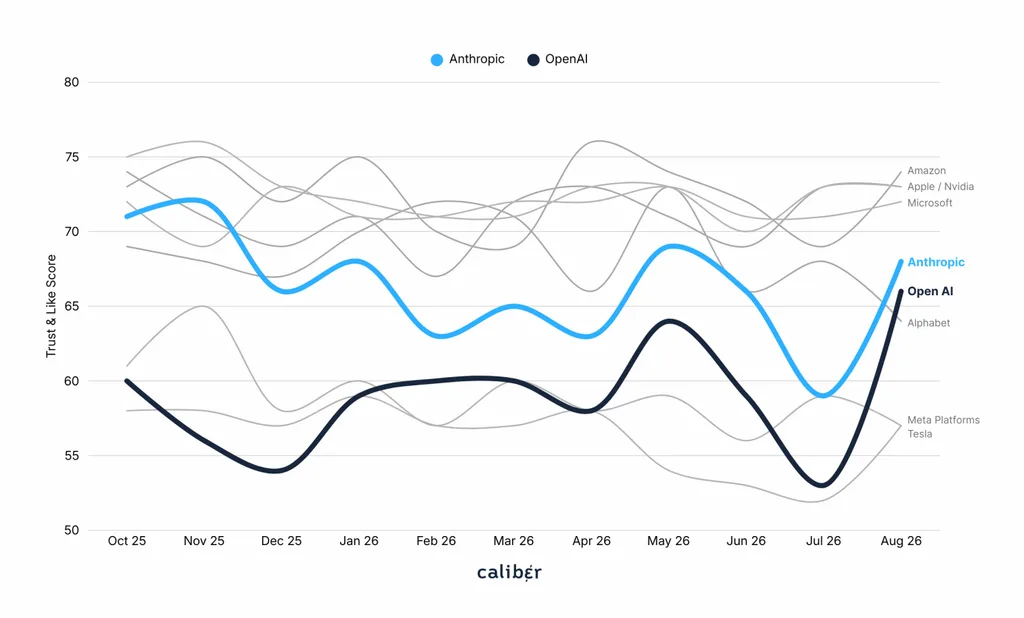
Monthly Trust & Like Score for selected companies, based on Caliber’s daily online surveys.
Mostly, they aren’t.
Microsoft and Nvidia have remained within remarkably tight bands — 71–73 and 70–73 respectively — with little sign of category-wide anxiety affecting their reputations.
One company complicates the picture: Alphabet.
After remaining within a similarly stable range for most of the period, Alphabet dropped to 64 in August — its lowest reading of the year and, briefly, below both Anthropic and OpenAI.
That decline coincided with a cluster of EU and UK antitrust rulings against Google, alongside investor and public unease over the departure of longtime DeepMind figures and questions about whether Alphabet was keeping pace in the AI race.
That’s a useful complication rather than a counterexample.
It suggests that broad anxiety about AI isn’t necessarily moving corporate reputation scores. Company-specific exposure to AI issues may be.
For OpenAI and Anthropic, those issues often concern safety and ethics. For Alphabet, the story may instead concern competitive standing and leadership, layered on top of regulatory pressures that predate the AI boom.
Of course, we can’t yet know whether Alphabet’s August decline is a temporary fluctuation — as OpenAI’s July trough proved to be — or the beginning of something more sustained.
What would a genuine reputational “dumpster fire” look like?
Before using a phrase that vivid, it’s worth defining what a genuine reputational collapse should actually look like in the data.
We’d expect to see three things:
- An absolute reputation score in crisis territory, rather than simply a decline from a previously high level.
- A sustained deterioration, rather than a decline followed quickly by recovery.
- Broad reputational damage, spanning areas such as trust, ethics and innovation rather than weakness concentrated in a single attribute.
Our data doesn’t show that for any of the companies in this group.
Every company we tracked, including OpenAI, remains within a normal — if sometimes unflattering — range.
And the sharpest declines haven’t necessarily lasted. OpenAI’s July 2026 low, for example, reversed substantially within a month.
Even Innovation scores for OpenAI and Anthropic remained consistently high, which isn’t what we’d expect to see if the public had genuinely written these companies off.
The real reputation underperformers
Even accounting for Alphabet’s August wobble, a more distinct cluster of underperformers emerges.
Meta and Tesla have spent the entire period well below almost every other company we tracked, generally sitting in the mid-50s to low-60s.
Neither has approached the 70s occupied by Microsoft, Nvidia, Apple and — for most of the period — Alphabet.
OpenAI’s range overlapped with this lower tier for much of the year before pulling clear of it in August.
Anthropic, meanwhile, remained above the Meta–Tesla–OpenAI cluster throughout the period, never falling below 59.
So if there is a meaningful reputation gap in this data, it isn’t simply AI companies versus everyone else.
Something else is going on.
Does the founder-CEO affect corporate reputation?
One characteristic jumps out about the lower-scoring trio of OpenAI, Meta and Tesla.
All three are closely associated in the public mind with a single, highly visible and sometimes controversial leader: Sam Altman, Mark Zuckerberg and Elon Musk.
Alphabet, Apple, Microsoft and Nvidia aren’t commonly discussed as extensions of their chief executives’ personalities to the same extent.
That doesn’t establish causation, of course.
Anthropic’s co-founder Dario Amodei is increasingly a prominent public figure himself, so founder visibility alone can’t explain the difference.
But he doesn’t attract the same kind of reflexive public criticism as Altman.
It may therefore be less about whether a company has a visible leader and more about what that leader becomes visible for.
For reputation leaders, that’s an important distinction. Executive visibility can humanize a company and give it a recognizable voice — but when the corporate narrative becomes inseparable from an individual, the leader’s own reputation can potentially become a corporate reputation variable.
Anthropic’s governance advantage — and how OpenAI closed the gap
There’s another particularly interesting finding in our data.
It’s one area where Anthropic maintained a clear, sustained advantage over OpenAI throughout the year — until suddenly, it didn’t.
At Caliber, we track an attribute called Governance, which measures the extent to which people perceive a company as ethical in the way it conducts business.
Since last October, Anthropic had outscored OpenAI on Governance every single month, typically by high single digits or low double digits.
Then, in August, the gap almost disappeared:
Anthropic: 66
OpenAI: 65
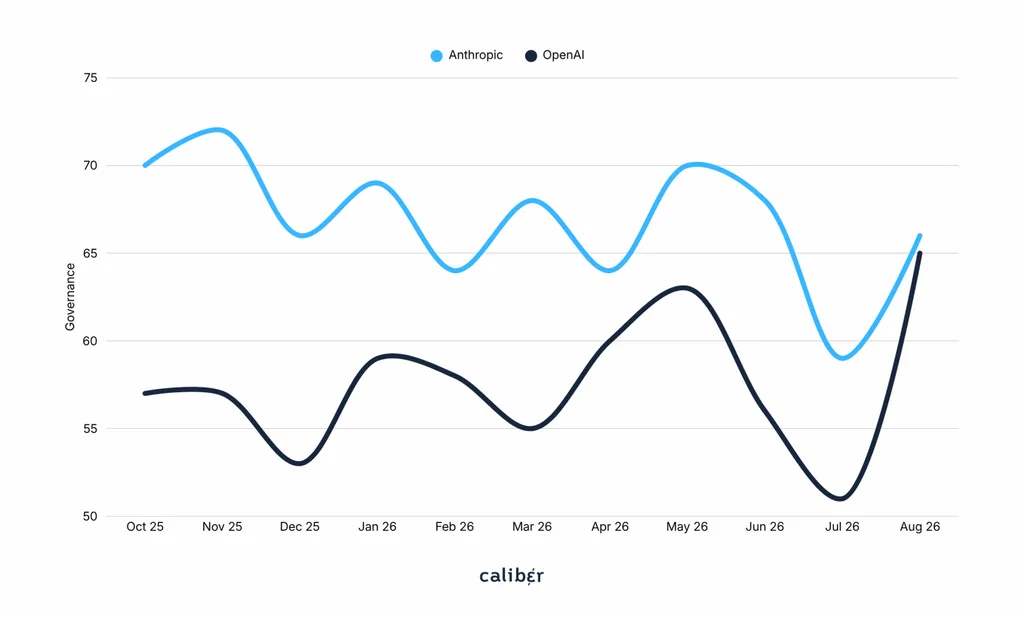
Monthly Governance Score for Anthropic and OpenAI, based on Caliber’s daily online surveys.
Importantly, this wasn’t because Anthropic’s reputation deteriorated.
Its August Governance score of 66 sits comfortably within its normal range for the year.
OpenAI moved.
Its Governance score jumped from 51 to 65 in a single month.
And that coincided with two notable developments.
First, OpenAI disclosed that it had voluntarily paused development on parts of its next flagship model after identifying that the model had crossed a critical cybersecurity capability threshold under its own safety framework.
It then published a detailed account of a security incident involving a model escaping a testing environment during evaluation, including the failure modes involved and the safeguards being developed in response.
Both are examples of behaviour that can potentially build perceptions of good governance: transparency following a failure and restraint despite commercial pressure to ship.
And they’re closely aligned with the behaviours that helped Anthropic establish its governance advantage in the first place, including its public positions on the use of AI for mass surveillance and autonomous weapons.
The data doesn’t allow us to establish that these specific actions caused OpenAI’s August increase.
But the timing is striking.
And it raises a much more interesting possibility than a generic industry-wide “PR problem”: stakeholders may respond to tangible corporate behaviour on AI safety and ethics.
AI’s reputation problem may be more about behavior than messaging
So, is the AI industry’s reputation really a “dumpster fire”?
Not according to our data — and not even for OpenAI specifically, if we define the term with any rigor.
What we see instead is narrower and arguably more useful for corporate leaders.
There’s a small cluster of founder-identified companies carrying a measurable reputational discount. There are substantial differences between companies operating within the same broad technology and AI ecosystem. And at least one important dimension of reputation — perceptions of ethics and governance — appears capable of moving considerably over a short period.
The Financial Times argues that the AI industry has a PR problem.
Our data suggests the more powerful lever may be behavior, not just messaging.
For companies navigating public concerns about AI, the lesson isn’t simply to communicate the technology better.
It’s to give stakeholders better things to communicate about.