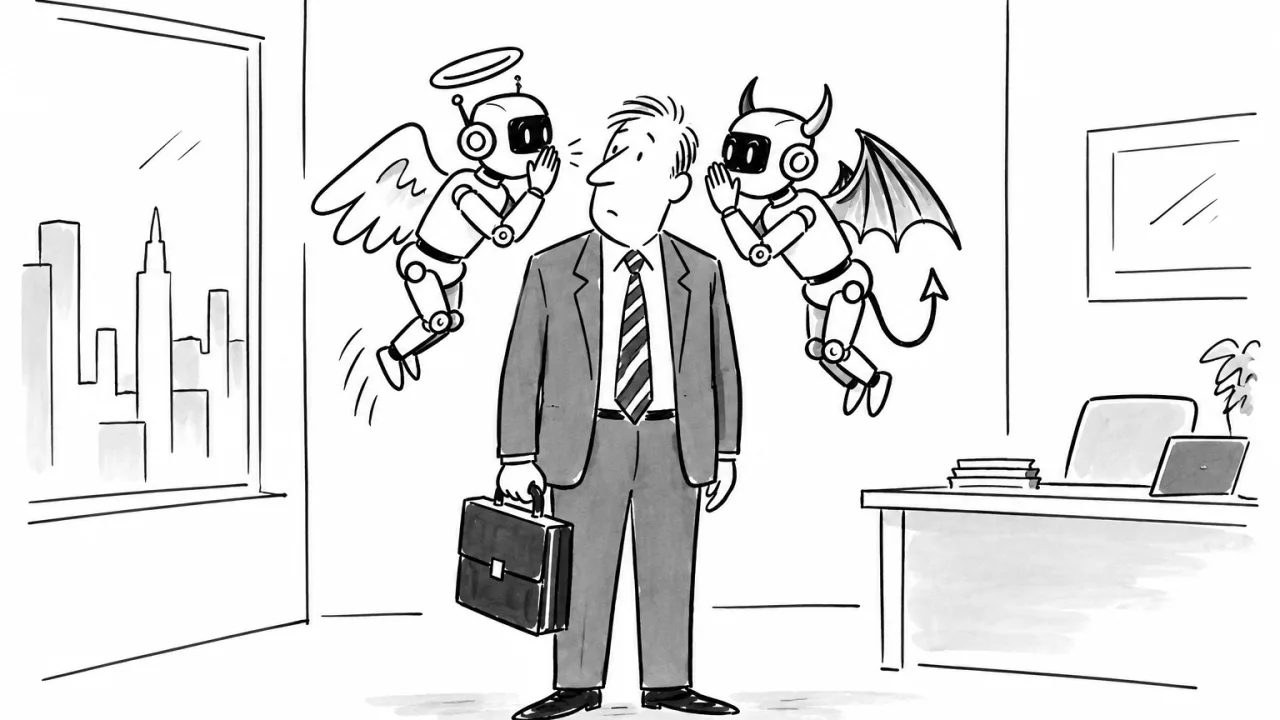

Quick answer: AI is a channel, not a stakeholder. Here’s why treating LLMs as audiences to be managed is a category error, and what communications teams should measure instead.
Something is shifting in how communications teams talk about artificial intelligence. Increasingly, the conversation has moved from “how do we use AI?” to “how do we manage AI?”, as if LLMs like Claude or ChatGPT had joined the list of audiences a company needs to win over. The implicit claim is that because AI can now describe, evaluate, and effectively recommend or dismiss a brand, it deserves to be tracked and managed the way we track and manage stakeholders.
It’s a seductive leap, but the wrong one. A related temptation, using AI to simulate the stakeholders it can’t replace, has its own serious limitations. Here’s why both framings fall short, and what to do instead.
Key takeaways
- AI is not a stakeholder; it’s a media channel. LLMs have no relationship with companies, no autonomous behavior, and no stable views. Measure them with sentiment and volume, the way you measure media.
- Synthetic audiences are useful for cheap, fast hypothesis-testing, and dangerous as a substitute for real stakeholder research. They produce more agreement and less diversity than reality, which creates false confidence.
- The category error has real costs. Building strategy on an LLM’s “attitudes” produces conclusions that are precisely wrong in ways that are hard to detect.
Is AI a stakeholder? Five reasons it isn’t
1. AI has no relationship with your company
Stakeholder management is built on the concept of mutual influence: stakeholders can affect your company, and your company can affect them. That reciprocity plays out through real decisions such as a purchase, a resignation, an investment, or a published story. Nothing like that exists between a company and an LLM. No model is sitting there forming views about your organization between prompts. The interaction only exists when a human initiates it.
2. AI has no autonomous behavior
Even the most capable agentic systems, the kind that can book flights or file forms without a human approving each step, are executing instructions, not pursuing goals. A stakeholder who loses trust in your company might quietly take their business elsewhere, warn their network, or show up at your AGM. An AI will never do any of that of its own accord. Influence without agency isn’t stakeholder influence.
3. AI’s “views” shift with the wind
One of the foundational assumptions of stakeholder research is that people hold views with some consistency: views you can measure, track over time, and connect to behavior. LLMs don’t work that way. Frame your question around governance and you’ll get a governance-themed answer. Switch to product quality and the picture changes. Push back and the model will often simply agree with you. What looks like a stable attitude is in fact a highly sensitive function of how the question was asked.
4. A media channel is the more useful frame
What an LLM does when asked about a company is closer to what a search engine does: it aggregates and synthesizes what’s already out there, filtered through the user’s query. The output reflects the corpus, not a considered view. The questions worth asking are the ones we already know how to ask about media: How does coverage skew? Positive, negative, neutral? And how often are people turning to AI about this topic in the first place? The variables are sentiment and volume, just in a new channel.
5. The category error has real costs
Treating AI as a stakeholder means measuring it like one: running driver analyses to understand which attributes are shaping its “trust” in you, tracking shifts in its “attitudes” over time. But an LLM’s response about your ethics and its response about your products aren’t two facets of a coherent worldview. They’re independent outputs that happen to come from the same model. Building strategy on the assumption they’re connected produces conclusions that are precisely wrong in ways that are hard to detect.
What are synthetic audiences?
A related temptation runs in the same direction: using AI to simulate the stakeholders it can’t replace.
Synthetic audiences are AI-generated personas built to simulate how real people would respond. They’re constructed from demographic data, behavioral patterns, and survey datasets, and they’re increasingly being used to model stakeholder views at scale.
They have genuine uses. If you want to know whether making croissants appealing to Gen Z is even worth pursuing, and which angles might land, you can run a dozen message concepts through a synthetic audience in an afternoon and get a rough directional read before spending a dime on real research. Fast, cheap signal on hypothetical scenarios is a way to eliminate obvious misfires before committing to real investment.
Where synthetic audiences fall short
The organizations that have built serious capability in this space are also the most emphatic about their limits. The core problem is that synthetic audiences produce more agreement and less diversity than reality. Real stakeholders hold contradictory views. They surprise you, and their outlier opinions, the ones that don’t fit the model, are often precisely the ones that matter most. Synthetic audiences, by construction, smooth all of that out.
Using synthetic data as a substitute for real stakeholder research doesn’t only produce noise. It produces false confidence, which is worse. The croissant test might tell you that “artisanal heritage” messaging lands reasonably well with a synthetic Gen-Z panel: a lukewarm positive that nudges you toward proceeding.
What it won’t surface is that the panel is hiding a sharp split: a subcategory of Gen-Z bakers for whom croissants are a genuine passion, and a much larger group who couldn’t care less. Knowing that changes everything, from your strategy to your targeting to your channel mix. But synthetic audiences tend to average out exactly that kind of variation, returning a muted signal where the reality is polarized. The danger isn’t that you miss something obvious. The danger is that you come away with misplaced confidence in a consensus that doesn’t exist.
A more rigorous approach is emerging. Rather than simulating individual responses, you can use models to predict distributions of responses across a population. Instead of asking “what would this demographic think?”, you can ask “what is the probability distribution of trust scores across this segment, given these characteristics and touchpoints?” That’s a more honest framing, and still early-stage research. Even then, it supplements real data rather than replacing it.
The thin end of the wedge: why the framing matters
The stakes in getting this framing right may be higher than they appear. Writing in the Financial Times this week, Yuval Noah Harari warned about Argentina’s move to create a legal category for non-human corporations: AI agents that can own assets, hire employees, litigate, and donate to political campaigns without any human input or liability. Once legal personhood is granted, Harari argues, it opens doors that are very hard to close again.
Treating AI as a stakeholder is a much smaller step than granting it legal personhood. But the underlying logic is the same: ascribing interests, agency, and standing to a system that has none, and then building frameworks around that assumption. The category error starts small, in a measurement methodology or a reputation framework. It doesn’t stay small.
How should companies measure AI? Like a media channel
AI is a genuinely important channel for how companies are described, discovered, and evaluated. Synthetic audiences are a genuinely useful tool for cheap, fast hypothesis-testing. Neither substitutes for real stakeholder research.
Measure AI the way you measure media. Use synthetic audiences the way you use a scratchpad. And keep actual human stakeholders, with all their contradictions and inconvenient outlier views, at the center of your intelligence framework.