

Privacy breaches, misleading marketing, and poor customer service are among the biggest challenges in the telecommunications industry — and remain the most significant threats to the sector’s reputation, according to our latest insights report.
Based on a global survey of almost 6,000 people, our new report shines a light on the telecom sector and reveals what’s driving — or dragging down — its reputation, as well as the broader pressures and industry-wide obstacles shaping public perception.
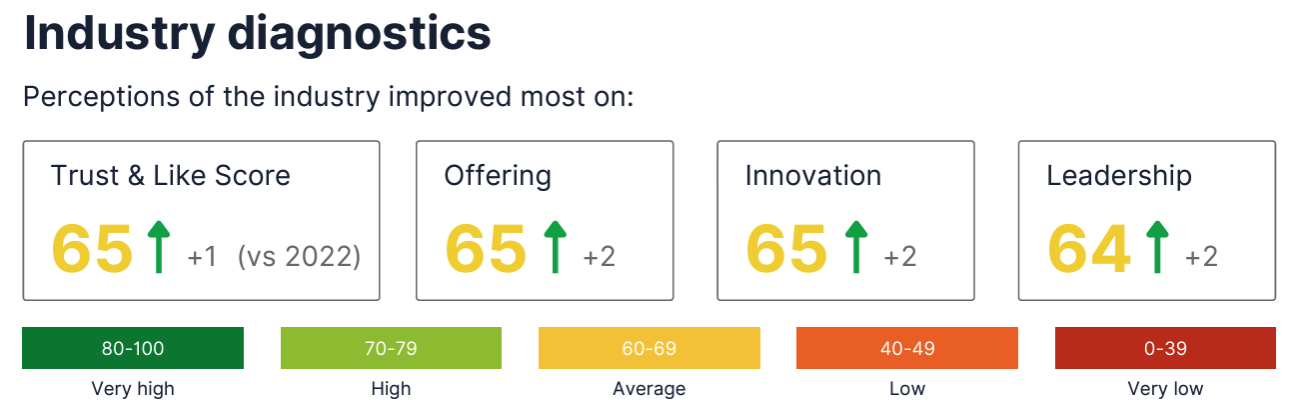
First, the good news — which is that the sector’s standing improved slightly. Not only has its Trust & Like Score (TLS) — our chief metric of corporate reputation — increased since 2022, but so too have some of its brand and reputation attributes.
For example, the telecom sector is seen as more innovative than it was a year ago, perhaps because it’s embracing AI to improve customer service. Telecom companies are also seen as having a stronger offering, possibly because many are diversifying beyond connectivity into media and entertainment services.”
In addition, people are more likely to support, consider or recommend telecom companies than they were in 2022. And almost a quarter of people (23%) say they perceive the industry as better than it was five years ago, with just 6% saying they perceive it as worse.
Read also: Learn how to measure trust — and what businesses keep getting wrong
The bad news for the telecom sector, though, is that its reputation remains relatively poor. With an average TLS of 65, the sector is perceived as worse than the banking and pharmaceutical sectors, among others, and better only than the energy sector.
Perceptions of the telecom sector’s ESG activities have also declined. Or rather, the sector’s Environment and Governance scores were static, whereas its Society score fell in 2022. It’s hard to say why, but we suspect that frequent coverage of job losses across the sector, as well as persistent concerns — and headlines — about data security, overcharging and contract transparency, may well have influenced people’s perceptions.
Heavy job losses — 55,000 layoffs at BT, 14,000 at Nokia — may also explain why less than a third of respondents worldwide (30%) would consider seeking a job in the telecom industry, a low number that’s unchanged from 2022.
As ever, we supplemented our sectoral snapshot with some questions about the challenges and opportunities facing the industry — and the answers provide plenty of insights not only into what’s driving the sector’s relatively poor reputation but also how it can fix it.
Read also: Why Reputation Matters More Than Ever
First, we asked respondents what they thought could most harm the telecom sector in the future. Globally, the top three answers were:
We also asked respondents what telecom companies should focus on to stand out from competitors and attract and retain customers.
Globally, the top three answers were:
Finally, we asked respondents how the telecom sector could contribute more positively to society.
Globally, the top three answers were:
So, how can telecom companies change how stakeholders perceive them and improve their reputation? In our view, the solutions lie in the problems themselves.
In other words, to improve their reputation, telecom companies need to acknowledge and address concerns about data breaches and deceptive advertising, improve customer service, provide more reliable coverage and introduce much more transparent pricing.
Older customers would welcome these developments. For instance, more than half of respondents over 45 said they want the sector to make their services affordable for underserved communities including those in rural regions. Likewise, more than half of over-45s said privacy breaches could most harm the sector’s reputation in the future.
In short, older customers are worried about cybersecurity and affordability — and they also think providing consistently reliable network coverage is the number one way that telecom companies can attract and retain customers.
Finally, our survey reveals several other ways the telecom sector can win over stakeholders. Sitting just outside the top three answers for how the telecom sector could contribute more positively to society were the following:
Meanwhile, almost one in five 18–24-year-olds (19%) said they thought telecom companies should implement programs that positively impact society, like supporting education and healthcare.
In other words, for a sector with a reputation problem, the solution shouldn’t just be to fix existing problems or address customer concerns.
It should also be about being more ethical, sustainable, and socially impactful. Of course, picking up a signal is one thing: for telecom companies today, the trick is making the right call.

James is a communications strategist and senior content lead at Caliber, where he writes about corporate reputation, stakeholder intelligence, and brand trust. He draws on more than a decade of experience helping organizations turn data into stories that build credibility and connection.
Telecom companies struggle with reputation because customers continue to experience price increases, data privacy concerns, confusing contracts, and service outages. According to the Telecoms Global Reputation Report 2024, the sector ranks near the bottom globally, with ESG scores—especially the “Society” dimension—declining due to issues like job cuts, transparency concerns, and data security risks.
Globally, consumers say telecom companies win customers by focusing on three key areas:
Reliable service (consistent coverage, fewer outages)
Strong data security
Transparent pricing (clear bills, no hidden fees)
The top three global risks identified are:
Privacy breaches (most cited globally across all age groups)
Misleading marketing (especially high in Brazil, with 50% selecting it)
Inadequate customer service
Environmental impact is also a major concern in markets like France, and monopolistic behavior ranks high in China and Japan
The report shows that the most effective ways to improve reputation are to focus on reliable network service, strong data security, and transparent pricing. These three factors were ranked globally as the most important drivers of customer trust and loyalty. Addressing misleading marketing, improving customer service, and showing genuine social impact also help rebuild credibility.
Customers care most about reliable service, data security, and clear, honest pricing—the top three areas identified in the report. Younger customers also value community engagement and social impact, while older customers prioritize privacy and protection from cyber threats. These insights show that expectations vary by age group and market.
Follow Caliber
Get the results of our latest research directly in your inbox!