Governance just overtook environment as the top ESG reputational risk companies face in 2026, according to GlobeScan. That shift did not happen because companies suddenly polluted more or less. It happened because stakeholders changed what they pay attention to and what they believe.
This is the distinction at the center of ESG reputation. ESG performance is what a company actually does: its emissions data, its diversity numbers, its governance structure. ESG reputation is how stakeholders interpret those actions. A company can score well on paper and still lose ground with investors, employees, and customers if its efforts are not recognized, understood, or trusted.
This article defines ESG reputation, explains why the gap between performance and perception keeps widening, and outlines what stakeholders actually weigh when they form a judgment.
Key Takeaways
- ESG performance and ESG reputation are not the same thing. A company can meet every disclosure requirement and still face a reputational gap if stakeholders do not know about, understand, or believe in its ESG efforts.
- Investor skepticism toward ESG claims is rising, not falling. According to EY’s Institutional Investor Survey, 85% of investors say greenwashing has become a more serious problem than it was five years ago, even as ESG-labeled assets under management continue to grow.
- Caliber tracks ESG reputation the way stakeholders actually experience it: continuously, and segmented by audience, rather than as a single annual score built from public disclosures.
What Is ESG Reputation?
ESG reputation is the sum of what employees, investors, customers, and policymakers believe about a company’s environmental, social, and governance conduct, based on what they have seen, heard, or experienced. It sits apart from ESG performance and from ESG ratings, and confusing the three leads companies to measure the wrong thing.
ESG Reputation vs. ESG Performance vs. ESG Ratings
ESG performance describes what a company does: its actual emissions, labor practices, and board composition. ESG ratings, issued by agencies like MSCI or Sustainalytics, translate that performance into a standardized score for investors. ESG reputation is different from both. It captures whether stakeholders recognize a company’s ESG activity at all, and if they do, whether they believe it is genuine.
A company can hold a strong ESG rating and still have a weak ESG reputation among the public, if awareness of its efforts is low or trust in its intent is thin. The reverse also happens: a company with an average rating can build a strong reputation through consistent, credible communication. Rating agencies and the general public are simply not evaluating the same thing.
Why the Gap Between ESG Action and ESG Reputation Keeps Growing
Two forces are pulling ESG performance and ESG reputation further apart. The first is stakeholder skepticism. EY’s Institutional Investor Survey found that 85% of investors now view greenwashing as a more serious problem than it was five years ago, and 36% say companies have made insufficient progress on nonfinancial reporting. Disclosure alone no longer earns automatic trust.
The second is a shift in what stakeholders are watching. GlobeScan’s 2026 reputational risk data shows governance overtaking environmental concerns for the first time, reflecting rising scrutiny of corporate ethics, accountability, and internal oversight rather than emissions alone. Meanwhile, the US SIF Trends Report tracks $6.6 trillion in assets explicitly marketed as ESG or sustainability-focused, which shows that capital has not walked away from ESG. It has simply become more demanding about what it will believe.
Companies that only track performance and ratings miss both shifts. Companies that track reputation directly can see them as they happen.
Why ESG Reputation Matters to Corporate Affairs Leaders
ESG reputation is not a communications afterthought. It shapes decisions made by three stakeholder groups whose behavior directly affects the business.
Turning this into a working program starts with setting the right KPIs for tracking stakeholder perception.
The Business Case: Investors, Talent, and Customers All Weigh In
Investors increasingly factor ESG reputation into capital allocation decisions, and rising greenwashing skepticism means they scrutinize the gap between disclosure and belief more closely than before. Talent evaluates a prospective employer’s ESG reputation when comparing offers, particularly around governance and workplace ethics. Customers, especially in categories where trust drives loyalty, weigh perceived ESG conduct alongside price and quality.
Caliber’s ESG Perception Rankings show how these dynamics play out across real companies and sectors.
Each of these audiences reaches its own conclusion independently. A single ESG rating cannot tell a communications team whether investors, employees, and customers actually see the company the same way.
Reputational Risk Doesn’t Wait for a Rating Downgrade
ESG reputational damage often appears well before a formal ratings downgrade or a disclosure failure. A governance controversy, a leadership misstep, or a poorly explained policy change can shift stakeholder sentiment within days. Companies that only check their ESG standing through annual ratings updates or periodic surveys discover the damage after it has already spread.
How Stakeholders Actually Judge Your ESG Reputation
Stakeholders do not evaluate ESG reputation the way a ratings agency does. Two factors come first, ahead of any specific environmental or social claim.
Awareness and Familiarity Come First
A stakeholder cannot form an opinion about ESG efforts they do not know exist. Awareness (whether someone recognizes the company at all) and familiarity (whether they know enough about its ESG activities to judge them) function as prerequisites to every other reputation metric. Low familiarity is not a rating problem. It is a communication problem, and it shows up clearly when reputation is tracked continuously rather than checked once a year.
The Three ESG Pillars, Through a Stakeholder Lens
Once awareness exists, stakeholders form views across the three familiar ESG pillars: environmental impact, social impact, and governance and ethics. What differs from a ratings-agency approach is the source of the evaluation. Instead of scoring disclosures against a fixed framework, this measures what real stakeholders believe after being exposed to a company’s actual communication and conduct.
This sits within Caliber’s broader stakeholder intelligence approach, which tracks awareness, familiarity, and trust across every audience that matters to your business.
Caliber’s ESG Perception Tracker is built specifically to capture this stakeholder view in real time.
Turning ESG Perception Into Action: A Global Food and Beverage Company’s Approach
A global food and beverage company with a highly diversified brand portfolio needed to understand how different stakeholder groups perceived its sustainability commitments across markets. Public reporting told the company what it had done. It did not tell the company whether customers, employees, and investors recognized or believed in that work.
By tracking stakeholder perception directly, the company’s communications team identified which sustainability narratives were landing and which were not resonating at all. That insight shifted the company’s approach from reactive statements after news cycles to proactive communication built around the themes stakeholders already cared about.
How to Start Closing Your ESG Reputation Gap
Closing the gap between ESG performance and ESG reputation starts with two habits most companies do not yet have in place.
Track Perception Continuously, Not Just Once a Year
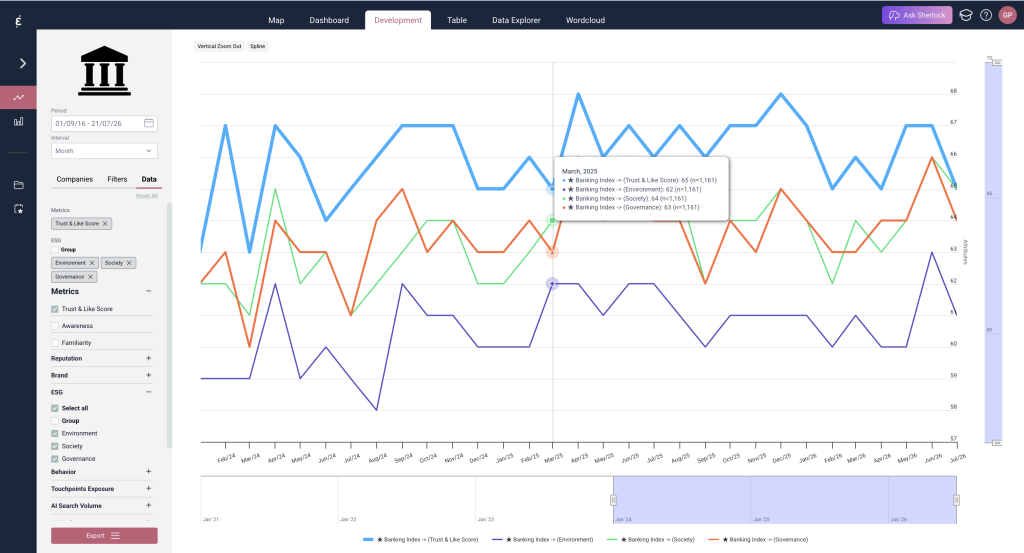
Annual surveys and ratings updates capture a single moment. Stakeholder sentiment moves in weeks, not years, particularly around governance and controversy. Continuous tracking catches shifts in trust while there is still time to respond, rather than after a crisis has already taken hold.
Align Communication With What Stakeholders Actually Believe
Once a company knows where perception and performance diverge, it can direct communication resources at the actual gap instead of repeating messages that are not landing. If a stakeholder group underestimates a genuine strength, that is a visibility problem to fix with communication. If a stakeholder group is skeptical of a claim the company considers strong, that is a credibility problem, and it requires a different response entirely.
For a deeper, step-by-step approach to building this into a broader ESG program, see our guide to improving ESG ratings and strategy.
The Bottom Line
ESG performance tells a company what it is doing. ESG reputation tells it whether stakeholders believe that work. In 2026, with governance scrutiny rising and investor skepticism toward ESG claims at a multi-year high, that distinction has become harder to ignore.
Caliber’s ESG Perception Tracker measures ESG reputation directly from the stakeholders who matter most to your business, continuously and segmented by audience, so communications teams can see the gap between performance and perception before it becomes a crisis.
Frequently Asked Questions
ESG reputation is how stakeholders, including employees, investors, customers, and policymakers, perceive a company’s environmental, social, and governance conduct. It reflects awareness, familiarity, and trust rather than the underlying performance data itself, and it can move independently of a company’s official ESG rating.
An ESG rating, issued by an agency such as MSCI or Sustainalytics, scores a company’s disclosed performance against a standardized framework. ESG reputation measures something different: whether real stakeholders know about that performance and believe it reflects genuine commitment. A strong rating and a weak reputation can exist at the same company at the same time.
Investor skepticism has grown alongside the volume of ESG disclosure itself. EY’s Institutional Investor Survey found that 85% of investors see greenwashing as a more serious problem than five years ago, and more than a third say companies have not made sufficient progress on nonfinancial reporting. Rising disclosure has not automatically translated into rising trust.
No. A company can meet every environmental and governance benchmark and still face a reputational gap if stakeholders are unaware of that performance or doubt its authenticity. ESG reputation depends on communication and credibility as much as on the underlying data.
ESG reputation should be tracked continuously rather than through an annual survey or a periodic ratings update. Stakeholder sentiment, particularly around governance issues, can shift within weeks. Continuous tracking gives communications teams the lead time to respond before a perception gap turns into a reputational crisis