How can you measure the reputation of a corporate brand? The question comes up in nearly every CCO and CMO conversation about communications effectiveness, and the answers are often unsatisfying. Some point to media sentiment. Others cite NPS or Glassdoor ratings. A few commission an annual brand study and present the results once a year. None of these capture what brand reputation measurement actually requires: a continuous, multi-stakeholder view of how people perceive your company, connected to the behaviors that affect your business.
This article lays out what rigorous brand reputation measurement looks like: the metrics that matter, how they fit together in a hierarchy, which tools and approaches work (and which fall short), and how to turn measurement into analysis that informs decisions. If you’re thinking of measuring your corporate reputation, this is where to start.
Key Takeaways
- Brand reputation is multi-dimensional. A single number tells you almost nothing. Credible measurement breaks reputation into specific attributes (rational and emotional), connects them to a primary KPI, and links that KPI to stakeholder behaviors like advocacy, purchase consideration, and recommendation.
- The right metrics need the right frequency. Quarterly measurement shows you where you were. Daily measurement shows you where you are and what’s changing. The difference determines whether you’re managing reputation proactively or reviewing it in retrospect.
- Measurement without benchmarking is incomplete. A score of 67 is meaningless without context. You need to know how it compares to your own trend, to your competitors, and to your sector’s norms.
What Brand Reputation Measurement Actually Requires
Measuring corporate reputation is not the same as tracking brand health among consumers. Brand health studies typically focus on one audience (consumers) and a narrow set of metrics (awareness, consideration, preference). Brand reputation measurement is broader in scope and deeper in what it captures.
Three characteristics define a credible approach.
Multi-stakeholder coverage. Your reputation exists across every group that shapes your success: customers, employees, investors, opinion leaders, regulators, and prospective talent. Measuring only consumers gives you a partial view. A company can have strong consumer perception and declining trust among investors or talent. Corporate reputation measurement tools need to capture all of these groups in a single, continuous model.
Hierarchical metrics. A flat list of scores is not a measurement framework. Credible brand reputation measurement organizes metrics in a hierarchy: a primary KPI that predicts behavior, supported by attribute-level scores that explain what’s driving it, connected to behavioral outcomes that tie perception to business results.
Continuous cadence. Perceptions shift in response to campaigns, news cycles, competitive moves, and external events. A quarterly study captures none of this movement. By the time you see a drop, the cause may have happened months ago. Continuous measurement captures perception shifts as they happen, giving leadership teams the time to investigate and respond.
The KPIs That Define Brand Reputation
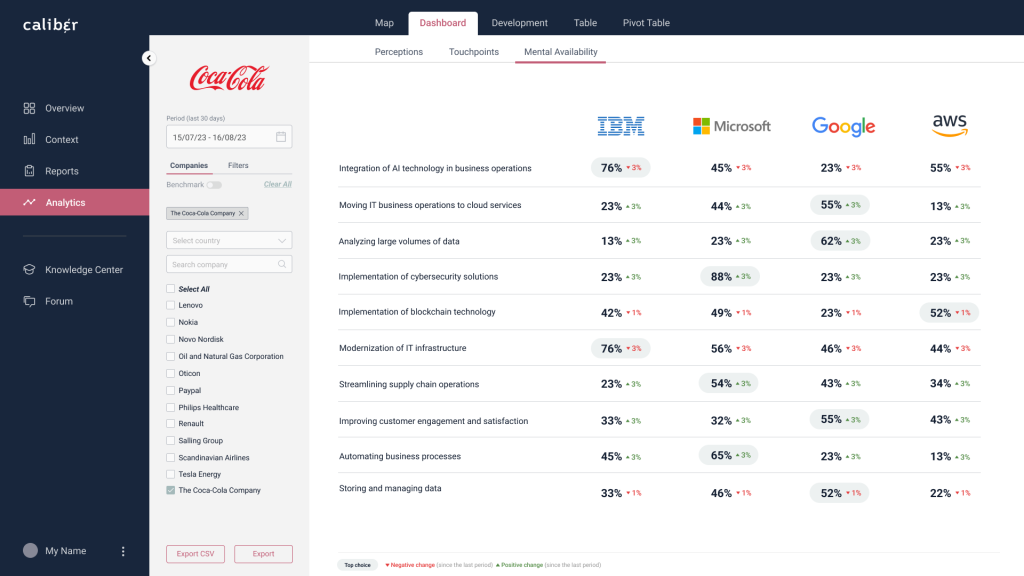
Not all reputation metrics are equal. Some describe what people think. Some explain why. And some predict what they’ll do. The most useful measurement frameworks cover all three levels.
Awareness and Familiarity: The Qualifiers
Before stakeholders can trust or like your company, they need to know it exists and understand what it does. Two metrics qualify the rest of the model.
Awareness measures whether stakeholders have heard of your company. High awareness is necessary but not sufficient. Many companies are well-known among consumers but invisible to the talent pools or investor communities they need to reach.
Familiarity goes deeper: do stakeholders understand what the company does, what it stands for, and what it’s like to engage with? Caliber’s research shows that each step up the familiarity ladder adds roughly 8–12 points to the Trust & Like Score. The gap between awareness and familiarity is one of the most underrated sources of reputational risk: people know your name but not your story, and when something goes wrong, they fill in the blanks themselves.
Trust & Like Score: the headline KPI
Caliber’s Trust & Like Score (TLS) sits at the top of the measurement hierarchy. It captures overall emotional trust and affinity toward a company among a representative sample of stakeholders, measured daily.
TLS matters because it predicts behavior. Caliber’s global data shows an R²=0.84 correlation between TLS and supportive stakeholder behaviors, including advocacy, purchase consideration, recommendation, and employment intent. In practical terms: how people feel about your company predicts, with high accuracy, what they’ll do. That makes TLS the single most valuable metric in brand reputation measurement.
Reputation Score: the rational drivers
The Reputation Score breaks down how stakeholders evaluate your company’s performance across four dimensions.
Offering. Compelling products and services.
Innovation. Forward-thinking and adaptive.
Integrity. Ethical, transparent, accountable.
Leadership. Well-managed and strategically sound.
These are rational assessments. They tell you which performance dimensions stakeholders rate highly and which are dragging the overall score. A company with a strong Offering score but weak Integrity perception has a specific, actionable insight.
Brand Score: the emotional drivers
Caliber’s Brand Score captures how stakeholders feel about your company at an emotional and identity level, measured across four dimensions.
Authenticity. Genuine and true to its values.
Differentiation. Distinct from competitors.
Relevance. Matters to the stakeholder’s life or work.
Inspiration. Inspires confidence or aspiration.
Brand attributes and reputation attributes are complementary. Reputation captures rational assessment; brand captures emotional connection. Companies need both to understand perception fully. Caliber measures them in an integrated model, so leadership teams can see how rational and emotional perceptions interact.
ESG Score: the responsibility layer
Caliber’s ESG Score tracks stakeholder perceptions of environmental responsibility, social impact, and governance practices. These perceptions increasingly influence investment decisions, purchasing behavior, talent attraction, and regulatory relationships, particularly in European markets and among younger demographics.
Behavioral Outcomes: the business connection
Metrics are only strategically useful if they connect to what stakeholders do. Caliber tracks four behavioral outcomes continuously.
Advocacy. Would they speak positively about the company?
Consideration. Would they consider buying?
Recommendation. Would they recommend it to others?
Employment intent. Would they consider working there?
This perception-to-behavior chain is what separates brand reputation measurement from brand vanity metrics. Without it, you have a dashboard of scores. With it, you have a direct line from stakeholder perception to revenue, talent, and investor confidence.
Corporate Reputation Measurement Tools: What Works and What Falls Short
The market for corporate reputation measurement tools ranges from free social listening dashboards to enterprise stakeholder intelligence platforms. Three categories are worth understanding.
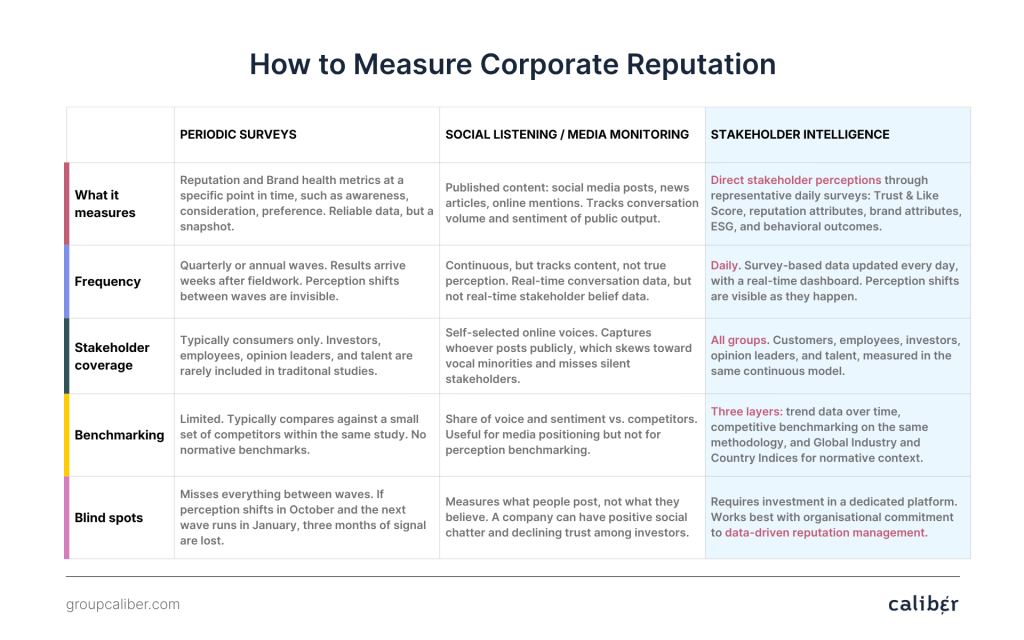
Periodic brand studies
The traditional approach: commission a research firm to survey stakeholders every quarter or every year. The data is methodologically sound at the moment of collection, but the gaps between waves leave blind spots. If your Integrity score dropped in March and your next wave runs in June, you’ve missed three months of signal. You’ll see the damage, but not when it started or what caused it. Periodic studies also tend to cover consumers only, missing the stakeholder groups that affect talent, investment, and regulatory relationships.
Social listening and media monitoring
These tools track what journalists write and what people post online. They’re valuable for understanding conversation volume, trending topics, and narrative direction. But they measure published content, not stakeholder perception. Social listening captures what a vocal online minority says publicly. It does not tell you what a representative cross-section of actual stakeholders believes. A company can have positive social sentiment and declining trust among investors. These tools complement brand reputation measurement but cannot replace it.
Stakeholder intelligence platforms
This is the approach that combines the rigor of survey-based measurement with the continuity of always-on data collection. Caliber surveys representative panels of stakeholders daily across 60+ countries, measuring TLS, reputation and brand attributes, ESG perceptions, and behavioral outcomes in a single platform with a real-time dashboard. The data is segmented by stakeholder group, benchmarked against competitors, and contextualized through Global Sector and Country Indexes.
Caliber was founded in 2016 by former Reputation Institute directors who recognized the limitations of periodic research. The platform was built tech-first for continuous measurement, not retrofitted from an annual research model. It has conducted more than 4 million stakeholder interviews and tracked over 6,000 companies in 40+ countries.
Analysis: Turning Metrics into Insight
Raw scores are starting points. Analysis is what makes them useful. Four types of analysis turn brand reputation measurement into actionable intelligence.
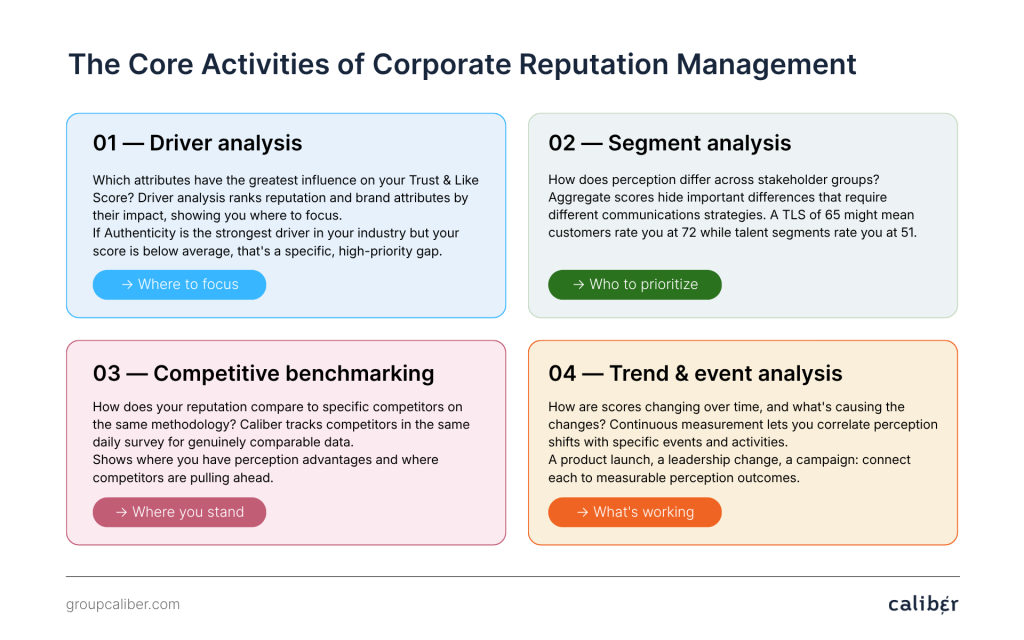
- Driver analysis. Which attributes have the greatest influence on TLS for your specific company? Driver analysis ranks reputation and brand attributes by their impact on overall trust and affinity. This tells you where to focus: if Authenticity is the strongest driver of TLS in your industry, but your Authenticity score is below sector average, that’s a specific, high-priority gap.
- Segment analysis. How does perception differ across stakeholder groups? A TLS of 65 might mean customers rate you at 72 while talent segments rate you at 51. Those two groups require very different communications strategies. Caliber’s stakeholder segmentation reveals these differences by group, by market, by attribute.
- Competitive benchmarking. How does your reputation compare to specific competitors on the same methodology? Caliber tracks competitors in the same daily survey, so all data is collected on comparable methodology. This shows where you have perception advantages and where competitors are pulling ahead.
- Trend and event analysis. How are scores changing over time, and what’s causing the changes? Continuous measurement lets you correlate perception shifts with specific events: a product launch, a leadership change, a campaign, a crisis. This connects communications activity to measurable perception outcomes.
What Good Brand Reputation Measurement Looks Like in Practice
Companies that do brand reputation measurement well share a few characteristics.
They measure daily, not quarterly. Perception moves between research waves. The companies that manage reputation proactively are the ones with always-on visibility into what stakeholders think and how it’s changing.
They measure all stakeholders, not consumers only. Investors, employees, opinion leaders, regulators, and prospective talent all hold perceptions that affect business outcomes. A measurement program that only tracks one group is missing the picture.
They use hierarchical metrics, not flat dashboards. TLS at the top, attributes explaining what drives it, behavioral outcomes showing what it predicts. The logic of the model is part of what makes the data actionable.
They benchmark everything. Against their own trend, against specific competitors, against sector and country norms. A score without context is a number without meaning.
They connect perception to business decisions. The point of brand reputation measurement is not to fill a board slide. It’s to inform which campaigns to run, which markets to invest in, which messages to adjust, and which stakeholder groups to prioritize.
Caliber provides the intelligence infrastructure for this kind of measurement program. The strategy and action remain with the communications, marketing, and HR functions. Caliber provides the continuous, stakeholder-level data that makes those decisions informed, timely, and evidence-based.
See What Your Stakeholders Actually Think
Most companies operate on assumptions about how they’re perceived. Caliber replaces those assumptions with data: measured daily, across all the stakeholder groups that shape your success, benchmarked against your competitors and your industry.
If you’re ready to move from periodic snapshots to continuous stakeholder intelligence, book a demo and see where your reputation stands right now.