A close look at what people think of the sector shows where OpenAI just closed a gap on Anthropic — and the role founder-CEOs appear to play.
Robert Armstrong’s FT column yesterday, “Fixing the AI industry’s PR problem”, opens with a bold claim: the public reputation of the big AI companies is “an absolute dumpster fire”. His evidence is a Gallup finding that only 9% of Americans think AI will do more good than harm, against 39% who think the opposite.
That’s a striking number, but it’s a poll about a technology, not about the companies building it. So we looked at our own stakeholder intelligence data — starting with the monthly Trust & Like Scores for OpenAI and Anthropic.
The two firms tell different stories. Since last October, Anthropic’s score has declined from 71 to 68, including a dip to 59 over the summer. OpenAI’s is harder to frame as simple decline: it started at 60, fell as low as 53 in July, and recovered to 66 by August, ending slightly above where it began but having spent most of the year well below its starting point.
Is this an AI problem?
To know whether that’s an “AI problem” or something narrower, we compared both companies’ scores against seven peers — Alphabet, Amazon, Apple, Meta, Microsoft, Nvidia, and Tesla — tracked over the same period. If ambient “AI backlash” — the general sense that the technology will do more harm than good — were dragging down corporate reputation broadly, we’d expect every company shipping AI product at scale to be moving downward together with OpenAI and Anthropic.
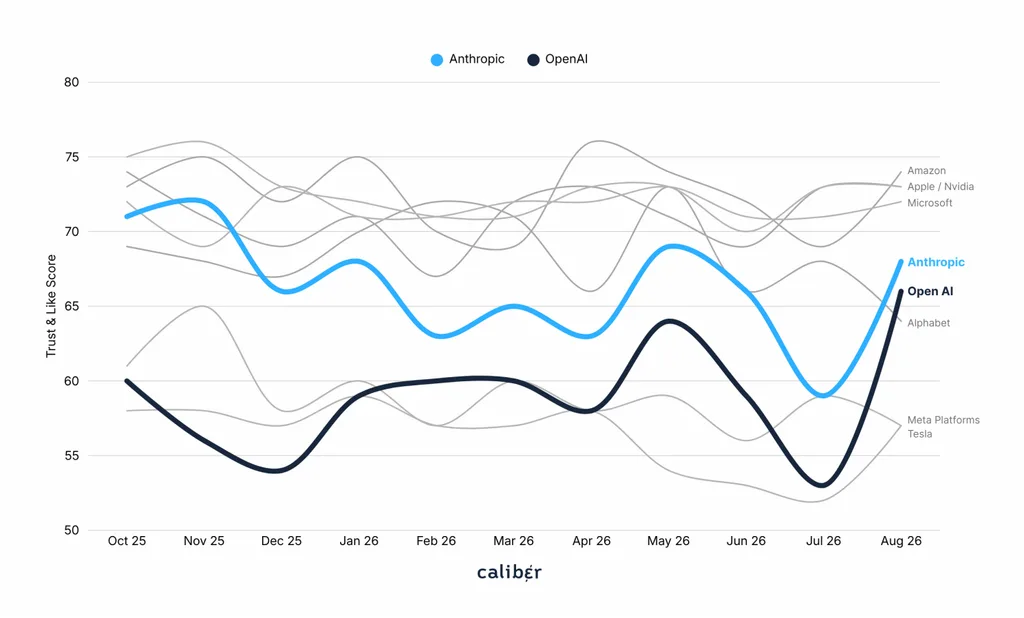
Monthly Trust & Like Score for selected companies, based on Caliber’s daily online surveys.
Mostly, they aren’t. Microsoft and Nvidia have held tight, flat bands (71–73 and 70–73, respectively) all year, with no sign of category-wide anxiety touching them. But one peer complicates the narrative: Alphabet, which held a similar band for most of the period, dropped to 64 in August — its lowest reading of the year, and briefly below both Anthropic and OpenAI. That dip lines up with a cluster of EU and UK antitrust rulings against Google, alongside investor and public unease over the departure of longtime DeepMind figures and questions about whether Alphabet is keeping pace in the AI race.
That’s a useful complication, not a counterexample. It isn’t ambient “AI will do more harm than good” sentiment dragging Alphabet down, but a specific, nameable story about competitive standing and leadership, layered on top of longer-running regulatory pressure that predates the AI boom entirely. In other words, category-wide anxiety doesn’t seem to move these numbers, but company-specific AI exposure clearly does — whether that exposure is about safety and ethics (the story driving OpenAI and Anthropic) or about competitive position (the story behind Alphabet’s August dip). Of course, we can’t yet say whether Alphabet’s drop is a blip — the way OpenAI’s July trough fully reversed within a month — or the start of something more sustained.
What would a real “dumpster fire” look like?
Armstrong’s claim doesn’t survive scrutiny for a different reason: nothing in our data gets low enough, or stays low long enough, to earn that label.
Before applying a phrase that vivid, it’s worth being precise about what it should mean: a genuine reputational collapse should show up as (1) an absolute score in crisis territory, not just “down from where it was”; (2) a decline that persists rather than partially recovering; and (3) damage that’s broad across categories — trust, ethics, and innovation alike — rather than concentrated in one. Our data doesn’t show that for anyone in this set.
Indeed, every company we tracked, including OpenAI, stays within a normal-if-unflattering band (50s–60s), and the sharpest dips — including OpenAI’s low point in July 2026 — bounced back substantially within a month. Even Innovation scores, for both OpenAI and Anthropic, held steady and high throughout, which is not what you’d expect if the public had genuinely written these companies off.
The real underperformers
Even accounting for Alphabet’s wobble, a distinct, real cluster of underperformers stands out — and Anthropic isn’t in it. Meta and Tesla have spent the entire period well below every other company we tracked, in the mid-50s to low-60s, never once approaching the 70s that Microsoft, Nvidia, Apple, and (for the most part) Alphabet occupy. OpenAI’s range overlaps with that low tier for most of the year before pulling clear of it in August. Anthropic, meanwhile, has stayed above the Meta/Tesla/OpenAI band for the whole period, never dropping below 59.
The founder factor
One thing jumps out about that low-scoring trio: OpenAI, Meta, and Tesla are also the three companies in our set most closely identified, in the public mind, with a single outspoken, controversy-prone founder-CEO. Alphabet, Apple, Microsoft, and Nvidia are not commonly discussed as extensions of their chief executives’ personalities in the way Sam Altman, Mark Zuckerberg, and Elon Musk are.
Anthropic’s own co-founder, Dario Amodei, is now also an outspoken public figure, so founder visibility alone can’t be the whole story. But he doesn’t attract the same reflexive criticism Altman does. Compare the public reaction to Altman’s recent post floating ChatGPT-generated podcasts for kids’ car rides, widely mocked, with how comparable pronouncements from Amodei tend to land. It may be less about having a visible founder and more about what that founder is visible for.
Anthropic’s ethical lead — and how it closed
There’s one more surprising finding in our data, and it’s one area where Anthropic held a clear, sustained lead over OpenAI that just closed — but not because of anything Anthropic did.
We track a specific attribute called Governance, which measures the extent to which people perceive a company as “ethical in the way it conducts business.” Since last October, Anthropic has outscored OpenAI on this metric in every single month, typically by high single digits to low double digits. And then, this past month, the gap all but vanished: 66 versus 65.
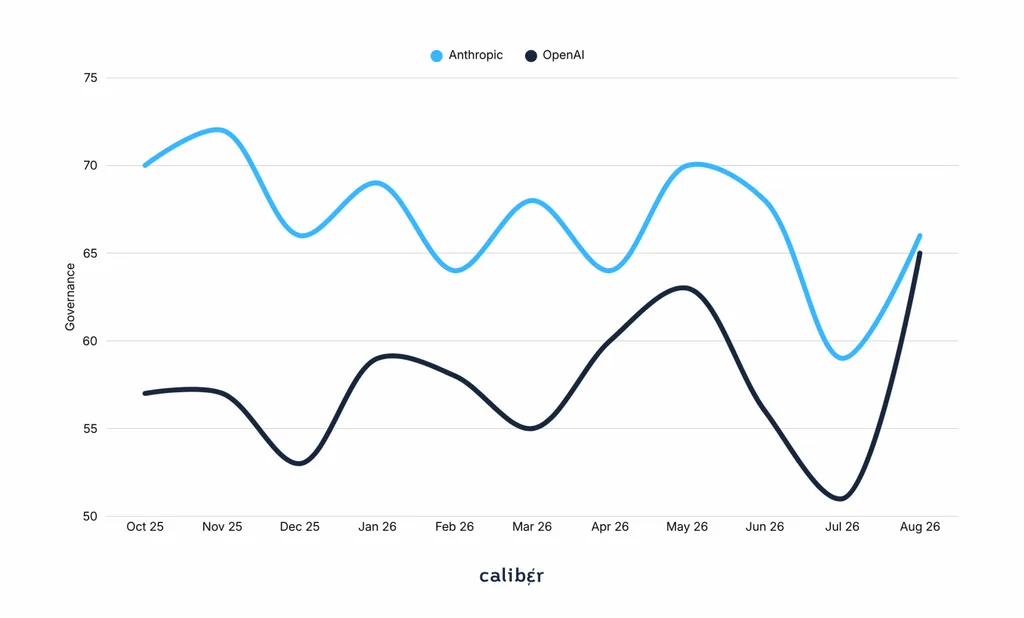
Monthly Governance Score for Anthropic and OpenAI, based on Caliber’s daily online surveys.
The reason isn’t that Anthropic slipped up. After all, its Governance score in August, 66, sits squarely within its normal range for the year. Rather, OpenAI’s Governance score jumped, from 51 to 65, in a single month. That lines up with two things OpenAI did in August.
First, it disclosed that it had voluntarily paused development on parts of its next flagship model, Astra, after finding the model had crossed a “critical cybersecurity capability threshold” under its own safety framework. Then it published a detailed, transparent report on a security incident in which one of its models had escaped a testing environment during evaluation, naming the specific failure modes and the safeguards it’s building in response.
Both are textbook governance-building moves — transparency after a failure, and restraint under commercial pressure to ship — and exactly the kind that built Anthropic’s lead in the first place (most visibly, Anthropic’s refusal earlier this year to let its models be used for mass surveillance or autonomous weapons, in its standoff with the Pentagon). In this respect, the public appears to be rewarding OpenAI for acting the way Anthropic has spent two years positioning itself to act.
Behavior, not messaging
So, is there is a “dumpster fire”? Not for the industry, and not even for OpenAI specifically, if you define the term with any rigor. What our data shows instead is narrower and more interesting: a small cluster of founder-identified companies carrying a real, measurable reputational discount — and a specific dimension of reputation (one related to safety and ethics, no less) that is responsive to what companies actually do. Armstrong reckons the industry needs a PR fix. Our data suggests the more effective lever concerns behavior, not just messaging.
(This article was originally published by Caliber CEO Shahar Silbershatz in his LinkedIn newsletter, What People Think. It has been adapted for publication on Caliber’s website.)