America has long been a deeply polarized society, but on trust in its biggest companies, Democrats and Republicans barely differ. Our data shows the real divides lie elsewhere.
I’m writing from Boston, my base for a few weeks while I spend time in the market that matters most to Caliber. We’ve just held a roundtable in Dallas, and later this month I head to Washington, DC for another. It’s a lovely time to be here. On election day, as America went to the polls, I took a walk across a very autumnal Boston Common.
It’s also a charged time. America has spent years being sorted into red states and blue states, and the midterms, with Democrats flipping Senate seats as far afield as Texas, Kansas and Ohio, showed that map is less fixed than it looked.
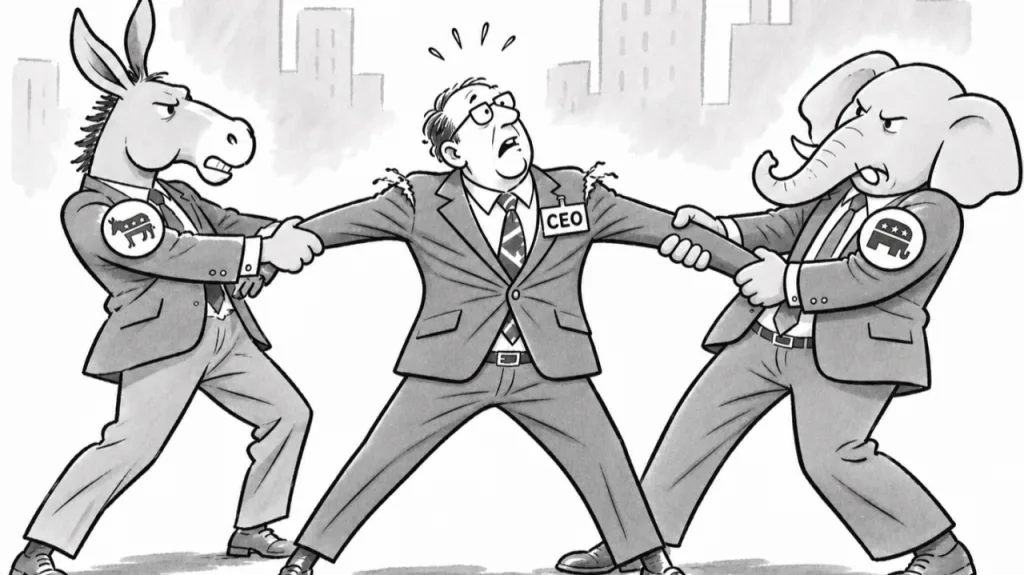
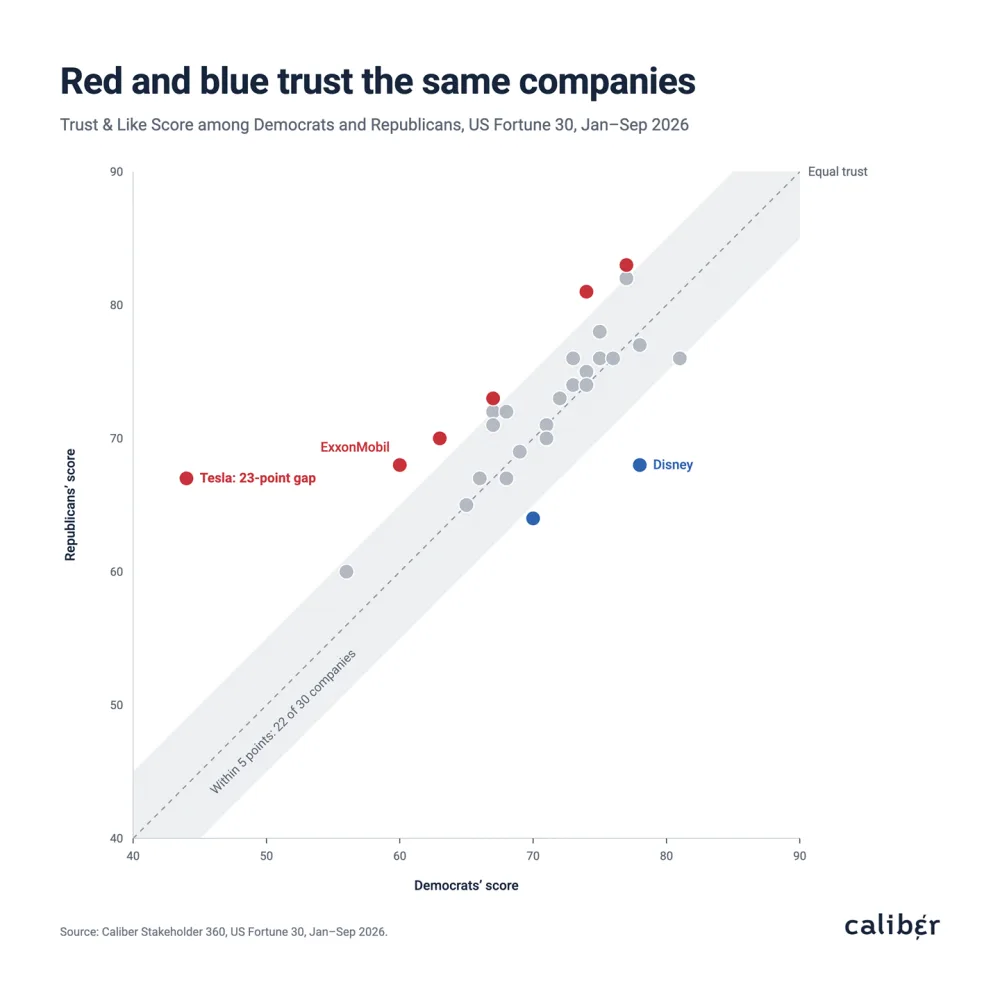
I arrived hoping to share exclusive Caliber data on how split America is over its biggest companies. But at first look – that’s not what the data says at all. When it comes to trusting America’s 30 biggest companies, Republicans and Democrats are remarkably close.
Here’s how close:
- 22 of 30 companies get Trust & Like Scores within 5 points of each other from the two parties.
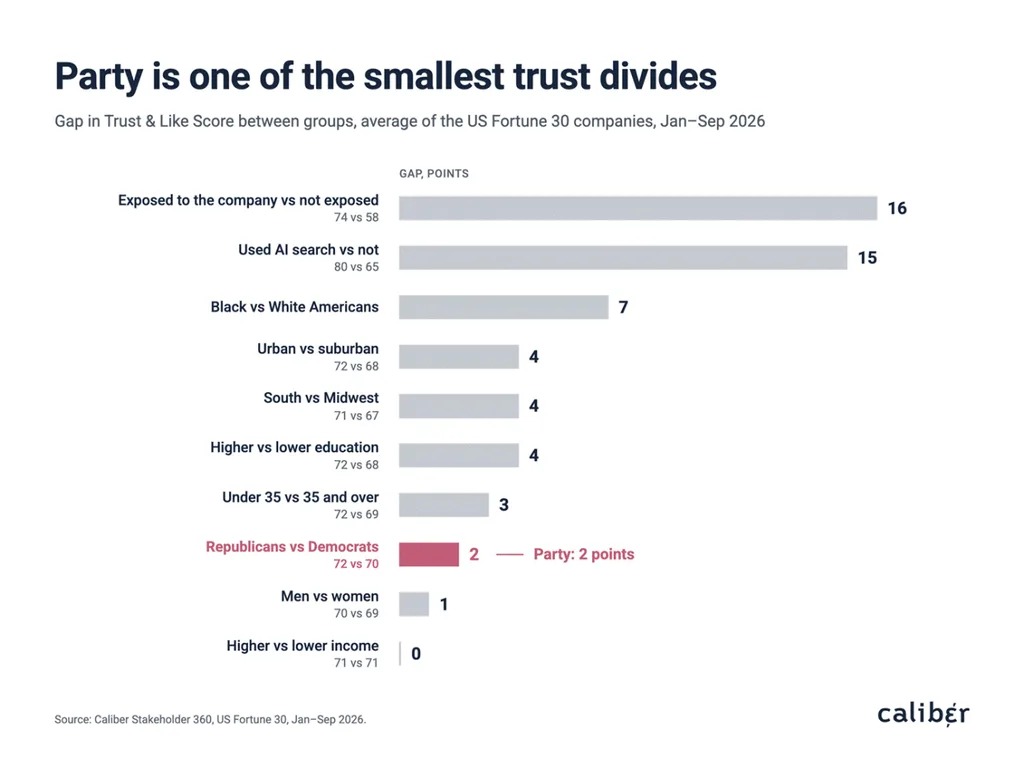
- 2 points is the average gap across all 30: Republicans 72, Democrats 70 (on a 0 – 100 scale).
- Tesla is the outlier. The parties rated it equally in 2023. By early 2025 the gap was 29 points. Today, it has narrowed to 18.
For any company that engages with stakeholders on both sides of the aisle, which is nearly all of them, that’s good news.
The bigger divides lie elsewhere
Party affiliation is one of the smallest trust-divides we measure. Turns out what matters far more is whether stakeholders have come across a company at all, and whether they used an AI chatbot to look it up. Even demographics split trust more than party does.
- Exposure: people who have encountered a company through any touchpoint (such as media, advertising, their product, or word of mouth) score it 74; those who haven’t, 58.
- AI search: stakeholders who used an AI tool to research companies score them 80, against 65 for those who didn’t.
- Independents: they score companies 66, below both Democrats (70) and Republicans (72). The gap holds among stakeholders who know the companies equally well, so they’re the toughest crowd of all.
Same levels of trust, different things driving it
Our analysts ran the numbers to work out how much perceptions of 11 brand and reputation attributes drive a company’s Trust & Like Score. That’s where Democrats and Republicans start to part ways, if only on a couple of them:
- Shared top driver: both parties put relevance (ability to relate to what the company stands for) first, and most drivers of trust rank alike.
- Democrats lean on impact: they rank a company’s impact on society 5th of 11 drivers; Republicans rank it 8th.
- Republicans lean on product: they rank the quality of products and services 3rd; Democrats rank it 8th.
- What it means: lead with the wrong proof point and half your stakeholders hear something that matters less to them. One message rarely works for both.
AI tells your story before you do
Regular readers will know I’ve recently been exploring AI from several angles: as an issue on people’s minds, as a new way for stakeholders to engage with companies, and as a channel that filters and reframes your reputation before you get a say. On all three, Democrats and Republicans are heading in the same direction – but here, too, some differences emerge:
- A top worry: in September, AI overtook the Trump presidency as Americans’ second biggest concern, after the cost of living.
- A bigger worry on the right: so far this year, AI is the second biggest concern for Republicans (29%) but only the fourth for Democrats (20%). Concern is rising in both camps, up 11 points in each since February 2025. The Trump presidency splits them most: 47% of Democrats name it, against 15% of Republicans.
- A shared habit: 34% of Republicans and 30% of Democrats used an AI tool to look up these companies. For Tesla, it’s 44% against 34%.
- A new storyteller: the chatbots now summarize your company’s reputation before anyone from your team gets a word in. As I wrote in September, that summary often doesn’t match what your stakeholders believe. For instance, Walmart has a Trust & Like Score of 76, yet just 11% of chatbot answers about it are positive.
So, how much of a reputational risk is political polarization? Less than you might think. The bigger risk may be the stakeholder who doesn’t know you yet, and the chatbot that’ll introduce you to them.
Let’s talk about it in Washington, DC
I’ll be discussing all this and more at a private roundtable for Communications, Corporate Affairs, Brand and Marketing leaders. I’m joined by Perry Yeatman, CDO of Save the Children Global Venture, and Greg Snapper, former Head of Global Corporate Communications at LinkedIn.
- When: Tuesday, November 17, 2026, 3:00 to 5:00 PM ET, with drinks afterwards at The Admiral
- Where: WorkBox, Embassy Row Meeting Room, 1333 New Hampshire Avenue NW, Washington, DC
- Format: a small group under the Chatham House Rule
- Topics: where the pressure points are, when to engage and when to stay quiet, and how AI platforms portray your company
Attendance is by request. Request your place.
(This article was originally published by Caliber CEO Shahar Silbershatz in his LinkedIn newsletter, What People Think.)