For the first time since we began tracking them all, Meta, Tesla and Elon Musk’s other companies have caught up with Anthropic’s reputation. The lesson for communicators? Stakeholder perceptions can change quickly, and never move in a vacuum.
There’s a delicious irony in Anthropic’s long-awaited IPO filing. Among the risks it lists, alongside the possibility that its own technology could pose “catastrophic or existential risks to humanity”, are the reputations of its founders, Dario and Daniela Amodei.
The irony is that it’s the company’s own reputation that’s slipping. It isn’t a “dumpster fire” (yet), to borrow the phrase from a recent FT headline. But consider this: Meta and Tesla have now caught up with Anthropic’s Trust & Like Score. OpenAI is a couple of points behind all three, for what it’s worth.
That’s interesting for two reasons. It shows how far Anthropic’s reputational stock has fallen. And Tesla and Meta are both run by founders whose personal reputations are, well, arguably a risk factor in their own right.
What a difference a year or two makes
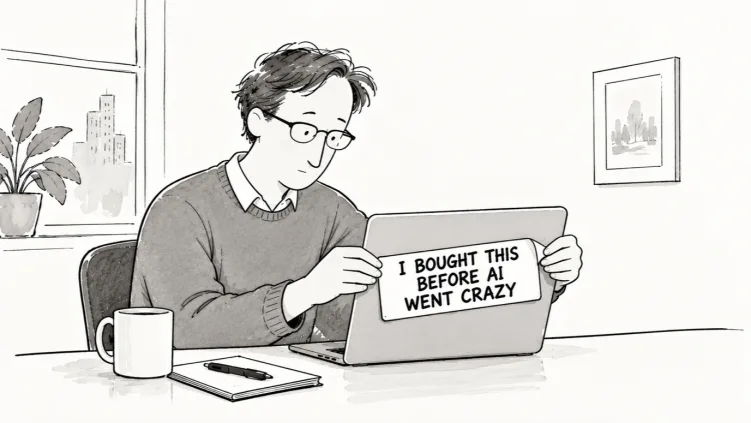
The picture used to look very different. Tesla and Meta had trailed the rest of Big Tech for years, with the former’s Trust & Like Score dropping through 2023 and 2024 before reaching its nadir in early 2025, after founder and CEO Elon Musk endorsed an antisemitic post on X, backed Trump for president, and was condemned for a gesture resembling a Nazi salute at the inauguration. (Things got so bad that some Tesla drivers put bumper stickers on their cars reading “I bought this before Elon went crazy”.) The company’s score spent most of the next 18 months stuck in the low 50s. Meta fared little better.
Anthropic, by contrast, was riding high. When we started tracking it, in mid-2025, it scored 78, nearly 30 points clear of Tesla, thanks in part to its image as the responsible alternative to OpenAI. (Its critics preferred “woke”.)
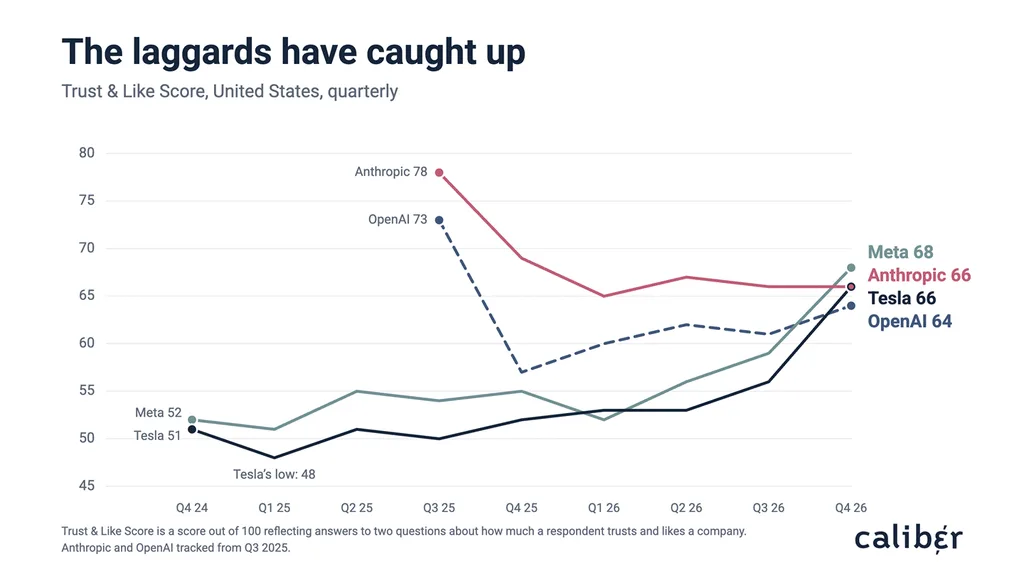
Now look at the scores.
Anthropic has spent months in headlines about AI ending the world, and that’s never good for your reputation. Its own filing now puts existential risk in writing, and AI has been cast as the “villain” of the US midterms, according to the Guardian. Anthropic’s Trust & Like Score has fallen 12 points, to 66. More telling is its Society score, people’s view of its impact on society, which has dropped from 71 to 63, from the top of this group to near the bottom. Its Environment score has fallen too, from 68 to 62, now the lowest of the four.
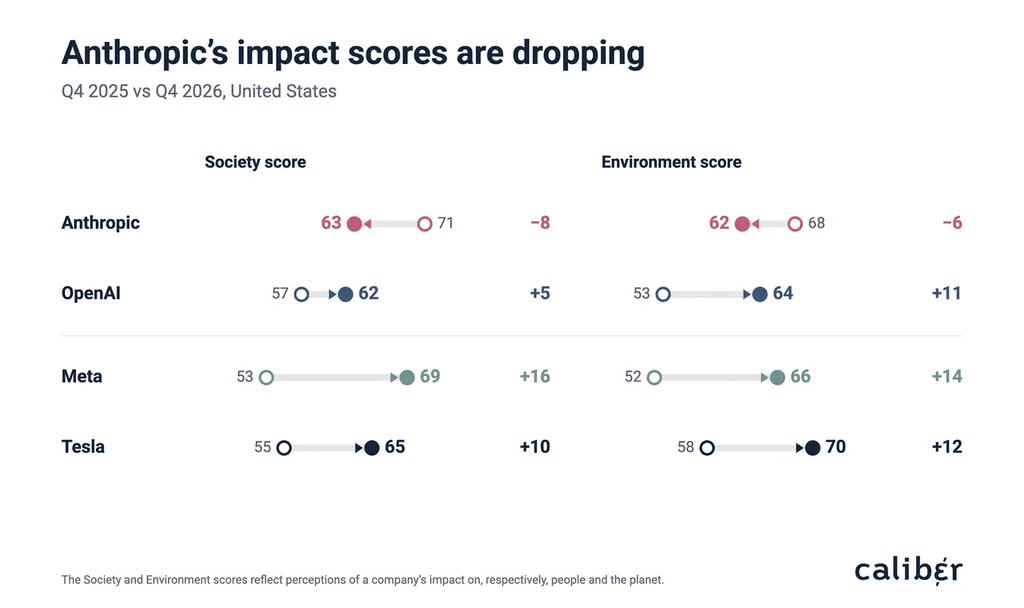
Meta has had its share of problems, from Sarah Wynn-Williams’s whistleblower memoir to a string of lawsuits, including a $375m child safety verdict in New Mexico in March. But its tech is going great guns. Its AI assistant, Muse, passed 10 million US downloads in its first 40 days, a pace only 11 other apps have matched, and Meta has now caught up with Anthropic on Offering, our measure of how compelling people find a company’s products.
And Tesla has recovered from the worst of the Musk effect. Elon is still Elon, but it’s a far cry from 2023 to 2025, when he was constantly in the headlines for the wrong reasons, at least reputationally. Little wonder that all three of his companies we track, Tesla, SpaceX and X Corp., have now caught up with Anthropic.
Anthropic is right to worry
Anthropic isn’t wrong to flag its founders’ reputations as a risk. Our 2024 study of Big Tech’s leaders found that few people connect a tech CEO with their company. Fewer than half could match most CEOs to the companies they run. The exceptions were Musk, whom 83% could place, and Zuckerberg, at 71%.
That’s the level of fame, or infamy, at which a founder’s reputation becomes the company’s. Dario Amodei could get there. So could Sam Altman, for that matter.
What’s also interesting is the other risks the filing flags: the fight with the Pentagon, and the danger that staff who joined for Anthropic’s safety commitments lose trust in its leadership. Neither shows up directly in a reputation score, but both shape it. Whether people buy from a company, recommend it or want to work there depends on what’s going on around them as much as on what they think of the company itself. It’s why we track the wider context, from the political climate to people’s financial outlook, and measure a company’s reputation among employees and would-be hires.
What’s going on?
Here’s our theory for why the reputation of Big Tech’s “heroes and villains” has seemingly narrowed.
Anthropic’s Awareness and Familiarity scores haven’t budged in the past six months — still only 12% of survey respondents have qualified knowledge of it — yet anecdotally, Anthropic seems to have replaced OpenAI as the poster child of AI. Thanks to Claude, it’s more synonymous with the technology than ever, and, in my experience at least, more people now talk about “asking Claude” than “asking Chat”. Being the face of a technology cuts both ways, though: you get the credit for what it does well and the blame for what people fear it will do. So Anthropic’s scores are probably “pricing in” every worry about AI, from taking our jobs to dulling our thinking to ending humanity altogether. OpenAI, out of the spotlight for once, is quietly recovering.
Meta and Tesla, by contrast, have already had their reckonings. Whatever reputational damage their products and personalities might still do, most of it is priced in. Both hit their lows a while ago, and the spotlight has moved on. It helps that Meta has a hit on its hands: Muse suggests people will reward a company for something they enjoy using, whatever they make of its founder.
Anthropic, meanwhile, seems to know what’s coming. Its S-1 mentions scrutiny more than 30 times and warns that bad press about AI in general may be pinned on the company whether it’s deserved or not. In other words, it expects to carry the whole industry’s baggage.
The IPO will only turn up the heat, and if the past couple of years are anything to go by, Big Tech’s reputational shifts can happen in months, if not weeks. In a sector in which the heroes and villains are seemingly always in the news cycle, we’ll be watching closely.
(This article was originally published by Caliber CEO Shahar Silbershatz in his LinkedIn newsletter, What People Think.)