
Chatbots are growing fast, but they’re still nowhere near how most people actually learn about companies.
This article was originally published by Caliber CEO Shahar Silbershatz in his LinkedIn newsletter, What People Think. It has been adapted for publication on Caliber’s website.
Spend enough time on LinkedIn and you’ll soon come across claims that AI is “shaping the reputation” of your company — and that you should know what AI is saying about your company, and why.
We don’t disagree. But it can be tempting to assume that because more people are using AI to learn about companies, everybody is.
So we decided to check the data.
We examined our stakeholder intelligence data to understand how much ground AI chatbots such as Claude and Gemini have actually gained as corporate discovery channels.
What we found cuts both ways: AI is growing faster than almost any other touchpoint we track, but it remains a relatively small part of how most people learn about companies.
How we measured the impact of AI on corporate reputation
At Caliber, we gather stakeholder intelligence through two platforms.
Stakeholder 360 measures perceptions across a broad range of stakeholders, while Talent 360 focuses on people aged 18–45 who are in education, employment or between jobs, giving us a useful view of potential jobseekers.
On both platforms, we ask people not only about their perceptions of companies, but also which touchpoints they have recently used to find out about those companies.
On Stakeholder 360, one of those touchpoints is Info Search, which encompasses traditional online search such as Google as well as newer AI-powered options such as chatbots.
Talent 360 separates the two into Info Search and AI Chat, allowing us to see how AI compares directly with traditional search among a younger, employment-relevant audience.
To understand the impact of a touchpoint, we consider three measures:
- Trust & Like Score (TLS): Caliber’s core measure of corporate reputation among people exposed through that touchpoint.
- Exposure: the percentage of people who say they recently came across the company through that touchpoint.
- Efficiency: a metric combining exposure and perception to indicate the overall effectiveness of the touchpoint.
For this analysis, we looked at US respondents evaluating Fortune 30 companies, comparing three consecutive two-month periods.
Each period included approximately 6,000 Stakeholder 360 respondents and 3,000 Talent 360 respondents.
1. AI chatbots still matter less than many people think
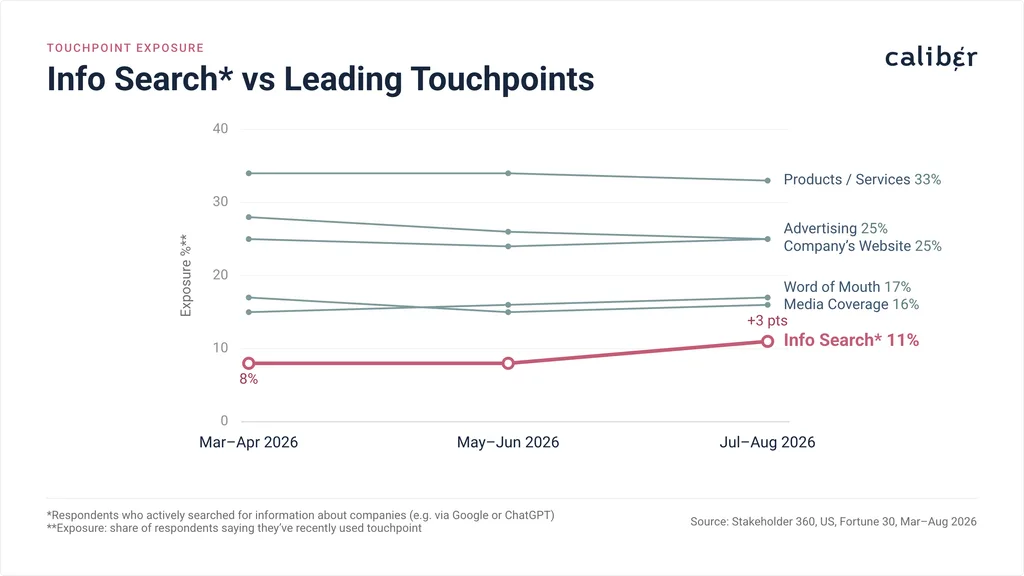
On Stakeholder 360, just 11% — roughly one in nine people — cited Info Search as a recent touchpoint for the average Fortune 30 company.
And remember: that figure includes both traditional search engines and AI chatbots.
Compare that with exposure through:
- Products and services: 33%
- Company websites: 25%
- Advertising: 25%
Whatever AI is doing to search behaviour, it hasn’t yet displaced the channels through which most stakeholders encounter companies.
This matters for corporate communications teams. Optimizing how a company appears in AI-generated answers may increasingly deserve a place in the reputation toolkit, but it shouldn’t come at the expense of the channels currently reaching substantially larger audiences.
2. But online and AI-driven search are growing quickly
The direction of travel is harder to ignore.
On Stakeholder 360, Info Search exposure increased from 8% to 11% across the latest two-month measurement windows.
It isn’t the dominant corporate reputation touchpoint yet. But it is one of the fastest-growing touchpoints we track.
That distinction is important: AI’s current influence and AI’s trajectory are not the same thing.
Companies shouldn’t treat AI as though it already determines corporate reputation. But neither should they wait until it does before understanding how their company is represented in AI-generated information.
3. Among potential jobseekers, AI Chat has already caught up with traditional search
The picture becomes much more interesting when we look at Talent 360.
Among 18–45-year-olds researching companies as potential employers, both traditional Info Search and AI Chat are substantially more prominent than they are among the broader stakeholder population.
Across the three periods measured:
Info Search: 15% → 21% → 17%
AI Chat: 13% → 20% → 18%
AI Chat is no longer significantly trailing traditional online search engines such as Google. The two channels have been running almost neck-and-neck, with AI Chat slightly overtaking traditional search in the latest period.
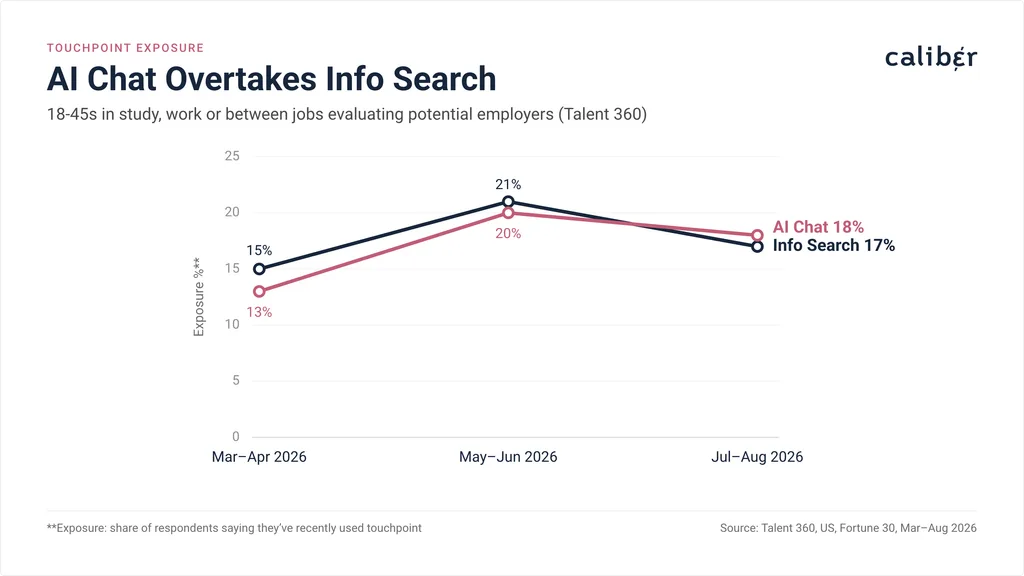
For younger, digitally native audiences, AI Chat has already emerged as a corporate and employer discovery channel in its own right.
That’s particularly relevant for employer reputation. Companies thinking about how they appear to potential candidates may need to consider not only their careers site, employer branding and search visibility, but increasingly the narratives surfaced by AI platforms.
→ Read also:
How Corporate Reputation Impacts Employer Attractiveness
2026 Employer Attractiveness Rankings
4. There also appears to be a seasonal effect
There’s another wrinkle in the Talent 360 data.
During July and August, exposure declined across almost every touchpoint — not only Info Search and AI Chat.
The exception was Social Media, which increased by four percentage points.
In other words, potential jobseekers may have been doing less active employer research during the summer holiday period, while continuing to scroll through social media.
Stakeholder 360 — covering the same period, companies and country — didn’t show the same decline.
That suggests we’re seeing a seasonal effect specific to this audience rather than a sudden retreat from AI or online search.
So, is AI reshaping corporate reputation?
Yes — but keep it in proportion.
AI is growing quickly and deserves serious monitoring. But today, eight in nine stakeholders aren’t citing Info Search — which includes AI — as a recent way they encountered a company.
Even among the younger Talent 360 audience, roughly four in five aren’t citing AI Chat as a recent company touchpoint.
Most people are still forming their perceptions through a much broader ecosystem: products and services, company websites, advertising, word of mouth, social media and, for potential employees, careers sites and recruitment marketing.
The current conversation around AI can make chatbots sound like the defining corporate reputation channel.
Our stakeholder perception data suggests something more nuanced: AI is still a subplot — but it’s becoming a much more important one.
The sensible position for corporate affairs and communications teams is therefore not to ignore AI, nor to reorganize their entire reputation strategy around it.
It’s to understand how AI represents their company, monitor how its influence develops, and manage it alongside the touchpoints that continue to shape stakeholder perceptions at scale.
Want to explore corporate reputation in the age of AI?
On October 8, Caliber CEO Shahar Silbershatz will be joined by former LinkedIn Chief Communications Officer Greg Snapper for a live conversation exploring how AI is changing corporate narratives, search and stakeholder trust.
They’ll look at what communications leaders should be monitoring now, where AI’s influence is being overstated, and how companies can prepare as AI becomes a more important intermediary between organizations and their stakeholders.
Reserve your spot: How AI Is Reshaping Corporate Narrative, Search and Stakeholder Trust →