
Most companies believe they understand their reputation.
They track brand perception. They monitor media coverage. They run annual surveys. Each produces data. None explain what actually drives stakeholder behavior.
The issue is not a lack of information. It is fragmentation.
Reputation is not a single metric. It is the result of how people experience a company, how they interpret those experiences, and how those interpretations translate into action. Measuring only one part of that chain creates blind spots.
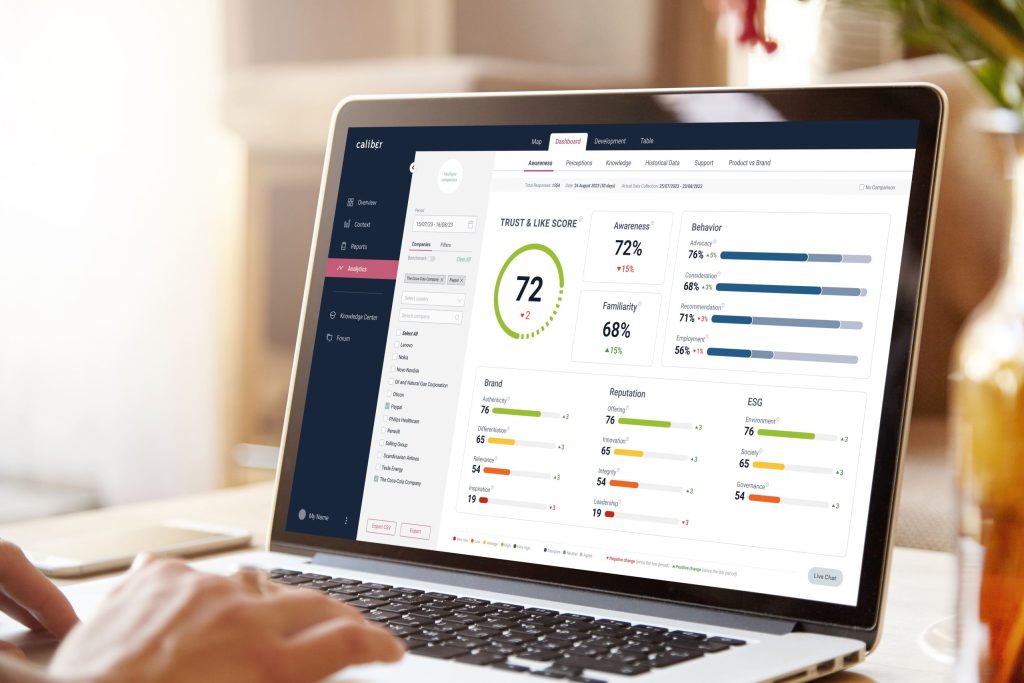
Caliber’s methodology was built to solve this. It treats reputation as a system, not a score. It tracks 16 specific attributes across four dimensions, connects them to a central emotional metric, and links that metric directly to stakeholder behavior.
Within Caliber’s stakeholder intelligence platform, this model provides a structured way to understand what key audiences think, how those perceptions evolve, and what they mean for decision-making. This is what Caliber refers to as stakeholder intelligence: a continuous understanding of how stakeholders think, feel, and act, and how those perceptions evolve over time.
This article breaks down how reputation is built, what moves it, and how to measure it in a way that leads to better decisions.
Reputation is a System, Not a Metric
At the center of Caliber’s methodology is a simple idea: people act based on how they feel about a company.
That emotional response is shaped by what they know, what they believe, and what they experience. The model captures this as a progression:
- Awareness and familiarity define who can form an opinion
- Perceptions shape how the company is evaluated
- Emotional connection determines overall sentiment
- Behavior reflects real-world impact
This structure is grounded in established theory and validated across large-scale global datasets, linking perceptions to emotions and ultimately to stakeholder behavior.
The result is a model that not only describes reputation but explains how it works.
Reputation is one part of the broader stakeholder intelligence system within the Caliber platform. The model captures how different stakeholders form perceptions, how those perceptions change over time, and how they translate into real-world behavior. This makes it possible to move beyond tracking scores and toward understanding what drives them, how they change over time, and what they mean for stakeholder behavior.
The Structure of the Caliber Standard Model
The model sits at the core of Caliber’s stakeholder intelligence approach and consists of five layers:
- Awareness & Familiarity (gateway metrics)
- Reputation (rational perceptions)
- Brand (attitudinal perceptions)
- ESG (impact perceptions)
- Behavior (outcomes)
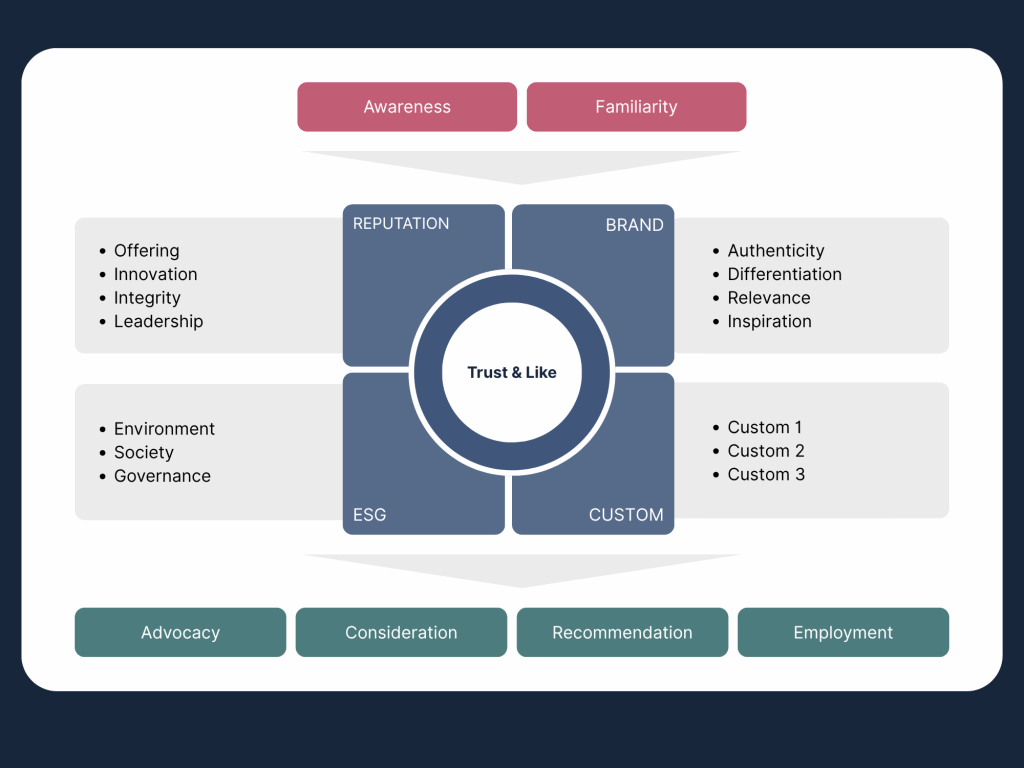
At the center sits Caliber’s Trust & Like Score (TLS), which brings these dimensions together into a single, comparable measure of stakeholder sentiment.
All perception-based attributes are measured on a 1–7 Likert scale and normalized to a 0–100 range. No weights, filters, or adjustment factors are applied, ensuring transparency and comparability across markets.
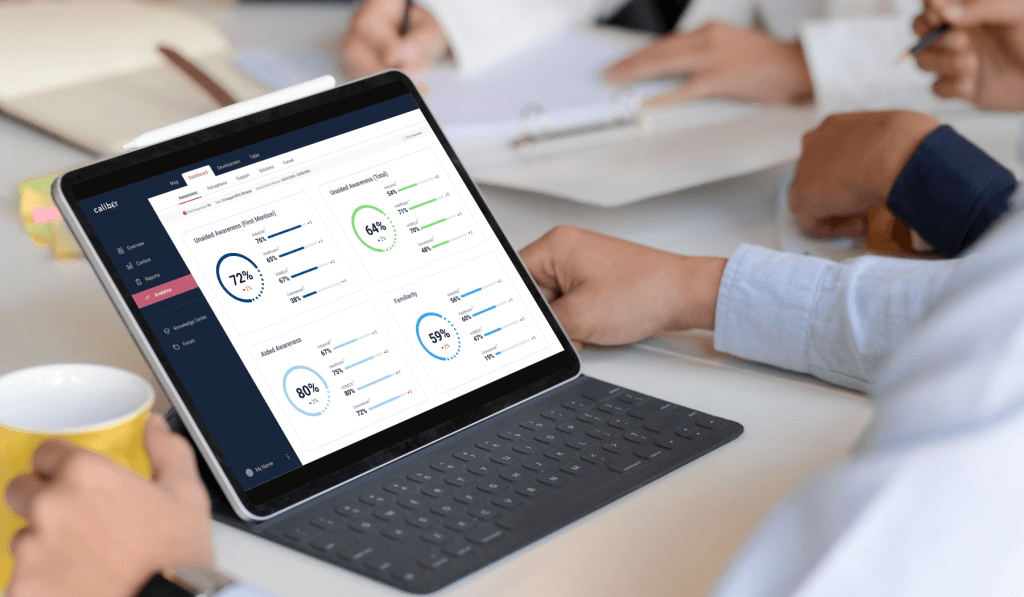
Awareness & Familiarity: Measuring Only Informed Opinions
Before reputation is measured, Caliber determines whether respondents are qualified to evaluate a company.
- Awareness measures whether a respondent recognizes the company
- Familiarity measures whether they understand it well enough to form an opinion
Only respondents who meet the familiarity threshold are included in the analysis.
This is a deliberate methodological choice. Reputation is measured among people who know the company, not among those guessing. This improves the validity of the results and reduces noise in the data.
The Trust & Like Score (TLS)
Caliber’s Trust & Like Score (TLS) is the central metric in the model.
It is calculated as the average of two survey statements:
- “[Company] is a company I like”
- “[Company] is a company I trust”
TLS is not derived from averaging Brand or Reputation attributes. It is a direct measure of emotional connection.
Caliber’s statistical analysis shows that trust and liking together are the strongest predictors of stakeholder behavior, including advocacy, recommendation, and consideration.
TLS serves as the primary benchmark for how a company is perceived overall.
The 16 Standard Attribute Scores
The model measures 16 attributes across four dimensions. Each dimension captures a different type of perception and plays a distinct role in shaping stakeholder sentiment.
Each attribute is tied to a specific survey statement and reflects how stakeholders evaluate a company.
Reputation: What a Company Does
Reputation attributes capture rational perceptions. They reflect how stakeholders assess a company’s performance and credibility.
- Offering — “[Company] offers compelling products and services”
Measures perceived quality and relevance of the company’s core offering. - Innovation — “[Company] is innovative in its field”
Reflects whether the company is seen as forward-looking and capable of developing new ideas. - Integrity — “[Company] behaves responsibly”
Captures perceptions of ethical conduct, accountability, and responsible behavior. - Leadership — “[Company] demonstrates leadership”
Measures whether the company is seen as a leader in its industry.
These attributes establish credibility. Without them, trust is difficult to build.
Brand: How a Company Feels
Brand attributes capture attitudinal perceptions. They reflect how stakeholders relate to a company beyond its functional performance.
- Authenticity — “[Company] is a company that does what it says”
Measures consistency between what a company communicates and how it behaves. - Differentiation — “I consider [company] as standing apart from the competition in a positive way”
Reflects whether the company is perceived as distinct and recognizable. - Relevance — “I can relate to what [company] stands for”
Captures alignment with stakeholder values, needs, or identity. - Inspiration — “I find [company] interesting”
Measures the company’s ability to engage attention and generate interest.
Reputation builds acceptance. Brand determines whether stakeholders feel a reason to choose the company.
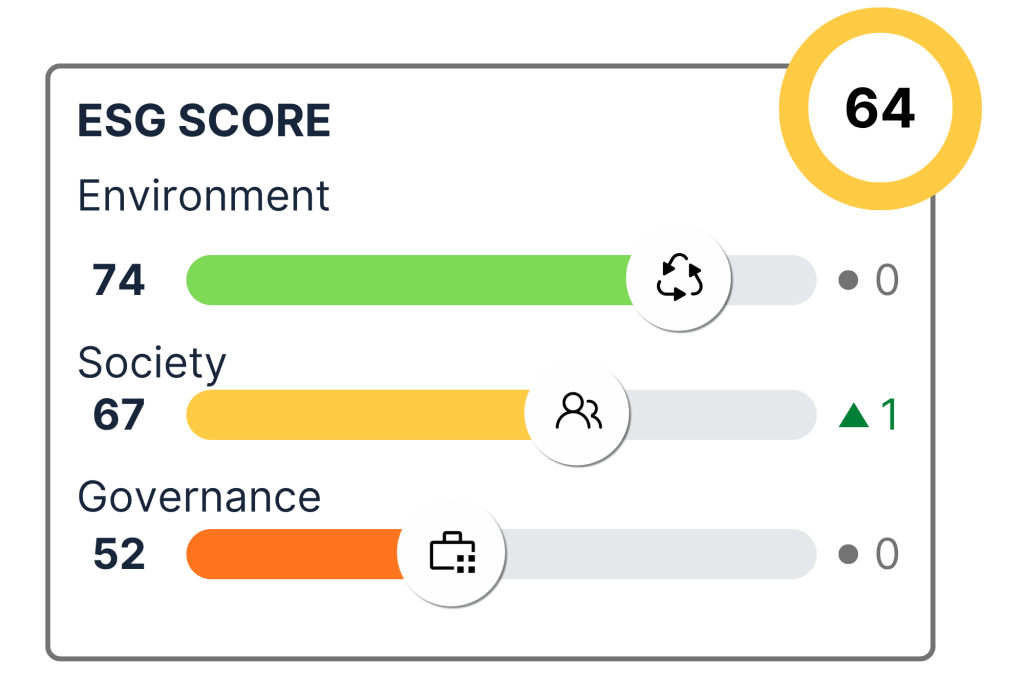
ESG: What a Company Contributes
ESG attributes capture perceptions of a company’s broader impact.
- Environment — “[Company] has a positive impact on the planet”
Reflects perceived environmental responsibility. - Society — “[Company] has a positive impact on people and society”
Measures how the company contributes to communities and society. - Governance — “[Company] is ethical in the way it conducts business”
Captures perceptions of transparency and ethical conduct.
These attributes reinforce trust and shape long-term reputation.
Behavior: What Stakeholders Will Do
Behavior metrics measure intended actions. They represent the outcome of all preceding perceptions.
- Advocacy — likelihood to speak positively about the company
- Consideration — likelihood to consider its products or services
- Recommendation — likelihood to recommend the company to others
- Employment — likelihood to consider working for the company
These metrics are presented as distributions of positive, neutral, and negative intent rather than a single normalized score.
Behavior connects perception directly to business impact.
The Normative Scale: Interpreting Scores
All normalized scores follow a standard 0–100 scale and are benchmarked against Caliber’s global database.
The normative scale is:
- 80–100 — Excellent (Very High)
- 70–79 — Strong (High)
- 60–69 — Average
- 40–59 — Weak (Low)
- 0–39 — Poor (Very Low)
This scale applies to the Trust & Like Score, as well as Reputation and Brand dimension scores.
It does not apply to Behavior metrics, Awareness, or Familiarity, which are calculated differently.
How Caliber Collects and Structures Data
The methodology is designed to produce reliable, comparable, and continuous insight.
- Data is collected through global online research panels provided by leading research partners that meet ESOMAR standards
- Respondents are selected to match demographic targets
- Only respondents familiar with the company are included
- Surveys are mobile-friendly and include both company names and logos
- Results are normalized to a 0–100 scale
- No weights or adjustments are applied
A typical setup includes at least 50 interviews per company per week in each country, enabling both statistical stability and real-time tracking.
This perception data forms a core part of Caliber’s stakeholder intelligence system. In practice, it is interpreted alongside other signals such as media coverage, market data, and external context to provide a clearer view of what is shaping stakeholder sentiment and why.
Why Caliber Does Not Adjust the Data
Many research methodologies apply statistical adjustments to account for cultural differences.
Caliber does not.
Adjustment methods often rely on assumptions and can reduce transparency. Instead, Caliber prioritizes raw, interpretable data and context-based comparison through local and industry benchmarks.
This approach preserves how respondents actually express their perceptions, rather than reshaping the data to fit a model.
From Data to Decision-Making
The model is designed not only to measure reputation, but to serve as a core input into stakeholder intelligence.
Driver Analysis identifies which attributes have the greatest impact on the Trust & Like Score, enabling organizations to focus on what actually influences perception.
Other techniques, such as Correspondence Analysis, reveal how perceptions differ across stakeholder groups, supporting segmentation and communication strategy.
By combining perception data with analytical methods and broader context, organizations can understand not just what stakeholders think, but why they think it and what it means for future decisions.
This moves the model from reporting to decision-making.
Continuous Measurement, Not Snapshots
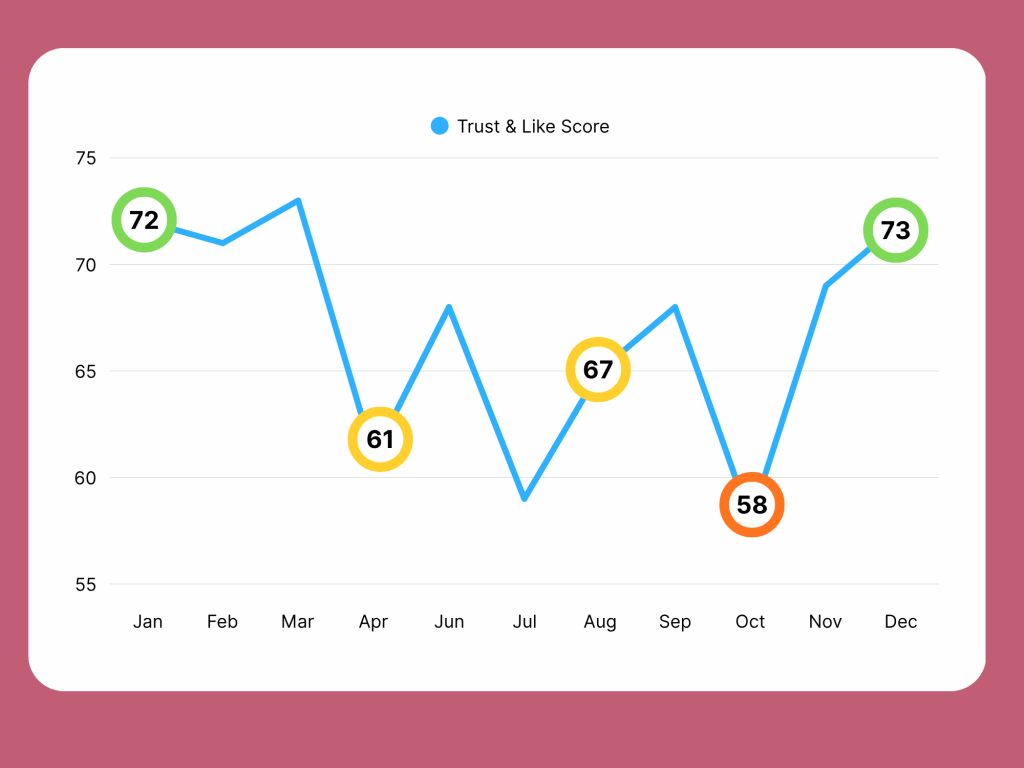
Reputation changes continuously.
Events, communication, and external factors reshape perception in real time. Annual studies capture static snapshots and miss movement.
Caliber collects data on an ongoing basis, allowing organizations to track changes as they happen and respond with greater speed and confidence.
This continuous approach enables real-time stakeholder intelligence, allowing organizations to detect shifts early and act before they become larger issues.
Customization Capabilities
The standard model is designed to be extended.
Organizations can:
- Add custom survey questions aligned with strategic priorities
- Create custom stakeholder segments
- Target specialized or hard-to-reach audiences
- Increase sample sizes for time-sensitive tracking
Customization is implemented in collaboration with Caliber’s team to ensure consistency and methodological integrity.
Conclusion
Caliber’s methodology brings structure to a complex problem and forms the foundation of a broader stakeholder intelligence approach.
It combines 16 attributes, four dimensions, and one central metric into a unified system that connects perception to behavior. It measures reputation continuously, without distorting the data through weighting or adjustment.
The result is a clear understanding of what drives stakeholder support, how it changes over time, and how to act on it, turning data into stakeholder intelligence that supports better decisions.
If you want a clearer view of what’s shaping and driving your reputation, get in touch with one of Caliber’s experts.