Awareness gets you on the radar. Familiarity keeps you there. Caliber’s inaugural Stakeholder Intelligence Report reveals that the gap between the two isn’t just a communications challenge — it’s a measurable, quantifiable source of reputational risk, and closing it may be the highest-return investment a company can make in 2026.
Most corporate strategy assumes a simple path: more awareness leads to more trust. Caliber’s inaugural Stakeholder Intelligence Report challenges that assumption — and replaces it with something more precise, more actionable, and considerably more urgent.
Awareness and familiarity are not the same thing. A stakeholder who has “heard of” your company is not the same as one who understands what you do, knows what you stand for, can describe your role in society, and has context for your decisions.
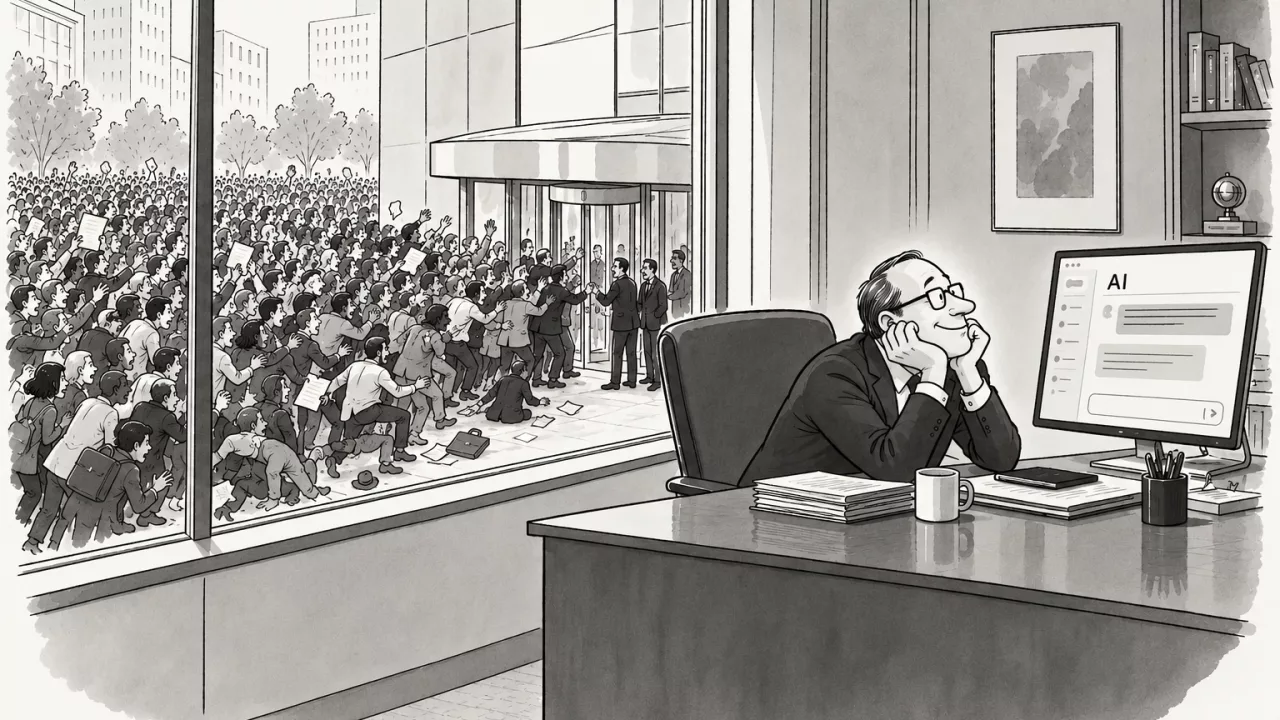
In many cases, awareness without familiarity creates the worst possible scenario: people know your name but not your story. And when something goes wrong, they fill in the blanks themselves.
The data is unambiguous
For the inaugural report, we tested two hypotheses. The first was straightforward: the more familiar stakeholders are with a company, the higher their Trust & Like Score.
The data confirms it — but the more compelling finding is what happens when companies actively move stakeholders up through familiarity levels rather than simply expanding their reach.
For Fortune 30 companies, the relationship is striking in its consistency:
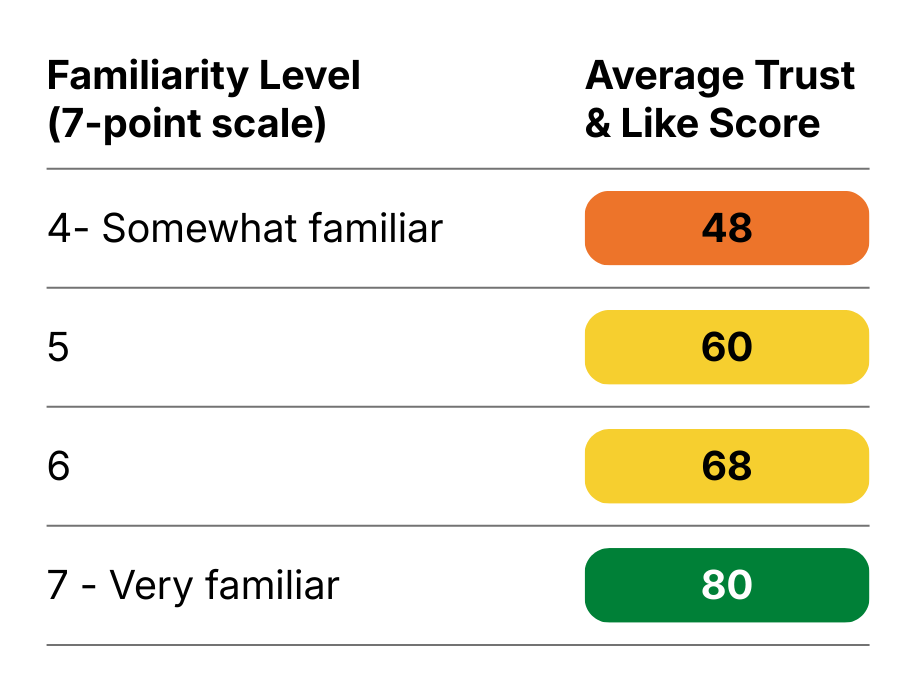
Each step up the familiarity ladder adds roughly 8–12 points to the Trust & Like Score. Moving a stakeholder from level 4 to level 7 represents a 32-point lift in trust.
More practically: if a Fortune 30 company were to move each tier of its stakeholders up just one familiarity level, it would see an estimated 6-point rise in its overall Trust & Like Score — from 68 to 74. That is not a marginal communications win. It is a direct, measurable driver of the scores that matter to boards, investors, and leadership teams.
The Awareness–Familiarity Gap: a reputational cliff edge
The second hypothesis concerned the ratio between awareness and familiarity. Our thinking was that the gap between how many people have heard of a company and how many actually understand it would be correlated with the company’s overall reputation.
We found a clear linear relationship between the Awareness–Familiarity ratio and Trust & Like Scores: as the gap narrows and more people become familiar, trust rises. But the more important finding concerns not the average, but the floor.
A wider Awareness–Familiarity gap dramatically increases variance in Trust & Like Scores, meaning companies with large gaps experience a far wider range of reputation outcomes — in either direction. Where the ratio exceeds 1.6, Trust & Like Scores range from 47 to 80.
When the ratio falls below 1.2, the lowest Trust & Like Score measured is 59. That’s not a small difference. That’s a reputational cliff edge — the difference between a company whose reputation collapses under scrutiny and one whose stakeholders extend the benefit of the doubt.
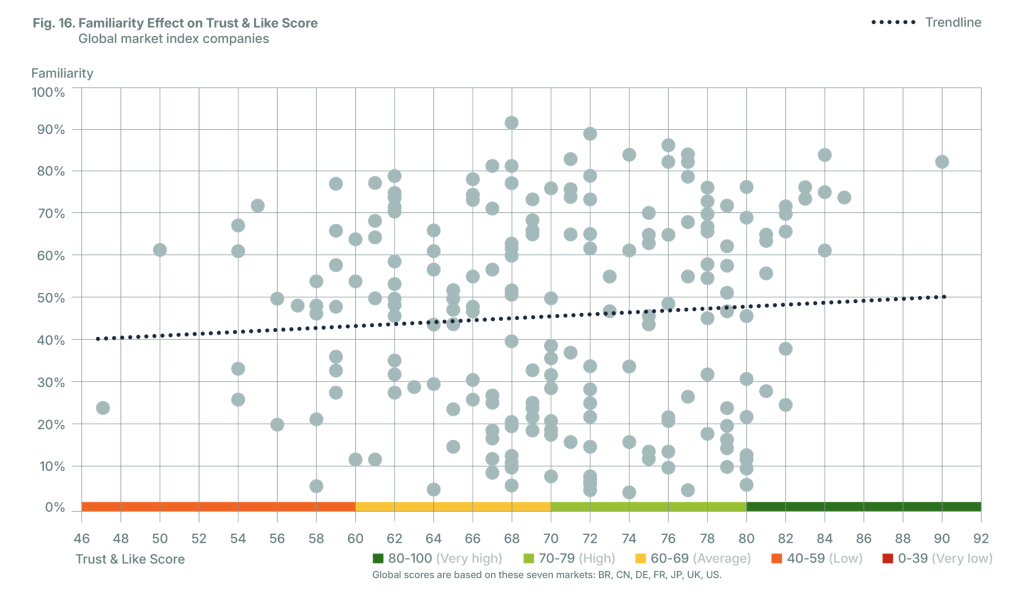
Familiarity, in other words, sets a floor under reputation. It stabilizes perception, reduces the impact of shocks, and makes trust harder to destroy. Awareness without it does the opposite: it amplifies volatility, leaving interpretation to chance — or to whoever is most motivated to fill the vacuum.
The implication for 2026
If you’re investing heavily in visibility but not in narrative clarity, you may be building risk rather than reducing it. One of the report’s strongest conclusions for leaders is this: if you don’t lead your narrative, someone else will. And changing perceptions after the fact is far more expensive and time-consuming than getting it right early.
This reframes what marketing and communications investment is actually for. The goal isn’t reach. It’s understanding — repeated, consistent storytelling, meaningful stakeholder contact, and proof points that make a company feel real and legible to the people who matter most.
Companies that invest in sustained engagement rather than episodic campaign bursts build a compounding trust advantage that lower-familiarity peers cannot easily close.
In 2026, silence is expensive. And reputational resilience is built before the crisis hits — not during it.