
This article takes a closer look at the energy sector — a vital part of the global economy where energy companies, from the smallest renewable startups to the largest corporations, keep the lights on and the engines running.
Without them, the world would be a cold, dark place. Every energy corporation plays an essential role in ensuring power generation, energy transfer, and access to both renewable and traditional energy sources.
But as our most recent reputation report shows, energy companies — including some of the largest and fastest-growing renewable firms — have their work cut out for them. The energy space continues to evolve rapidly, and this article provides the key details you need to understand how reputation shapes that transformation.
The sector earned an overall Trust & Like Score — our key reputational metric — of 64.
A company’s Trust & Like Score reflects the degree to which survey respondents say they trust and like that company. The sectoral score represents the average across all firms.
A score of 64 ranks as Average — and, given recent headlines, it’s surprising it’s not lower.
Over the past few years, rising household bills and petrol prices, concerns about supply security, and the prominent role of fossil fuels in climate change have placed enormous reputational pressure on energy companies, especially the largest ones dominating the market.
At the same time, these challenges have opened opportunities for renewable energy companies to build trust — not only with consumers but also with the wider communities they serve. Effective and transparent energy transfer systems, sustainable practices, and community engagement have become crucial in earning public confidence in the energy space.
This is a good time to read and reflect on how these companies interact with their stakeholders and contribute to their communities, shaping the future of an industry that powers the world every day.
Read also: 9 of the biggest reputational risks and how to mitigate them
Below we take a look at which energy companies, including some of the largest energy companies in the world, topped this year’s list in Europe and the US.
Together, they’re helping shape the future of the global energy industry through innovation, investment, and sustainable development.
Across Europe, green energy unites almost all of the top firms.
From leaders in renewables to companies pivoting to low-carbon solutions, the top 10 companies in Europe share a strong commitment to sustainability and a clear role in the ongoing energy transition. These efforts show how the largest players are aligning reputation with responsibility.
The picture in the United States is different.
Many of the top 10 companies by reputation are midstream service providers involved in the exploration and production of crude oil and natural gas. For them, the challenge lies in balancing profitability with sustainability — while preparing for the next phase of the energy transition.
There are notable exceptions, including the most “trusted and liked” U.S. energy company, NextEra Energy, which is committed to moving beyond “net zero”; EDP Renewables, which has doubled its clean energy generation since 2007; and RWE US, the American division of German energy giant RWE, now one of the largest renewable companies in the U.S. and the fourth-largest globally.
Read also: Companies must be more honest and human to protect their reputation
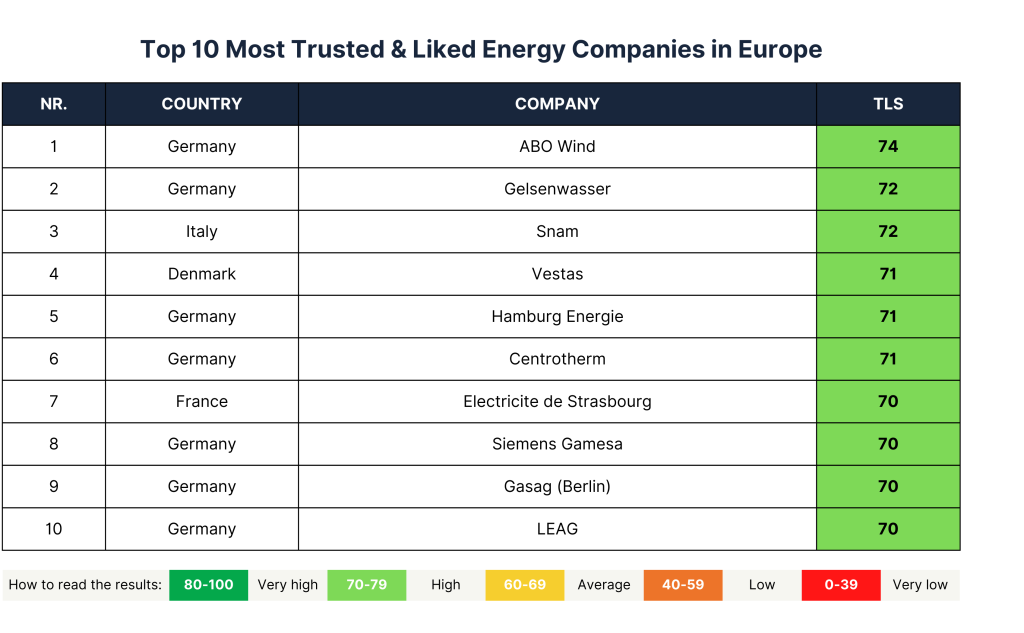
“Renewables are our DNA” says Europe’s most trusted and liked energy company. The German firm develops and builds wind and solar farms, as well as battery and hydrogen projects. Operating in 16 countries with over 25 years of experience, ABO Wind is one of the leading companies driving the transition toward sustainable power while creating local employment opportunities.
Trust & Like Score: 74 (Germany)
The Germany-based supplier of water, gas, electricity, and heat says it’s on “team blue-green,” highlighting its strong commitment to sustainable energy solutions. As one of the largest energy companies in its region, Gelsenwasser is recognized for ensuring reliable access to clean water and wastewater treatment.
Trust & Like Score: 72 (Germany)
One of the world’s leading energy infrastructure companies, Italy-based Snam says its mission is “to guide the evolution of the energy sector through the most innovative sustainable energy network” in Europe, which now spans more than 38,000 km. As one of the largest energy firms in Europe, it attracts global investors who closely monitor its transition strategies and risk management practices.
Trust & Like Score: 72 (Italy)
“Wind energy is our heritage and core competence,” says the Danish company, which built its first wind turbine in 1979 and has never looked back. Today, Vestas aims to become “the global leader in sustainable energy solutions.” It is one of the biggest names in the renewable utilities sector, associated with long-term stability and employment growth.
Trust & Like Score: 71 (Denmark)
Two years after its merger with Wärme Hamburg, the municipal energy company rebranded as Hamburger Energiewerke in February 2024. Its mission remains the same: to supply Hamburg with natural gas and green electricity from wind and solar. As a key player in Germany’s utilities sector, it supports both regional energy access and employment.
Trust & Like Score: 71 (Germany)
This German company supplies technology and equipment for growth sectors such as photovoltaics, semiconductors, and microelectronics, while also innovating in fiber and battery production. Although not one of the largest energy companies, Centrotherm plays a critical role in advancing renewable technology and reducing industry risk.
Trust & Like Score: 71 (Germany)
Founded in 1899, this Alsatian company is France’s second-largest electricity distributor. Its mission is to “offer Alsace a future with low-carbon energy,” producing and supplying local renewable power while improving energy efficiency for customers.
Trust & Like Score: 70 (France)
“When the wind blows, we see infinite possibilities,” says the Hamburg-based company, formed in 2017 from a merger of Spanish and German wind engineering firms. Now a global leader in renewable energy, Siemens Gamesa is known for producing world-class offshore and onshore wind turbines.
Trust & Like Score: 70 (Germany)
“The future is now. Berlin’s energy is going green,” proclaims GASAG, a 176-year-old company recently sold by Vattenfall to the state of Berlin. As the main provider of natural gas in the capital, GASAG operates 14,000 km of networks across Berlin and Brandenburg, remaining central to energy access and employment stability.
Trust & Like Score: 70 (Germany)
LEAG is the umbrella brand for a group of German energy companies and one of the top five electricity producers in the country. It supplies power to millions of households and has realigned its strategy toward sustainable energy solutions.
Trust & Like Score: 70
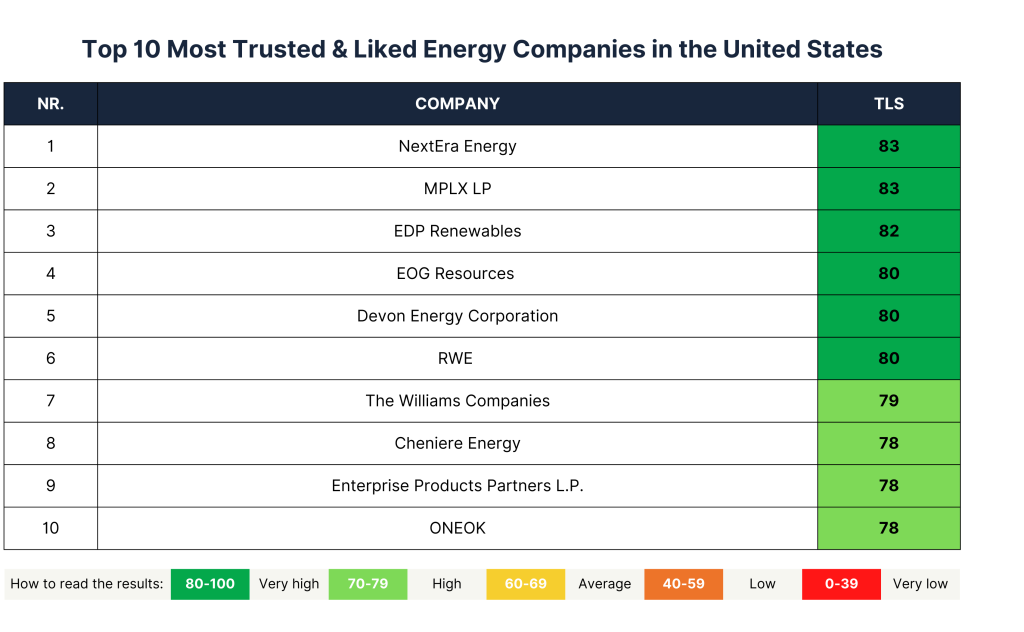
With its commitment to moving beyond “net zero”, NextEra Energy produces electricity through wind, solar and natural gas, and operates nuclear power units via subsidiaries. As one of the largest utilities by market capitalization, it has expanded into many countries to support the global energy transition. Its strategy is to leverage low-cost renewables like wind and solar to drive energy affordability and independence, reduce fuel price volatility, and expand research into next-generation technologies.
Trust & Like Score: 83
Headquartered in Ohio, MPLX is a limited partnership formed by Marathon Petroleum Corporation. It acquires, owns and operates crude oil and other hydrocarbon-based product pipelines and processing assets, especially in the Appalachian region. Its focus on midstream oil gas infrastructure highlights its importance to both producers and consumers across many countries.
Trust & Like Score: 83
The North American division of Spain’s EDP Renewables, the company has more than doubled its clean energy generation since 2007, becoming one of the top five renewable energy producers in the US in operating clean energy capacity. Today it generates more than 8,400 MW of renewable energy including 12 solar parks and 60 wind farms. Backed by international research and innovation, EDP Renewables is active in many countries, reinforcing its position as a trusted name in both wind and solar.
Trust & Like Score: 82
Headquartered in Houston, EOG Resources is one of America’s largest independent crude oil and natural gas exploration and production companies, with proved reserves in the US and Trinidad & Tobago. Known for efficient oil gas operations, it also engages in advanced research to lower emissions. EOG says it’s focused on being “among the lowest cost, highest return and lowest emissions producers, and playing a significant role in the long-term future in energy.”
Trust & Like Score: 80
Founded in 1971 and headquartered in Oklahoma City, Devon Energy is a leading independent oil and natural gas exploration and production company, with onshore operations in the US. Twenty years ago, Devon was one of several petroleum companies that introduced shareholder resolutions requiring them to monitor their effects on climate change. Today, its oil gas business remains central to its market capitalization, while it invests selectively in renewables such as wind and solar.
Trust & Like Score: 80
The US division of German multinational energy giant RWE has around 1,500 employees and plays a key role in RWE‘s strategy to become carbon neutral by 2040. It operates the fourth-largest renewable energy company in the US and is its second-largest solar owner and operator, present in most states. By combining traditional oil and gas experience with expanding solar assets, RWE demonstrates the balance many energy leaders are pursuing.
Trust & Like Score: 80
Founded in 1908 and headquartered in Oklahoma, the Williams Companies produces about a third of the natural gas used daily in the US.
Its core business is natural gas processing and transportation and it owns strategic assets in the Gulf of Mexico, the Rockies, the Pacific Northwest and the Eastern Seaboard. With strong exposure to oil and natural gas transportation, it remains one of the biggest infrastructure players in the US energy sector.
Trust & Like Score: 79
Cheniere is a full-service LNG provider, buying natural gas in North America, processing it into LNG for delivery onto customers’ vessels or to regasification facilities around the world. After launching operations in 2016, it is already the largest producer of LNG in the US and the world’s second-largest LNG operator. Its operations complement global oil and solar growth by ensuring secure supply for many industries.
Trust & Like Score: 78
Founded in 1968 and headquartered in Houston, Enterprise Products Partners “provides midstream energy services to producers and consumers of natural gas, natural gas liquids, crude oil, refined products and petrochemical”. Its network connects North American producers with international markets and domestic consumers, showing the continuing importance of oil even as solar expands.
Trust & Like Score: 78
Founded in 1906 and headquartered in Oklahoma, ONEOK is one of the largest energy midstream solution providers in the US and a major player in the natural gas industry. Its operations include a 61,000-km integrated network of pipelines, processing plants, fractionators and storage facilities. While primarily focused on natural gas and oil, ONEOK has also started adapting infrastructure to accommodate renewables like solar.
Trust & Like Score: 78
A closer inspection of our recent report on the reputation of the world’s leading energy companies helps explain the composition of these two lists, especially in Europe.
We asked people to pick three issues they feel are the most important for energy companies to address.
Here are the top five answers:
A closer inspection of our recent report on the reputation of the world’s leading energy companies helps explain the composition of these two lists, especially in Europe.
We asked consumers to pick three issues they feel are the most important for energy companies to address.
It’s almost certain that many stakeholders who participated in our survey saw some, if not all, of these factors in each of the energy companies that made the top 10 in US and Europe.
The importance of reducing carbon emissions, transitioning to clean and renewable energy, and investing in modern technologies seems key to understanding the reputational standing of many energy companies.
More generally, our report illuminates several ways that energy companies could potentially improve their brand and reputation with stakeholders.
For example, while older people want the energy segment to focus mainly on supply and on reducing emissions, younger people also want the energy industry to promote social justice, support local communities and ensure they have diverse and inclusive workplaces.
Second, our report reveals that only 1 in 3 people can name the exact energy source that powers their home. This suggests a surprising lack of consumer knowledge and education about energy sources and the “energy journey” from extraction to power outlet.
In other words, if consumers don’t know “how the sausage is made”, energy companies can potentially do more to educate people about where their energy comes from. Indeed, energy firms can use that narrative to communicate their initiatives and improvements — and deepen their relationship with consumers.
Third, our report reveals that energy companies could differentiate their consumer-directed communication more by age group, in order to inspire them, be more relevant, and reestablish authenticity. That is, by helping people be better energy consumers — with a focus on both price and the environment — energy companies could help build a better reputation.
Download the full energy sector reputation report. Or, to learn more about how we can help your company understand your stakeholders better and become more trusted, drop us a line.
You may also be interested in: