Customer reviews are one of the most visible signals of how a company is perceived. A string of negative reviews on Google or Trustpilot can dent sales. A wave of positive ones can boost conversion. For businesses that depend on direct consumer transactions, managing those reviews is a real operational priority.
Tools built for this purpose do the job well. Platforms like Momos, for example, help multi-location hospitality brands manage guest feedback, automate responses, and turn review data into operational improvements across hundreds of sites. At that level, review management is a core business function.
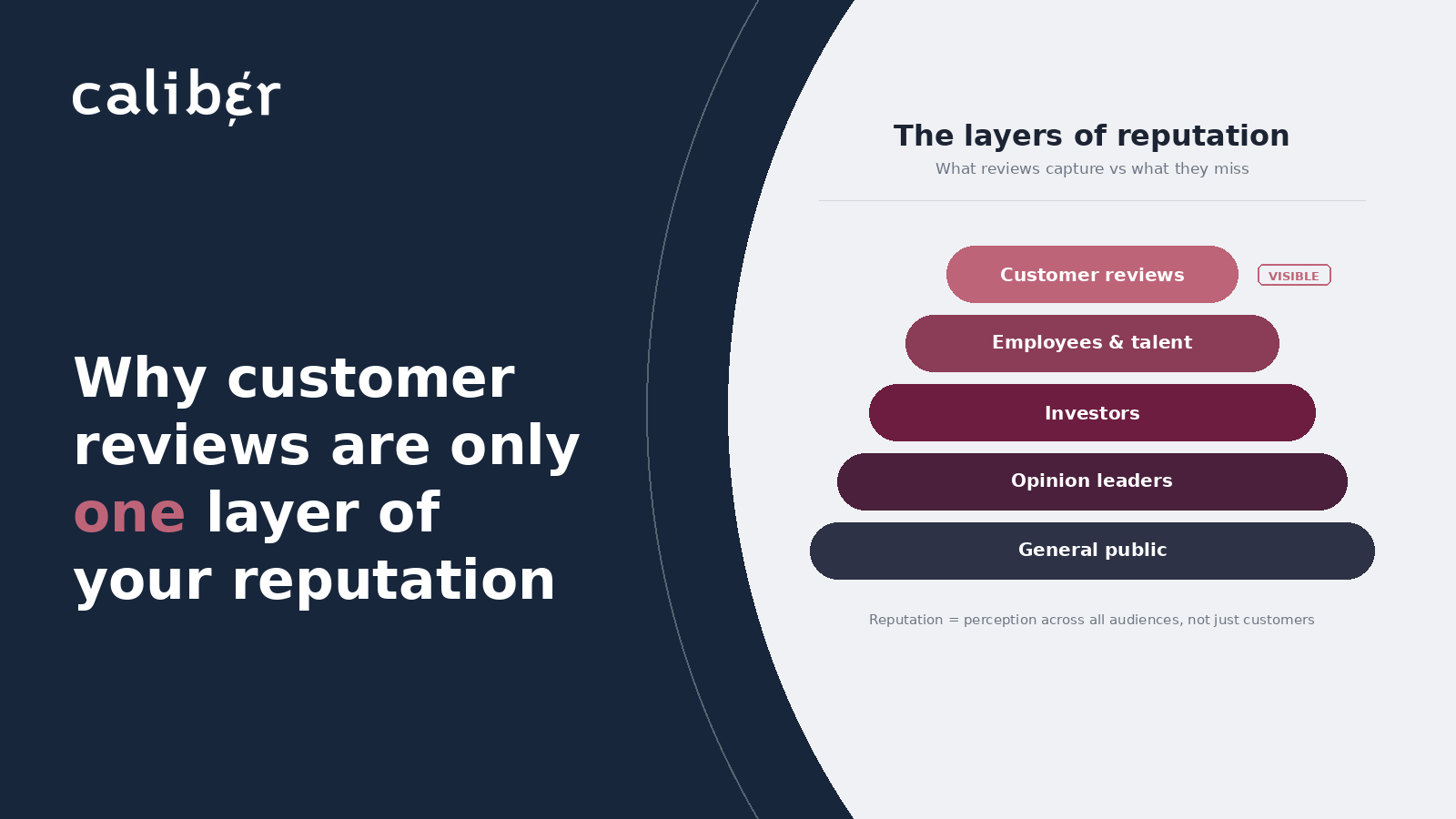
But reviews are only one layer of a company’s reputation, and for large enterprises, they’re often not the most consequential one.
A customer leaving a review on Google is sharing their experience with a product or service. That’s useful data. But it tells you nothing about how investors view your governance, how prospective employees perceive your employer brand, how opinion leaders judge your societal contribution, or how the general public feels about your company’s role in the world.
These groups rarely leave reviews. But their perceptions drive capital allocation, talent acquisition, media coverage, regulatory treatment, and the social license to operate. For a company like Airbus, ASML, or Novo Nordisk, the perception gap among these stakeholder groups matters far more to long-term business outcomes than a dip in Google ratings.
Operational feedback tools are designed to capture customer experience at scale: what happened at this location, with this order, during this visit. They work with structured review data and direct customer feedback, and they produce actionable insights for frontline teams.
Enterprise stakeholder intelligence works differently. It measures perceptions across multiple audiences simultaneously, using representative survey panels rather than self-selected reviewers. It tracks not just satisfaction but trust, credibility, relevance, and behavioral intent: whether stakeholders would buy from, recommend, invest in, or work for the company.
Caliber’s Trust & Like Score, for example, shows an R²=0.84 correlation with supportive stakeholder behaviors across a 2024 global seven-country dataset. That connection between perception and behavior is what makes stakeholder intelligence strategic rather than just informational.
The mistake some enterprise communications teams make is assuming their reputation is healthy because customer satisfaction scores are high. Customer satisfaction is one input. It doesn’t account for what other stakeholder groups think, and it doesn’t capture the upstream perceptions (trust, integrity, authenticity) that determine whether people support your company even when they’re not buying from you.
Companies that manage reputation well tend to operate on both levels. They use operational tools to handle customer-facing feedback in real time. And they use continuous stakeholder measurement to track how all the audiences that matter perceive the company across the dimensions that drive long-term business performance.
The first keeps your daily operations running smoothly. The second tells you whether your company is building or losing trust with the people who shape its future.
Follow Caliber
Get the results of our latest research directly in your inbox!
Yes. Sustained patterns in customer feedback can influence how media, analysts, and the public perceive a company. But individual reviews are a trailing indicator of customer experience, not a leading indicator of stakeholder trust across all audiences.
Review management focuses on monitoring and responding to customer feedback on review platforms. Reputation management is broader: it involves understanding and shaping how all stakeholder groups perceive the company across multiple dimensions, including trust, governance, societal contribution, and employer attractiveness.
Reviews only capture the opinions of people who chose to leave feedback, typically after a direct transaction. They miss investors, prospective employees, opinion leaders, regulators, and the silent majority of the public. Measuring reputation requires surveying representative panels across all relevant stakeholder groups.
They use stakeholder intelligence platforms that survey representative samples of multiple audiences daily. Caliber, for example, tracks perceptions across customers, investors, employees, talent, and opinion leaders in 40+ countries, connecting those perceptions to behavioral outcomes like purchase intent, recommendation, and advocacy.
Yes. They serve different functions. Review management tools handle operational customer feedback. Stakeholder intelligence platforms provide strategic visibility into how all audiences perceive the company. Using one without the other creates blind spots.