Quick answer: The strongest Ipsos alternatives in 2026 are Kantar, RepTrak, Morning Consult, and Caliber — each filling a different need. Kantar leans on consumer and brand insight. RepTrak offers standardized reputation benchmarks. Morning Consult runs high-frequency public polling. Caliber works differently: continuous, multi-stakeholder intelligence that tracks how every audience shaping your business sees you, in real time, and connects those perceptions to likely behavior. The right pick depends on whether you need a one-off study or an always-on system, and on how many audiences you need to measure.
Ipsos is one of the largest research and consulting firms in the world, operating across more than 90 markets. It is best known for large-scale, multi-country research, public opinion and political polling, consumer and brand studies, and custom corporate reputation programs.
Its reputation work is typically designed as a bespoke program, shaped around a client’s sector, geography, and audiences, and often blends methods: online, phone, and face-to-face. That flexibility is the draw. If you need a carefully designed, deeply analyzed study, Ipsos is built for it.
Ipsos works best for organizations that want:
These programs are mostly wave-based or project-based rather than always-on. For teams in fast-moving stakeholder environments, cadence and integration can become the deciding factors.
Because reputation risk has become more dynamic and spread across more audiences, and a project-based study captures a moment rather than a live picture.
A custom program answers the questions you ask at the time you ask them. Between studies, perceptions keep moving. As employee activism, investor expectations, and regulatory pressure grow, more leaders want measurement that runs continuously and reaches every audience that affects their license to operate — not just consumers. They also want to understand not just what is shifting, but why, and what to do about it.
Because reputation risk has become more dynamic and spread across more audiences, and a project-based study captures a moment rather than a live picture.
A custom program answers the questions you ask at the time you ask them. Between studies, perceptions keep moving. As employee activism, investor expectations, and regulatory pressure grow, more leaders want measurement that runs continuously and reaches every audience that affects their license to operate — not just consumers. They also want to understand not just what is shifting, but why, and what to do about it.
Tools compared with Ipsos belong to five categories that often get blurred together. Knowing which one matches your decision is the fastest way to a useful shortlist.
Category | What it measures | Typical cadence | Main users |
|---|---|---|---|
Custom research | Bespoke studies built around specific questions, often multi-method | Per project | Insights, Corporate Affairs |
Brand tracking | Consumer awareness, favorability, and purchase intent | Quarterly or biannual | CMOs, brand teams |
Reputation tracking | Corporate reputation drivers such as governance, leadership, and responsibility | Periodic waves | CCOs, boards |
Public opinion and polling | Economic, political, and societal sentiment at scale | Daily or weekly | Public affairs, comms |
Stakeholder intelligence | How every key audience sees you, linked to likely behavior and business outcomes | Continuous | CCOs, CMOs, CHROs, CEOs |
Ipsos lives mainly in custom research and reputation tracking. The alternatives below cover different mixes of these five.
Here is how the five platforms line up on the points that usually shape a shortlist: category, audience, cadence, and best fit.
Platform | Category | Who it measures | Cadence | Best fit |
|---|---|---|---|---|
Ipsos | Custom market research | Consumers, citizens, custom cohorts | Project-based waves | For bespoke, in-depth studies |
RepTrak | Reputation tracking | Periodic waves with some real-time capabilities | For standardized board benchmarks | General public |
Kantar | Brand and market research | Mainly consumers | Periodic trackers | For measuring consumer brand health |
Morning Consult | Public opinion and polling | Consumers, general public | Daily | Fast public and political sentiment |
Caliber | Stakeholder intelligence | Employees, customers, investors, policymakers, public | Continuous | Real-time, multi-stakeholder intelligence linked to behavior |
Platform details reflect public positioning and documentation. Exact configurations vary by program, so confirm current scope with each vendor.
Kantar is best known for consumer insight, brand tracking, and advertising effectiveness. Its reputation work usually sits inside broader brand analytics, making it a strong fit for marketing teams that want structured brand health tracking at scale.
Strengths:
Worth weighing:
RepTrak is built around a standardized corporate reputation model, measuring drivers such as products, governance, workplace, leadership, and citizenship among the general public. It suits organizations that value consistent benchmarks across markets and years.
Strengths:
Worth weighing:
Morning Consult is known for daily consumer brand tracking and political polling, especially in the United States, combining economic, political, and brand data at high frequency. It fits teams that need near real-time reads on public mood.
Strengths:
Worth weighing:
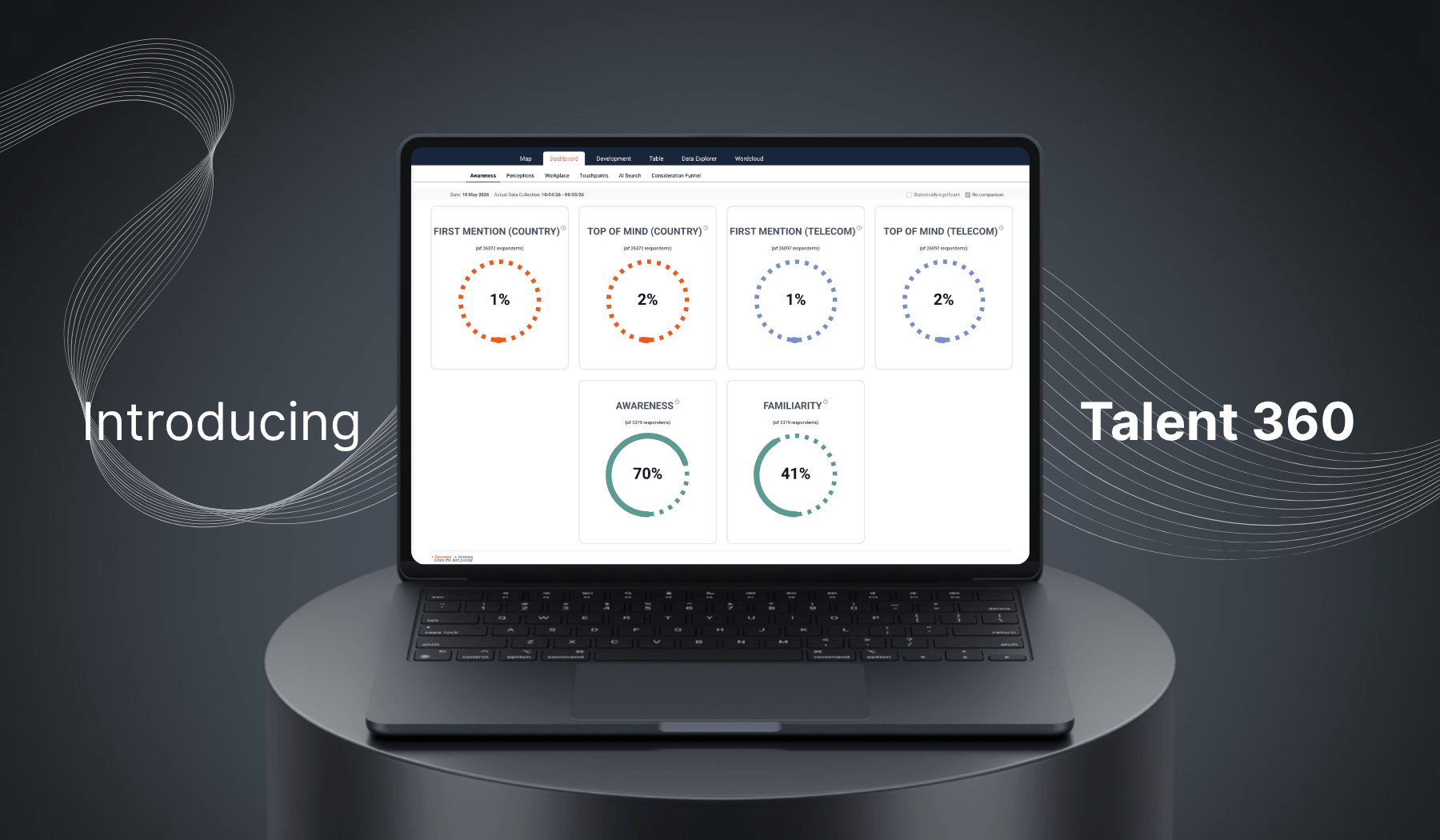
Caliber is a stakeholder intelligence platform rather than a research consultancy. Instead of commissioning a study each time a question arises, you measure perception continuously across the audiences you define as your own — employees, investors, policymakers, customers, and the public — inside one program. Using AI to connect the dots, it turns that data into real-time, actionable insights that show not just what is happening, but why, and what to do next.
Strengths:
Worth weighing:
Founded in 2016 by former Reputation Institute directors and headquartered in Copenhagen, Caliber has conducted more than four million stakeholder interviews and tracked over 6,000 companies across 40+ countries. Clients include Airbus, ASML, AstraZeneca, BASF, Boehringer Ingelheim, Henkel, and Novo Nordisk. For organizations in complex regulatory, investor, or ESG settings, measuring every audience in one framework can provide visibility that project-based research does not deliver between studies.
The real difference between these platforms is cadence, audience breadth, and whether they can tell you why perceptions are shifting and what to do about it. This matrix maps common goals to each option.
What you want to do | Ipsos | Kantar | RepTrak | Morning Consult | Caliber |
|---|---|---|---|---|---|
Measure trust across every audience | Requires separate study | Requires separate study | Public-focused | Limited | Built in by design |
Understand why perceptions shift | Requires separate study | Limited | Limited | Limited | Built in by design |
Track perceptions continuously | Project-based | Periodic | Periodic, with some real-time options | Daily (public only) | Always-on, all audiences |
Connect perception to likely behavior | Limited | Limited | Limited | Limited | Core capability |
Monitor reputation during a crisis | Project-based | Periodic | Periodic | Fast (public only) | Continuous, all audiences |
Integrate surveys, media & market signals | Separate tools | Separate tools | Limited | Limited | Unified in one platform |
Read ESG and governance perception | Requires separate study | Requires separate study | In the model | Limited | Across all stakeholders |
Run large bespoke multi-market studies | Core strength | Strong | Moderate | Moderate | Available within platform |
Start with the decisions your organization needs to make, then choose the tool. Five questions usually settle it.
Three shifts are changing how organizations weigh Ipsos alternatives, and they explain the pull toward continuous, multi-audience tools.
Ipsos remains a respected research firm with genuine methodological depth and strong custom study capability. For large, bespoke programs, it is still a compelling option.
Kantar, RepTrak, Morning Consult, and Caliber each take a different route — through brand tracking, reputation benchmarking, public polling, and stakeholder intelligence respectively. Caliber’s distinction is that it measures all the audiences that shape your business, continuously, and uses AI to integrate survey data with media, market, and behavioral signals in one place — so intelligence becomes a daily input rather than a periodic report. For leaders who need always-on visibility across many audiences and a way to connect perception to business outcomes, it is worth a close look.
Discover what your stakeholders really think
Caliber brings every stakeholder audience into one real-time platform — so you always know what’s changing, why, and what to do next. Fill out the form below to talk to our stakeholder intelligence experts
Follow Caliber
Get the results of our latest research directly in your inbox!
It depends on what you need. Kantar fits consumer brand health, RepTrak suits standardized reputation benchmarks, and Morning Consult is built for fast public polling. For organizations that need to track perception continuously across multiple stakeholder groups — employees, investors, customers, and policymakers — and understand what is driving those perceptions, Caliber is purpose-built for that job.
Yes. Ipsos is a global research and polling organization working across consumer, public opinion, and corporate reputation studies, usually on a custom or project basis.
Ipsos designs custom studies that answer set questions at a point in time. A stakeholder intelligence platform like Caliber measures multiple audiences continuously, integrates that data with media and market signals, and uses AI to show the cause and context behind the numbers — so you see what is changing, why, and what to do about it.
Not on its own. Polling captures public sentiment at scale, but it rarely provides detailed corporate driver analysis, segmentation across employees and investors, or the cause-and-effect context needed to inform strategic decisions.
Stakeholder intelligence is the continuous measurement and interpretation of how an organization’s defined audiences perceive it, integrated with data sources such as media coverage, share price, and market signals, and linked to likely behavior. It gives the C-suite a unified, real-time view across all audiences — showing not just what people think, but why, and what they are likely to do next.
Pricing depends on the model. Custom research firms like Ipsos typically quote per project or per wave, and costs grow with scope, markets, and methodology. Caliber is generally among the more cost-effective options in this space, with a flexible pricing model that scales to your organization’s size, markets, and audiences — so you pay for what you actually need rather than a fixed package. Confirm current pricing with each vendor.
For companies that need to track several audiences across many markets within a single, consistent program, Caliber is designed to deliver unified, multi-stakeholder intelligence at scale. Teams running occasional, in-depth bespoke studies may still prefer Ipsos or Kantar.