
Audi, a subsidiary of the Volkswagen Group, is renowned as one of the leading German car brands in the premium segment. With a global presence, Audi operates nine production facilities across the world, contributing to its remarkable success.
In its journey toward vehicle electrification, Audi announced the goals to become a sustainable, social, and technological leader by 2030, as well as produce only electric cars by 2026.
In 2015 Audi’s reputation was hit hard by the Volkswagen Dieselgate scandal, which resulted in years of extremely critical media coverage.
In order to identify the specific business areas that suffered adverse effects, Audi recognized the importance of actively engaging with stakeholders. By listening attentively to their perspectives, Audi gained valuable insights into the impact on the company’s reputation and, consequently, the necessary steps to rebuild trust.
In conversation with Caliber’s Shahar Silbershatz, AUDI AG’s Florian Mueller reveals the multiplying effect businesses can realize when their communications strategy embraces the potential of sophisticated, real-time data to react to changing circumstances and to make more informed decisions, especially during times of economic uncertainty.
In 2019 the company conducted a comprehensive reputation survey, targeting its primary stakeholders – the informed general public, employees, journalists, and analysts.
The initial results were shocking – 5 out of 8 reputation dimensions indicated a problem area. Audi was determined to turn these negative insights into a communicative comeback.
Based on the reputation analysis Audi developed its first-ever overarching communication strategy and a long-term narrative. The brand gave birth to its Focus Stories and established the Strategy Circle to set the strategic communication framework on an annual basis.
At the center of this process is a deep outside-in and inside-out -analytic reality check. Based on these insights, Audi derives and sets goals, objectives, and KPIs, tracked and discussed every month.
The Outside-in perspective focuses on the following key business inquiries:
The Inside-out perspective focuses on the stories of the business:
With the strategic framework established, the primary objective was to ensure efficient communication management. Recognizing the need for continuous tracking of objectives, Audi sought an integrated data approach.
The ultimate aim was to comprehensively analyze the entire communication process, encompassing output, outcome, and impact.
Output
The framework begins by assessing whether the investment in activities was appropriate. Were the relevant topics and assets given due attention? Did the team employ the correct communication channels?
Outcome
Audi measures this in the form of media performance, aiming to find out how many people are reached in social or traditional media, internally, externally, or through owned channels.
Impact
The findings revealed that product-related communication was performing satisfactorily; however, there was a need to enhance the impact of corporate messages.
Audi recognized that having a strong media presence alone does not guarantee alignment with target groups or the ability to shape stakeholders’ perceptions.
They identified the importance of measuring real-time impact, leading to their collaboration with Caliber in 2021.
Audi and Caliber customized the Caliber real-time tracker (RTT) to align with Audi’s specific focus topics by incorporating custom attributes.
Currently, Audi conducts approximately 1500 interviews per week and integrates media analysis with real-time data on stakeholder perceptions.
After collecting a large number of data points on standard and custom attributes, Audi uses the insights – collected through standard and custom attributes – to understand its current performance and based on this evaluation, Audi sets specific targets to be assessed on a monthly basis.
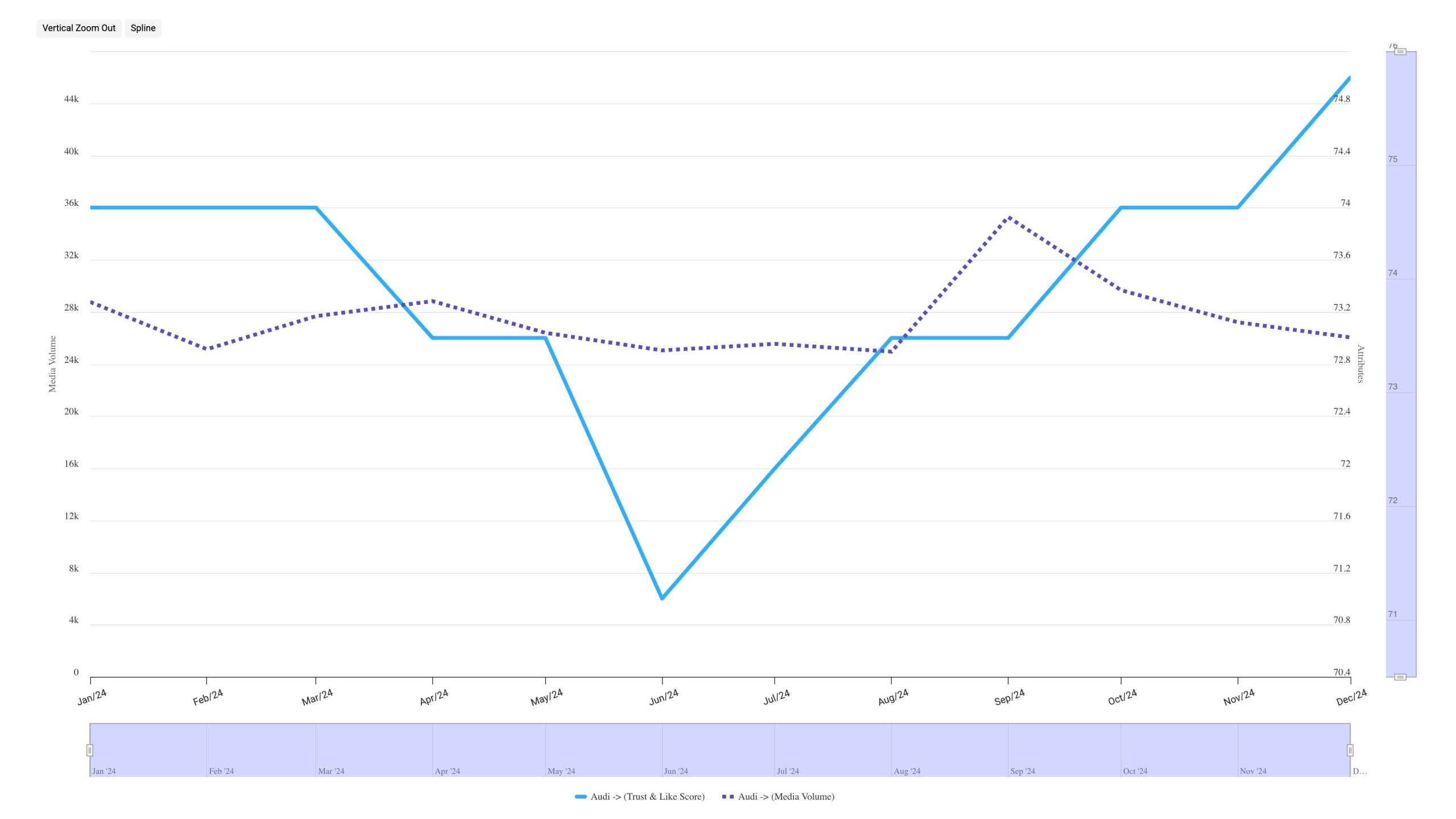
As an example, one of Audi’s focus areas is to lead mobility into a sustainable future.
To see whether this message resonates with the general public, Audi has defined a target for the custom Environment Score (shown in the RTT) to be achieved by the end of 2023.
Each month, the progress is evaluated within a strategic meeting, which is aimed at assessing, adjusting, discussing responses, and allocating resources toward achieving this goal.
During the monthly meetings, the Audi team actively uses the following functionalities of the Caliber RTT to analyze the reputation data:
The implementation of the global multi-market cross-stakeholder tracking solution has brought enhanced efficiency and alignment to Audi’s communication functions.
It enables Audi to allocate budgets based on impact and facilitates the development of brand activities that actively engage stakeholders in the company’s pursuit of its new purpose.
This solution has proven valuable in assessing the reputational impact of Audi’s announcements, external events, and media coverage.
It also aids in making informed decisions on how to respond or proactively design future strategies.
You may also be interested in
Follow Caliber
Get the results of our latest research directly in your inbox!