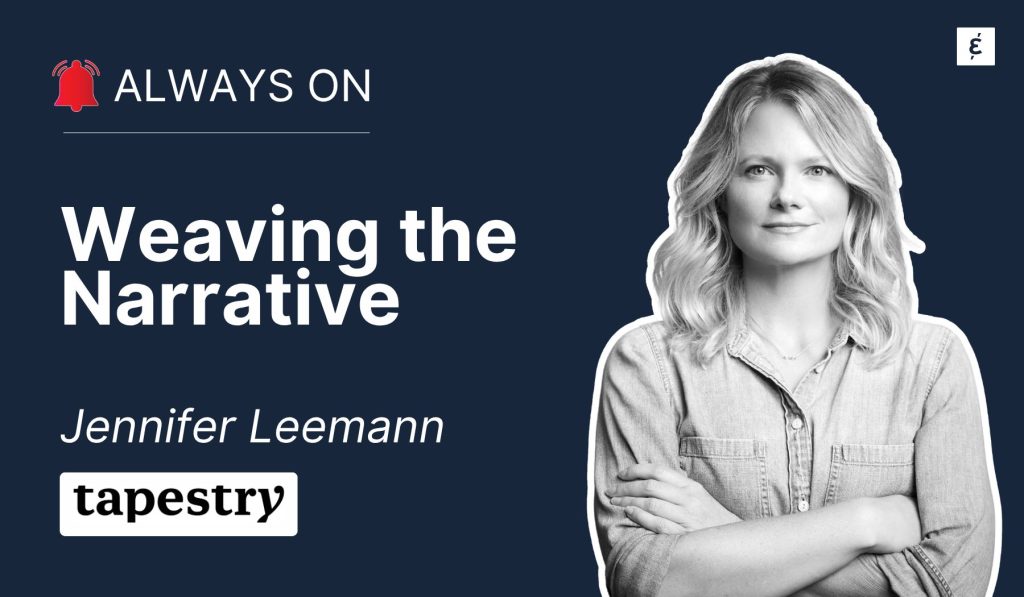
What does it take to lead communications at one of fashion’s most iconic houses?
Jen Leemann, SVP Global Head of Communications, Inclusion and Social Impact at Tapestry, joins Shahar Silbershatz to explore how the CCO role is evolving — from AI’s dual impact on brand, reputation and internal workflows, to why transparency is a company’s greatest protection, and why the fundamentals of great storytelling matter more than ever in an age of constant disruption.
If you’ve ever had to argue for a seat at the table, or wondered how to prove the commercial value of communications, this one’s for you.
Watch the video episode
Read the full transcript
Shahar Silbershatz: Welcome to Always On, the podcast about brand, reputation and data-driven communications. I am Shahar Silbershatz in Copenhagen, and today we have with us Jen Leemann. She’s the SVP Global Head of Communications, Inclusion and Social Impact at Tapestry. Great to have you here, Jen.
Jen Leemann: Great. It’s great to be here for a good conversation.
Shahar Silbershatz: So tell us a little bit about your company. For those listeners who are not familiar with Tapestry, what’s your elevator pitch?
Jen Leemann: Well, Tapestry is a global house of brands based here in New York City, and we always say our vision is to give more people the power to bring their own style and story into the world. So we’re very focused on self-expression, and we do that through what most people would know is our iconic brands, Coach and Kate Spade.
Shahar Silbershatz: So self-expression is what it’s about today. So let’s hear a little bit about your role, and obviously we talk to a lot of CCOs on this podcast, but we have a feel that every CCO has a very different day-to-day. And we want to know a little bit about your, your day as a CCO. Tell us about what, what did you do yesterday? How was your day like?
Jen Leemann: Well, the fun thing about being in this role or is that there’s very few days that are predictable and repetitive. Every day is new and different, but yesterday, kicked off the week. So I usually start my day around 5:00 AM. I am definitely an early bird when I have my most energy and I like to start with a cup of coffee and poring over the headlines. You know, what am I, what am I in for today? So, a quick scan of anything happening in the world. We’re a global business. What happened overnight? And then dive into the day when I get into the office. I usually start by organizing my thoughts. There’s the calendar of what you think is going to happen, and then there’s the reality of what will happen. And I spend a lot of time setting up the week, meeting with my team, making sure my team has the context. You know, one of the great things about being in a leadership role is that you know a lot. It’s so important that I make sure my team knows how any context or business decisions are changing, so that they’re all running in whichever direction they’re running with the same information sharing. I think sometimes that’s the biggest role we play, connecting dots across the organization.
And then, you know, shifting gears into meeting with key business partners, key leaders, understanding what’s happening across the business. There might be an interview there, there might be a strategic planning meeting.
We are business people first, so what are we doing to drive the business? And then I usually end my day with some kind of physical activity. I think in these roles it’s really important that we take care of ourselves and I always think about being a life athlete. Am I prepared for what I have to face every day? And do I have the stamina and the energy and the passion to keep at it and making sure I eat well, sleep well, move well.
Shahar Silbershatz: Okay. That sounds like a good mix. So there’s, there’s a lot of reading and getting information from different sources, but there’s also listening and talking to people. And I guess it is, at the end of the day, a people kind of role, right? Being a chief comms officer?
Jen Leemann: Absolutely. I would say I spend most of my time listening. I think that’s always one of those weird things people don’t think about communications. You have to listen more than you talk.
Shahar Silbershatz: Yeah, and that’s something that we also talk about. What do you spend a lot of your time on that people from outside our profession would be surprised about? I think people from outside the profession expect us to be communicating most of the time rather than listening, right?
Jen Leemann: I think they do. In fact, I think one of the common misconceptions is that we’re copywriters, and that is probably the furthest from the truth. It is listening for understanding, listening for themes, listening and influence. Listening for how you frame an idea. So I would say it’s very much a listening focused role.
Shahar Silbershatz: And is there a part of the job today or things that are on your plate now that wouldn’t have been there 10 years ago? I mean, obviously the field has changed a lot. What would you say is really new to this day-to-day agenda?
Jen Leemann: I’m not sure there’s just one. I would, I’m gonna group it in two different ways. One, I think you can’t ignore AI. And AI is multifaceted because there’s one, how, how is the company reputation being shaped by AI? And are we doing the right things to evolve our comms strategy to excel in that environment? One. And then the second is, how is AI changing the function and how we work? And, you know, thinking about all of these crazy ideas about using agents and, you know, will you manage digital teams? Am I making sure I’m keeping myself knowledgeable on the cutting edge of that and am I making sure I’m developing my team to excel in that environment? I think this is one of those times where technology is gonna change a lot. You have to know how to use the technology. You gotta play with it and make time for that. That’s definitely new. And I would say the second thing that’s new in my role is this idea of sort of the CCO plus. Comms taking on more and more business objectives than just pure communications. So I do lead our inclusion team, our social impact team, and employee listening. And so, I mean, a larger remit, none of those things would’ve been on my list of to-dos, you know, 10 years ago. But putting those things together gives us incredible power. One, I love having employee listening and being able to ask questions that allow me to measure the things that we need to. How that plays out in the way we show up in the world as a responsible company and how we create our culture where everyone feels welcome.
Shahar Silbershatz: It’s great. These are two topics I really want to delve into in a bit more detail. First of all, AI of course, we cannot have a conversation today without talking about AI, so let’s just get it out of the way. So let’s talk about your perspective on AI. I mean, how do you see, ’cause you mentioned a little bit, but I wanna hear more from you on how you see AI changing, not just your role, but generally our function, the communication function.
Jen Leemann: I think it’s hard to imagine what parts it won’t change. So if you start there, the more communications changes, the more I think there are certain fundamentals that don’t. Can you listen? Can you think strategically? Can you connect with people? What’s your curiosity? I think those capabilities are more important than ever. AI to me is a tool. It’s a tool at our disposal that you can use in a lot of different ways. So, strategic planning. It used to take us days and weeks to do some strategic planning. You can use AI as a thought partner, not to do the thinking for you, but to fast track, you know, pulling a lot of data together and pulling the themes out, you know, I’m gonna say with a smart prompt and a click of a button, and an ongoing dialogue. I think it has made me sharper. It is helping with capacity because one of the challenges in this role is it’s never over. You could work around the clock and probably never feel like you’ve gotten it all done. And I think it really does become an extension of your team and what you can get done. I think there’s also a lot of important, but maybe not the best use of time, work. And if we can automate that through AI and get to a smarter place faster, I think that’s amazing and would love to see that. And then this idea of how AI is gonna change the way consumers engage with brands is completely wild. How reputations are built. You know, what we’re seeing in some of our data is earned media and owned media being more important than ever. So the fundamentals of communications are back in the forefront. I think people doubted some of that for a while. Who needs it? And AI is sharpening that authority from those credible sources.
Shahar Silbershatz: Yeah, and that’s a bit counterintuitive actually. It brought back the old-fashioned earned media side to the picture. But we recently did a study about AI and what people worry about when it comes to AI, and we found that people’s… of course, there’s a primary concern around your job being at risk, that’s obvious. There’s also a concern by a lot of people, more than we expected, about skills erosion. People are worried about losing their ability to either to think or to do something that they used to do and don’t have to do anymore, for example, copywriting. There’s a lot of other skills that people are worried about. From your perspective then, what is the role of communications when it comes to rolling out AI in a company? I mean, considering all the fears that people have, considering all the obstacles, what’s the role of comms? How do you ensure that it lands in the right way internally?
Jen Leemann: Well, here at Tapestry, comms is very much at the center of how we’re rolling it out, for a couple of different angles. One is, what is our narrative on AI? You know, we’re not just tackling AI because it’s a buzzword, but how are we using it to enable our strategy? How are we using it to connect with the consumer? How are we talking about it as part of our business? So helping get crisp on that narrative and that framing has been one part. The other part is, how do we get our employees interested in AI and learning the skill and adopting and changing workflows? And to me that is, you know, comms 101, so sitting and talking about where are we today? What are our objectives? What are our roadblocks? How do we create content that drives behavior change? And, you know, one of the funniest things for me was we did our most recent corporate employee listening survey, and one of the questions we put on the survey was, do you use AI in your day to day work? You know, for me, it was a way to benchmark, over time, if we’ve moved the needle on that. The number of people who simply commented on: why are they asking that question? And so when you remember everything communicates, how are we inspiring people to lean in to something that is scary and is a new way of working? But doing that through a very strategic comms plan that has behavior change and business outcomes at the center.
Shahar Silbershatz: Yeah, I think it’s an interesting aspect, the role of comms in internal rollout of AI, that when comms functions typically think about AI, they think about it in a little bit of a, I guess, ecocentric way, right? It’s like, what do we do with AI? How are we benefiting from AI in the comms function? Rather than, you know, what is our role to support the company in going through a change? Because AI is a change for all companies, both internally and externally, how people perceive you and how people perceive the way you use AI, because that also has an impact on your reputation. And also another thing that we know for a fact is that people are looking at companies and how they use AI and are not very trusting when it comes to how companies use AI. So there’s a big role for comms in actually helping the company adapt to this new age.
Jen Leemann: Absolutely. And there’s governance and there’s trust and there’s reputation. It’s not a small thing. I mean, this is a pretty big transformation for all of us in how we think and act. And I think that’s the kind of conversation I wanna be part of, as a head of comms. I believe deeply that our role is to connect stakeholders with our business strategy and drive business outcomes, and you have to help shape plans for work like this.
Shahar Silbershatz: And that’s also interesting ’cause I read a little bit about other things that you’ve said before. And you talked a lot about your interest in intersections that you’ve always been interested in, basically, not just being a specialist in one narrow area. And I guess that ability to understand that we’re usually operating on the edges of different domains probably helps you with adapting to this new age of AI. Or do you see it the same way?
Jen Leemann: Yes, the idea of intersectional thinking and can you bring ideas from multiple places together and what happens to innovation when you do? That was something that I was taught at a very young age, and last week I was thinking about my undergraduate experience where I was concentrating in marketing and management information systems. I haven’t thought about that for a really long time, but we were going through some AI thought leadership work at a conference, and people were talking about process mapping, and how you have to map process, and that communicators aren’t good at that. And all of a sudden I thought, oh my gosh, I can process map. And I think, you know, the way technology changes our ability to communicate is exciting and you do need to bring skills from across different places, and that’s what unlocks expansive thinking.
Shahar Silbershatz: Which also talks to your purpose of stretching as much as possible, right?
Jen Leemann: Yes, yes.
Shahar Silbershatz: We’re definitely all stretched these days. Let me ask you about kind of the commercial side, in terms of the role of comms, because we often have this struggle within the communications function of proving our worth to the business and actually being able to have a conversation with the CFO and prove that we’re helping the bottom line, we’re helping the company commercially. How do you have those conversations? What do you say to a CFO that asks you that question?
Jen Leemann: I go back to my tried and true line that comms is about connecting our stakeholders to business strategy and driving business outcomes. We talk a lot about wanting to create a company that employees love to work for and that all of our stakeholders believe in. So you fast forward and say, you need employees to move towards a goal, AI adoption? You better have strong internal communications. You want investors to engage in your strategy and your growth story? You better have a credible story and trustworthy leaders that people believe in. You want people to have benefit of the doubt in a crisis? People better know what you stand for. And if you want a transformation to take hold, people need to know where you’re headed and why, and comms is at the heart of every single one of those things. To me, walking in and having that conversation hasn’t always been easy. But I would say where we are now is quite strong. In fact, you know, I have a moment in my career where I was sitting in a room and someone said to me like, why are we where we are? I had been fighting and fighting and fighting to get at the table, and here I am at the receiving end of disappointment. And I said, well, if comms were in the room, we wouldn’t be here. And I have never been left out of the room since then.
Shahar Silbershatz: Do you get challenged, though, a lot about the commercial contribution of comms? Is that something that people do ask of you and your department?
Jen Leemann: I’m gonna say no. I think I challenge myself because there’s this intellectual… can you put it on the balance sheet? Or is it in brand equity? Or, like, how do you quantify all of this? Is there a perfect cause and effect? And I don’t think it’s that simple, to go from A to B. There’s so many different things that influence a commercial outcome, but I have no doubt that comms is part of that.
Shahar Silbershatz: And do you use any kind of measurements or any kind of dashboards that, for example, if you have to give up all the different tools and dashboards that you have and keep one of them, is there one that you feel this is my best tool or my best weapon when it comes to knowing that we’re on the right track?
Jen Leemann: I think it’s hard to say just one, and I’m gonna go back to… every conversation for me starts with what’s our objective? And depending on the objective, you need a different metric. And so to say, if I only had one dashboard, employee engagement, I wanna make sure employees are engaged, but I’m not paying attention to reputation, I would not be set up for success. So I would say I am data-obsessed. We do have a culture that’s very focused on using data, and moving beyond data to insights and the “so what?” is really important. I think for comms, that’s where it’s fun because, you know, the reason I started in this line of work was I believe communications can drive outcomes. I sat in meetings and I watched people pitch ideas, and some really good ideas failed, and then mediocre ideas succeeded. I kept going, Why? Why? Why? And the ability to communicate and influence was my conclusion. If you’re good at those two things, you can actually move much further in business. And that’s what ended up making me go back to grad school and focus my career in communications.
Shahar Silbershatz: Interesting. So why do you think it is that the comms function typically is seen as not very good with data, that a lot of other departments seem to be a lot more advanced, whether it’s marketing or strategy, operations. There’s always this kind of sense that comms is not using the right data or not using enough data, or doesn’t have the skills to interpret the data. Why do you think there’s that perception?
Jen Leemann: I think there’s two parts to that. One is you have to… for me, it’s important to work somewhere where communications is valued and, you know, one of the things I’ve worked hard on over my tenure here at Tapestry is building belief in the power of comms. I started, we were, I think, two people, and we’ve grown to be a global function, and I think that is building trust and delivering time after time after time. You start with one project and you demonstrate your capability. You use data to tell the story about how it was successful, and the next time you get better and better. And I think it’s important for communicators, to the question about having multiple disciplines, to be good at business. If you want to work in a business, you need to know data, you need to understand the business, you need to understand financial statements, and what the financial statements tell you about where the company is headed. So to me, it is a skill gap that we have to close. And if it’s a perception gap, we have to communicate more effectively about how we’re using data to drive outcomes.
Shahar Silbershatz: Yeah, that’s a good point. I think it’s also a good point that it’s important to work in a company that values communications, and if it doesn’t, that’s actually your first task, isn’t it? Because if the function and its work is not valued internally, it’s going to be very difficult for you to do your job effectively.
Jen Leemann: Absolutely.
Shahar Silbershatz: And I want to talk a little bit more about the other point that you mentioned that’s different today from 10 years ago, which is the CCO plus side of your role in the CCO role. Tell me a little bit about that. I imagine, especially today, that might be harder to defend with all the backlash that’s going on and a very loaded debate about the plus, especially when it’s the area of sustainability and inclusion. How do you see that side of your job?
Jen Leemann: Vital, I mean, culture. I mean, there’s the old “culture eats strategy for lunch”. The culture that you create, does it enable your strategy? And things like, you mentioned “Stretch what’s possible”. Our company purpose is “stretch what’s possible”. How do you, think expansively? How do you bring innovation to our industry, to our space, to everything that we do? And innovation comes from looking in unexpected places, and that requires people with different ways of thinking and different ways of seeing the world. So to me it’s fundamental for our business to succeed. We want to reach our bold growth objectives? We’ve got to have the best people bringing our diverse perspectives to all of our business, and, you know, we are very, very focused on having a diverse supply chain. So the way we think about ESG and being a responsible business in all of the areas of our business, again, fundamental to who we are, and something that we take a lot of pride in.
Shahar Silbershatz: I want to talk a little bit about the trade-offs of our profession. Let’s call it that way, because, you know, there’s quite often, this is quite a unique, I think the CCO role is quite unique, both because you combine, you know, gut feelings with data, and you have to deal with, you know, soft data and hard data. There’s a lot of balancing that needs to be done. And I wonder if you could give me some examples of situations where you, for example, had to make a decision between what the data showed you and what your gut feeling was, and how you handled that.
Jen Leemann: It’s important to look at data, but I was working on a project, and the data kept saying, go right, go right, go right. And everyone said, go right. And in the back of my mind, I kept saying, gosh, I think we need to go left. everyone said, no, you’re, you know, don’t waste time and energy going left. You don’t need to worry about that. And like any great communicator, I said, you know what, I’m gonna make sure I’m prepared to go left or right, because what we know is it’s good to have scenarios, and it’s good to be ready for anything, and it turned out we needed to go the opposite direction, and my gut was right. And so having prepared for that moment was one of those things you’re like, great, I’ve got it. We’re gonna pivot. We’ll be ready in 10 minutes. A little finessing, but we were ready. And I think it’s really easy if your gut tells you something different, you’re ready for it.
Shahar Silbershatz: Would you say that, in our profession, gut tends to trump data in fact? Or would you say that it’s just the ability to balance the two and be prepared?
Jen Leemann: I think it’s the balancing the two. Data can tell you any story you want. That’s sometimes the hard thing about data. You can find data to argue any point. So, part of experience, part of being curious about the world, I think part of living in this era is that the unexpected happens all the time. And so you do build a little bit of a gut feeling that says, you know what? I just wanna be ready for this just in case.
Shahar Silbershatz: That makes sense. Another trade off, or maybe just a tough decision, is handling CEOs, because quite often it’s not an easy job, and part of your job, of course, is to be an advisor to the CEO and guide them in what they can say or should do. Are there any situations, were there any situations recently or in your previous job where you actually had to advise a CEO not to do something that they wanted to do or not to say something they wanted to say?
Jen Leemann: I would say it’s increasingly rare for me to tell a leader no. And I think the nuance there is, when you are at the table shaping the direction, and you’re in the room asking the questions, there’s fewer and fewer places where you need to say no. I love when people say, we need comms in the room, or what does comms think about this before we land a decision? And I think that’s a really rewarding part of this role.
Shahar Silbershatz: Well, how about the opposite then, when you had to convince the CEO to get involved in something and voice an opinion about something? Has that happened?
Jen Leemann: Many times. But you know, I think there’s a really interesting thing that’s happened for me in my career, which is very early on I felt like I had to have all the answers. I had to be the person who was right. And what I have learned many years later is I have to have the right questions and, you know, the art, I think the art of this role isn’t pounding your fist on the table saying, we must or we must not. It’s being able to come in and say, great, we can make this decision. It might result in A, B, or C. Can you live with A, B, or C? Cool. We’ll be ready for that. If you can’t live with A, B, or C, let’s step back and say, what do we need to do differently for a different outcome?
Shahar Silbershatz: That’s interesting. It also goes back a bit to the point in the beginning about the importance of listening rather than communicating. So, asking the right questions makes your job easier because then you can at least prepare for the different scenarios and at least make people aware of the potential consequences.
Jen Leemann: Yeah, absolutely. And I think really good questions, like being a good question asker, is one of those skills that I think is vital to succeed in comms.
Shahar Silbershatz: Yeah, I couldn’t agree more. So here’s another trade-off. We in communications always advocate for transparency, but in some cases, transparency can actually be harmful for the business. How do you balance those two? Or do you have another good example of cases where you had to balance the two?
Jen Leemann: I’m going to say it’s a false choice. I think transparency protects a company. Now I want to be careful to say transparency is not every detail. So there’s an importance in owning your story and not letting other people own it for you. And I think if you’re not authentic, you run the risk of two, three, four steps later going, wait, hold on, how did I get here? Now I’ve completely deviated from where I started and what I wanted to achieve. You know, and I think one of my roles is to be the person in the room who says, is “our say and our do gap” as small as possible. Are we doing what we say and saying what we do? And if those things are going in opposite directions, we have a problem. And so, to me, you have to respect the boundaries of what, you know, you need to disclose from financial expectations. I mean, there are rules to this, but I have very rarely found a moment where transparency wasn’t a better answer.
Shahar Silbershatz: I imagine that there are situations where you’re in the room and there’s finance, there’s maybe operations, comms, maybe the CEO, and you don’t agree on what is the right course of action because maybe you are arguing for transparency, and they’re maybe reticent or maybe they’re worried or concerned. I mean, how do you handle such a situation? I mean. I know that I’ve seen those situations quite a lot, and I imagine you’ve experienced them too. I mean, what is your, I would maybe phrase the question differently. What is your argument? What is your line of argument to say, we need to be transparent around this because…
Jen Leemann: it’s hard to say an abstract: we must do this. I think for any of those cases, it’s presenting what you think the next thing will happen, which goes back to this: all right, we’re gonna go path A and that’s the decision. Again, you know, business is a team sport, and I think there’s so many of these moments where we’re all like, oh, I have to be right. And then you get so emotional about it, and it’s really not emotional. And the faster you learn that, the more composure, the more fun you have in jobs like this. If the company decides we’re going A, I think it’s important, and I have a responsibility, to say, here’s what I see. If we’re going to do that, then we need to have what our next step is. And again, part of this role is seeing two, three, four steps ahead and not being unprepared for that.
Shahar Silbershatz: So it goes again into kind of scenario planning and knowing what are the consequences of different choices?
Jen Leemann: Absolutely.
Shahar Silbershatz: So how do you see our profession going into the future? I mean, we talked about AI and some of the changes. We talked about the plus side of our discipline. What are you seeing as some of the trends and changes that are happening in the years to come?
Jen Leemann: It’s funny, I would say probably in the past couple of years, I mean, we’re living in a very interesting moment, and if I think about what we’ve lived through in the past five or six years, in a communications function, it’s quite remarkable. But I think what I’m also noticing is that the basics are more important than ever. Like, good, clear, compelling communications. No jargon, don’t overcomplicate it. You know, connecting with your audience through the things that matter most to them. So, knowing your audience, I mean, how important it is to make sure you know the people you’re communicating with. Creative content. Those things to me are at the center again. And that is fun. You know, I love storytelling. I love moving audiences forward. And I think we have more tools to do that in really fun and creative ways. And so I get excited about what the future holds for comms. And I think it’s a great career path for people who are curious, who don’t like to do the same thing every day, who like to be informed about the world around them, and like to bring creativity to work every day.
Shahar Silbershatz: Yeah, it’s still about telling good stories.
Jen Leemann: It’s still about telling good stories.
Shahar Silbershatz: Do you think there are any parts of our jobs or your job that just wouldn’t exist in a few years from now?
Jen Leemann: I think if you think about comms from a very traditional sense, I think we go back to those very basic things and those will continue to be important. The what and the how or how might keep evolving. But I have a hard time thinking about any one thing going away. You know, I was, I was thinking, oh, would employee listening go away? We can use biometrics to tell if you’re happy or sad today. And then I go, yeah, but I actually wanna ask, do you understand our strategy? And I can’t read that on a biometric, so I still wanna ask. Maybe I’ll use different technology. But I still wanna have the insight. So I think we’re just gonna get better and better at the things that define the function smarter.
Shahar Silbershatz: And maybe get better tools to help us along the way, as you said. Tools that make us sharper in what we do rather than not do things that we do today.
Jen Leemann: I’ll tell you, it’s funny, I was recently traveling internationally and talking to teammates and consumers and, you know, one of the things I think we keep hearing is content’s getting shorter and shorter and shorter, and we’re communicating in these micro sections of things and your brain is changing. But there’s starting to be a different trend where the content’s getting a little bit longer and so they’re doing these micro-dramas that are no longer, you know, half a second, they’re now two or three or seven minutes. And so it’s interesting just to even see the form of storytelling changing.
Shahar Silbershatz: Yeah, and every trend has a countertrend, right? So whatever happens, then there’s those people who are looking for… for example, there’s this, there’s a lot of people today who are trying to do away with technology as much as possible because technology is becoming so, you know, invasive and all-consuming. So there is also a trend of people seeking a human contact and seeking authenticity in a way that is very, very human, not without any machine intervention. And I think that type of the pendulum swinging, you know, one way and then the other way, is probably gonna continue. Just like the short read, long read thing, we’re also seeing that, we’re seeing, you know, even in our space of providing insights, reputation insights, you know, some companies prefer now to consume reputation insights in the form of a 10-minute podcast instead of three PowerPoint slides, you know, because then that’s a way of engaging with the insights, even though it takes you longer. Which I find very, very interesting. So we see that too.
Jen Leemann: Well, and I don’t think it’s a bad thing for us ever to move more towards a human direction, in anything we do. Technology’s amazing. It’s made life better in so many different ways, but there are things that make us human, like connecting and having conversations, and anything that keeps that more balanced I think is probably a good thing.
Shahar Silbershatz: That sounds good. So I’ll wrap up with the last question. Have you picked up, over the years, any skills that you actually didn’t expect to pick up in your role within communications. You mentioned the intersectional thinking, which is a fascinating area. Were there other skills that you feel you picked up that were a surprise to you?
Jen Leemann: It’s hard to think about what skills you don’t use in communication because it’s so broad. The one that stands up and is very timely in this moment, I would say, is organizational design and talent assessment. And I think in this moment where AI is changing so much, and we’re working in these really complicated worlds, have you structured your team in a way to succeed? Are you being thoughtful about how work gets done in different places? And there’s very strategic ways to design your teams for success. And I think that is probably one place where I didn’t think I would ever spend time studying, but when you’re leading a function and building a function, designing it for success so that the teams are having fun and the work is flowing in the right way, has been pretty powerful.
Shahar Silbershatz: Yeah, that’s very understandable. That sounds good, Jen. Thank you so much for being with us today. I really appreciated your perspectives.
Jen Leemann: Thank you. It was fun.
Shahar Silbershatz: Many thanks for listening to this episode of Always On. If you haven’t done so already, check out some of the other episodes. They’re packed with unique insights from seasoned experts at leading companies. Oh, and if you have any comments or questions about anything you’ve heard on the pod, we’d love to hear from you. Just drop us a line at [email protected]. Thanks again for listening. Till next time, take care.