Measuring and managing corporate reputation means asking stakeholders directly, through continuous, structured surveys, rather than inferring perception from media coverage or website traffic.
The measurement identifies where trust is strong or weak across each stakeholder group; the management half turns that data into decisions: which messages to adjust, which stakeholders to prioritize, and where to invest.
This guide covers what that measurement actually involves, the most common approaches and where they fall short, and the five practices that separate companies that manage reputation well from those that just measure it.
Key Takeaways
- Reputation is a perception construct. The only rigorous way to measure it is to ask stakeholders directly, through representative, structured surveys. Media monitoring and social listening measure published content, not what people believe.
- Continuous measurement changes the game. Quarterly brand studies give you a snapshot. Daily stakeholder measurement gives you a motion picture. You see what’s shifting, when it started, and what’s driving it.
- Measurement without management is a reporting exercise. The value of corporate reputation measurement comes from connecting perception data to business decisions: which stakeholders to prioritize, which messages to adjust, and where to invest.
What Does Corporate Reputation Measurement Actually Involve?
Measuring corporate reputation means capturing how stakeholders perceive your company across the dimensions that matter. That sounds straightforward, but the details determine whether the data is useful or misleading.
Four questions define a credible measurement approach.
Who are you measuring? Reputation exists across multiple stakeholder groups: customers, employees, investors, opinion leaders, regulators, and prospective talent. A measurement system that only surveys consumers is measuring brand health, not corporate reputation. The distinction matters because a company can have strong consumer perception and weak trust among investors or talent.
What are you measuring? Corporate reputation is multi-dimensional. A single score tells you very little without understanding what’s underneath it. Credible measurement breaks reputation into specific attributes so you can see which dimensions are strong, which are weak, and which are shifting.
How often are you measuring? Perceptions shift in response to events, campaigns, competitor actions, and external pressures. A system that measures once a quarter will always show you a historical picture. By the time you see a score dropped, the cause may have happened months ago.
What are you comparing against? A reputation score without context is a number on a slide. You need to know how that score compares to your own history, to your competitors, and to sector and geographic norms.
Which Corporate Reputation Metrics Matter — and What Do You Do When They Shift?
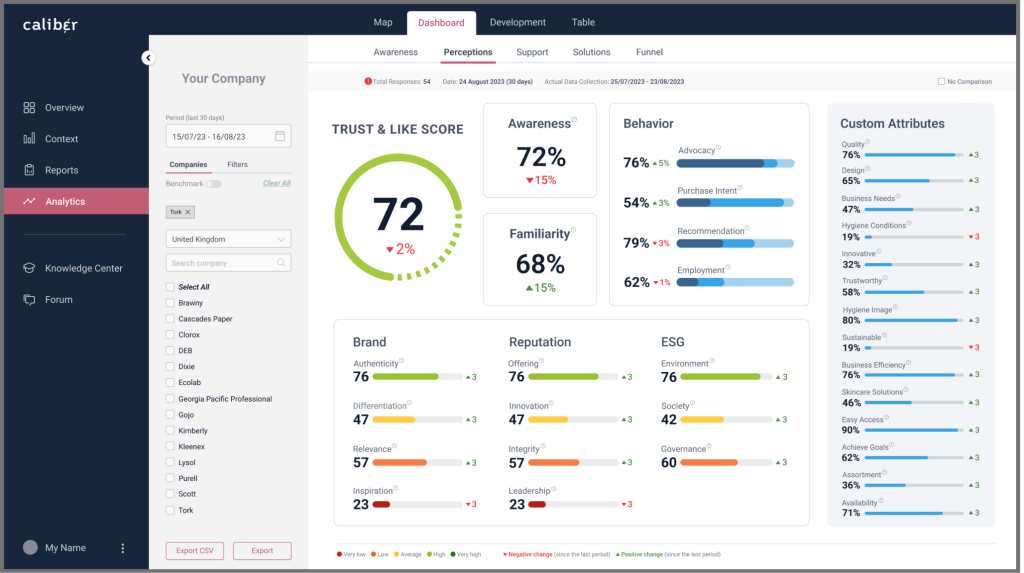
| Metric | What it captures | What to do when it shifts |
|---|---|---|
| Trust & Like Score (TLS) | Overall emotional trust and affinity, the primary KPI | Track weekly. A single dip is noise; a sustained multi-week decline is signal |
| Reputation attributes (Offering, Innovation, Integrity, Leadership) | What’s rationally driving the TLS number | Target your response to whichever attribute is falling, an Integrity dip needs a different fix than an Innovation dip |
| Brand attributes (Authenticity, Differentiation, Relevance, Inspiration) | The emotional layer behind TLS | Use to diagnose gaps between what you communicate and how you’re actually perceived |
| ESG Score (Environment, Society, Governance) | Perceived ESG conduct, distinct from actual ESG performance | Flag gaps between real ESG performance and perceived ESG performance as a communications priority, not a compliance one |
| Behavioral outcomes (Advocacy, Consideration, Recommendation, Employment intent) | What stakeholders are actually likely to do | Prioritize fixes where behavioral intent is dropping, not just where sentiment is dropping, intent is the closer predictor of business impact |
For the full definition of each metric and how it’s calculated, see our complete measurement framework.
What Are the Common Approaches to Measuring Corporate Reputation?
Most companies default to one of three approaches. Each has value, but also significant blind spots.
Periodic brand studies
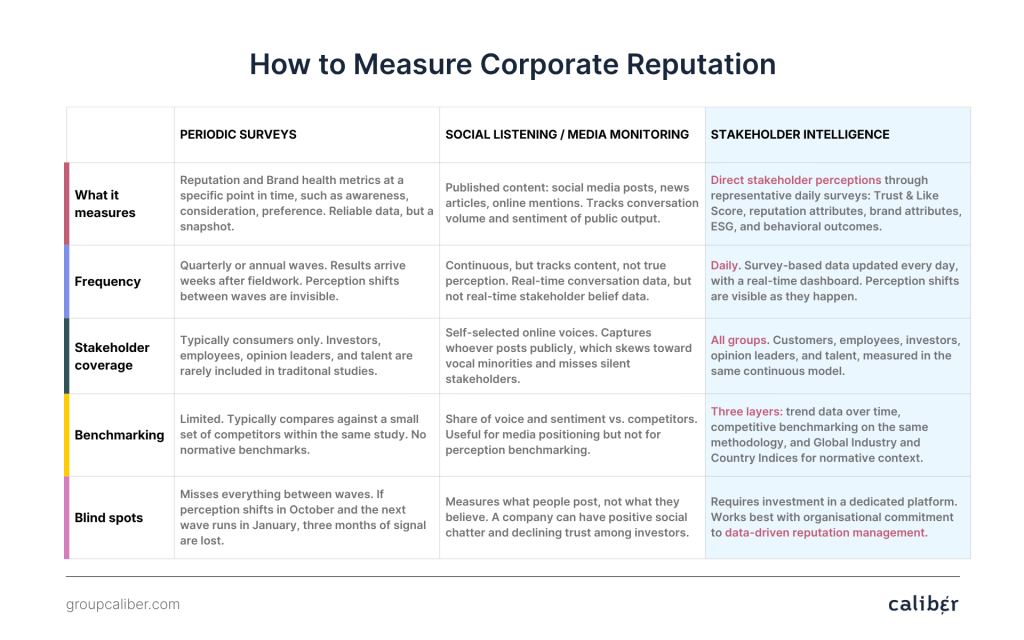
The traditional method: commission a research firm to run a survey once a quarter or once a year. The data is methodologically sound at the moment of collection, but the gaps between waves create blind spots. If your Integrity score dropped in March and your next wave runs in June, you’ve missed three months of signal. You’ll see the damage but not when it started or what caused it.
Social listening and media monitoring
These tools track what journalists publish and what people post online. They’re useful for understanding public conversation volume, trending topics, and narrative direction. But they measure output, not perception. Social listening captures what a vocal online minority says publicly. It does not tell you what a representative cross-section of your stakeholders genuinely believes. A company can have positive media coverage and declining trust among investors, or negative social chatter from a vocal minority while the broader customer base remains supportive.
Stakeholder intelligence platforms
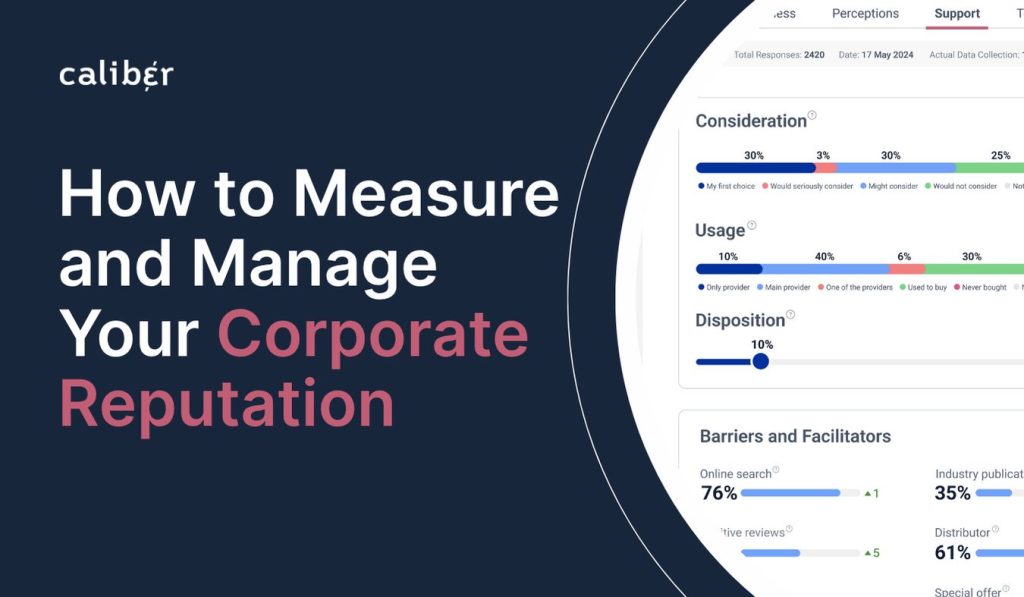
This is the approach Caliber pioneered: combining the methodological rigor of survey-based measurement with the continuity of always-on data collection. Caliber surveys representative panels of stakeholders daily across 60+ countries, measuring TLS, reputation and brand attributes, ESG perceptions, and behavioral outcomes in a single platform with a real-time dashboard.
The key difference is that you don’t have to choose between rigor and speed. You get representative, survey-based data updated daily, segmented by stakeholder group, benchmarked against competitors and industry norms. Caliber was founded in 2016 by former Reputation Institute directors who saw the limitations of periodic research and built the platform to deliver continuous, multi-stakeholder intelligence from day one.
How Do You Turn Reputation Measurement Into Management?
Measuring corporate reputation is necessary but not sufficient. The value comes from connecting measurement to management: using perception data to inform strategy, allocate resources, and make better decisions.
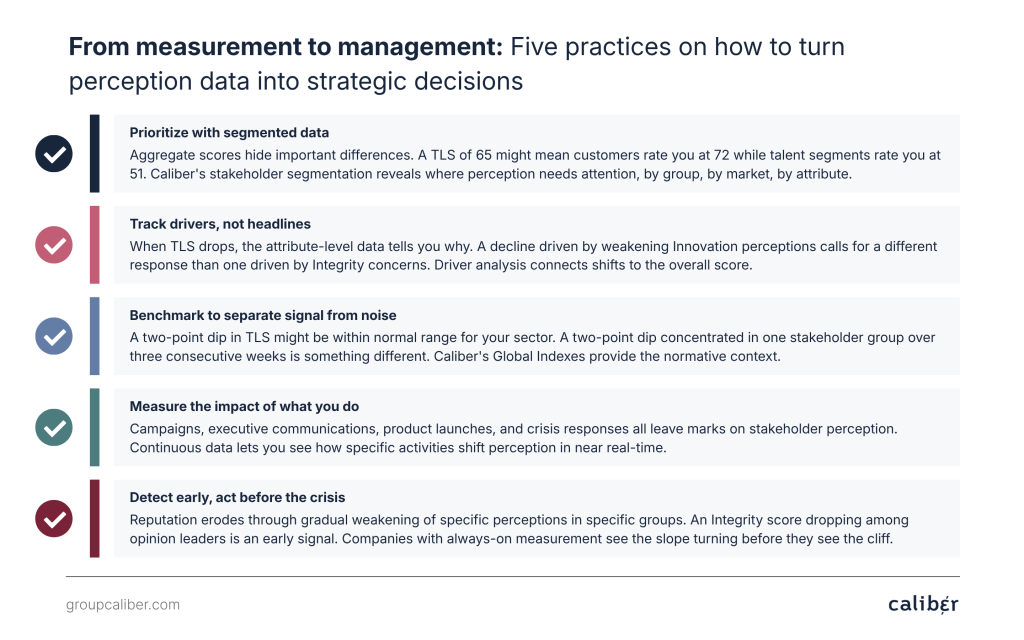
Five practices separate companies that manage reputation well from those that simply measure it.
Use segmented data to prioritize. Aggregate scores hide important differences. A TLS of 65 might mean customers rate you at 72 while talent segments rate you at 51. Those two groups require very different responses. Caliber’s stakeholder segmentation reveals where perception is strongest and where it needs attention, by group, by market, by attribute.
Track the drivers, not the headline number. When TLS drops, the attribute-level data tells you why. A decline driven by weakening Innovation perceptions calls for a different response than one driven by Integrity concerns. Driver analysis connects attribute-level shifts to the overall score, showing which dimensions have the greatest influence on trust and affinity for your specific company.
Benchmark to separate signal from noise. A two-point dip in TLS might be within normal range for your sector. A two-point dip concentrated in one stakeholder group over three consecutive weeks is something different entirely. Caliber’s Global Sector and Country Indexes provide the normative context that separates real risk signals from routine fluctuation.
Measure the impact of what you do. Campaigns, executive communications, product launches, and crisis responses all leave marks on stakeholder perception. Caliber’s continuous data allows companies to see how specific events and activities shift perception in near real-time, connecting communications investment to measurable outcomes.
Detect early, act before the crisis. Reputation doesn’t collapse overnight. It erodes through the gradual weakening of specific perceptions in specific stakeholder groups. An Integrity score dropping among opinion leaders, or Offering perceptions weakening among customers in a particular market: these are the early signals that something needs attention. Companies with always-on measurement see the slope turning before they see the cliff.
Who Owns Reputation Measurement and Management?
Corporate reputation doesn’t belong to one function. It spans communications, marketing, HR, investor relations, and the C-suite. Each function manages perception among different stakeholder groups, and effective reputation management coordinates these efforts around shared intelligence.
The CCO typically leads measurement and strategy, but the CMO is accountable for brand perception among customers, the CHRO for employer reputation among talent, and the CEO for leadership visibility and overall corporate narrative. Caliber’s platform is built for this cross-functional model: a shared dashboard where each function can access the stakeholder data relevant to their remit while seeing how their piece connects to the company’s overall reputation.
This shared intelligence model is what separates reputation management from siloed brand tracking, employee engagement surveys, and media monitoring running in parallel without connection.
Discover What Your Stakeholders Actually Think
Most companies operate on assumptions about how they’re perceived. Caliber replaces those assumptions with data: measured daily, across all the stakeholder groups that shape your success, benchmarked against your competitors and your industry.
If you’re ready to move from periodic snapshots to continuous stakeholder intelligence, book a demo and see where your reputation stands right now.