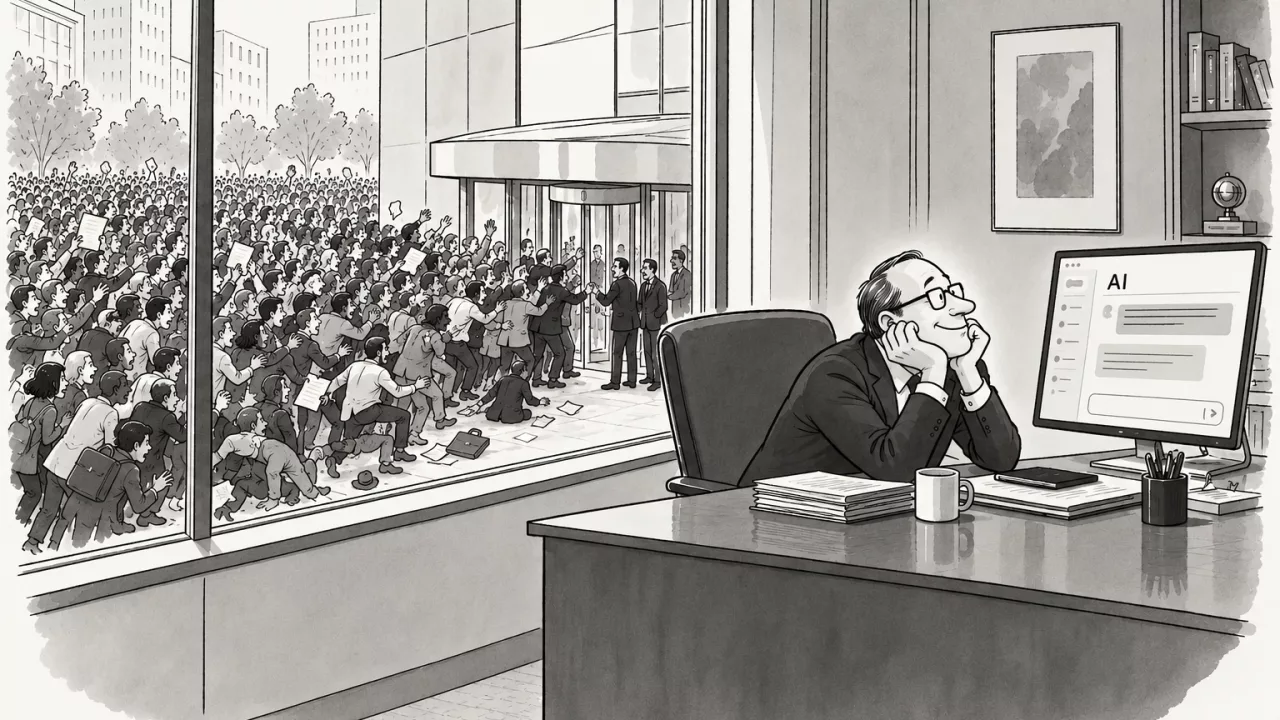
Every company will face a crisis at some point. Surveys of business leaders show that 69% have already experienced one in the past five years, and companies with more than 5,000 employees average roughly one crisis per year (Northwestern Medill, 2025). The question isn’t whether it will happen. It’s whether you’ll know it’s coming, and whether you’ll know if your response is working.
Most crisis management advice focuses on the response: what to say, when to say it, which channels to use, and how to manage the media. That guidance is necessary. But it addresses only the visible part of the crisis lifecycle.
Two phases get far less attention, and they’re often the ones that determine the outcome: what happens before the crisis becomes public, and what happens after the response, when you need to know whether trust is genuinely being rebuilt.
This article covers both, alongside the response itself, with a focus on how continuous stakeholder measurement strengthens every phase of crisis management and brand reputation protection.
Key Takeaways
- Brand reputation protection is an ongoing discipline, not a crisis-day activity. The companies that recover fastest are the ones that invested in understanding stakeholder perceptions long before anything went wrong.
- Crisis response is the most visible phase, but detection and recovery measurement are where outcomes are decided. Catching perception erosion early gives you time. Measuring recovery tells you whether your response worked.
- Continuous stakeholder intelligence closes the gap between when reputational damage begins and when it becomes visible, and replaces guesswork with evidence during recovery.
What Is a Brand Reputation Crisis?
A brand reputation crisis is an event or series of events that causes a significant negative shift in how stakeholders perceive your company. The trigger can be a product failure, an executive scandal, a data breach, an insensitive public statement, a viral customer complaint, or an operational failure that reaches public attention.
What separates a crisis from a bad day is scale and speed. A negative customer review is not a crisis. A product recall covered by major media, amplified across social platforms, and discussed in boardrooms of your clients and partners: that’s a crisis. The defining feature is that stakeholder trust is materially at risk, with consequences for revenue, talent, investor confidence, and license to operate.
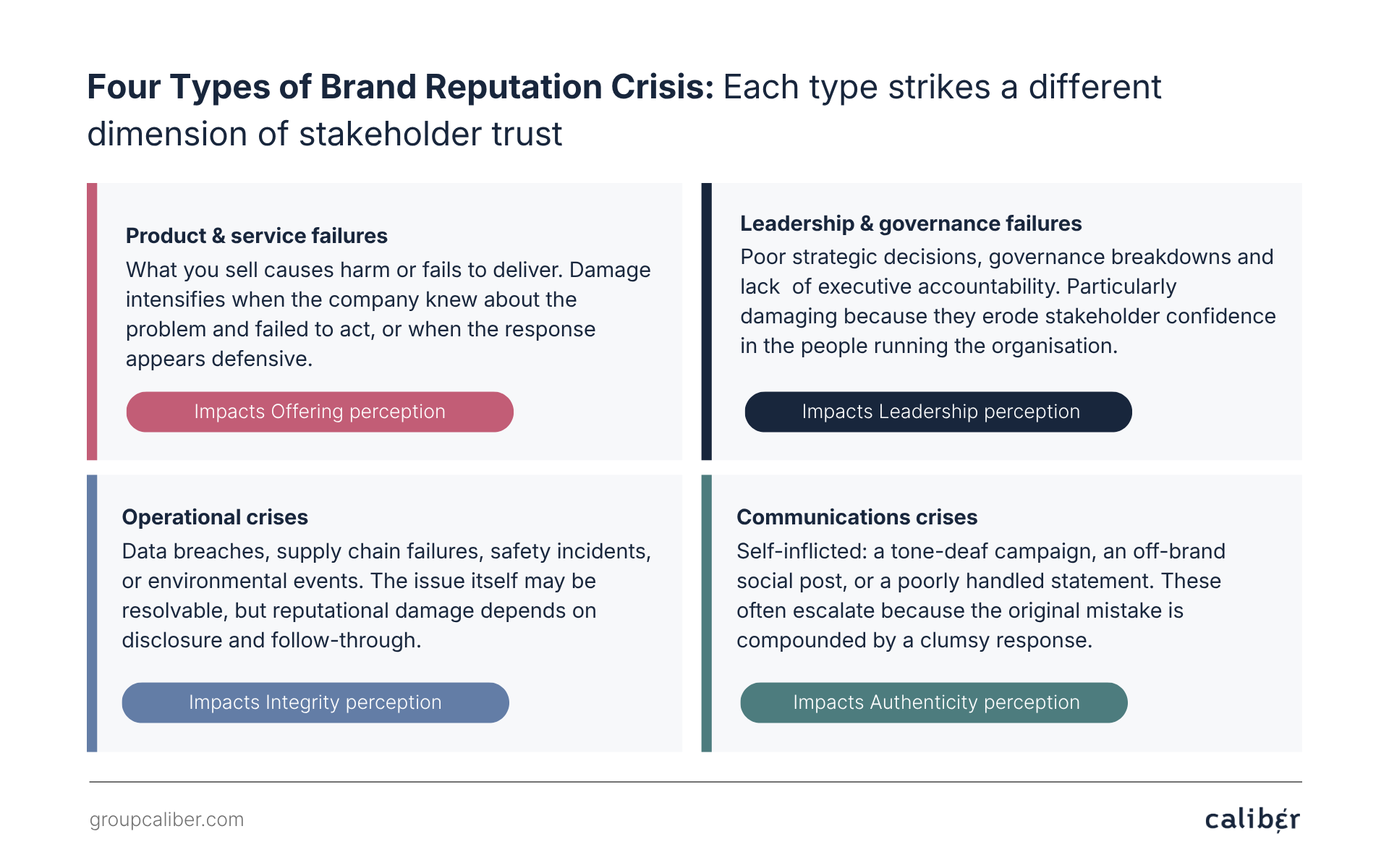
Crises come in several forms.
Product and service failures occur when what you sell causes harm or fails to deliver. Airlines, pharmaceutical companies, food manufacturers, and technology firms face these most visibly. Reputational damage intensifies when the company knew about the problem and failed to act, or when the initial response appears defensive rather than accountable.
Leadership and governance crises stem from poor strategic decisions, governance breakdowns and lack of executive accountability. Particularly damaging because they erode stakeholder confidence in the people running the organisation.
Operational crises include data breaches, supply chain failures, workplace safety incidents, or environmental events. The operational issue itself may be resolvable, but the reputational damage depends on how the company handles disclosure, accountability, and follow-through.
Communications crises are self-inflicted: a tone-deaf marketing campaign, an off-brand social media post, or a poorly handled public statement. These often escalate because the original mistake is compounded by a clumsy response.
In all cases, the reputational damage is a second-order effect. The event triggers it, but stakeholder perception determines how deep it goes and how long it lasts.
Why Most Crisis Playbooks Fall Short
PR crisis management has a well-established framework: assemble a response team, identify a spokesperson, draft holding statements, coordinate across channels, monitor media and social coverage, and communicate with transparency and empathy. This framework is sound. Every organization should have one.
Where it falls short is in two areas that sit outside the traditional communications toolkit.
Before the crisis: the detection gap
Most companies find out about a reputation crisis through media coverage, a spike in social media mentions, or a sudden increase in customer complaints. By that point, the damage is already visible and spreading.
But reputational crises rarely appear from nowhere. They build. Stakeholder perceptions shift before the public conversation catches up. An Integrity score dropping among opinion leaders, a weakening of trust among investors in a specific market, a cluster of negative associations appearing in top-of-mind responses: these are signals that something is developing beneath the surface.
Companies that rely on social listening and media monitoring for early warning are tracking the conversation, not the perception. Social listening tells you what a vocal online minority is saying publicly. It does not tell you what a representative cross-section of your stakeholders genuinely believes. A company can have low social media chatter and deteriorating trust among the stakeholder groups that matter most to its business.
Caliber’s daily measurement of stakeholder perceptions across all relevant groups closes this detection gap. A sudden drop in the Trust & Like Score (TLS) among a specific segment, or a decline in the Integrity attribute concentrated in one stakeholder group while others remain stable, are early warning signals. They give communications teams a window to investigate, prepare, and potentially intervene before the situation escalates publicly.
This is not a crisis prediction. Caliber does not predict crises. But it enables earlier detection and proactive preparation, which is a meaningful difference from discovering a problem through a news alert.
After the response: the recovery gap
The second gap in most crisis playbooks is measurement during and after the response. Once the statement is issued and the media cycle moves on, how does the company know whether trust is being rebuilt?
The typical answer is anecdotal: coverage is improving, complaint volume is declining, the CEO feels the situation is stabilizing. These are indicators, but they’re imprecise. They don’t tell you which stakeholder groups are recovering, which are still declining, whether employees are losing confidence faster than customers, or whether opinion leaders have moved on while investors remain skeptical.
Caliber provides the evidence layer for recovery. Because it measures Trust & Like Score, reputation attributes, and behavioral outcomes daily, companies can track the recovery curve at the segment level. They can see whether Advocacy is rebounding among customers while Employment consideration remains suppressed among talent. They can compare their post-crisis trajectory against their pre-crisis baseline and against sector norms.
This turns crisis recovery from a feeling into a measurable process. And it tells the communications team when their work is done, and when it isn’t.
A Three-Phase Approach to Brand Reputation Protection
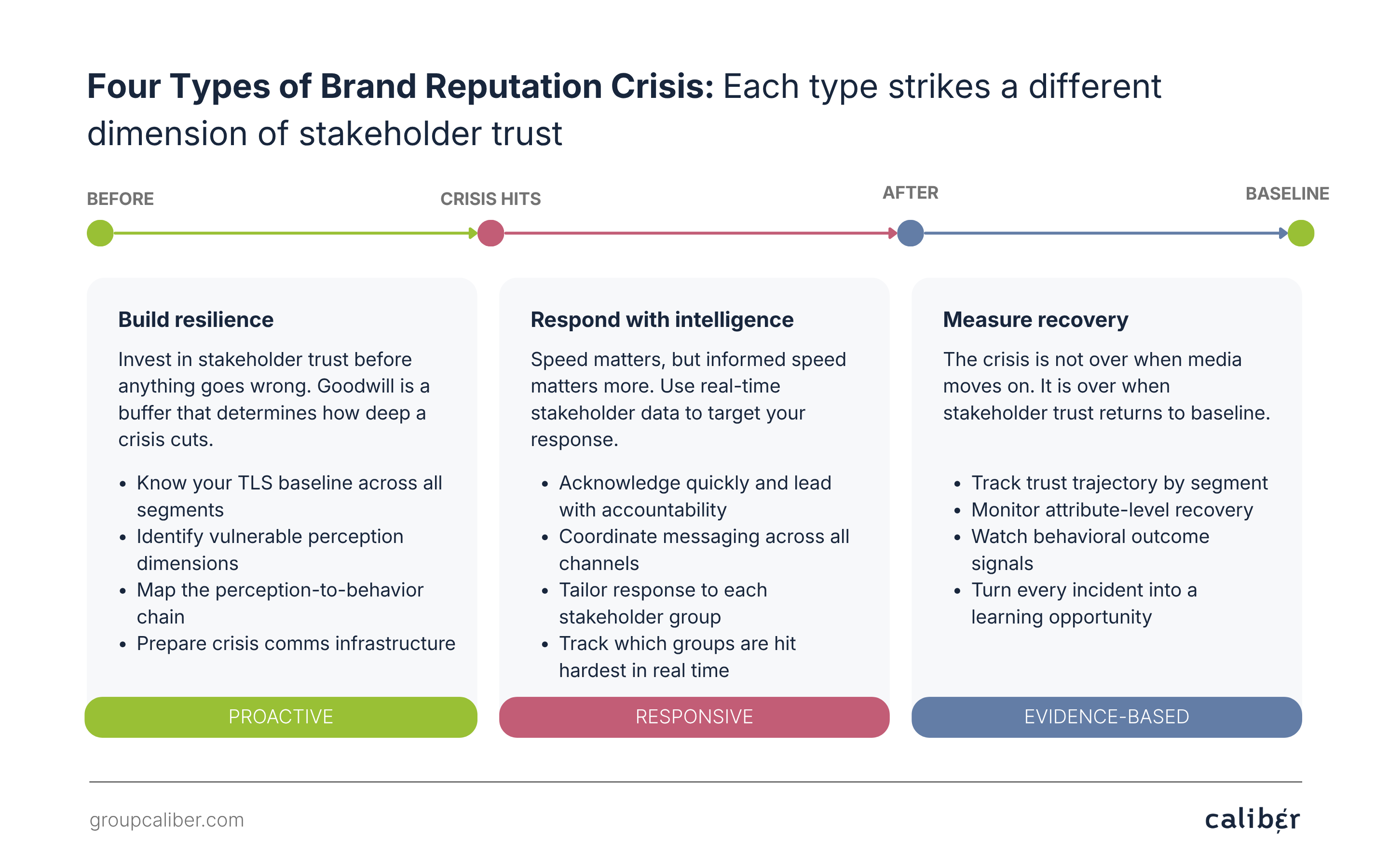
Effective brand reputation protection spans three phases: building resilience before a crisis, managing the response during one, and measuring and guiding recovery afterward. Most coverage of this topic focuses on phase two. The real competitive advantage is in phases one and three.
Phase 1: Build reputation resilience before the crisis
The companies that handle crises best are the ones that enter them with strong stakeholder trust. Goodwill is a buffer. When stakeholders already trust you, they’re more likely to give you the benefit of the doubt. When trust is low or untested, there’s no margin for error.
Building resilience requires four things.
Know your baseline. You need to know where your reputation stands across every stakeholder group before anything goes wrong. What is your TLS among customers, employees, investors, opinion leaders, and prospective talent? Which reputation attributes are strong, and which are vulnerable? Without this baseline, you can’t measure the impact of a crisis or track recovery.
Identify your vulnerabilities. Which perception dimensions carry the highest risk for your company? For a pharmaceutical firm, Integrity and product safety perceptions may be most critical. For a technology company, data privacy and Innovation scores may matter most. Map your reputational exposure against the attributes that stakeholders weight most heavily in your industry.
Invest in the perception-to-behavior chain. Caliber’s global data shows an R²=0.84 correlation between Trust & Like Score and supportive stakeholder behaviors (2024 Caliber Global 7-country data). Companies with high TLS don’t just survive crises better; they convert positive perception into commercial and organizational outcomes during normal times. That strength becomes a reserve when trouble arrives.
Prepare your crisis communications infrastructure. This is the standard playbook: designate spokespeople, pre-draft holding statements, define escalation protocols, train leadership on media engagement, and establish cross-functional coordination processes. Every organization should have this in place. What makes it meaningfully better is when the communications team has continuous stakeholder data to inform which groups to prioritize and which messages will resonate.
Phase 2: Respond with intelligence, not instinct
When a crisis hits, speed matters. But informed speed matters more. A fast response that misjudges the audience or misreads the severity of the perception shift can make things worse.
The core principles of crisis response are well established.
Acknowledge quickly. Silence creates a vacuum that others will fill. Issue an initial statement that acknowledges the situation, expresses concern, and commits to transparency. This doesn’t mean having all the answers immediately. It means signaling that you’re aware, you take it seriously, and you’ll communicate as you learn more.
Lead with accountability. Audiences are more forgiving of companies that own their mistakes than those that deflect or minimize. The Northwestern Medill crisis communications framework emphasizes that brands demonstrating transparency and placing care for affected parties at the center of their message tend to fare better.
Coordinate across channels. Your response needs to be consistent across earned media, owned channels, social platforms, and internal communications. Employees are stakeholders too, and often the most influential ones during a crisis. If your external message says one thing and your internal communication says another, the gap will become public.
Tailor to stakeholder groups. Different groups need different messages. Customers need to know how they’re affected and what you’re doing about it. Employees need reassurance and clear guidance. Investors need to understand the financial and strategic implications. Regulators need to see compliance and accountability. A single press statement cannot serve all of these audiences.
This is where continuous stakeholder data becomes a strategic advantage during the response itself. Caliber’s segmented TLS and attribute data shows communications teams which groups are being hit hardest, which perceptions are driving the decline, and which channels are most effective at reaching each audience. That intelligence turns a generic crisis response into a targeted, evidence-based one.
Phase 3: Measure recovery and learn
The crisis response is over when stakeholder trust has returned to baseline, or when the organization has established a new, stable equilibrium. It is not over when the media moves on.
Recovery measurement should track three things.
Trust trajectory by segment. Is TLS recovering among customers but not employees? Are opinion leaders rebuilding confidence while investors remain skeptical? Segment-level tracking reveals where the recovery is working and where it needs more attention.
Attribute-level recovery. Which reputation dimensions took the biggest hit, and which are recovering fastest? If the crisis was an integrity issue, Integrity scores should be the primary recovery indicator. If it was a product failure, Offering scores matter most. Watching the specific attribute that was damaged tells you whether the root cause is being addressed in stakeholder minds, not whether the news cycle has moved on.
Behavioral outcome signals. Are Advocacy, Recommendation, and Consideration returning to pre-crisis levels? These behavioral metrics are the link between perception and commercial impact. If perception scores recover but behavioral intent remains suppressed, the crisis has left deeper damage than the headline numbers suggest.
Caliber tracks all three continuously, giving communications and leadership teams a real-time view of the recovery. This turns every crisis into a learning opportunity: what worked, what didn’t, which groups were most resilient, and where the organization needs to strengthen its baseline for next time.
What Brand Reputation Protection Is Not
A few distinctions worth making.
Brand reputation protection is not the same as online reputation management (ORM). ORM focuses on search results, review management, and digital presence. It’s relevant for consumer-facing businesses managing their online image. Brand reputation protection at the corporate level covers all stakeholder groups, online and offline, and requires measurement that goes far deeper than star ratings and search rankings.
It is not social media management. Social channels are one surface where crises play out, but they are not the full picture. A company can have a well-managed social presence and a deteriorating reputation among investors, regulators, or talent. Social media is one channel in a multi-stakeholder environment.
It is not the sole responsibility of the PR function. PR and communications teams are central to crisis response, but brand reputation protection involves the CCO, CMO, CHRO, CEO, and often legal and operations. The communications team manages the message. The organization manages the reality behind it.
It is not a one-time project. Reputation protection is continuous. It requires ongoing measurement, ongoing attention to stakeholder expectations, and ongoing investment in the perceptions that create resilience. Companies that treat it as a crisis-response exercise will always be reacting rather than preparing.
Caliber provides the intelligence infrastructure that makes brand reputation protection a continuous, measurable, evidence-based capability, rather than a set of crisis-day reflexes. The strategy and action remain with the executive team and the communications function. Caliber provides the data that makes those decisions informed, timely, and targeted.
Protect Your Reputation Before, During, and After a Crisis
Most companies manage crises reactively: respond to the coverage, wait for the cycle to pass, and hope trust recovers. Caliber gives you the intelligence to detect perception shifts before they become public, measure whether your crisis response is landing, and track recovery at the stakeholder level.
If you’re ready to make reputation protection a continuous, data-driven capability, book a demo and see where your stakeholder trust stands today.