Your company has a reputation whether you manage it or not. Every stakeholder, from customers and investors to employees and regulators, holds a perception of who you are and what you stand for. Those perceptions shape their decisions: whether to buy, invest, apply for a job, or grant you a license to operate. Corporate reputation management is the discipline of understanding those perceptions and acting on them with intention.
This guide explains what corporate reputation management is, why it matters, and where most companies get it wrong. For the full measurement framework and a step-by-step strategy, see our complete guide to corporate reputation.
Key Takeaways
- Corporate reputation management is a strategic discipline, not crisis response or review management. It directly affects revenue, talent attraction, and investor confidence.
- Quarterly surveys and social listening tools only show part of the picture. Continuous, multi-stakeholder measurement is what separates proactive companies from reactive ones.
- How people feel about your company predicts what they’ll do. Caliber’s global data shows a strong link between the Trust & Like Score and supportive stakeholder behaviors — including Advocacy, Consideration, Recommendation, and Employment.
Corporate reputation management is the practice of measuring, shaping, and protecting how stakeholders perceive your company over time. That includes customers, employees, investors, opinion leaders, regulators, and the talent you’re trying to attract.
It is not the same as PR, crisis communications, or online review management, though it touches all of them. Reputation management is a broader, ongoing discipline. PR focuses on earned media and narratives. Crisis communications kicks in when something goes wrong. Online reputation management (ORM) deals with search results and review sites.
Corporate reputation management sits above all of these: it’s the strategic function that makes sure your company understands, measures, and acts on how it is perceived across every stakeholder group that matters to your success.
The distinction matters because companies that treat reputation as a PR or communications issue often end up managing it reactively. Something goes wrong, media picks it up, the communications team responds. That cycle is necessary, but it’s not reputation management. It’s crisis response. Real reputation management happens before anyone writes a headline.
Why Corporate Reputation Matters
Reputation affects nearly every part of a business, but three areas stand out.
Revenue and growth. Stakeholders who trust and like a company are more likely to buy from it, recommend it, and advocate for it. Caliber’s global data shows a strong correlation between Trust & Like Score and supportive stakeholder behaviors, including Advocacy, Consideration, Recommendation, and Employment. Companies with strong reputations convert attention into action more efficiently.
Talent. Employer reputation directly affects who applies for your jobs and how much you need to spend to attract them. According to Glassdoor, 83% of job seekers research company reviews and ratings before deciding where to apply, making employer reputation a primary filter before a single application is submitted.
If you’re competing for skilled professionals, your reputation is part of your compensation package, whether you measure it or not.
Resilience. Companies with strong reputations recover faster from crises. The goodwill you’ve built acts as a buffer. When stakeholders already trust you, they’re more likely to give you the benefit of the doubt during a difficult moment. Companies without that trust have no margin for error.
The Core Activities of Corporate Reputation Management
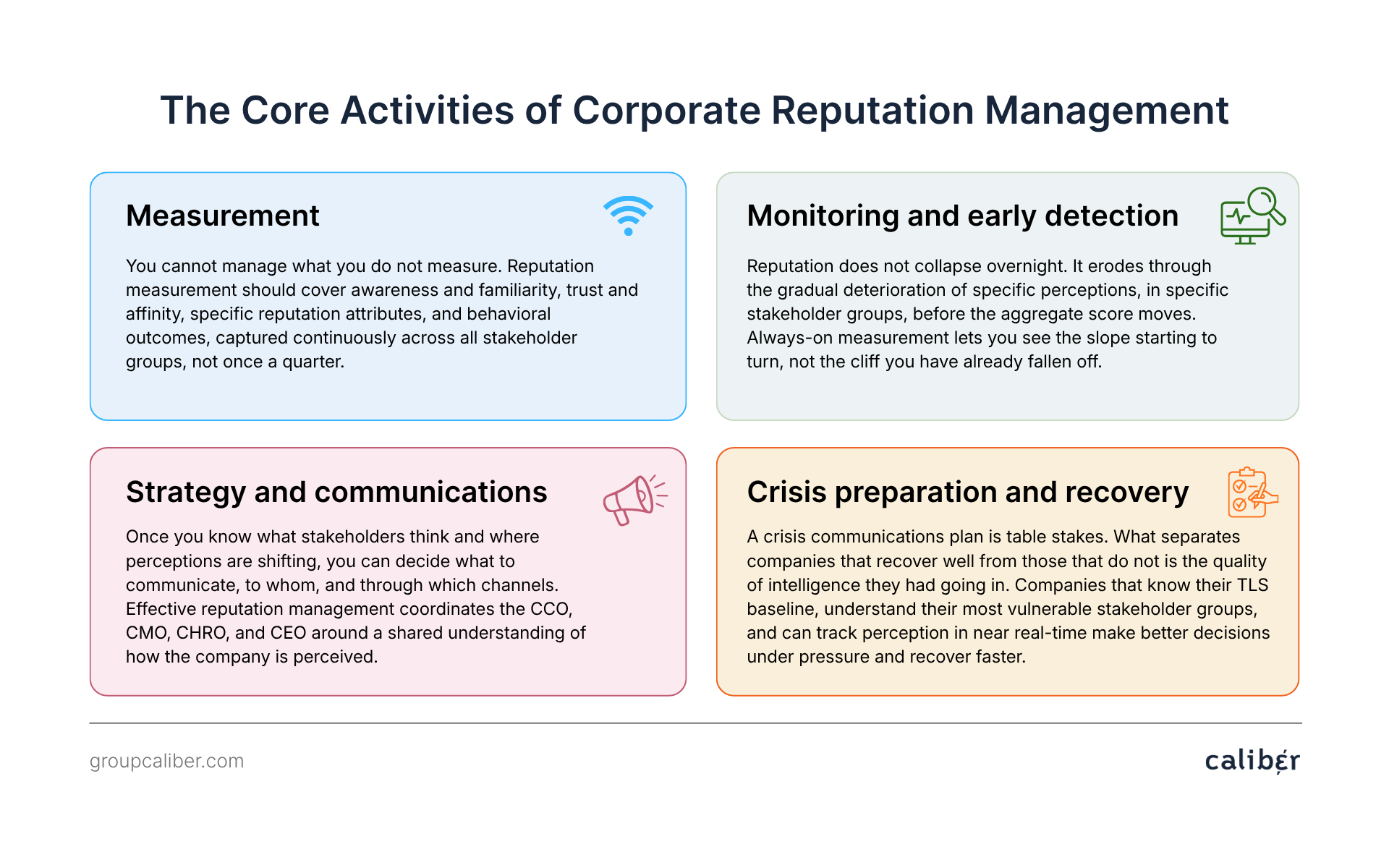
Corporate reputation management covers four areas. Some are proactive, some reactive, and the best programs do all four continuously.
Measurement
You can’t manage what you don’t measure. The foundation of reputation management is knowing what your stakeholders think, how their perceptions are changing, and what’s driving those changes. This requires a measurement system that captures perception data across stakeholder groups, not once a quarter, but continuously.
Measurement should cover awareness and familiarity (do they know you?), trust and affinity (do they trust and like you?), specific reputation attributes (what do they think of your integrity, your leadership, your products?), and behavioral outcomes (will they buy from you, recommend you, work for you?).
Most companies default to one of two approaches: periodic brand studies or social listening tools. Both have blind spots. A quarterly brand study gives you a snapshot, but you miss everything that happened between waves. You’ll see a score dropped, but you won’t know when it started dropping or what caused it. Social listening, on the other hand, captures what a vocal online minority posts, not what a representative cross-section of your stakeholders genuinely believes.
Caliber takes a different approach. It runs daily surveys across all relevant stakeholder groups, capturing their perceptions of your company, your competitors, and your industry. The result is continuous, representative data that shows perception shifts as they happen, not weeks or months later. The Trust & Like Score (TLS) serves as the primary KPI, with a validated correlation to the stakeholder behaviors that matter most: advocacy, purchase consideration, recommendation, and employment intent.
Monitoring and early detection
Reputation doesn’t collapse overnight. It erodes through the gradual deterioration of specific perceptions, often in specific stakeholder groups, before the aggregate score moves. An Integrity score dropping among opinion leaders, or a weakening of your Offering score among customers in a specific market: these are the early signals that something needs attention.
This is where continuous measurement becomes critical. A company measuring reputation quarterly will see the cliff it’s already fallen off. A company with always-on measurement sees the slope starting to turn.
Strategy and communications
Once you know what stakeholders think and where perceptions are shifting, you can make informed decisions about what to communicate, to whom, and through which channels. Reputation management strategy includes deciding which perception gaps to close, which stakeholder groups to prioritize, and how to allocate communications resources across the business.
This is the work of the CCO, the CMO, the CHRO, and the CEO, each with their own stakeholder groups and their own communications priorities. Effective reputation management coordinates these efforts around a shared understanding of how the company is perceived.
Crisis preparation and recovery
A crisis communications plan is table stakes. What separates companies that recover well from those that don’t is often the quality of intelligence they had going in. Companies that know their TLS baseline, that understand which stakeholder groups are most vulnerable, and that can track perception recovery in near real-time make better decisions during a crisis and recover faster afterward.
Caliber clients use the platform to track perception shifts before, during, and after a crisis, measuring whether their response is working, which groups are recovering trust, and which are not.
How to Measure Corporate Reputation
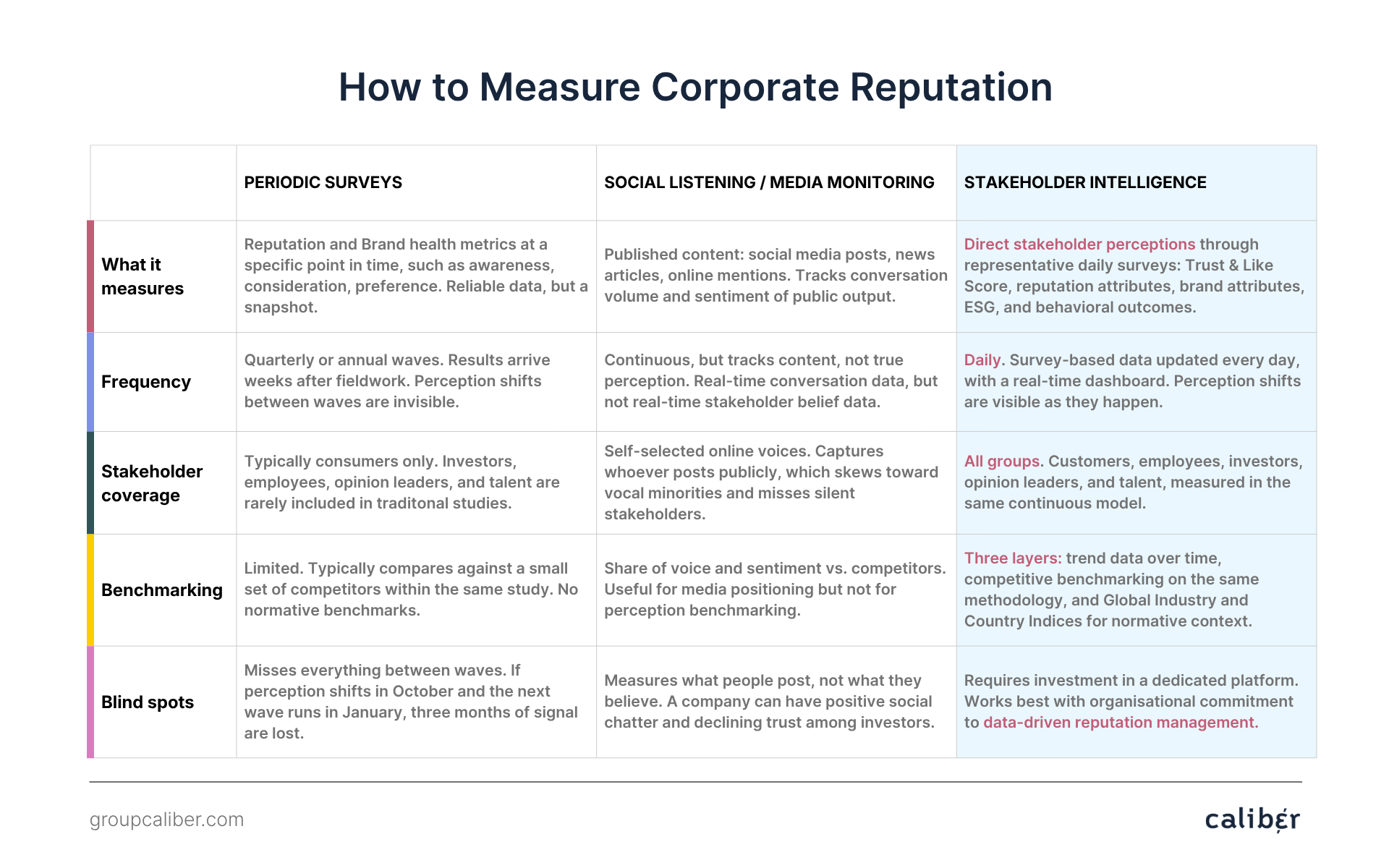
Reputation lives in the minds of your stakeholders, so measuring it requires asking them directly, not inferring it from media coverage or website traffic.
The two traditional approaches, periodic brand studies and social listening, both leave real gaps: one is infrequent, the other captures online volume rather than genuine belief.
For the complete measurement framework, including the specific metrics, methodology, and how to build a hierarchy from primary KPI down to attribute-level drivers, see our complete guide to corporate reputation.
Corporate Reputation Management vs. Related Disciplines
Reputation management gets confused with several related but distinct disciplines. Here’s where the boundaries are.
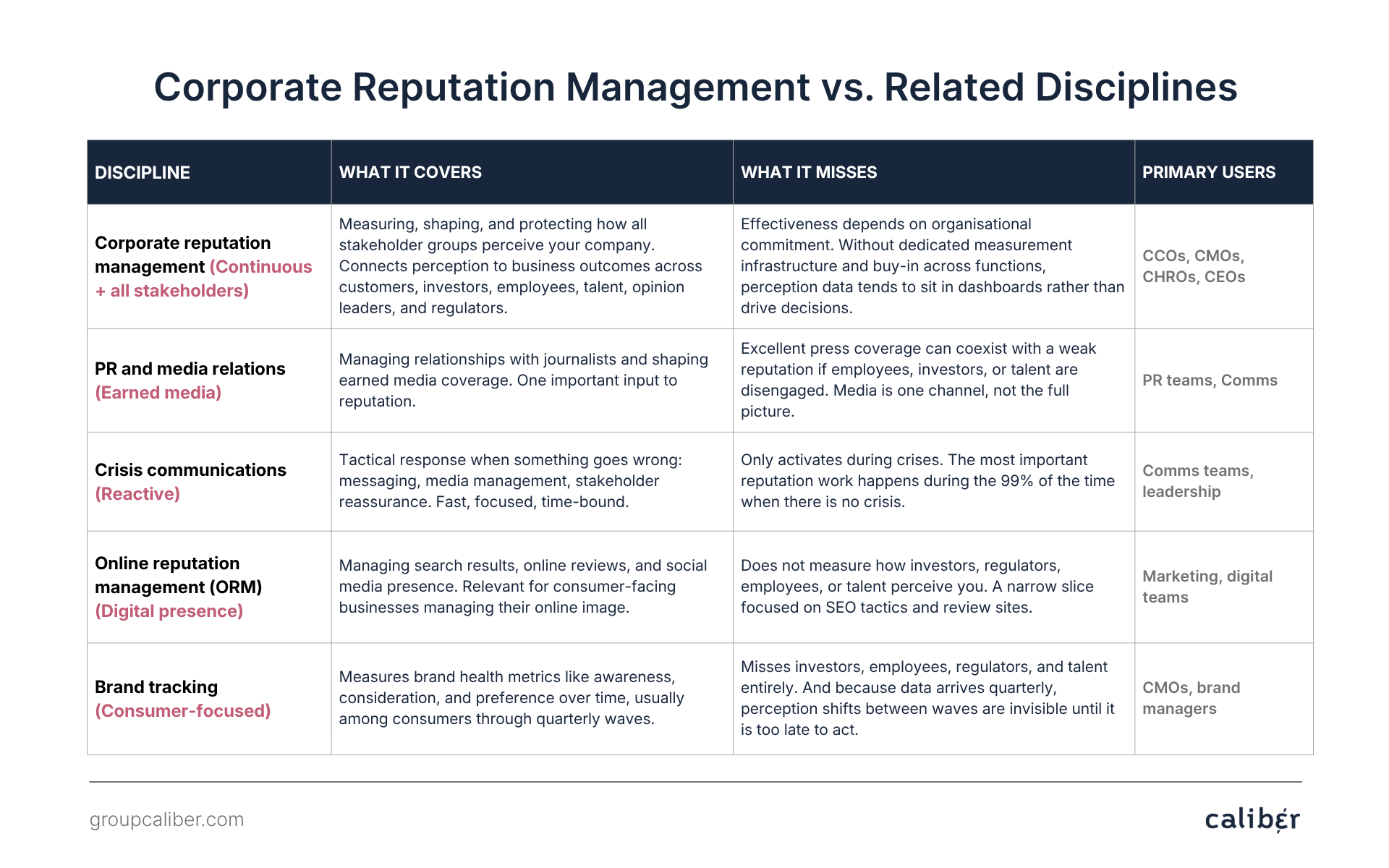
PR and media relations focus on managing relationships with journalists and shaping earned media coverage. This is one input to reputation, but not the whole picture. You can have excellent press coverage and a weak reputation if other stakeholder groups, like employees or investors, are disengaged.
Crisis communications is the response function that activates when something goes wrong. It’s tactical, fast, and focused on damage control. Reputation management includes crisis preparedness, but extends well beyond it. The most important reputation management work happens during the 99% of the time when there is no crisis.
Online reputation management (ORM) typically refers to managing search results, online reviews, and social media presence. It’s often focused on SEO tactics, suppressing negative content, and encouraging positive reviews. This is relevant for consumer-facing businesses, but it’s a narrow slice of corporate reputation management. ORM doesn’t measure how your investors, regulators, or talent pools perceive you.
Brand tracking measures brand health metrics like awareness, consideration, and preference, usually among consumers. Reputation management is broader in scope (all stakeholders, not consumers only) and deeper in what it measures (trust, integrity, governance, leadership, not only brand preference).
Caliber was built specifically for the corporate reputation management space because it recognized these distinctions. It measures across all stakeholder groups, not consumers alone. It integrates brand, reputation, and ESG perception into a unified model. And it runs continuously, so companies can act on fresh data rather than stale reports.
What a Good Reputation Management Program Looks Like
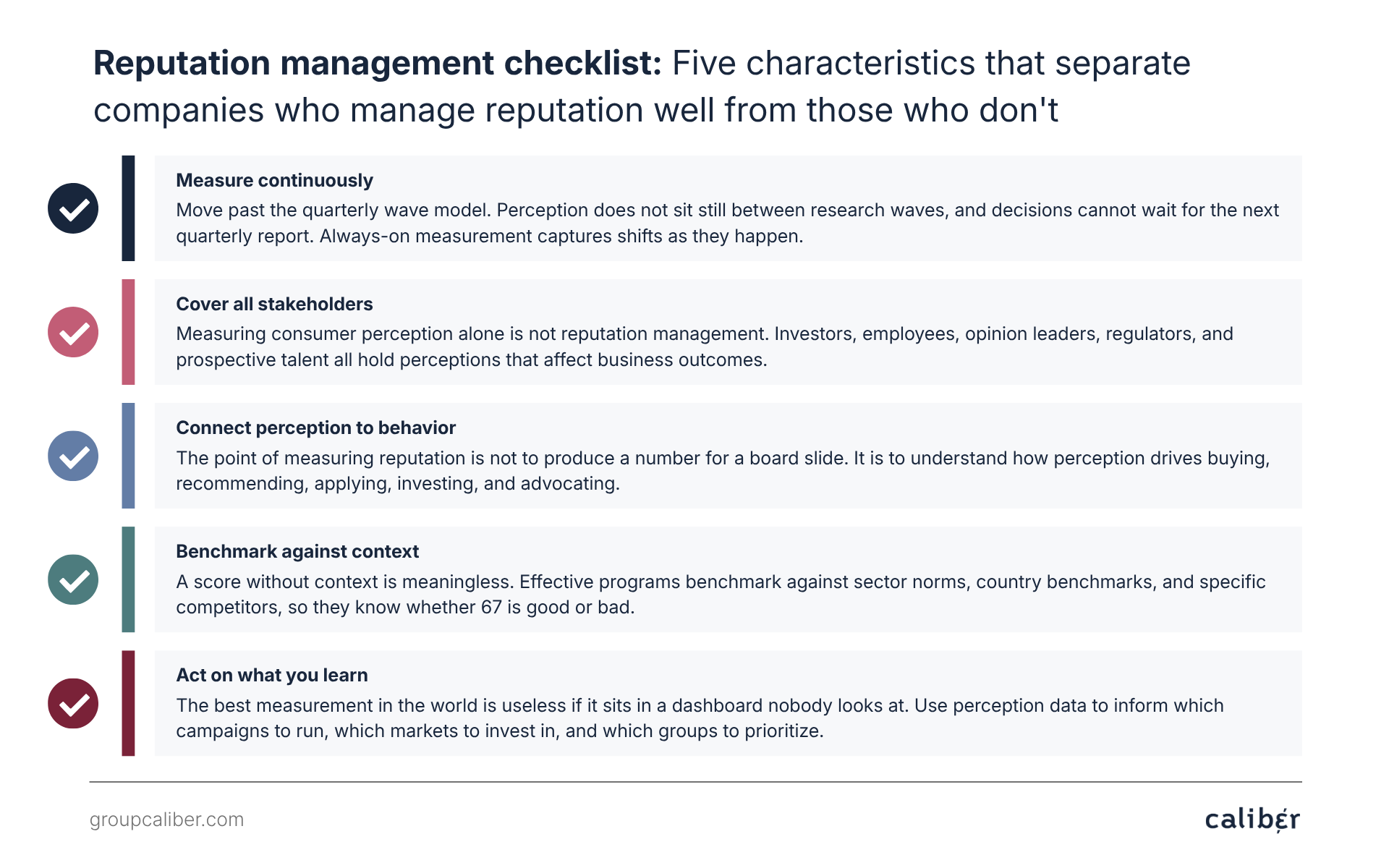
Companies that do reputation management well tend to share a few characteristics.
They measure continuously. They’ve moved past the quarterly wave model and invested in always-on measurement. Perception doesn’t sit still between your research waves, and decisions can’t wait for the next quarterly report.
They cover all stakeholders. Measuring consumer perception alone is not reputation management. Investors, employees, opinion leaders, regulators, and prospective talent all hold perceptions that affect business outcomes. A program that only tracks one group is missing the picture.
They connect perception to behavior. The point of measuring reputation isn’t to produce a number for a board slide. It’s to understand how perception drives the behaviors that matter: buying, recommending, applying for a job, investing, granting a license to operate. Caliber’s measurement model is built around this connection, with behavioral outcomes tracked alongside perception data.
They benchmark. A score without context is meaningless. Is 67 good or bad? That depends on your sector, your geography, and your competitors. Effective reputation programs benchmark against all three.
They act on what they learn. The best measurement in the world is useless if it sits in a dashboard nobody looks at. Companies that manage reputation well use perception data to inform decisions: which campaigns to run, which markets to invest in, which messages to adjust, and which stakeholder groups to prioritize.
Caliber provides the intelligence infrastructure for this kind of program. The strategy and action remain with the communications, marketing, and HR functions. Caliber provides the data and insights that make those decisions informed rather than intuitive.
See How Your Stakeholders Perceive You
Most companies have a view of their reputation built on assumptions. Caliber replaces those assumptions with data, measured daily across all the stakeholder groups that shape your success.
If you’re ready to move from periodic snapshots to continuous stakeholder intelligence, book a demo and see what your reputation looks like right now.