Based on Caliber’s Pharmaceuticals Global Reputation Report 2024. Fieldwork conducted across 13 countries, 30,197 respondents. Last reviewed March 2026.
The pharmaceutical sector had a landmark year in 2024. Blockbuster weight-loss drugs like Wegovy and Zepbound dominated headlines, Novo Nordisk briefly became Europe’s most valuable company, and the public’s relationship with big pharma grew more complicated than ever.
But which pharmaceutical companies actually have the strongest reputations among the people who matter most — general stakeholders across global markets? And what does the data reveal about how the sector as a whole is perceived?
Caliber tracked the reputations of 34 of the world’s largest pharmaceutical companies — each with a global market capitalization of at least $25 billion USD — across 13 countries, using our proprietary Trust & Like Score methodology. Here’s what we found.
Caliber’s Trust & Like Score (TLS) is our core metric for measuring the strength of a company’s brand and reputation. It’s grounded in a simple but powerful insight: stakeholder behavior — whether someone recommends a company, considers buying its products, or wants to work there — is strongly linked to the degree to which they trust and like it.
To arrive at the TLS, we survey real people and ask them to rate companies across a range of attributes: Innovation, Integrity, Authenticity, Inspiration, Offering, Leadership, Relevance, and Differentiation. We also track four behavioral outcomes: Advocacy (willingness to speak positively about a company), Consideration (likelihood of buying its products or services), Recommendation, and Employment.
To ensure data quality, we screen all respondents for awareness and familiarity before they rate any company. Only respondents who rate their familiarity at 4 or above on a 1–7 scale are invited to complete a full company rating — meaning our scores reflect genuinely informed stakeholders, not casual name recognition.
For the 2024 pharma report, we conducted:
This is part of Caliber’s broader stakeholder intelligence platform — a continuous, real-time system for measuring how companies are perceived across all key audiences.
Every TLS result is benchmarked against Caliber’s database of comparable studies:
| Score | Rating |
|---|---|
| 80–100 | Very high |
| 70–79 | High |
| 60–69 | Average |
| 40–59 | Low |
| 0–39 | Very low |
As you’ll see below, most pharma companies — even well-known ones — fall in the Average range. This reflects a structural challenge: public familiarity with corporate pharma brands is low, and those who are familiar tend to hold complex or mixed views.
Of the 34 companies we surveyed, only eight cleared our standard 15% global familiarity threshold — the minimum required to appear in the main ranking. This threshold ensures scores reflect genuine stakeholder opinion rather than vague brand recognition.
| Rank | Company | Trust & Like Score |
|---|---|---|
| 1 | Roche | 66 |
| 2 | Novartis | 64 |
| 3 | GSK | 64 |
| 4 | Bayer | 64 |
| 5 | Johnson & Johnson | 63 |
| 6 | Pfizer | 57 |
| 7 | Moderna | 56 |
| 8 | AstraZeneca | 52 |
All scores fall in the Average (60–69) or Low (40–59) range — a reflection of the sector’s ongoing reputational challenges. The 14-point gap between Roche (66) and AstraZeneca (52) is significant and worth unpacking.
Several well-known companies did not appear in the main ranking because their global familiarity fell below 15%: Novo Nordisk (14%), BioNTech (12%), Sanofi (10%), Eli Lilly (9%), and Boehringer Ingelheim (7%). A full ranking of all 34 companies appears at the end of this article.
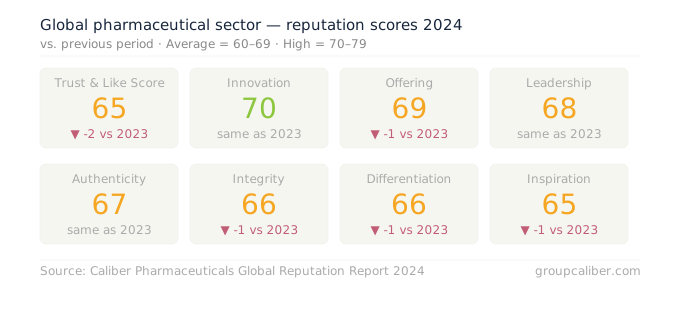
The pharma sector’s average global Trust & Like Score dropped from 67 in 2022 to 65 in 2024 — a two-point decline. Half of the brand and reputation attributes we track fell by one point over the same period, including Inspiration (65, down 1) and Integrity (66, down 1). Authenticity (67) and Leadership (68) held steady.
The behavioral data told a mixed story. Stakeholders were slightly less likely to advocate for pharma companies (Advocacy: 38%, down 1 point) or consider employment in the sector (Employment: 37%, down 1 point). Recommendation held flat at 39%, while Consideration — the likelihood of buying pharmaceutical products or services — rose one point to 41%.
The one standout positive: Innovation, which scored 70 — the sector’s highest attribute and the only one to reach the “High” tier. The year that brought Wegovy’s cardiovascular benefits to light, promising Alzheimer’s drug trials, and cancer treatment breakthroughs was always going to register strongly on innovation perception.
These trends mirror patterns seen across other sectors where reputational risks are rising — particularly around pricing, ethics, and the gap between innovation claims and public trust.
Headquartered in Basel, Switzerland, Roche tops the global reputation ranking. Its leadership reflects pioneering work in oncology, immunology, and diagnostics — including blockbuster therapies such as Herceptin and Avastin, alongside newer treatments like Ocrevus (multiple sclerosis) and Hemlibra (haemophilia). Roche’s diagnostics division played a significant role during the COVID-19 pandemic by delivering large-scale testing worldwide. The company invests billions annually in R&D and is now expanding into cardiometabolic disease, inflammatory bowel disease, and neurology.
Novartis ranks second globally. Known for its portfolio spanning oncology, immunology, neuroscience, and ophthalmology, the company’s breakthrough therapy Kymriah became the first FDA-approved CAR-T cell cancer treatment. Novartis combines innovation with accessibility, expanding patient access to advanced therapies and integrating digital health technologies into drug development.
GSK is a global leader in vaccines, respiratory medicines, and HIV treatments. Its shingles vaccine Shingrix is one of the most successful recent launches in the category. Following its demerger creating Haleon, GSK has sharpened its focus on biopharma innovation. The company is investing heavily in oncology and immunology R&D and prioritizes global health initiatives targeting diseases in lower-income countries.
Bayer remains a major force in pharmaceuticals and life sciences, with key products including Xarelto (anticoagulant) and Eylea (macular degeneration treatment). Alongside pharma, Bayer maintains strong consumer health and agriculture divisions, making it one of the most diversified healthcare companies globally — and, as the market data below shows, one of the most consistently top-ranked companies across individual markets.
J&J leads in oncology, immunology, neuroscience, and infectious diseases through its Janssen pharmaceutical division. The company’s COVID-19 vaccine contributed significantly to global immunization efforts. With continued R&D investment and strategic acquisitions, J&J is reinforcing its position across multiple therapeutic areas.
Pfizer is one of the world’s most recognized pharmaceutical companies, gaining worldwide prominence through its COVID-19 vaccine partnership with BioNTech. Beyond COVID-19, Pfizer remains active in oncology, immunology, and cardiovascular health. Its 57 TLS — notably lower than the companies above — likely reflects the reputational complexity of being one of the most visible and scrutinized brands in the sector.
Moderna’s mRNA-based COVID-19 vaccine propelled it to global prominence. The company’s innovative mRNA platform now underpins a pipeline targeting infectious diseases, cancer, and rare disorders. Like Pfizer, Moderna’s high public familiarity appears to come with reputational trade-offs — pandemic-era controversies and pricing debates have left a mark.
AstraZeneca leads across oncology, cardiovascular, respiratory, and immunology treatments. The company developed its COVID-19 vaccine with the University of Oxford and continues to invest in antibody-drug conjugates and inflammation research. Its 52 TLS — the lowest in the ranking — reflects the significant reputational headwinds it has faced since 2021, including vaccine safety controversies and supply disputes.
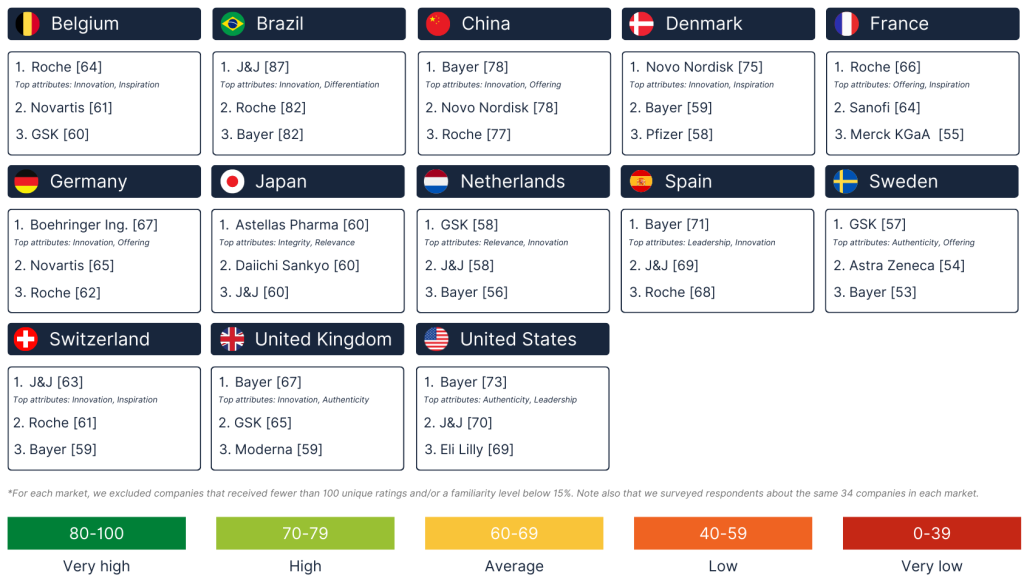
The same company can have a very different reputation depending on where in the world you ask — one of the most actionable findings in Caliber’s data.
Bayer is the strongest cross-market performer, ranking first in China (TLS: 78), Spain (71), the US (73), and the UK (67), and appearing in the top three in Denmark, the Netherlands, Sweden, and Switzerland.
Roche tops the ranking in Belgium (64) and France (66), finishes second in Switzerland, and third in China and Germany.
Johnson & Johnson leads in Brazil (87) and Switzerland (63), finishes second in the US (70), the Netherlands (58), and Spain (69), and third in Japan (60).
GSK tops Sweden (57) and the Netherlands (58), and ranks second in the UK (65).
Home market effects are also clearly visible. Novo Nordisk is the top-ranked company in Denmark with a TLS of 75. Boehringer Ingelheim leads Germany with 67. Sanofi ranks second in France with 64.
The top-scoring reputation attributes across all market leaders were Innovation, Inspiration, and Offering — consistent signals of what drives positive stakeholder perception in this sector.
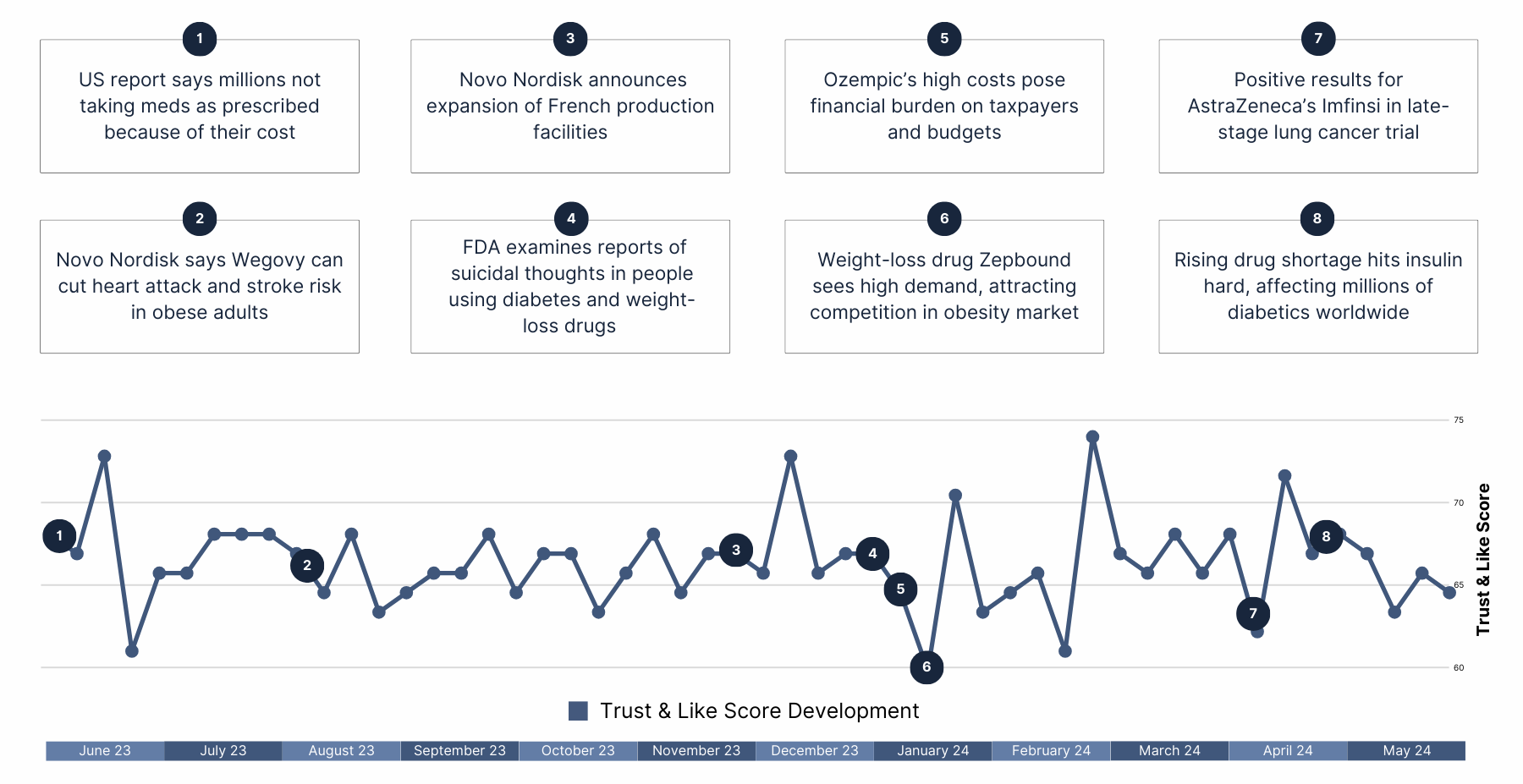
Using data from Caliber’s partner Polecat, which analyses media coverage at scale, we tracked how different categories of reporting correlated with changes in the sector’s weekly Trust & Like Score.
Innovation & Technology coverage had by far the greatest media impact — both in volume of published articles and overall reputational influence. Within that category, general Innovation coverage was the dominant sub-category, followed by Business Collaborations and R&D.
The data also revealed a visible inverse relationship between “unhealthy” media coverage and the sector’s Trust & Like Score. When negative coverage spiked, TLS tended to dip; when it subsided, TLS recovered. This was particularly evident in January 2024, when the TLS fell to a low of 60 before rebounding to 74 just weeks later.
The practical implication: the reputational stakes of negative media are real and measurable — but so is the upside from amplifying innovation narratives. This is why CCOs and corporate affairs teams increasingly rely on real-time reputation data to stay ahead of coverage shifts rather than reacting after the fact.
An often underestimated touchpoint is the company’s own website. According to a Bowen Craggs study of nearly 54,000 visitors to the websites of seven pharmaceutical companies, 53% of visitors said their perception of the company was better after visiting its website.
Among all stakeholder touchpoints, the Company Website generated an average Trust & Like Score of 77. Products and Services remains the highest-impact touchpoint by volume (29% of all stakeholder interactions), with an average TLS of 74. Sales and Customer Service scored 80 but accounts for only 8% of touchpoints.
The top five pharmaceutical companies for corporate digital communications, according to the Bowen Craggs Index: GSK (217), Bayer (201), Roche (194), Eli Lilly/CSL (192), and AbbVie (190).
Part two of Caliber’s 2024 pharma report focused specifically on public perceptions of the weight-loss drug market — one of the most significant reputational battlegrounds in the sector today.
More than half (53%) of respondents globally view obesity as a condition mainly caused by lifestyle choices, while 19% see it as mainly triggered by genetic or biological factors. This framing matters enormously for pharma companies: when the public sees obesity as self-inflicted, pharmaceutical interventions face a higher burden of justification.
Regionally, people in northern Europe tend to hold the most critical view — 60% of UK respondents and 58% of those in Denmark see obesity as a result of lifestyle choices. The US is notably more ambivalent, with less than half (48%) holding this view. France stands out with the smallest share seeing obesity as lifestyle-related (43%) and the highest share attributing it to genetic or biological factors (28%).
The single biggest public concern about weight-loss drugs is the perception that they represent a “quick fix” — cited by 55% of respondents globally, rising to 63% in both the UK and the US. The second most cited issue is cost, flagged by 34% globally and 44% in the US.
Only 22% of people globally believe pharma companies are helping solve a global health crisis by bringing weight-loss treatments to market. A further 12% believe companies are actively exploiting the situation. The majority (59%) see both sides simultaneously.
The most charitable market is China, where 43% say pharma companies are helping solve the crisis. The most skeptical are France and the US, where 16% believe companies are taking advantage of the situation.
Asked which companies they associate with weight-loss drugs, 30% of people globally said they were “not sure” — the highest single response by far. Novo Nordisk, whose drug Wegovy is the market leader, was identified by only 20% of global respondents. Pfizer — which has no approved weight-loss drug on the market — was identified by an equal 20%. Eli Lilly, maker of Zepbound, was cited by just 12% globally.
In the US specifically, Pfizer (27%) and AstraZeneca (22%) ranked ahead of Eli Lilly (17%) and Novo Nordisk (15%) — a striking disconnect between market reality and public perception, and a clear signal that managing stakeholder perceptions around new product categories requires active, sustained communication effort.
For completeness, here is the full ranking of all 34 pharmaceutical companies included in Caliber’s 2024 survey, including those below the 15% familiarity threshold:
| Rank | Company | Familiarity | TLS |
|---|---|---|---|
| 1 | Alnylam Pharmaceuticals | 2% | 74 |
| 2 | Genmab | 3% | 73 |
| 3 | BeiGene | 2% | 71 |
| 4 | Chugai Pharmaceutical | 5% | 71 |
| 5 | Regeneron Pharmaceuticals | 3% | 71 |
| 6 | BioMarin Pharmaceutical | 3% | 71 |
| 7 | AbbVie | 3% | 71 |
| 8 | Novo Nordisk | 14% | 70 |
| 9 | Jiangsu Hengrui Pharmaceuticals | 3% | 70 |
| 10 | Daiichi Sankyo | 6% | 69 |
| 11 | Amgen | 3% | 69 |
| 12 | Gilead Sciences | 3% | 68 |
| 13 | Astellas Pharma | 5% | 68 |
| 14 | Takeda Pharma | 8% | 68 |
| 15 | Argenx | 3% | 68 |
| 16 | Boehringer Ingelheim | 7% | 67 |
| 17 | Merck & Co | 7% | 67 |
| 18 | CSL | 3% | 67 |
| 19 | Sun Pharma | 4% | 67 |
| 20 | Vertex Pharmaceuticals | 4% | 66 |
| 21 | Biogen | 6% | 66 |
| 22 | Bristol-Myers Squibb | 6% | 66 |
| 23 | Eli Lilly | 9% | 66 |
| 24 | Roche | 20% | 66 |
| 25 | Sanofi | 10% | 65 |
| 26 | Merck KGaA | 7% | 65 |
| 27 | Novartis | 15% | 64 |
| 28 | GlaxoSmithKline (GSK) | 15% | 64 |
| 29 | Bayer | 38% | 64 |
| 30 | BioNTech | 12% | 63 |
| 31 | Johnson & Johnson | 48% | 63 |
| 32 | Pfizer | 48% | 57 |
| 33 | Moderna | 27% | 56 |
| 34 | AstraZeneca | 35% | 52 |
Companies ranked 1–7 and 9–26 did not meet Caliber’s 15% global familiarity threshold. Their high TLS scores likely reflect the views of informed industry insiders — buyers, analysts, healthcare professionals, and journalists — rather than general public perception.
Several patterns emerge from the full dataset.
Alnylam (74) and Genmab (73) — barely known outside the industry — score highest. Pfizer, one of the world’s most recognized brands at 48% familiarity, scores just 57. High familiarity tends to correlate with greater public scrutiny, media exposure to controversies, and vulnerability to negative narratives. Companies operating primarily in B2B or specialist markets can build strong reputations within those ecosystems without the drag of mass public exposure.
AstraZeneca (52) and Moderna (56) — whose reputations were built largely on pandemic vaccines — score at the bottom of the main ranking. The vaccine debates, combined with pricing and supply controversies, appear to have created reputational damage that innovation credentials alone cannot repair.
Novo Nordisk’s 75 TLS in Denmark, Boehringer Ingelheim’s 67 in Germany, and Sanofi’s 64 in France all reflect the premium of being a national champion. But global familiarity for these companies remains low, suggesting the home market advantage doesn’t travel well.
Across virtually every market and demographic, Innovation scored highest and was the most cited driver of positive reputation. For pharma communicators, leading with innovation credentials is the most evidence-based lever available — and the data from Polecat confirms that impactful innovation coverage directly moves the Trust & Like Score.
Understanding these dynamics — and tracking how they shift over time — is exactly what stakeholder intelligence is built to do. For more on how corporate affairs teams are putting this data to work, see our guide to setting KPIs for stakeholder perception management.
This article is based on findings from Caliber’s Pharmaceuticals Global Reputation Report 2024, published in July 2024. The full report is available to download at groupcaliber.com/pharmaceuticals-global-reputation-report-2024.
Caliber is a stakeholder intelligence platform that helps leading global companies — including AstraZeneca, Pfizer, Boehringer Ingelheim, Novo Nordisk, and Siemens Healthineers — measure and manage their reputations in real time across all stakeholder groups. Our Trust & Like Score is used by communications, marketing, and corporate affairs teams to connect reputation data to business outcomes.
Follow Caliber
According to 2024 revenue data on Companies Market Cap, the top pharmaceutical companies are CVS Health, Walgreens Boots Alliance, Johnson & Johnson, Sinopharm, Roche, Merck, Pfizer, AbbVie, AstraZeneca, and Novartis.
Based on Caliber’s Trust & Like Score, the most trusted pharmaceutical companies in 2024 are Roche, Novartis, GSK, and Johnson & Johnson. These rankings are derived from public perception data collected across 13 countries.
Headquartered in Bagsværd, Novo Nordisk is a global leader in diabetes care, hormone therapy, and obesity treatment. Its blockbuster drugs Ozempic (for type 2 diabetes) and Wegovy (for weight loss) have driven massive global demand and revenue growth.
As of 2024, Novo Nordisk is not only Denmark’s largest pharmaceutical company but also one of Europe’s most valuable companies by market capitalization. It operates in over 80 countries, serving millions of patients worldwide.
In Caliber’s 2024 Global Reputation Report, Novo Nordisk ranked as Denmark’s most trusted pharmaceutical company, earning top scores for Innovation and Inspiration — reflecting strong national brand equity and public trust.
“Big Pharma” refers to the world’s largest pharmaceutical corporations with significant influence over drug development, healthcare policy, and public health spending.
While these companies are recognized for medical innovation, they are also scrutinized for high drug prices, lobbying practices, and ethical controversies surrounding access and transparency.
Trust in the pharmaceutical industry remains fragile. While innovation is the sector’s strongest reputational attribute, only 22% of global respondents believe pharma companies are helping solve global health crises, and 12% think they are exploiting them — highlighting a persistent trust gap.
Blockbuster weight-loss drugs such as Wegovy and Zepbound have generated major profits — but also public concern. Many see them as expensive “quick fixes”, raising questions about accessibility, marketing ethics, and their broader influence on health culture.
The pharmaceutical industry’s reputation is complex and polarized, reflecting a tension between its scientific achievements and public skepticism.
According to Caliber’s 2024 Global Reputation Report, the global Trust & Like Score for the sector declined slightly to 65 (down from 67 in 2023). This indicates average trust levels overall, with wide variation by region and company.
Only 22% of respondents believe pharma companies are helping solve a health crisis, while 12% think they are taking advantage of it — reinforcing the reputational gap.
Rebuilding trust will require greater transparency, ethical leadership, and active public engagement, especially as the industry expands into new frontiers such as weight-loss drugs, gene therapies, and AI-driven medicine.

Thursday, October 8th l 17:30 CET/ 8:30am PT/ 11:30am ET