
Recruiting top talent is a strategy problem, not a sourcing problem. Most companies focus on the mechanics of hiring: better job descriptions, faster interview loops, broader job board coverage. Those things matter. But they all happen after a candidate has already decided to consider you. The real question for CHROs and CPOs is what happens before that moment. What do the people you want to hire think about your company right now, before they’ve seen a single job posting?
This article covers the full talent recruitment picture, from building the employer reputation that attracts high-quality candidates to measuring whether your efforts are working.
Key Takeaways
- Recruitment starts with reputation. The decision to consider your company as an employer is shaped long before a candidate applies. Your employer reputation is your first filter, and most companies don’t measure it.
- Tactical fixes can’t compensate for a weak employer brand. Better job descriptions and faster hiring processes help, but they won’t close the gap if target talent segments don’t trust or recognize your company as an employer.
- Measuring employer brand perception among external talent gives recruitment teams the intelligence to focus spend, tailor messaging, and compete for the people they want most.
Recruiting top talent has become one of the most persistent challenges for large organizations. A 2024 Gartner survey found that 48% of HR leaders agree the demand for new skills is evolving faster than existing talent structures can support. Investment has followed: according to The Conference Board, 78% of large organizations now invest in employer branding — yet only 18% can demonstrate the ROI of those efforts internally. The money is going in. The pipeline still underperforms.
The gap isn’t always about process. It’s often about perception. Before a candidate visits your careers page, reads your job description, or speaks to a recruiter, they’ve already formed an impression of your company. That impression, your employer reputation, acts as a filter. It determines whether they click, scroll past, or never see you at all.
Companies that recruit well understand this. They treat employer reputation as a strategic input to talent acquisition, not a marketing afterthought.
Why Traditional Recruitment Tactics Hit a Ceiling
Most recruitment advice focuses on execution: write better job descriptions, use employee referral programs, diversify your sourcing channels, speed up your offer process. These are sound practices. Companies should do all of them.
But they share a common assumption: that candidates already know your company, are open to considering it, and have a broadly positive impression. For many organizations, especially those competing outside their home market or trying to attract talent from different industries, that assumption doesn’t hold.
Employ’s Hiring Benchmarks Report found that average applications per role climbed from 207 to 258 between 2024 and 2025, while qualified applicant rates and screen-to-interview rates both declined. More volume, less quality. That pattern is a symptom. When your employer brand isn’t resonating with the right talent segments, you attract more noise and less signal.
Tactical improvements to the hiring process can’t fix an upstream reputation problem. If software engineers in Germany don’t know your company, or if marketing professionals in the US associate you with an outdated product line, no amount of recruiter outreach will close that gap efficiently. You need to know where the perception problem is before you can solve it.
Employer Reputation: The Invisible First Round
Glassdoor data shows that 83% of job seekers research company reviews and ratings before deciding where to apply. Caliber’s Talent360 data shows that the top drivers of employer attractiveness are brand-level attributes — Inspiration, Relevance, Differentiation, and Authenticity — while compensation ranks 20th and work-life balance 17th out of 24 attributes measured. What wins the talent war is purpose and perception, not solely the benefits package.
These numbers point in the same direction: the decision to consider your company happens before any recruiter makes contact. It’s shaped by what candidates hear from their networks, what they read online, and what associations they already hold about your company as an employer.
For C-level leaders, this means employer reputation is a business input to talent acquisition. It’s the reason some companies attract strong candidates organically while others spend heavily on recruitment marketing and still struggle.
Three specific dimensions of employer reputation matter most for talent attraction.
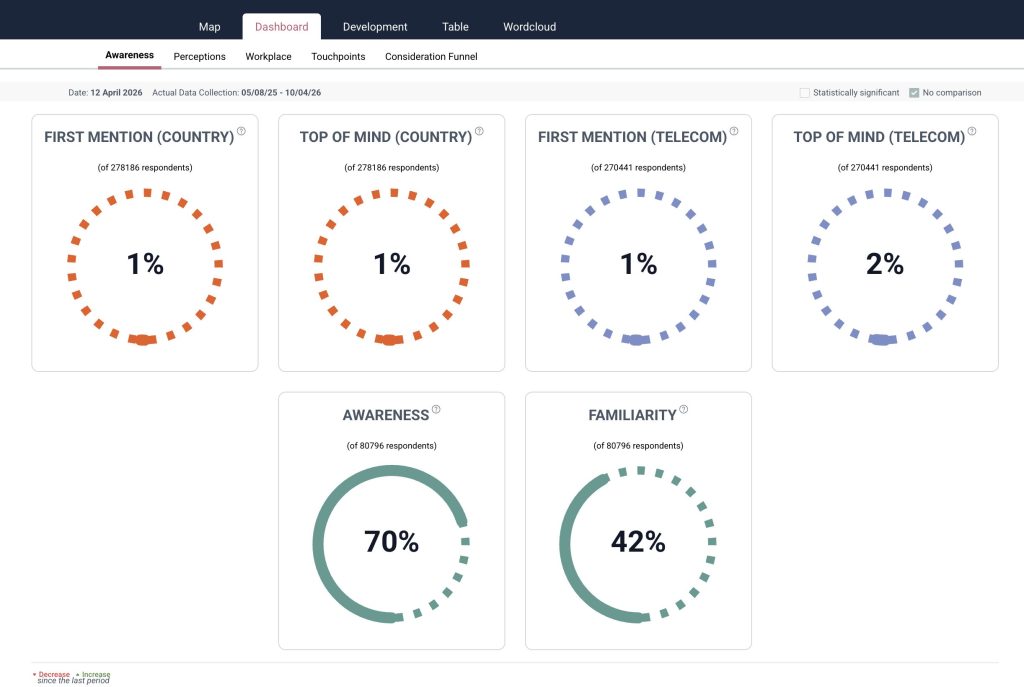
- Awareness. Do the talent segments you’re targeting know your company exists as an employer in their field? Many companies are well-known among customers but invisible to the talent pools they need. A B2B industrial company, for example, might have high brand recognition among procurement professionals but near-zero awareness among the software engineers it’s trying to hire.
- Familiarity. Even if candidates have heard of your company, do they know what it stands for as a workplace? Familiarity goes beyond name recognition. It includes an understanding of what you do, what it’s like to work there, and what you offer as an employer.
- Employment consideration. This is the behavioral outcome that matters: would they consider working for you? A candidate might be aware of your company and generally positive about it, but not think of it as a relevant employer for their career. Turning passive awareness into active consideration is the work of employer branding, and it requires knowing where you currently stand.
Building an Employer Brand That Attracts Talent
Employer branding is the bridge between reputation and recruitment. It’s the deliberate effort to shape how target talent segments perceive your company as a place to work. When done well, it turns your reputation into a recruitment asset. When done poorly, or not at all, it leaves the narrative to Glassdoor reviews and word of mouth.
Five components consistently separate effective employer brands from weak ones.
A clear and honest employee value proposition (EVP)
Your EVP is the promise your company makes to current and prospective employees. It encompasses culture, purpose, growth, and yes — compensation and flexibility.
But the EVP’s job is not to win the talent war on its own. Caliber’s Talent360 data shows that compensation and work-life balance consistently rank near the bottom of employer attractiveness drivers, at 20th and 17th respectively out of 24 attributes measured. What actually attracts candidates is how your company is perceived on brand and purpose-level attributes: Inspiration, Relevance, Differentiation and Authenticity.
The EVP matters because it needs to be honest and coherent. A candidate who joins based on an inflated promise leaves quickly, and the word travels. According to Top Workplaces research, job seekers trust employee feedback three times more than corporate messaging.
Strong EVPs are specific — they name the things your company does well and acknowledge what it doesn’t. They’re built on employee feedback, not executive aspiration.
Executive visibility and thought leadership
The voices of leadership play an outsized role in employer perception. When senior leaders are visible, articulate about company direction, and credible in their public presence, it signals something about the organization’s culture and ambition that no careers page can replicate.
Candidates — especially experienced professionals evaluating a career move — read leadership as a proxy for what the company is really like.
Thought leadership that works for employer branding is consistent, relevant to the audiences you’re trying to reach, and grounded in the leader’s actual expertise. Thought leadership that backfires is reactive, off-topic, or performative.
Employee advocacy
Your current employees are your most credible employer brand asset. Content and stories that come from real people inside the company consistently outperform polished corporate messaging — in reach, in credibility, and in the kind of candidates it attracts.
Companies with socially engaged employees are 58% more likely to attract top talent and 20% more likely to retain them.
This doesn’t mean asking employees to repost corporate content. It means creating a workplace worth talking about, and then making it easy for people to share their experience authentically.
Consistent presence where talent pays attention
Employer brand needs to be visible in the places your target talent segments spend time. For many professional and executive roles, that’s LinkedIn. For technical roles, it might be GitHub, Stack Overflow, or niche industry communities. For early-career talent, it’s increasingly short-form video and social platforms.
The principle is the same across channels: show up consistently, with content that reflects the real experience of working at your company, in the places where your target candidates are already paying attention.
Caliber’s Talent360 data shows that earned media — editorial coverage, third-party commentary, news — reaches twice as many potential employees as paid HR content, at nearly identical perception outcomes. Channel allocation should follow the data, not habit.
Measuring what’s working
Most employer branding programs have no feedback loop. Companies invest in EVP development, campaigns, careers pages, and social content — then wait for recruitment metrics to tell them whether it worked. By the time those metrics move, months of budget have already been spent on the wrong message, in the wrong channel, to the wrong audience.
Caliber’s Talent 360 addresses this directly. It measures how prospective employees and target talent segments perceive your company as an employer — from the outside, continuously. It tracks Trust & Like Score, awareness, familiarity, and employment consideration among defined talent segments by profession, seniority, and market. It also shows which channels and touchpoints are most effective at influencing employer perception among each group.
This is different from internal engagement surveys, which measure how current employees feel. Talent 360 measures how the people you want to hire perceive you. That distinction matters: internal sentiment tells you about retention. External perception tells you about attraction.
Seven Strategic Questions Talent Intelligence Should Answer
Employer reputation is the foundation. These are the decisions that sit on top of it — and what separates companies that recruit well from those that spend heavily and still struggle.
1. Which talent segments actually know you exist?
Awareness varies enormously by profession, seniority level, and geography. Before investing in outreach, know your baseline. A company can have strong employer brand recognition among one talent pool and near-zero visibility among another it urgently needs to reach. Hiring strategy built on assumed awareness is hiring strategy built on guesswork.
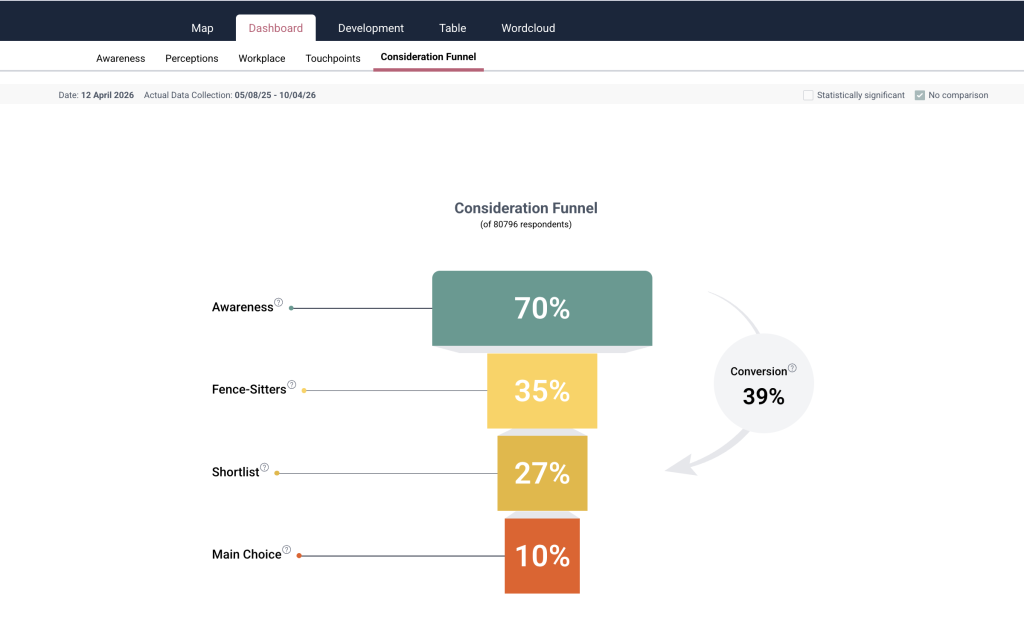
2. Where does your consideration funnel break down?
The gap between awareness and genuine employment consideration is where most recruitment spend is wasted. Understanding where candidates drop off — do they know you but not consider you? Consider you but not shortlist you? — tells you exactly where to intervene and what message needs to change.
3. What do your target talent segments actually value?
Not what you assume they value. Caliber’s Talent360 data consistently shows that the attributes driving employer attractiveness are brand and purpose-oriented — not compensation tables and workplace perks. The top drivers are brand-level: how inspiring, relevant, differentiated, and authentic a company is perceived to be. If your employer brand messaging leads only with benefits, you’re competing on the wrong terrain.
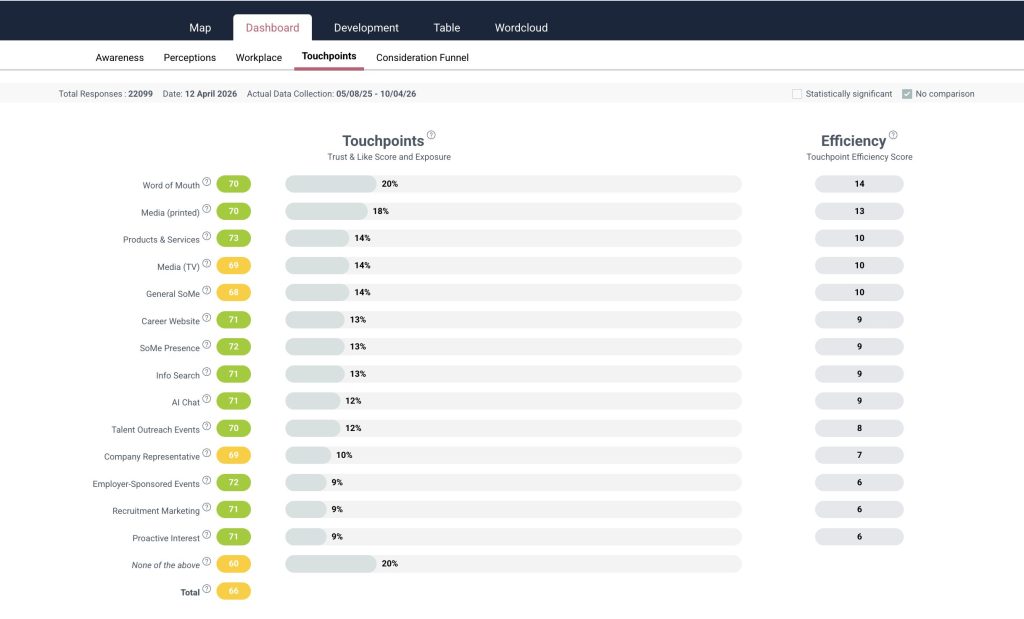
4. Which channels are actually shaping perception?
Understanding which touchpoints your target talent segments are actually using — and which ones are influencing their view of you — should determine where your employer branding budget goes, not the other way around.
5. How does your employer brand perform by segment?
A mid-career software engineer in Germany and a recent finance graduate in the US are not the same audience. They search differently, respond to different messages, and evaluate employers on different criteria. Caliber’s data shows that employer brand rankings among talent pools frequently diverge — sometimes dramatically — from general stakeholder reputation scores. A single employer brand strategy rarely serves all segments equally.
6. Are you managing your presence in AI-generated answers?
An increasing share of candidates now use AI tools — ChatGPT, Gemini, Copilot — to research potential employers before they apply. Caliber’s data shows a clear pattern: the lower someone’s familiarity with a company, the more likely they are to turn to an AI chatbot to fill the gap. What those tools say about your company is now part of your employer brand. Generative Engine Optimisation (GEO) is no longer a marketing edge — it’s a talent acquisition imperative.
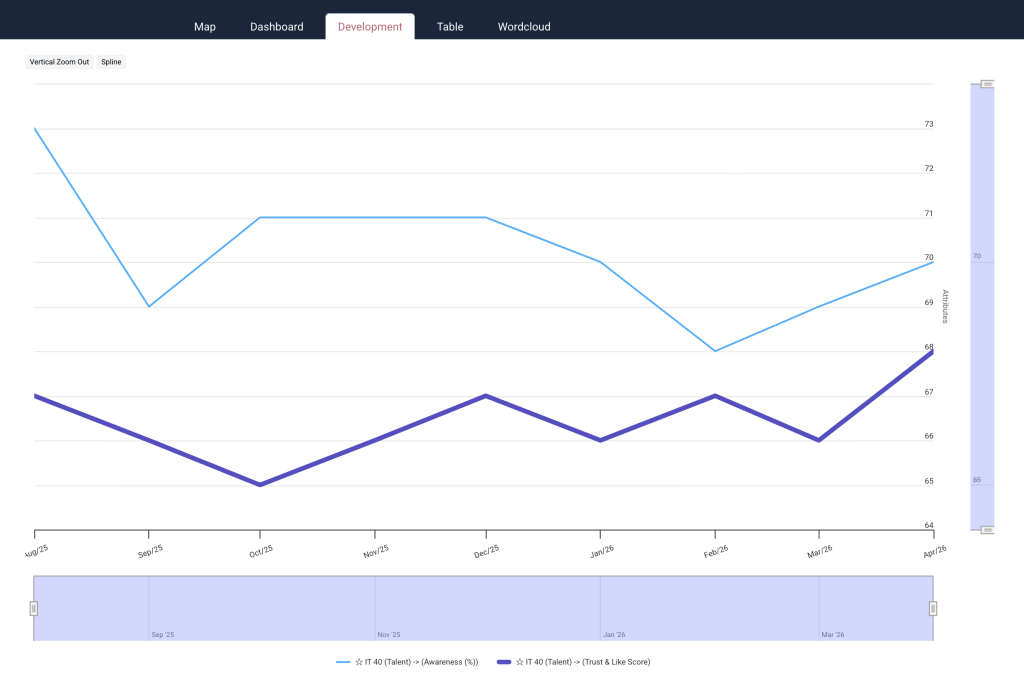
7. Is your employer brand moving in the right direction?
Most companies don’t know. They measure lagging indicators — applications, time-to-hire, offer acceptance — and wait for results. By the time those metrics move, the damage or the opportunity is already months old. Measuring employer brand perception shifts among target talent segments on a continuous basis tells you whether your hiring strategy is working before the recruitment numbers catch up.
The Measurement Gap Most Companies Miss
Companies track recruitment outcomes: time-to-hire, cost-per-hire, offer acceptance rates. These are lagging indicators. They tell you what happened, not why.
What most companies don’t measure is the perception layer that sits upstream of all those outcomes. Among the software engineers you’re targeting in the Nordics, what’s your awareness level? Among finance professionals in the US, do they see you as a credible employer? Among mid-career marketing talent in Asia, would they consider applying?
This is the intelligence that Caliber’s Talent 360 provides. It gives CHROs and talent leaders a continuous, segment-level view of how their company is perceived as an employer across the markets and talent pools that matter most. When a company knows its Trust & Like Score is low among a specific talent segment in a specific geography, that’s actionable intelligence — it should shape where recruitment marketing budget goes, what messages to lead with, and which perceptions need to change.
Talent 360 is not a recruitment tool. It doesn’t manage job postings, applicant pipelines, or interview scheduling. It’s the employer brand measurement layer that tells you whether your talent attraction efforts are landing with the right people — so the recruitment spend that follows is better targeted and more effective.
Know How Your Target Talent Perceives You
Most companies invest in employer branding without measuring whether it’s working. Caliber’s Talent 360 shows you how prospective employees and target talent segments perceive your company as an employer, by profession, by market, updated daily.
If you’re ready to make employer brand decisions based on data instead of assumptions, book a demo and see where your employer reputation stands right now.