
The war for talent is expected to rage on
The competition to attract talent was already fierce before the pandemic reshuffled global workforce expectations. Today, it is reaching a critical inflection point.
A landmark Korn Ferry study projected that by 2030, the global economy could face a talent deficit of 85.2 million workers — greater than the entire population of Germany — resulting in $8.452 trillion in unrealized annual revenue, equivalent to the combined GDP of Germany and Japan.
That forecast is rapidly becoming a lived reality. According to the World Economic Forum’s Future of Jobs Survey 2025, AI and big data skills are expected to be the most critical driver of business performance by 2030, yet 58% of organizations already struggle to attract AI and tech talent due to global demand.
Meanwhile, 47% report difficulty integrating new technical profiles into existing structures, and 39% cite gaps in leadership readiness and strategic upskilling (PwC Future of Work Pulse 2025; Deloitte Human Capital Trends; Gartner Talent Intelligence).
This isn’t simply a recruiting challenge. It is a strategic risk.
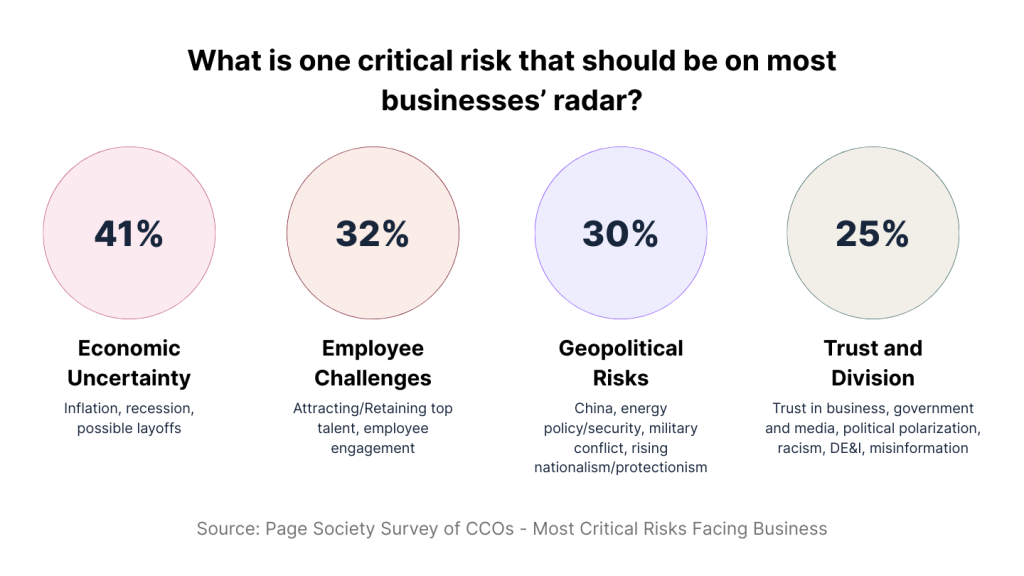
During the preparation for the World Economic Forum’s Annual Meeting, the Page Society surveyed its members on the most critical business risks for 2023. Attracting and retaining employees ranked as the second-highest risk — above geopolitical instability, inflation, and supply chain disruption. That ranking reflects a fundamental shift: talent has become a board-level concern.
The pandemic accelerated this shift by transforming employee expectations around where, how, and when people work. Employers now operate in a landscape where navigating those evolving expectations is table stakes — and where Chief Communications Officers hold a significant responsibility in portraying their companies as desirable employers.
Key Takeaways
1. Corporate reputation is a measurable talent attraction asset — not a soft metric. Companies with poor reputations pay up to 10% more per hire, while those with strong employer brands cut cost-per-hire by up to 50% and hire up to twice as fast. Reputation has a direct, quantifiable impact on hiring efficiency and the bottom line.
2. Traditional methods for measuring talent perception are not enough. Glassdoor reviews, internal surveys, and periodic market research all have significant blind spots. They are reactive, biased, or too slow to capture how the broader talent pool — especially passive candidates — actually perceives your employer brand in real time.
3. In the AI era, employer reputation determines access to the most critical talent. 58% of organizations already struggle to attract AI and tech talent. For the profiles that will define business competitiveness through 2030 — AI/ML engineers, data scientists, cybersecurity specialists — reputation is the deciding factor. Companies that are not known, trusted, or seen as attractive employers by these segments are effectively invisible in the race for talent.
Why Does Corporate Reputation Matter for Talent Attraction?
Corporate reputation is one of the most powerful — and most underutilized — levers in a company’s talent attraction strategy. When candidates evaluate where to work, they are not only assessing salary and job titles. They are assessing the company behind the offer: its integrity, leadership, culture, ESG credentials, and how it treats its people.
The evidence is unambiguous:
- Companies with poor reputations spend 10% more per hire on wages, according to research by Harvard Business Review.
- 92% of people would consider leaving their current jobs if offered a role with a company that had an excellent corporate reputation (ReputationX).
- 88% of job seekers say they would leave their current employer to join a company with a stronger reputation (Vouch; Amra & Elma; Keevee, 2025).
- 64% of consumers have stopped purchasing a brand after hearing news of the company’s poor treatment of employees (Career Arc, Employer Branding Study).
- Millennial employees were 30% more likely than Gen-Xers and 60% more likely than Baby Boomers to stop purchasing or promoting an employer’s products due to poor employee experience (Career Arc, Employer Branding Study).
- 96% of companies believe employer brand and reputation can positively or negatively impact revenue, yet fewer than half (44%) actually monitor that impact (Career Arc, Employer Branding Study).
Add to this the accelerating financial importance of intangible assets. According to Ocean Tomo’s Intangible Asset Market Value Study (2020), intangible assets — including brand and reputation — now account for 90% of S&P 500 market value, up from just 17% in 1975. Employer reputation is not a soft metric. It is a financial asset with measurable consequences.
What Are the Business Benefits of Being an Attractive Employer?
Attract talent more effectively — and from a larger pool
A strong employer reputation is the foundation of effective talent attraction strategies. 84% of people consider a company’s reputation when deciding whether to apply for a job. According to Gartner, well-managed employer brands have access to over 60% of the labor market, compared to just 40% for organizations with weak employer brands. Companies with strong employer brands attract 2x more qualified applicants (LinkedIn Talent Solutions; IESF; Apollo Technical, 2024–2025).
Reduce hiring costs by up to 50%
Being perceived as an attractive employer directly reduces the need for financial incentives to close candidates. Companies with strong employer brands report up to 50% reduction in cost-per-hire and are 3x more likely to make quality hires (LinkedIn Talent Solutions; Apollo Technical, 2024–2025). The Harvard Business Review documented that companies with poor reputations pay, on average, a 10% wage premium per hire — a direct tax on weak employer positioning.
Improve employee engagement and retention
Reputation has a profound impact on employee engagement. When a company is perceived positively as an employer, employees are more likely to feel proud, motivated, and connected to their work. Companies with strong employer brands experience up to 28% lower employee turnover (Universum Global; HR Lineup; Amra & Elma, 2025). High engagement and low attrition translate directly into lower replacement costs and stronger organizational continuity.
Streamline the recruitment process
Research by LinkedIn shows that attractive employer brands allow companies to hire one to two times faster. When reputation precedes you, candidates reach out proactively, reducing the time spent sourcing and accelerating the entire hiring funnel. In a competitive market for AI/ML engineers, data scientists, and cybersecurity specialists — the most searched profiles in 2025 according to LinkedIn’s Emerging Jobs Report — speed to hire is a decisive competitive advantage.
Protect and enhance your bottom line
The financial consequences of a poor employer reputation extend well beyond hiring costs. Candidates and consumers are often the same people. A negative candidate experience drove Virgin Mobile to lose 6% of its customer base to a competitor, amounting to £4.4 million in revenue.
Employer branding also impacts the ability to attract investment, maintain trust with stakeholders, and drive advocacy. 72% of recruiting leaders affirm that employer branding significantly impacts hiring outcomes (Universum Global; HR Lineup; Amra & Elma, 2025). According to a Transmission Private study, strong reputation is a key factor not just in attracting and retaining top-tier candidates, but also in attracting financial capital.
The AI Era Is Raising the Stakes for Talent Attraction
Which talent profiles are hardest to attract in 2025?
The convergence of digital transformation and AI adoption has fundamentally altered which skills are in demand — and how scarce they are. The most searched talent profiles in 2025, according to the LinkedIn Emerging Jobs Report and McKinsey Global Institute, include AI/ML Engineers (39%), Data Scientists (38%), Cybersecurity Specialists (35%), Cloud Solutions Architects (33%), and AI Product Managers (30%).
The World Economic Forum’s Future of Jobs Survey 2024 confirms that AI and big data, technological literacy, and analytical thinking will be the defining core skills of 2030 — with demand continuing to accelerate.
For these profiles, competition among employers is global, immediate, and highly reputation-sensitive. A company that is not known, trusted, or seen as an attractive employer by these talent segments is effectively invisible.
Why Traditional Methods for Tracking Talent Perceptions Fall Short
Most companies rely on one of three approaches to understand how talent perceives them: online review monitoring, internal employee surveys, or periodic market research. Each has significant blind spots.
Online review platforms such as Glassdoor or social media primarily capture the opinions of people who actively choose to share their experiences — a self-selected, often emotionally motivated group. This leaves out the silent majority of the talent pool, including passive candidates who would never post a public review.
Internal employee surveys capture the perspectives of existing employees, not prospective talent. They are shaped by lived experience and personal bias, and they tell you nothing about how your employer brand is perceived externally — by the people you most need to attract.
Periodic market research is costly, time-intensive, and inherently backward-looking. By the time insights are gathered and analyzed, market perceptions may have already shifted. In an environment where a single leadership change, a viral news story, or an ESG misstep can move talent sentiment overnight, waiting months for a data snapshot is a meaningful strategic risk.
Organizations need an approach that is continuous, objective, representative, and built for real-time decision-making.
What Does It Take to Attract Talent in the AI Era? A Data-Driven Approach
The ability to attract talent reliably — particularly in highly competitive segments like AI, tech, and digital — requires more than a strong EVP on paper. It requires knowing, in real time, how your employer brand is actually perceived by the specific talent segments you are trying to reach.
How should companies measure and improve employer attractiveness?
Caliber’s approach is built on this premise. Rather than reacting to perception problems after they have already damaged hiring outcomes, leading organizations are now treating employer brand intelligence as a continuous, proactive discipline — one that integrates awareness, familiarity, reputation, ESG perception, and employment intent into a single, measurable framework.
The Caliber Talent 360 platform is purpose-built for this challenge. It shifts employer brand positioning from a periodic branding exercise into a core workforce strategy lever — connecting real-time talent perception data to measurable business outcomes.
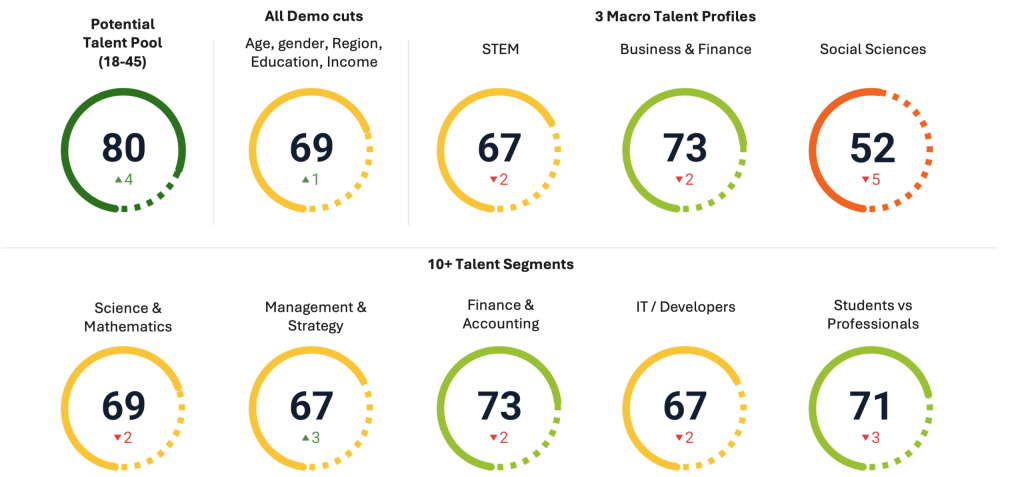
The platform is structured around five strategic pillars:
1. Strategic Talent Segments — Are you known and top-of-mind among the talent profiles that matter most to your strategy? Talent 360 tracks awareness, familiarity, and employer attractiveness among 10+ talent segments — from STEM and IT/Developer profiles to Business & Finance and Social Sciences — segmented by age, gender, education, and region.
2. Priority Topics and Talent Expectations — What narratives resonate with high-value candidates? What do they expect from their employer around compensation, working practices, sustainability, inclusion, or career development? Caliber’s framework tracks performance across four key topic areas — Brand, Reputation, ESG, and Workplace — with full customization to reflect a company’s specific priorities.
3. Talent Channels and Activation Moments — Which touchpoints actually drive employer consideration? Talent 360 maps performance across direct experiences, HR-specific media, owned channels, paid media, and earned media, helping organizations allocate their talent attraction investment where it will have the greatest impact.
4. Data Source Integration — Talent perception data becomes exponentially more valuable when connected with internal KPIs such as engagement surveys, exit interviews, application rates, and media monitoring. Caliber’s open API and integration capabilities create a unified view of employer brand health across all relevant data streams.
5. Business Value — Caliber’s proprietary Trust & Like Score (TLS) is statistically proven to drive employment intent. The platform’s Consideration Funnel identifies precisely where the largest margin for improvement lies — from awareness to fence-sitters, shortlisting, and final employer choice — allowing CHROs to track recruitment ROI with rigorous precision.
Caliber’s research model is grounded in an objective, representative methodology that goes beyond vocal online reviewers or annual survey snapshots. It conducts ongoing surveys across 40+ countries, capturing a broader and more accurate picture of how talent genuinely perceives a company — updated continuously, not quarterly.
How Do the Best Employers Compare? Benchmarking Talent Attractiveness
Understanding your employer reputation in isolation is not enough. The talent decisions that matter most are relative — candidates choose between you and your competitors. Knowing where you lead, where you lag, and what is driving that gap is essential intelligence for any organization serious about attracting and retaining top talent.
Caliber publishes annual Employer Attractiveness Rankings across multiple markets, measuring how companies are perceived as employers by the talent segments that matter most.
These rankings provide a rigorous, independent benchmark for organizations assessing their competitive employer brand positioning — and a starting point for identifying where investment will have the greatest return.
Six Proven Benefits of Building a Strong Employer Reputation to Attract Talent
The return on investing in employer reputation is well-documented and multi-dimensional:
Attract and retain top talent — A strong reputation is the foundation of effective talent attraction strategies. It positions the organization as a destination employer for the candidates most sought after by competitors.
Improve employee engagement — Employees who are proud of where they work are more motivated, more productive, and more likely to become advocates. This is directly linked to the perception of employer brand attributes such as leadership, integrity, and workplace culture.
Avoid overpaying for talent — Being perceived as an attractive employer minimizes the need for financial incentives to close candidates and reduces the likelihood of overpaying to counter competitive offers.
Expand the talent pool — Positive employer perception expands the number of candidates who would actively consider joining the organization. According to Glassdoor research, 84% of people consider a company’s reputation when deciding whether to apply.
Streamline recruitment — LinkedIn research shows that companies with strong employer brands hire one to two times faster due to higher volumes of proactive, high-quality applicants.
Enhance the bottom line — As the Virgin Mobile case study demonstrates, the reputational and financial consequences of poor employer experience extend directly into customer relationships and revenue.
Conclusion — Corporate Reputation Is Your Most Valuable Talent Attraction Asset
In today’s talent market, attracting and retaining exceptional people is not simply an HR priority — it is a strategic imperative with direct implications for business performance, innovation capacity, and long-term competitive positioning.
The evidence is clear: companies with strong employer reputations attract more candidates, hire faster, pay less, and retain better. Those with weak reputations pay a premium in wages, lose customers, and increasingly find themselves locked out of the talent segments most critical to future growth — AI engineers, data scientists, and digital leaders who have abundant choices and will gravitate toward the organizations they trust and respect.
Measuring and managing employer attractiveness must therefore move from an annual exercise to a continuous, data-driven discipline. With the right intelligence infrastructure, organizations can stop guessing what talent thinks about them and start making strategic decisions grounded in real-time perception data.